
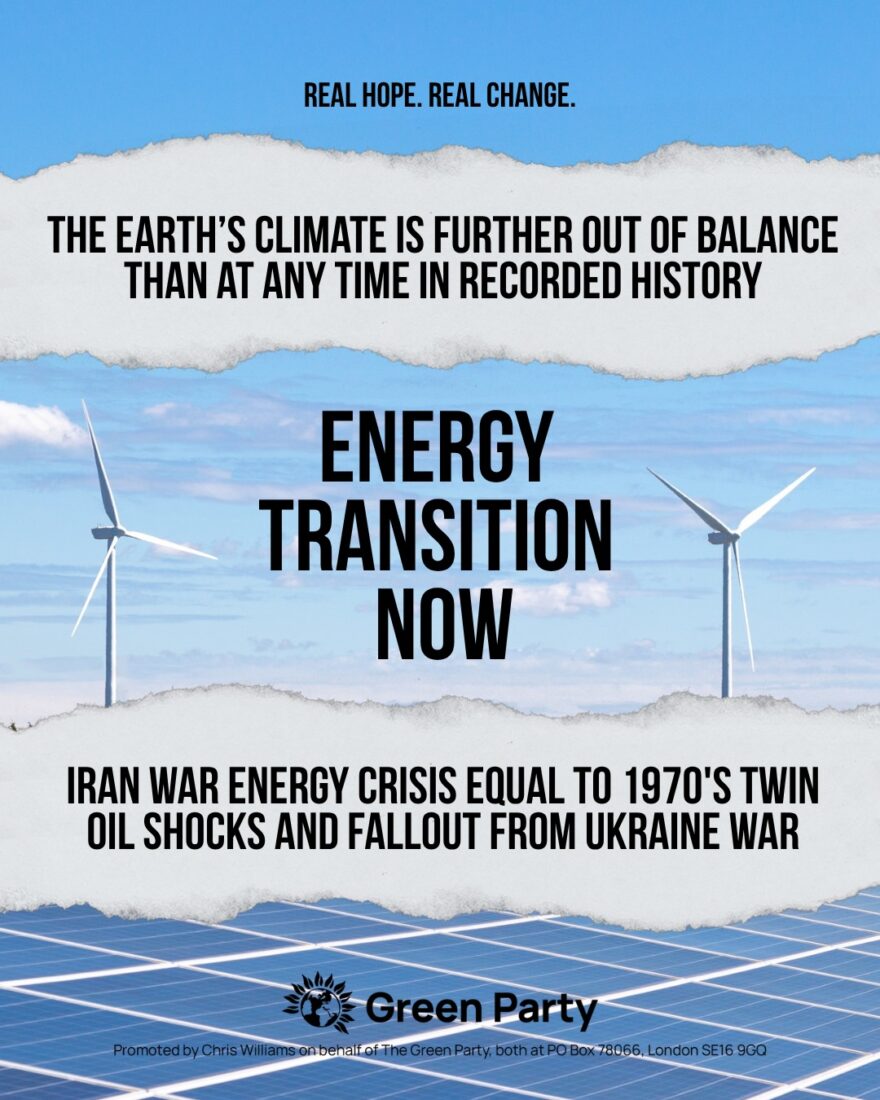
 (Source: The Green Party on Facebook)
Last week’s blog promised: “In the next few blogs, I will continue to follow …how the Iran war is currently serving as a wake-up call for continuing energy supply changes.” This blog is a follow up; I’ll start with an overview:
War in the Middle East made the case for renewables – what’s happening in each country tells a harder story
Hormuz – through which more than a quarter of global seaborne oil trade and a fifth of the world’s liquefied natural gas flow – is at a virtual standstill. Oil prices have climbed, briefly topping US$119 a barrel.
The largest release of oil from countries’ strategic reserves in history is under way, in an effort to ease prices. But even so, billions of people are dealing with surging energy prices and spiking food and fertilizer costs. Governments are scrambling for alternatives, too. To reduce energy demand, Sri Lanka has declared every Wednesday a holiday for public officials, Myanmar is limiting private vehicle use to every other day, and Bangladeshi colleges have canceled classes.
Leaders of South Korea and the European Commission have used the current energy crisis to call for accelerating the shift away from fossil fuels and toward homegrown renewable sources. U.N. Secretary-General António Guterres put it plainly in a March 10, 2026, social media post: “There are no price spikes for sunlight and no embargoes on the wind.”
The impact is not restricted to energy (Global Food Supply Faces a Dangerous Bottleneck as Iran War Persists – The New York Times):
One of the biggest economic casualties of the U.S.-led war in Iran has been the global fertilizer supply. Shipments of it have piled up on the wrong side of the Strait of Hormuz. In India, Algeria and Slovakia, fertilizer plants have shut down or slowed their output because of rising natural gas prices. China has restricted fertilizer exports. Australian wheat farmers are planting less, and corn and soy farmers in the United States are begging President Trump for relief.
For Europe, the impact of the Iran war is deja vu—another energy crisis that mirrors the one they went through after the Russian invasion of Ukraine (Europe Heads for Another Energy Shock as Iran War Raises Natural Gas Prices – The New York Times):
Europe is facing its second major energy shock in less than five years, and there are intensifying concerns about the region’s relatively meager stores of natural gas as prices surge during the U.S.-Israeli war in Iran. Despite making drastic changes to its sources of energy supplies since Russia’s invasion of Ukraine in 2022, Western Europe is still heavily dependent on natural gas: It accounts for about a fifth of energy use in the European Union, and nearly a third of all households rely on gas for heating. Although the 27-country bloc imports relatively little gas from the Middle East, the restriction of energy exports from the Gulf has pushed up prices in Europe. The region’s benchmark price of natural gas has climbed more than 70 percent since the strikes on Iran began on Feb 28. Making matters worse, the European Union ended winter with less than 30 percent of its gas storage capacity filled, the lowest level since 2022, when imports of Russian pipeline gas plummeted.
One economic sector that almost immediately responded to the major insecurity in the availability of fossil fuels is cars. Electric cars are in again, in a direct reversal of their decline over the last two years:
… current fuel crisis scares consumers, and how many will try to insulate themselves from future shocks by turning to battery power.
Australia already has more than one-third of households with rooftop solar, which is a further incentive to switch to EVs and PHEVs as they can use their own electricity to charge the vehicles, further lowering costs. Already EVs and PHEVs are making inroads in many countries, driven by the increasing cost-competitiveness of Chinese cars and some government incentives that boost affordability.
China is the leader in the adoption of EVs, which isn’t surprising given the massive investment in battery technology the country has made in recent years.
Sales of EVs and PHEVs were around 12 million units in China last year, taking a more than 50% share of new vehicle sales for the first time.
While this may rise toward 60% this year, it’s outside of China that the biggest opportunity for growth lies. Australia’s sales of EVs and PHEVs hit a record high in 2025 and accounted for about 12.7% of total light vehicle purchases.
PHEVs saw faster growth as consumers still worry about battery range and availability of electric charging facilities. Cheaper EVs and PHEVs, as well as government tax incentives for leases, are helping boost sales in Australia, but the bigger question is how deeply will the huge price spikes and the fear of shortages are likely to boost the appeal of electric vehicles (EVs) and plug-in hybrid-electric vehicles (PHEVs), as well as electric motorbikes in Asia.
However, accelerating anthropogenic climate change is still in focus. The importance of adjusting energy use away from fossil fuels is not limited to the belief in future climate change. Numerous catastrophic changes in the climate are taking place on a regular basis that is unexplainable without existing contributions from anthropogenic climate change:
An unusually early spring heatwave is developing across the southwestern United States (US), with temperatures that are more typical of summer than mid-March (AccuWeather, 16 March 2026). Driven by a strong, slow-moving high pressure system, called a ‘heat dome’, the event is causing temperatures to rise 11-17℃ (20-30℉) above average across parts of California, Nevada and Arizona (BBC, 17 March 2026). In many areas, temperatures are expected to exceed 37.8℃ (100℉). In Phoenix, temperature forecasts show multiple consecutive days of around 41.1℃ (106℉), a huge increase over the previous all-time March record of 100℉. The impacts of this early-season heatwave are likely to extend beyond health and have environmental implications. High temperatures are expected to accelerate snowmelt in these parts, including the mountains of Colorado where the snowpack levels are already lowest since 1981 due to the preceding warm winter, and the Sierra Nevada region in California, where although snowfall was average, the high heat is likely to drive rapid snowmelt. Early snowmelt in these parts can reduce water availability during the summer months, increasing the risk of water shortages, prolonging and intensifying dry seasons and increasing wildfire danger (Gergel et al., 2017; Uzun et al., 2021).
Most of global electricity production still runs on fossil fuels. The fate of countries that rely on fuels that need to pass through the Strait of Hormuz can be visualized through the situation in Cuba. Cuba is not involved in the Iran war, and its fossil fuels didn’t pass through the Strait of Hormuz. It depended on Venezuela for its fossil fuel supply. After the American army’s abduction of Nicolas Maduro, however, the US took control of Venezuela’s oil, blocking its continuing flow into Cuba. Cuba is now in the dark, with a line of citizens looking for ways to get out of the country.
Table 1 shows a list of the countries that are most vulnerable to electricity interruption based on obstacles to their fuel supply through the Strait of Hormuz. Each of these countries imports over 25% of its energy. The first column of data was extracted from the NYT article on the issue (Which Countries Depend the Most on Persian Gulf Oil and Gas – The New York Times). The rest of the data came from other sources.
Table 1 – The countries most sensitive to fossil fuel supply availability through the Strait of Hormuz, and the % of renewable energy that they use
| Country | Share (> 25%) of Energy Imported (in 2024) from Persian Gulf Countries (%) | % of primary energy imported | Renewable power generation as a % of total 2022) | List of net exporters of fossil fuels (among the 10 largest in oil, gas and coal) |
| Pakistan | 81 | 40 | 30 – 35 | |
| Japan | 57 | 97 | 23 | |
| Thailand | 56 | 57 | 12 | |
| South Korea | 55 | 98 | 9 | |
| Taiwan | 40 | 98 | 8 | |
| China | 35 | 74 | 32 | |
| Malaysia | 29 | Almost 0 | 20 | |
| Singapore | 27 | 96 | <5 | |
| Philippines | 26 | 51 | 23 | |
| Greece | 36 | 84 | 50 | |
| Poland | 30 | 49 | 27 | |
| Kenya | 98 | 20 | 90 | |
| Egypt | 76 | 9 | 12 | |
| Zambia | 61 | 10 | 90 | |
| Namibia | 56 | 70 | 72 | |
| Malawi | 55 | 90 | 95 | |
| South Africa | 45 | 20 | 7.3 | coal |
| Tanzania | 45 | 14 | 39 | |
| Morocco | 38 | 94 | 21 | |
| Mozambique | 38 | – 106 (net exporter) |
90 | coal |
| Madagascar | 33 | 15 | 45 | |
| Zimbabwe | 30 | 23 | 65 | |
| Senegal | 29 | 85 | 21 |
The data in Table 1 covers three continents, with a significant fraction of the global population. It also includes both developing and developed countries and a mixture of countries that are already well prepared for the energy transition and those that still have much preparation needed before they could join.