
Research can lead to practical innovations that impact people’s lives. Often, it takes the efforts of both scientists and engineers to make the bridge from pure research to useful innovations. It also takes time. Patent filing is a common outcome of successful innovation. Figure 1 does not include data that corresponds with the most recent change in governance that took the US into the second Trump term. We see China surpass the US; the two lines’ crossing approximately coincides with the beginning of President Trump’s first term.
The data show that even from the beginning of this century, the US never excelled in this category. However, the graph also illustrates that while China started the century well behind the developed countries, it managed to come out well ahead of everybody else within a single generation.
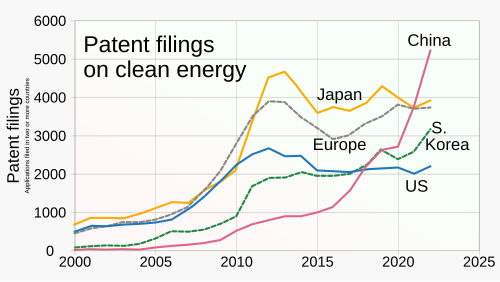
Figure 1 – Patent filings on clean energy, based on country, 2000-2025 (Source: NYT)
Patent filing is a delayed indicator of research excellence, but there are also more immediate ones. This blog describes some of them:
- Global College Ranking – NYT
Harvard recently dropped to No. 3 on the ranking. The schools racing up the list are not Harvard’s American peers, but Chinese universities that have been steadily climbing in rankings that emphasize the volume and quality of research they produce.
The reordering comes as the Trump administration has been slashing research funding to American schools that depend heavily on the federal government to pay for scientific endeavors. President Trump’s policies did not start the American universities’ relative decline, which began years ago, but they could accelerate it.
- International student enrollments – The Economic Times.
Figures 2 and 3 show international student enrollment in Chinese and American universities.
Foreign student enrolment at US universities fell this fall for the first time in three years after the Trump administration clamped down on immigration and took aim at a bevy of elite schools.
The number of international students across the country dropped by close to 5,000, even as the overall number of students grew by 1%, according to data released Thursday by the National Student Clearinghouse Research Center
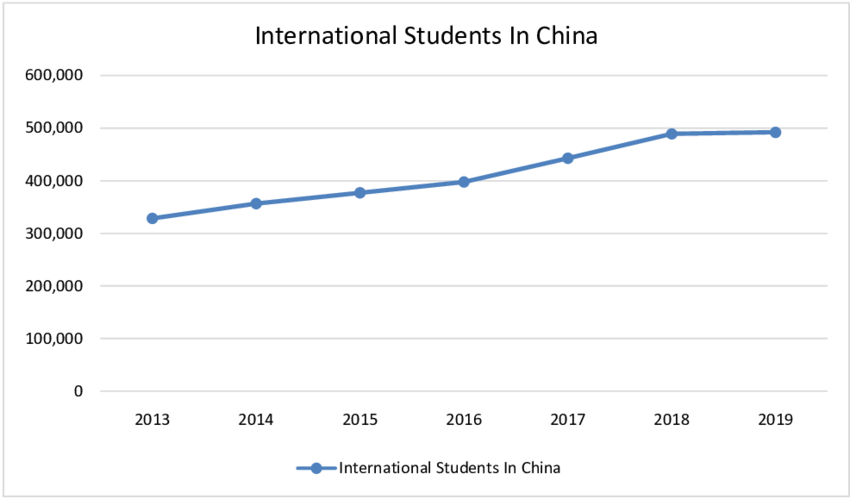 Figure 2 – International student enrollment trends in Chinese universities [inbound and outbound student mobility, 2013-2019]. Source: Institute of International Education (2019), retrieved from: https://www.iie.org/en/Research-and-Insights/Project-Atlas/Explore-Data/China.
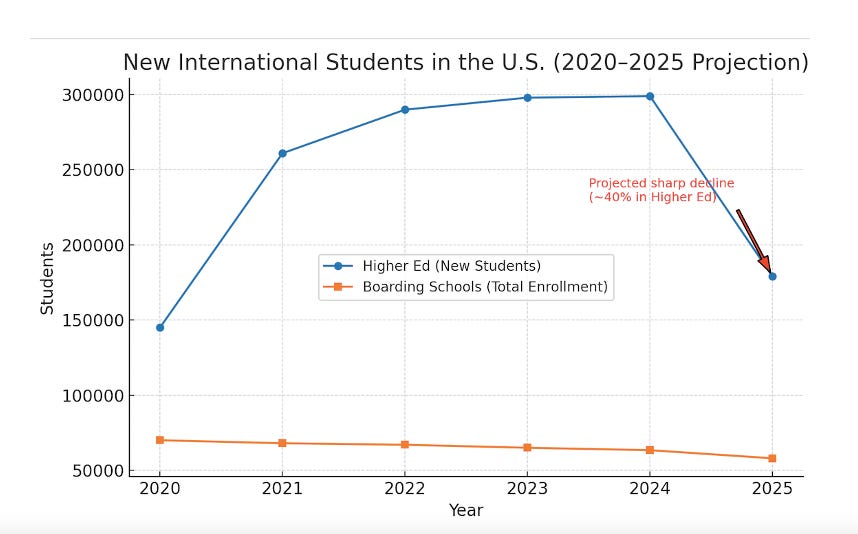
Figure 3 (Source: Mark Sklarow)
Figure 2 shows no signs of the first Trump presidency, but it doesn’t extend to his second term. Figure 3 extends until the first year of his second term. The recent sharp decline in Chinese students, who are now being discouraged from attending American universities and are staying home, is a major contributor to both Figures 2 and 3. Until recently, about a third of the international students enrolled in American universities were Chinese.
- PhD enrollment: A major impact on the decline of productive research in the US is the decline of acceptance of PhD students in the leading US universities
These recent shifts in research activities have directly resulted in a US decline and the rise in Chinese leadership in innovations in many areas. A few examples from the energy-related shift follow:
The first two examples come from The Economist’s “Dawn of the Solar Age” issue (June 22, 2024):
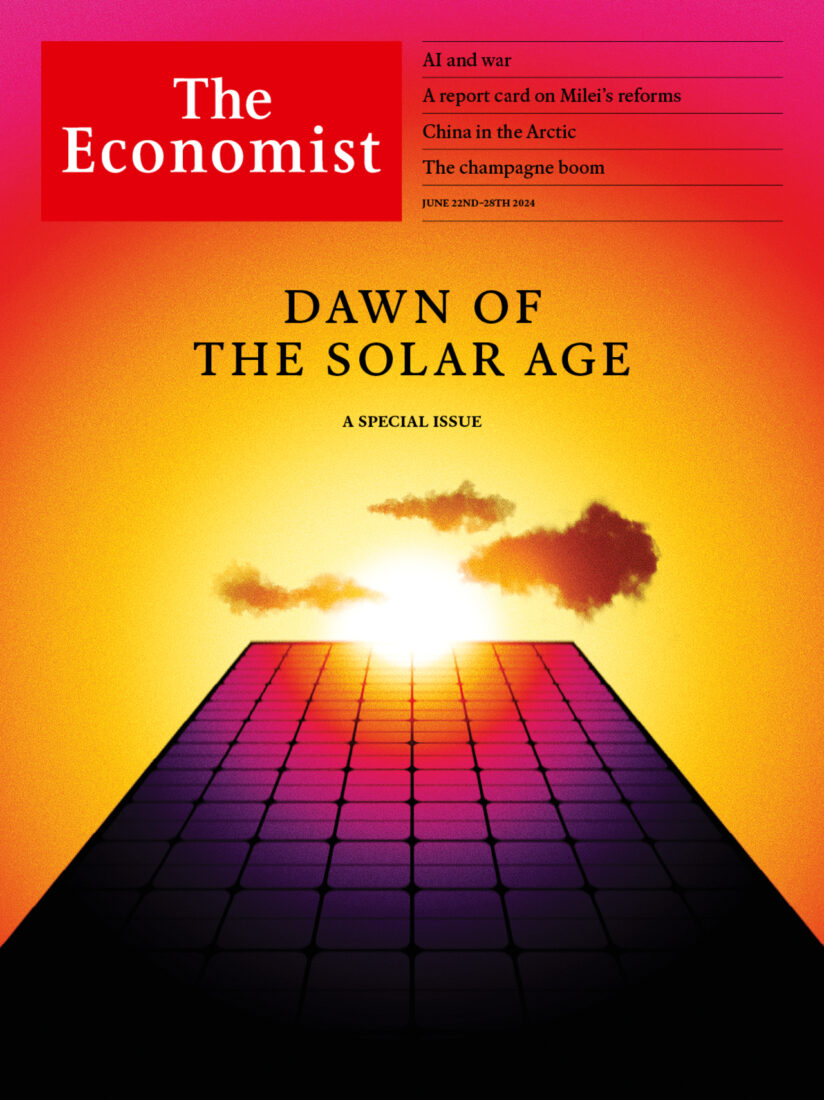
Figure 4 – Cover of The Economist special edition, Dawn of the Solar Age
- Floating Solar Cells:
Floating solar projects like this one do face plenty of challenges. The kit has to be water-, wave-, wind- and storm-resistant, which adds complexity and cost. When located on salt water, corrosion can be a problem, though inland projects in fresh water fare better. The fish in lakes attract plenty of birds, whose droppings can block the sun. To deal with this, engineers for the project at Alqueva have developed remote-controlled cleaning robots and are working on autonomous ones. “Like a Roomba for the panels,” explains one.
Yet floating solar projects also enjoy several advantages. When they are located at existing hydroelectric dams they do not require any additional land, thus evading NIMBY opposition, and can be connected to the grid without the multi-year wait common for solar projects. The cooling effect of being on water boosts the efficiency of the modules, with studies suggesting gains of between 5% and 15% over land-based PV, while the shade they produce slows the evaporation of the reservoir.
I wrote about floating solar cells in an earlier blog (July 2, 2024).
-
-
-
- Exponential Growth of Solar Power: To call solar power’s rise exponential is not hyperbole, but a statement of fact. Installed solar capacity doubles roughly every three years, and so grows ten-fold each decade. Such sustained growth is seldom seen in anything that matters. That makes it hard for people to get their heads round what is going on. When it was a tenth of its current size ten years ago, solar power was still seen as marginal even by experts who knew how fast it had grown. The next ten-fold increase will be equivalent to multiplying the world’s entire fleet of nuclear reactors by eight in less than the time it typically takes to build just a single one of them.
-
-
As was mentioned earlier, the shift to sustainable energy has reached a resiliency that makes it almost impossible to stop:
The abrupt U-turn in federal energy notwithstanding, the demand for more solar power in the US persists. After all, money talks. Solar is the fastest most economical way to add more kilowatts to the nation’s grid. That’s why solar investors are still pumping money into the US market, the latest example being a newly expanded $80 million line of credit for the Virginia-based solar real estate financing firm SolaREIT.
We will follow the progress. My next blog will shift to the impacts of the transition on developing countries.
shows that the perfect combo can make pixels feel alive!