
Last week’s blog focused on my reading of Thomas Friedman’s NYT Op-Ed, in which he addressed the US slogan “Out of many, one.” I wrote it few days before Independence Day, July 4th. On that Sunday (June 28th), I did something else. I got an invitation to take part in an event commemorating the Holocaust at the Holocaust Memorial Park in Brooklyn. The program is posted in Figure 1. A year ago, I gave a talk at the same event and since then, my wife and I took part in another meeting organized by the same organization. As I mentioned after my participation last year, I am ashamed that prior to my involvement, I had never heard of this park. In the Facebook entry, I included a few photographs of it. You can find more information about the park on Wikipedia.
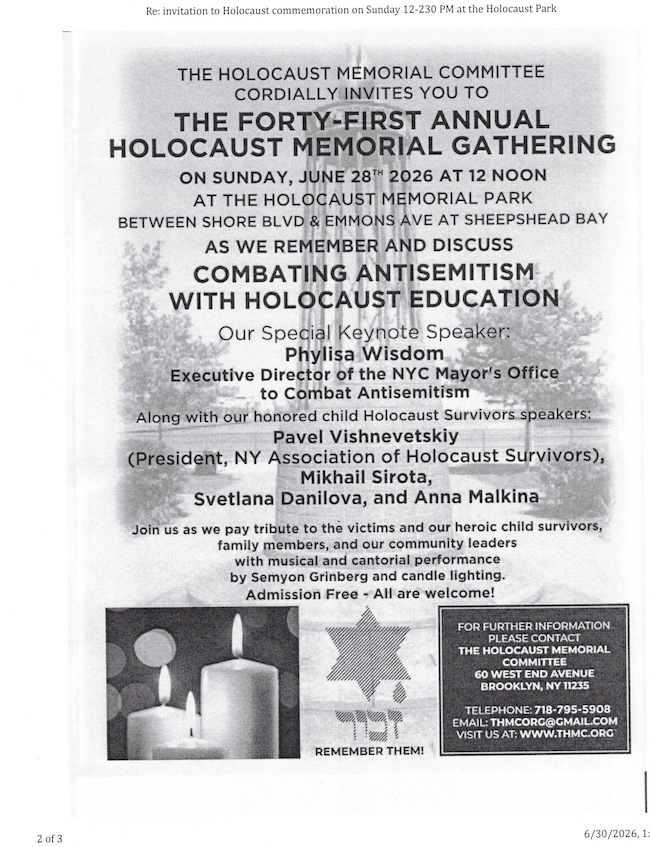
Figure 1 – Invitation to take part in a commemoration the Holocaust
As you can see in the invitation, the main speaker in the program was the head of the mayoral unit dedicated to preventing antisemitism. I didn’t know that Mayor Mamdani had such a unit. Anyway, before the meeting started, the organizers made a point of telling everybody that the park is supported by the city and there are no politics involved in running it. The park was constructed to honor the memory of the victims of WWII, and its only objective is to educate post-WWII generations about the Holocaust through the experiences of survivors. When Ms. Wisdom was about to start speaking, planted members of the audience started to shout, accusing her of antisemitism. There were attempts to stop the heckling, but eventually she left without saying a word. This was the most intense instance of trying to connect the Holocaust, antisemitism, and Israel that I have experienced.
The park is in Sheepshead Bay, a Russian section of Brooklyn.
After the charade, the managers of the park gave certificates of appreciation to a few Russian survivors, who then gave short speeches in Russian (the audience was mostly from the neighborhood). There were translations for the rest of us. In the middle of the event, I saw my wife crying. I asked for the reason; the answer was that she was seeing the age and conditions of the survivors (she is 79 I am 87 years old), and she realized that we are part of that crowd. After the event, I took her to a Jewish restaurant there. I also got a certificate of appreciation, shown in Figure 2, but I didn’t open my mouth throughout the event.
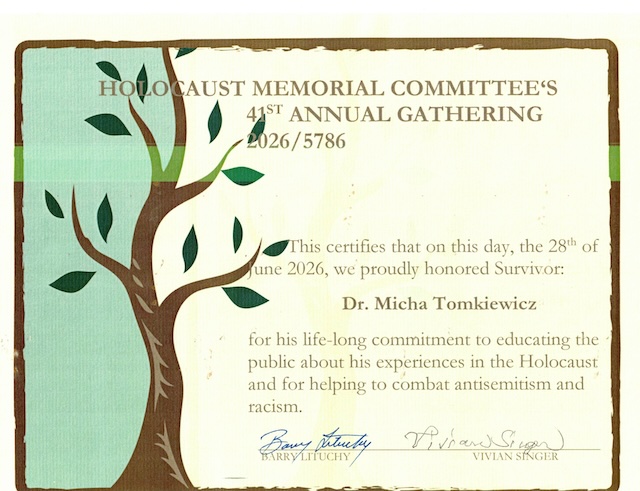 Figure 2 – Certificate of Appreciation given to me by the Holocaust Memorial Committee
I was very interested to hear Ms. Wisdom’s talk and find out if Mayor Mamdani’s effort is restricted to fighting antisemitism or whether it extends to other minorities, such as hate against Muslims. However, I didn’t have a chance to hear her there. So, after we returned home, I looked her up and read about the mayor’s effort:
The Mayor’s Office to Combat Antisemitism (MOCA) is tasked with identifying and developing efforts to combat antisemitism and anti-Jewish hate crimes, support victims of antisemitism, and celebrate Jewish culture and traditions using the resources of the City of New York. MOCA liaises with an Interagency Task Force to Combat Antisemitism, composed of representatives of the Office for the Prevention of Hate Crimes, New York City Police Department, New York City Commission on Human Rights, and other City agencies to fulfill its mission and deliver for the City’s more than one million Jewish New Yorkers. Additionally, MOCA coordinates non-law enforcement responses to incidents of antisemitism on behalf of the Office of the Mayor and serves as a liaison with the Jewish community to address issues related to services for victims of hate crimes and bias incidents motivated by antisemitism, and security for vulnerable populations and institutions.
The event in the park didn’t end with the certificates of appreciation. A member of the audience, long involved in the park but not a direct Holocaust survivor, gave a speech (mostly in English), expressing that he agrees with the committee on almost everything, with some small exceptions. Specifically, he argued that it is not a good idea to mix accusations of antisemitism with educational efforts about the Holocaust. I agreed with him; I wrote an earlier blog on the topic, “These Days, It Is Hard to Be a Jew and Even Harder to Be an Israeli!” (June 11, 2025):
I encountered antisemitism before October 7, 2023 and I wrote about my experiences (see the December 3, 2019 and February 11, 2020 blogs). After October 7, 2023, and President Trump’s inauguration in January 2025, antisemitism acquired much more complexity. This blog will focus on the Israeli connection to antisemitism. The American connection was well covered in Senator’s Schumer’s new book “Antisemitism in America: a Warning,” published this year by GCP Grand Central. I strongly recommend reading that book, irrespective of readers’ background.
There is a strong tendency by many to want to free themselves from the boundaries of the IHRA definition. This is similar to the many voices that want to free themselves from the 1948 Genocide Prevention Convention’s definition of genocide and the original Lemkin definition that were described in earlier blogs. This relates to my perspective in the context of genocide: I view such efforts as a weaponization of the concept. Below is Wikipedia’s description of the weaponization of antisemitism:
However, one more argument was made on this occasion which made me uncomfortable. The argument was that after October 7th, only Israeli citizens can criticize Israeli government; criticism by anybody else weaponizes antisemitism.
I am a physicist. Symmetry is very important in Physics. It is also very important in life. If only Israeli citizens can criticize Israel, does that mean only Jews can criticize antisemitism??
To borrow from civil law suits, you don’t have to have “standing” to be anti-Israel or anti-antisemitic. There are already consequences:
Across Europe, many Jewish museums have seen visitor numbers drop, patrons back away and security threats rise since the fall of 2023, according to a recent report by the Amsterdam-based Association of European Jewish Museums, a nonprofit network of 55 institutions. The association’s members also reported online harassment, vandalism and acts of aggression against staff members.
I truly appreciate the reflections shared in your post about the Holocaust Memorial Park event. It’s a poignant reminder of how crucial it is to create spaces for both remembrance and dialogue on historical injustices. I recently participated in an event that encouraged collective storytelling, similar to what you described; it really brought to light our shared human experiences and responsibilities. fnaf