
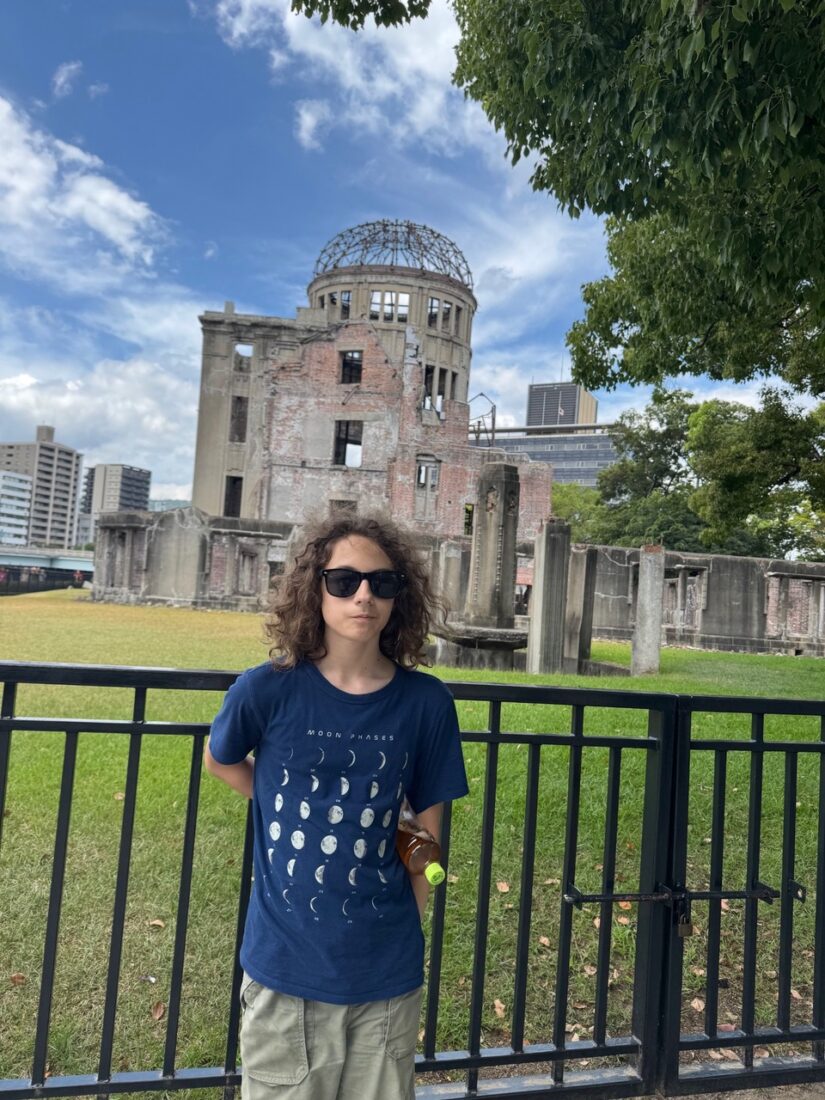
 A young visitor at the Peace Memorial Park in Hiroshima
Last week’s blog focused on one non-academic mechanism to immortalize and expand the concept of “never again,” through support for young people to connect to both the Holocaust Institute and a trip via another organization focused on mitigating one of the other global threats. Such a combination has the potential to help mitigate future existential threats by teaching the history of past existential genocides. It was proposed that the organization (and the financing) of such an effort should be coordinated by the Holocaust Museum, where the youngster would spend an internship to acquire background knowledge about the Holocaust. Organizationally, the effort would be similar to the “Birthright” effort that is now directed at Jewish youth who live outside Israel, to familiarize themselves with the country.
This and the next blog will focus on two such examples: this one will focus on nuclear war, specifically Hiroshima and Nagasaki, the only two cities to experience the consequences of such a war. Next week’s blog will focus on climate change through exposure to the deterioration of major reefs in Australia and Belize. These two examples represent the two classes of global threats: one directly inflicted by humans, in this sense similar to the Holocaust, and the other indirectly caused by humans (anthropogenic) through destruction of the common environment. Both classes fit the Lemke definition of genocide, as described in an earlier blog (May 28, 2025), with the “group” being humanity and the “intent” meaning that science was aware of the consequences and we decided to ignore it:
In the present Convention, genocide means any of the following acts committed with intent to destroy, in whole or in part, a national, ethnical, racial or religious group, as such:
-
a) Killing members of the group;
-
b) Causing serious bodily or mental harm to members of the group;
-
c) Deliberately inflicting on the group conditions of life calculated to bring about its physical destruction in whole or in part;
-
d) Imposing measures intended to prevent births within the group;
-
e) Forcibly transferring children of the group to another group.
However, if we are taking inspiration from Birthright, then before going into details about the two examples to immortalize and expand “never again,” it is essential to examine the scope that Birthright is reaching. As usual, I have mobilized AI (through Google) to summarize the present extent of Birthright:
Birthright Israel’s annual participant numbers have varied over time, with a peak of over 48,000 participants in 2018. The average number of participants prior to recent reductions was approximately 45,000 per year, with around 80% coming from the United States and Canada. However, recent years have seen a decline in participation due to a combination of factors, including:
- Budgetary constraints:The cost of sending one participant has risen significantly, partly due to inflation. This has led to cuts in the number of available spots.
- Safety concerns:The ongoing conflict in Gaza and the trauma of the October 7th attacks have impacted travel to Israel, leading to a decline in participants, particularly from the U.S. and Canada.
- Decreased donor support:Reduced contributions from major donors have also contributed to the funding shortfall.
- Pandemic-related disruptions:Travel restrictions and uncertainty caused by the COVID-19 pandemic also impacted participation in previous years.
Despite these challenges, Birthright Israel continues to be a popular program, with high demand and waiting lists for available spots. In 2023, for example, Birthright had a waiting list of 20,000 applicants for only 12,000 available North American seats during the summer program.
For the summer of 2025, Birthright Israel expects a rebound in participation, with 33,000 participants projected for the 10-day program, and a long-term goal of reaching 200,000 annual participants by 2029.
Birthright is focused on the Jewish diaspora. The global Jewish population outside Israel is about 8 million (most of them reside in the US). Birthright is limited to ages 18 – 26. The percentage of this population in the US is 12%. This translates to about 1 million eligible candidates for Birthright. It is estimated that by now Birthright has been able to reach 20% of their eligible population (see the sources for the statistics in last week’s blog). To find resources to fund a similar effort to immortalize “never again” is obviously not simple. But, on the bright side, the two examples in this and next week’s blogs also involve non-US countries that might help.
Let me now move to the first example of expanding “never again” to include nuclear war by shifting to Hiroshima and Nagasaki, the victims of the only direct nuclear attacks that took place (Bombing of Hiroshima – August 6, 1945; Nagasaki – August 9, 1945).
An example of directly correlating Hiroshima with the Holocaust can be found in the Asia-Pacific Journal: Japan Focus article, “Never Again: Hiroshima, Auschwitz and the Politics of Commemoration もう二度と… 広島、アウシュヴィッツと記念の政治学”:
Because of the nature of the tragedy and the enormous importance given to the efforts to formulate a proper reply to it, the victims of Hiroshima and Nalgasaki came to possess important symbolic power. The bombing was thought to have bequeathed to Hiroshima’s victims a global mission and importance. This was synchronous with and influenced by a similar view of the place of the victim/witness in Holocaust discourse. In both discourses, the survivor was eventually elevated as the ultimate bearer of moral authority; what Avishai Margalit called “a moral witness.”7 This development was a direct consequence of the unprecedented nature of the tragedies and the failure of conventional means to represent and explain them. This had important implications for commemoration and politics in Japan and elsewhere, a phenomenon that went well beyond the confines of one nation or culture. As evidenced by Robert Lifton’s story, whose moment of shock in Hiroshima led him on to a career that impacted profoundly both cultures of memory, Hiroshima had an important role, now largely forgotten, in the making of global memory culture. However, the importance of Hiroshima was not appreciated by scholarship on either Hiroshima or the Holocaust so far (not to mention Nagasaki, which Hiroshima should not stand for and has a unique history of its own).
The ongoing follow-up on the health effects of the bombings can be found at the Radiation Effects Research Foundation (RERF).
As was shown in the previous citation, the interdependence of the Holocaust and the American bombing of Hiroshima and Nagasaki is extensive. AI is a convenient tool to summarize interactions. A short summary (through Google) is given below:
On Cooperation between Holocaust institutions and Hiroshima or Nagasaki:
Collaboration between institutions focused on the Holocaust and those dedicated to the atomic bombings of Hiroshima and Nagasaki exists and takes various forms, driven by the desire to remember and learn from these devastating events, despite their significant differences.
One instance of collaboration involved a Japanese delegation of peace activists who visited Auschwitz-Birkenau in 1962 and exchanged “mementos,” receiving an urn containing ashes of the victims from the Polish side. This exchange, and others involving Holocaust urns sent to Japan, aimed to solidify ties between State Museum Auschwitz-Birkenau and different Japanese institutions.
Another example of cooperation is the Los Alamos Japan Project, established in 2016. It facilitates dialogue between the Los Alamos History Museum, the Hiroshima Peace Memorial, and the Nagasaki Atomic Bomb Museum. Their focus is on “Creating understanding through shared history, partnerships, dialogue, multiple perspectives, and collaboration,” and they’re cultivating second-generation seeds of trees that survived the atomic bomb blast in Hiroshima.
While these events were distinct, some have considered the histories of Hiroshima and Holocaust commemorations “entangled histories.” Both tragedies were seen as symbols of modern failure and potential harbingers of future horrors. The symbolic connections between Hiroshima and Auschwitz were particularly strong before the 1980s, when the Holocaust’s rising importance and the end of the Cold War somewhat eclipsed Hiroshima in the collective imagination.
It’s important to recognize that the Holocaust and the atomic bombings of Hiroshima and Nagasaki are separate events with unique historical contexts and discourses. However, the shared objective of preserving the memory of victims, fostering peace, and educating future generations about the consequences of human-instigated devastation has led to instances of cooperation and collaboration between institutions dedicated to each event.
More specifically, here is AI’s take on cooperation between the US Holocaust Institute and Hiroshima or Nagasaki:
While there’s no direct partnership between the United States Holocaust Memorial Museum (USHMM) and the Hiroshima Peace Memorial Museum or Nagasaki Atomic Bomb Museum explicitly stated in the provided search results, there are connections and parallels worth noting:
- Shared Focus on War’s Aftermath and Promoting Peace:Both the USHMM and the museums in Hiroshima and Nagasaki focus on the devastating consequences of war and aim to promote peace and understanding, drawing on the horrific lessons of the past.
- Archival Cooperation and Global Outreach:The USHMM engages in archival cooperation with institutions like Fondazione Polanco ETS (ARSI) and Yad Vashem, according to the United States Holocaust Memorial Museum. They also have a strong global outreach program, collaborating with various partners worldwide to promote Holocaust education and remembrance, states the United States Holocaust Memorial Museum. This suggests a potential for future collaborations with museums dedicated to other significant wartime events.
- Traveling Exhibitions:The USHMM and the American Library Association offer a traveling exhibition titled “Americans and the Holocaust,” which explores US responses to Nazism, war, and genocide in Europe. This model of a traveling exhibition could be a means for shared educational initiatives, perhaps incorporating aspects of the atomic bombings into a broader context of wartime destruction and humanitarian concerns.
- Emphasis on Survivor Testimonies:Both Holocaust museums and the Hiroshima and Nagasaki museums rely heavily on survivor testimonies to convey the human impact of these events, helping to ensure that the stories of those who endured these tragedies are not lost, notes ICAN – International Campaign to Abolish Nuclear Weapons.
In conclusion, while not formally partnered, there is a conceptual alignment between the USHMM and the Hiroshima and Nagasaki museums in their dedication to remembering the past, preventing future atrocities, and advocating for peace. Existing USHMM initiatives like archival cooperation and traveling exhibitions could potentially be adapted to facilitate collaboration and shared learning experiences focusing on the atomic bombings and their legacy.
My next blog will summarize the suggestions for the future common youth exposure to the Holocaust and to climate change through coral reef destruction.