
By the time this blog is posted, COP30 will be “history.” It officially ends on Friday, November 21st, and this blog will be posted on Wednesday, November 26th. I will use this blog and the one that follows to summarize the event. This blog will be focused on the change in leadership of COP30, and the next will focus on how that change in leadership affected the final resolutions of the meeting.
The attitude of President Trump and his administration toward climate change is no secret. Just put President Trump into the search box, and you will get all my references to both his first term and the present one. When a COP meeting has taken place during his presidency, a change in leadership has been accepted and delivered. However, these changes do not take place without responses. This blog focuses on these changes. Most of the global responses were anticipated, and since almost everybody, including myself and the readers of the blog, is polarized between pro- and anti-Trump, I found it best to summarize the impacts on COP30 using AI (through Google). However, one response that was not anticipated was that of the International Court of Justice, shown below and described in Inside Climate News. Members of the International Court of Justice arrive to issue an advisory opinion on states’ legal obligations to address climate change in The Hague on July 23.
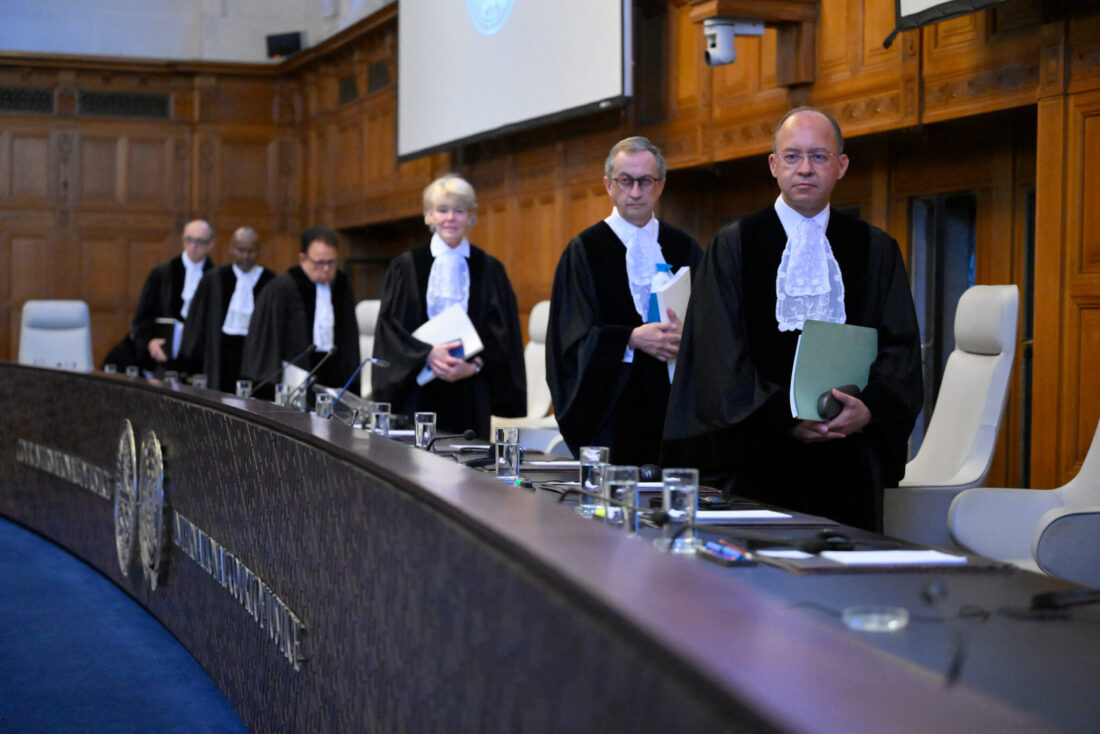
The International Court of Justice (ICJ) members arrive to issue first Advisory Opinion (AO) on States’ legal obligations to address climate change, in The Hague on July 23, 2025. The top UN court on July 23, 2025 described climate change as an “urgent and existential threat”, as it handed down a landmark ruling on the legal obligations of countries to prevent it. (Photo by JOHN THYS/AFP via Getty Images)
The essence of the AI response is summarized below:
Una May Gordon, Jamaica’s former principal director of climate change, noted on opening day of the United Nations climate summit last week in Brazil that her country had recently suffered “catastrophic loss and damage” in the wake of Hurricane Melissa.“We just need some accountability for those who are definitely responsible for this crisis,” Gordon said, calling for an end to impunity for major greenhouse gas emitting countries. Climate justice advocates have been demanding this for years, always with science on their side. Now they say the law is, too. For the first time in the 30-year history of the U.N. climate talks, this year’s negotiations in Belém are happening against the backdrop of a recent landmark ruling from the International Court of Justice—the world’s highest court—clarifying what countries must do to confront the climate crisis under international law, and what the legal consequences are for failing in their responsibilities. In doing so, the Court has turned what many governments treated as political choices into enforceable duties.
In its unanimous, historic advisory opinion delivered in July, the court recognized that the climate crisis is an “existential problem of planetary proportions” and that taking action to mitigate and adapt to it is not optional, but a requirement under multiple sources of international law. The court also found that U.N. member states can be held liable for breaches of their legal obligations to protect the climate system.Countries like Vanuatu, the small Pacific island state that led the initiative to seek a climate change advisory opinion from the ICJ, are hopeful that the court’s declaration can serve as a turning point in catalyzing more ambitious climate action and infusing more accountability into global climate diplomacy.
As was mentioned in previous blogs (put international law into the search box), international law is not sovereign. There is no way to enforce judgments. Only sovereign states can do so. AI (through Google) will follow with a summary of the leadership change, focusing on US, China, and the European Union:
Summary of Impacts of US Federal Withdrawals:
The primary leadership change impacting COP30 is the shift in the U.S. federal government’s approach to climate policy following the election of Donald Trump, leading to increased international discord, U.S. withdrawal from certain efforts, and a potential realignment of global climate action without U.S. dominance.
Impacts of the U.S. Leadership Change
- Hostility to Global Efforts:The U.S. government has displayed “fresh hostility” to differing global views, including using “tactics of intimidation” at the International Maritime Organization (IMO) to scuttle efforts to limit shipping emissions.
- Withdrawal and Absence:The U.S. has once again deprioritized climate action, with President Trump’s absence from COP30 and a general opposition to international agreements like the Paris Agreement.
- Increased Discord:The U.S. position has created a new era of discord in global climate politics, with other world leaders openly criticizing the U.S. stance and climate denial.
- Potential for Multilateral Realignment:Some observers suggest the absence of the U.S. may free other countries to have “real multilateral conversations” without one player dominating the outcome, potentially fostering new avenues for cooperation among the remaining parties.
US Withdrawals are Shaping Outcomes:
Beyond the specific U.S. situation, other leadership themes at COP30 are shaping outcomes:
- Shift from Pledges to Implementation:The conference is emphasizing a shift from political commitments to tangible, on-the-ground implementation of climate solutions.
- Importance of Inclusive Leadership:There is a strong focus on inclusive leadership, ensuring the benefits of the transition reach all people, and advancing the role of indigenous communities, women, and local leaders in decision-making.
- Private Sector and Local Action:Business leaders and local governments are pushing forward with their own climate action plans and innovations, sometimes shielded from federal-level policy uncertainty.
- Focus on the Global South:As the COP is held in Belém, Brazil, in the Amazon, the focus is on the immediate, existential challenges faced by developing nations and the need for adequate and predictable climate finance.
In essence, while the change in U.S. leadership presents significant headwinds and policy uncertainty for global climate governance, it is also spurring a potential shift towards more decentralized, inclusive, and implementation-focused climate action from other global actors.
However, despite US federal withdrawals from global commitments, others in state and local government continue to demonstrate their belief in the importance of confronting climate change:
The United States is maintaining a presence at COP30, despite the Trump administration declining to send an official delegation to the climate conference in Brazil. This is the first time since the inaugural Conference of the Parties (COP) to the United Nations Framework Convention on Climate Change (UNFCCC) in 1995 that the U.S. will not be officially represented at the annual climate summit. However, a large number of state and local representatives — as well as environmental nonprofits based in the U.S. — are in attendance. A coalition of 100 local U.S. leaders — including governors, mayors and other top city and state officials — made the trip to Belem, Brazil, as part of the U.S. Climate Alliance. California Gov. Gavin Newsom, among the notable Americans at COP30, bashed President Donald Trump for disregarding the event, which kicked off Monday. “While Donald Trump skips the world stage, California is showing up — leading, partnering, and proving what American climate leadership looks like,” Newsom said on Tuesday. Sen. Sheldon Whitehouse, D-RI, said in a press conference on Friday that the “Trump administration simply does not represent the American public on climate issues.” Whitehouse, a ranking member on the Senate Environment and Public Works Committee, accused the current administration of representing the fossil fuel industry, “most particularly the big fossil fuel donors who contributed hundreds of millions of dollars to Trump’s political campaign.”
Leadership shifts to China and the European Union (Through AI):
China is emerging with a larger leadership role in climate diplomacy and clean technology, while the European Union faces challenges in maintaining its traditional leadership position, particularly due to the absence of a U.S. presence.
China’s Assertive Role:
-
-
- Technological Dominance: China is leveraging its position as the world’s leading manufacturer and exporter of renewable energy technologies (solar panels, wind turbines, batteries) to boost its climate diplomacy and provide affordable green tech to other nations, especially in the Global South.
- Filling the Void: With the U.S. having withdrawn from the Paris Agreement and largely absent from COP30, China has stepped in to a more prominent role in the negotiations, acting as a “bridge-builder” and a stable partner in the global energy transition.
- High-Level Representation: China has sent a large delegation, led by Vice Premier Ding Xuexiang, underscoring its support for the Brazil-hosted summit and solidifying its presence.
- Criticism of the EU: China’s climate envoy, Liu Zhenmin, has publicly criticized the EU’s climate targets as insufficient, arguing that developed nations need to accelerate their pollution cuts faster.
-
The European Union’s Challenges
-
-
- Erosion of Influence: The EU is experiencing a perceived reduction in its overall geopolitical influence and is grappling with domestic pushback against climate policies, which some argue necessitates a new strategy of forming alliances with “middle powers” like Brazil.
- Policy Divisions: The EU is facing internal divisions on the ambition of its own 2035 climate targets, which has delayed the finalization of its updated Nationally Determined Contribution (NDC).
- Financial Hurdles: The EU faces challenges regarding climate financing, particularly in committing to and delivering on the necessary funds for developing nations to combat climate change and adapt to its impacts.
- Maintaining Credibility: The EU is striving to remain a central player, but its ability to lead is being tested by the political and financial challenges it faces internally and externally.
-
In essence, while the EU still has a crucial role to play, China’s economic and technological strategy has effectively translated into growing climate soft power, leading to a visible shift in the dynamics of leadership at COP30.
China is not enthusiastic about its new role:
China is committed to the energy transition needed to avert climate breakdown – but does not want to take the lead alone in the absence of the US, one of the country’s senior advisers has told the Guardian.
Wang Yi said China would provide more money to vulnerable countries, but the EU’s climate commissioner has warned Beijing is not doing enough to cut emissions.“I don’t think China would like to play a leadership role alone,” said Wang, the vice-chair of China’s expert panel on climate change. “The most important thing is how to maintain momentum. Now we have two possible directions: one, we go forward with clearer, more ambitious targets. The other may be going back. “So that’s why China would like to do our best to steer in this kind of direction towards low-carbon or green transition, but in cooperation with other countries. We don’t want to take the lead alone. We need comprehensive leadership.”
COP30 is one of the forums in which the world is trying to adapt to global affairs without US “guidance.” The recent G20 meeting in Johannesburg, South Africa, is another such forum. It recently adopted a declaration despite the US boycott over the alleged persecution of white South Africans and opposition to the scientific consensus on anthropogenic (human-caused) climate change.
Next week’s blog will summarize the final decisions of COP30 and the voting rules on such resolutions.