
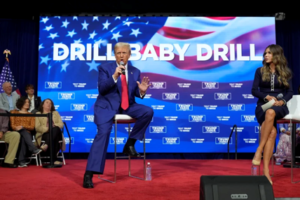
(Source: National Public Radio)
This blog should be viewed as a continuation of last week’s blog (November 12) that focused on the possible revival of the US as an important participant in the global effort to mitigate climate change through the global energy transition from its dependence on fossil fuels.
This effort is being coordinated through the UN in the yearly global meetings that are now known as the COP (stands for Conference of the Parties). The present meeting is COP31 taking place in Antalya Turkey. Last week’s blog was focused on two issues – the midterm elections that took place that resulted in a Democratic “Blue Storm” that drastically changed both houses of Congress and many state governments from being controlled by Republicans, giving the US a split government: a Republican President (Donald Trump) and a Democratic legislature. In such a government, both sides will need to compromise, or the government will freeze.
It was suggested that a face-saving way for the President to compromise would be to try to nullify some of the Presidential Executive Orders that were issued over the last two years. Following last week’s blog, this blog will focus on what it takes to reverse those orders and the impacts that the approaching Congress might have on climate mitigation. The new Congress will be sworn in in January, so attitude changes right now are “anticipated” and not assured. As always, my emphasis will be on Climate-Change.
To start, I asked AI (through Gemini): How can Congress stop executive orders?
Here is what I got:
Yes, Congress can stop or restrict a presidential executive order, though doing so faces major constitutional and political hurdles. [1, 2, 3]
How Congress Can Stop Executive Orders
-
-
- Pass a new law: Congress can pass legislation that explicitly reverses or counteracts an executive order. If the order relies on authority previously delegated to the president by Congress, lawmakers can alter or revoke that underlying statutory authority. [1, 2]
- Control federal funding: Congress can restrict or cut off the money required for federal agencies to implement or enforce specific provisions of an executive order. [1, 2]
- Investigate and hold hearings: Congress can use its oversight powers, issue subpoenas, and hold public hearings to pressure an administration or expose legal and practical issues with an order. [1]
- Impeachment: In extreme cases of abuse of power, the House of Representatives can impeach a president, though removing a president requires a two-thirds majority in the Senate. [1, 2, 3]
-
The Hurdles Congress Faces
-
-
- The Presidential Veto: Any new law passed by Congress to block an executive order can be vetoed by the president. To override a veto, Congress needs a two-thirds supermajority in both the House of Representatives and the Senate, which is difficult to achieve. [1, 2, 3, 4]
- Inherent Constitutional Powers: If an executive order is based on the president’s direct constitutional authority under Article II (such as acting as commander-in-chief), Congress has far less power to restrict it unilaterally. [1, 2]
- Discussion on Limits: As noted in online legal discussions like Reddit, opinions are mixed regarding how far Congress can go without infringing upon the separation of powers. [1]
-
Other Ways Executive Orders Are Stopped
Future Presidents: Any succeeding president can simply sign a new executive order to revoke, modify, or replace orders issued by their predecessor. [1, 2, 3]
I continued to ask AI (through Gemini) the following:
List President Trump’s Executing order to reverse Climate Change Mitigation:
President Donald Trump’s second-term executive orders and related directives focus heavily on rolling back federal climate policies, dismantling environmental justice initiatives, and expanding domestic fossil fuel production. [1, 2, 3]
Key executive actions and policy changes include:
Core Climate and Energy Executive Orders
-
-
- Unleashing American Energy (EO 14154): Directs federal agencies to expand energy production on public lands and waters, eliminate electric vehicle (EV) mandates, pause disbursements under the Inflation Reduction Act (IRA) and Bipartisan Infrastructure Law (IIJA), terminate the American Climate Corps, and restart liquefied natural gas (LNG) export reviews. [1]
- Paris Agreement Withdrawal: Formally withdrew the United States from the international Paris climate agreement, ending national emissions pledges and United Nations financial commitments. [1]
- National Energy Emergency: Declared a national energy emergency to accelerate domestic oil, gas, and Arctic National Wildlife Refuge (ANWR) drilling while bypassing certain environmental reviews. [1]
- Protecting American Energy From State Overreach: Directs the Attorney General to identify and challenge state-level climate, cap-and-trade, and environmental justice laws (such as programs in California, Washington, New York, and Vermont). [1, 2]
-
Power Plants, Emissions, and the Endangerment Finding
-
-
- Repeal of the Endangerment Finding: The EPA finalized the termination of the 2009 Obama-era endangerment finding—which legally designated greenhouse gases as a threat to public health and welfare—removing the primary legal foundation for federal greenhouse gas regulations. [1, 2]
- Clean Power Plan & Methane Rules: Directs the EPA to review, suspend, or rescind carbon dioxide limits for power plants, revoke carbon capture mandates for new plants, and weaken federal methane regulations for oil and gas operations. [1]
- Social Cost of Carbon: Disbanded the Interagency Working Group and rescinded federal estimates for the social cost of carbon, methane, and nitrous oxide. [1, 2]
-
Vehicles and Fuel Standards
-
-
- Vehicle Emissions Rollbacks: Gutted federal vehicle tailpipe and fuel-efficiency standards managed by the EPA and National Highway Traffic Safety Administration (NHTSA).
- California Emissions Waiver: Revoked the federal emissions waiver that allowed California to set stricter auto emission standards for the nation.
- EV Mandates & Incentives: Terminated federal electric vehicle sales targets and moved to restrict or eliminate EV tax credits. [1, 2, 3, 4]
-
Environmental Justice and Public Lands
-
-
- Abolishing Environmental Justice Initiatives: Revoked prior environmental justice executive orders (including Clinton EO 12898 and Biden EO 14008/14096) and directed agencies to terminate diversity, equity, and inclusion (DEI) and environmental justice offices and screening tools like EJSCREEN. [1]
- Public Lands and Leasing: Lifted federal coal leasing moratoriums, opened millions of acres in Alaska for resource extraction, halted offshore wind approvals, and revoked Council on Environmental Quality (CEQ) NEPA climate guidance. [1, 2]
-
Track ongoing updates and archival records via the Ballotpedia Executive Orders Tracker, the Sabin Center for Climate Change Law Database, or PBS NewsHour Coverage of Trump Climate Actions. [1, 2, 3]
COP31 will end on Friday, November 20, one day after this blog will be posted. Usually, decisions (which require unanimous agreements) are settled one or two days after the meeting’s official closing. US participation in any new agreement should be known earlier.
Below we find a few entries about the present transition period and the goals of the COP31 meeting:
From the Council on Foreign Relations:
With the legacy of the Paris Agreement in question, COP31 President Murat Kurum has set the goal of moving beyond climate pledges to the concrete implementation of existing commitments. Alongside the formal COP agenda, Kurum has introduced an Action Agenda organized around ten themes, including the clean energy transition and electrification, zero waste and methane reduction, and climate-resilient cities. The COP31 presidency has also put forward voluntary pledges, including a 35-by-35 pledge aimed at increasing electricity’s share of total energy consumption to 35 percent by 2035—up from 23 percent today—as well as a commitment encouraging countries, corporations, and investors to make artificial intelligence more sustainable. COP31 comes after three decades of work on climate change. Major concrete outcomes are not expected, but hope remains that parties can press forward on goals such as methane emissions reductions, adaptation and finance, and accelerating the implementation of existing COP agreements.
As world leaders begin addressing the United Nations climate summit today in Antalya, Turkey, 197 nations will be represented. From Albania to Zimbabwe, heads of state and governments and top ministers will commit to the global goal of a livable planet.
But not the United States.
For the second year in a row, the most powerful country on Earth and the largest contributor of planet-warming emissions in history has refused to participate in the global effort to slow climate change. President Trump, who called global warming the “greatest con job ever perpetrated on the world,” withdrew the United States from the 2015 Paris climate agreement and stopped sending American delegations to the annual negotiations, known this year as COP31. The United States is no longer trying to reduce its greenhouse gas emissions, has cut support for scientific research into global warming and halted funding to help vulnerable countries cope with the impacts of climate change.
A squabble over the publication timetable for several climate reports has turned into one of the burning issues of this year’s United Nations climate conference, as some warn that fossil fuel interests might be interfering with the world’s pre-eminent climate science organization. The U.N.-backed Intergovernmental Panel on Climate Change produces landmark reports that generally come out every five to seven years. The next round of reports would take on topics like physical changes to the earth and greenhouse gas emissions. Timing is critical because in 2028 nations are supposed to assess their progress and then ramp up their efforts to do more, based on the best science. That process, known as stock take and occurring every five years, is the engine of the Paris Agreement.
President Trump already issued an official order to block US participation in COP31, similar to the order that he issued last year on participation in COP30. US participation in any new agreement should be known earlier.
I asked AI (through Gemini) to detail the unofficial American participation in the conference: American participation in COP31.
This is what I got.:
The Trump administration has refused to send an official U.S. delegation to COP31 in Antalya, Türkiye, marking the second consecutive year the federal government has skipped the United Nations climate summit. [1, 2, 3]
Sub-National and Congressional Participation
Despite the federal absence, sub-national leaders and U.S. lawmakers are attending the summit to maintain climate diplomacy:
-
-
- Congressional Delegation: Nearly 20 Democratic members of Congress—including a House delegation of 18 lawmakers led by Rep. Sean Casten and Senator Sheldon Whitehouse (D-RI)—traveled to COP31. Because they lack official State Department assistance, some trip funding has relied on philanthropic support. [1, 2, 3, 4]
- State and Local Leaders: California Governor Gavin Newsom is leading state-level efforts alongside the America Is All In coalition, Climate Mayors, and the U.S. Climate Alliance. Newsom met with global leaders like Brazilian President Luiz Inácio Lula da Silva and signed clean-energy memorandums with international partners. [1, 2, 3]
-
Federal Stance
The Trump administration—which initiated the U.S. exit from the Paris Agreement and the UNFCCC framework—dismissed the summit through a White House official, stating the conference “rejects reality by failing to acknowledge that extremist climate policies are destroying countries around the world”. [1, 2]
My next blog will focus on the unanimous decisions of the COP31 meeting and the US reactions from various directions.