
 (Source: Shivaram’s Substack)
This blog will be posted on Thursday, October 29, four days after the second round of the Brazilian election and the Serbian elections, two days after elections in Israel and five days before the US midterm election.
Only three US states don’t have no-excuse early voting – Alabama, Mississippi and New Hampshire. My family voted on Saturday, October 24, the day that I started to write this blog. So, I can define this period as a “global” election period. By many accounts, all these elections will be critical for our near-term collective future, at least in democratic countries. It’s no surprise then that when we turn on our TV or look at our mobile phones for news, we see an avalanche of advertising (especially in the US in which the Supreme court outlawed any set limit on money spent on the election as a Constitutional infringement of free speech). Almost everything must be translated into “Simple Rules” that were discussed in the previous two blogs.
Last week’s blog ended with a quote from the NYT Guest Opinion writer Chris Marquis titled “I Teach at a Business School. It’s Times to Shut Them Down.” I ended that blog with a promise to address the same issues without closing business schools.
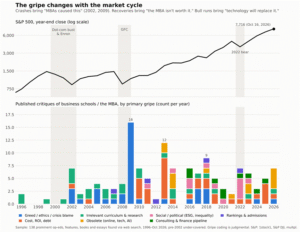
Almost immediately after the publication of the NYT piece, a response came from another business school teacher from which I took the top figure. The picture shows that reactions to professional schools such as business schools, medical schools and law schools were always a target for frustration.
I encountered this attitude when I helped to introduce the Environmental Studies Program in my school. There were objections based on the argument that students need to master disciplines before they move to interdisciplinary programs. A similar attitude is periodically faced by professional schools. However, reality and technology are now in a state of flux and universities are slowly following.
I asked AI (through Gemini) to detail the percentage of graduates from non-business majors who go on to get an MBA:
Over 60% of full-time MBA students majored in fields other than business as undergraduates. [1]
Undergraduate Backgrounds of MBA Students
-
-
- Non-Business Majors: More than 60% of full-time MBA students come from non-business backgrounds, including engineering, the sciences, liberal arts, and humanities. [1, 2]
- GMAC Survey Data: According to the Graduate Management Admission Council (GMAC) Prospective Students Survey, roughly 51% to over 60% of MBA applicants and enrolled students majored in non-business fields. [1, 2]
- Top Programs: At many top U.S. business schools (such as Wharton and other top 25 programs), non-business and humanities/STEM majors frequently make up the majority of the incoming class, with business majors often accounting for less than 40% to 45% of total enrollment. [1, 2, 3].
-
I further asked – What academic disciplines is AI threatening? This is what I got:
Generative artificial intelligence threatens academic disciplines that rely on routine text generation, structured data processing, or pattern analysis, while also challenging core academic integrity across all fields. [1, 2, 3, 4]
Most Vulnerable Disciplines
-
-
- Humanities (Literature, Philosophy, History): Considered by researchers to face an existential challenge because generative AI can analyze texts, draft essays, and replicate creative or historical narratives. [1]
- Computer Science and Statistics: Ranked among the highest-risk fields because AI models excel at writing code, handling structured data, and automating entry-level software development tasks. [1]
- Finance and Business Analytics: Vulnerable to algorithmic automation, quantitative modeling, and automated financial management. [1, 2]
- Journalism and Creative Writing: Impacted by automated content generation, cost-cutting measures, and synthetic writing tools. [1]
- Graphic Design and Marketing: Exposed to low-cost AI image generators, automated campaign design, and data-driven marketing tools. [1]
-
Broader Institutional and Research Threats
Scientific Research and Publishing: AI lowers the barrier to producing mass-generated or synthetic papers, complicating peer review, fueling paper mills, and risking scientific “monocultures” where researchers produce more but understand less.
Maybe it’s not the time to question successful programs (business schools) for lack of interactions with other disciplines. Let’s wait until the AI contributions to our education settle down. With AI availability, academia doesn’t need simple rules. Governments elected by the people do.
For many, higher education is the conventional path for earning power. Recently the NYT tried to summarize the college degree earning guide.
Table 1 from this article shows earning details of graduates from 10 schools, four years after graduation. The data are based on information from the HEA (High Education Act). The data shows the schools of the 10 highest earners, all of them higher than $200,000 per year.
Table 1
Graduates from top-earning programs can earn over $200,000 after four years (Source: the HEA)
| School | Earing ($) | Majors |
| All Institutions | 64,500 | All Majors |
| Duke University | 297,029 | Mathematics |
| Carnegie Mellon | 268,121 | Computer Science |
| Carnegie Mellon | 250,168 | Electrica, Electronics and Communication Engineering |
| University of Pennsylvania | 241,380 | Computer and Information Science |
| Harvard University | 230,876 | Statistics |
| UCLA | 228,705 | Computer Engineering |
| MIT | 225,141 | Computer Science |
| Cornell | 223,309 | Computer Science |
| Princeton | 217,973 | Computer Science |
| Pomona College | 217,051 | Computer Science |
The high earner majors include computer science (8) and math (2). Today, these two professions are the most vulnerable to progress that AI is making. Below are some of the details:
Majoring in computer science used to be considered a safe career bet, ensuring stable pay and work. After the 2008 recession, many students turned to the field’s promising outlook: Between 2008 and 2024, the number of computer science degrees grew by almost 500%, according to The Washington Post. During this period, computer science was the third-most-popular major behind nursing and psychology, making up almost 5% of early-career college graduates. But the underemployment rate for CS graduates is 19%, according to 2024 Federal Reserve Bank of New York data. Recent tech layoffs across companies like Amazon, Meta, and Microsoft make the field look even less appealing. College students are taking note: A National Student Clearinghouse Research Center survey shows that undergraduate students enrolling in CS programs has dipped by 8.4%.
And Math
A few short years ago, asking AI to add two four-digit numbers together for a third-grade math assignment would have been a bad idea. Over half the time, the answer would be wrong, studies have shown. Long division or a “leaky tank” problem, an algebra class staple? Forget about it. Although AI still struggles with arithmetic, in 2024, Google DeepMind’s AI systems scored high enough for a silver medal in an elite high school competition that tests mathematical reasoning rather than basic calculation. A year later, Open AI grabbed the gold.
That was just a warm-up.
In May 2026, AI made headway on a question that mathematician Paul Erdős posed in 1946. Given a fixed number of dots on a flat surface, how many pairs can sit exactly one unit apart? Experts had a long-standing prediction, but the bot overturned it once and for all.
Before my retirement, I taught in the Physics Department. A common strategy in many Physics Departments is to test students in Math before accepting them if those students want to major in Physics. Many now think that Physics will follow Math and Computer Science in being affected by the advances of AI. When I listed, near the beginning of the blog, AI responses to prospective affected majors, Computer Science, Math and Physics were not mentioned. The issue is still in flux.
Since Physics is close to my training, I tried to follow the situation:
AI has grown so adept at solving mathematical puzzles that critics fear the flood of new proofs it creates will overwhelm academics and actually set the field back. Until now, AI has had limited impact on other areas of science, but there are signs that physics may be about to experience a similar upset. John Sous at Yale University says AI models may have an unfairly bad reputation when it comes to physics because of the way they are tested. Cutting-edge models have previously scored as low as 30 per cent on six different tests designed specifically to assess AI’s ability on tough physics problems, but this doesn’t square with the successes Sous and his colleagues have seen when using them, he says.
My next blog will be posted after the US elections, and we will also have the results from the elections that are taking place elsewhere in the coming two weeks. Next week’s blog will be the last one on the topic of “Simple Rules.” The title of the blog will be The Simplest “Simple Rule” – Three Letters, One Number and One Symbol. We will find that what is known as the Copernican Revolution that started with Nicolau Copernicus (1473 – 1543) and started modern science preceded Kathy Eisenhardt in our attempt to understand reality using “simple rules.” The language was different (mostly Mathematics) but the objective was the same: to enable us to function in the real world.