
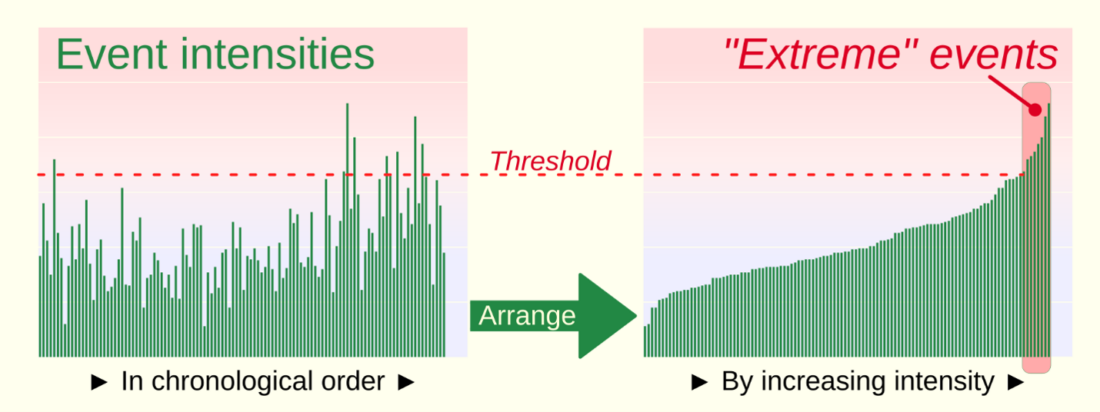
(Extreme event attribution – Wikipedia)
Recently, a college (Brown University) roommate of my wife’s, who lives in California, spent 3 days with us, taking advantage of invited talks (NYU and Cornell) that she got from schools on the East Coast. We had three great days and opportunities to chat. Her name is Kathleen Eisenhardt (Kathy). She did very well academically. Before she came, my wife described her as the “only girl in Brown Engineering School.” In her previous visit, she told us she dedicated her recent book that she wrote together with a college friend of hers (Donald Sull) titled “Simple Rules (How to Thrive in a Complex World)” to us. I didn’t read the book. Before she came for the present visit, I thought that since I am living, teaching and writing about a “complex world” I’d better read the book and try to see if the book applies to “My World.”
In the next blog, I am going to write about the book. In this blog, I want to explore how the reality described in “Simple Rules” fits the description of realities that I am more familiar with and have been writing about in this blog for the last 15 years. In order to find these relevant blogs that I’ve written, you can put “Prospect Theory” in the search box and/or Popperian Scientific Theory” in the box. (One blog that the search for “Prospect Theory” will show is from December 5, 2017, and Popperian theory will show one from October 6, 2020.)
In this blog, I use AI to correlate the two older theories with Kathy’s theory that is also known as the Eisenhardt Theory or the Agency Theory. I ask AI (through Gemini) to correlate all three theories to my interest in extreme climate events.
I will start with a simple straight question from Google that was run through Gemini:
Difficulties of finding accountability for extreme climate events
Finding legal and practical accountability for extreme climate events is challenging because climate science measures probabilities rather than single-cause responsibility, and governance systems struggle to link global emissions to local damage. [1, 2, 3]
Scientific and Technical Difficulties
- Probabilistic Causation: Extreme event attribution cannot prove an event happened solely because of human-caused global warming; instead, it calculates how much climate change increased the probability or severity of the event. [1]
- Varying Confidence Levels: Scientists have high confidence in attributing heatwaves and heavy rainfall to climate change, but lower confidence for complex or small-scale phenomena like tornadoes, hail, and localized thunderstorms due to short observational records and model limitations. [1, 2]
- Natural Variability: Weather extremes are naturally driven by chaotic atmospheric and ocean dynamics (such as El Niño or La Niña cycles), making it difficult to cleanly separate natural background noise from anthropogenic (human-caused) signals in every single incident. [1, 2]
- Data and Model Gaps: The Global South and remote regions frequently suffer from a lack of dense observational weather data and high-resolution climate modeling capacity, hindering local attribution studies. [1]
Legal and Attribution Hurdles
- Chain of Causation: Tying a specific ton of greenhouse gas emissions from a specific corporation or country to a distinct flood, wildfire, or loss-of-life event remains legally complex in courtrooms.
- Confounding Local Factors: Extreme impacts are heavily shaped by human exposure and vulnerability—such as building in floodplains, poor forest management, or aging municipal infrastructure—allowing defendants to argue that local planning failures caused the damage rather than global emissions. [1, 2]
- Cross-Border Cascades: Disasters frequently cross administrative and national boundaries, leaving gaps in jurisdiction over who should be held accountable and in what legal forum. [1]
Governance and Policy Deficits
- Missing Global Frameworks: International climate agreements have historically lacked standardized, legally binding mechanisms to integrate attribution science directly into loss-and-damage compensation. [1]
- Fragmented Financial Backing: Major institutional investors and fossil fuel underwriters often distance themselves from the direct physical consequences of the projects they fund. [1]
Here I continue to put all three theories, and my focus on climate change, together and ask Gemini for correlation:
Can you suggest a common description to the following: “Prospect Theory, Agency Theory and Popperian Scientific Theory?
My answer to this question was, “Yes, please”:
A compelling common description for Prospect Theory, Agency Theory (often associated with Kathleen Eisenhardt’s seminal work), and Popperian Scientific Theory is that they are all frameworks of bounded rationality and institutional governance under uncertainty.
While they span behavioral economics, organizational sociology, and the philosophy of science, they share a foundational premise: how human actors cope with incomplete information, hidden motivations, and the inherent fallibility of knowledge.
Here is how they intersect under a unified umbrella:
Key Connections
- Behavioral Reality vs. Idealized Models: Prospect Theory (Kahneman & Tversky) challenges the classical economic assumption of pure human rationality by showing that people weigh losses and gains differently under risk. Similarly, Agency Theory (Jensen, Meckling, and Eisenhardt) recognizes that principals and agents have misaligned interests and bounded information, making perfect contracts impossible. Popperian theory applies this same humility to science itself, arguing that human knowledge can never be proven “true,” only provisionally tested and falsified.
- The Management of Risk and Error: All three frameworks are fundamentally preoccupied with how systems react to error and uncertainty. Prospect Theory looks at how psychological biases distort risk assessment; Agency Theory designs structural incentives to mitigate the risk of opportunistic behavior (moral hazard); and Popperian theory builds a methodology around actively hunting for errors to drive intellectual progress.
- Anti-Dogmatism: Whether applied to decision-making, corporate governance, or empirical research, each theory rejects dogmatic certainty. They assert that robust systems—whether human minds, corporate hierarchies, or scientific paradigms—must incorporate mechanisms to correct for cognitive bias, hidden agendas, or false assumptions.
Suggested Unified Label
If you need a concise umbrella term for them in a comparative analysis, you might call them “Frameworks of Fallibility and Institutional Control” or “Epistemic and Behavioral Models of Bounded Rationality.”
Would you like to explore how these three frameworks specifically intersect when analyzing human attribution to climate extremes or complex socio-economic systems?
Prospect Theory and human attribution to climate extremes?
Prospect Theory (developed by Daniel Kahneman and Amos Tversky) is a behavioral economics framework describing how people make decisions under risk and uncertainty. When applied to climate extremes and event attribution (how humans attribute extreme weather events to climate change and react to them), it explains several cognitive biases and behavioral paradoxes that traditional rational-choice theories fail to address.
Core Mechanics of Prospect Theory in Climate Attribution
- Reference Dependence & Shifting “Normals”
- Concept: People evaluate outcomes as gains or losses relative to a psychological baseline or “reference point,” rather than absolute status.
- Application to Climate Extremes:
- If the reference point is set at the historical climate baseline (“the weather of my childhood”), an extreme weather event is perceived as a severe, unexpected loss.
- However, due to shifting baseline syndrome (or climate acclimatization), if individuals adapt to rising temperatures, their reference point shifts. Extreme weather gradually gets re-framed as “the new normal,” decreasing the perceived necessity to attribute the event to systemic anthropogenic climate change or take defensive action.
- Loss Aversion vs. Status Quo Bias
- Concept: Losses loom larger than equivalent gains—the psychological pain of losing something is roughly twice as intense as the pleasure of gaining it.
- Application to Climate Extremes:
- Risk-Seeking to Avoid Losses: When facing imminent threats (e.g., severe heatwaves, wildfires, or flooding), communities and governments are often willing to take high-stakes, risk-seeking gambles on costly defensive measures (like sea walls) rather than proactive, steady investments.
- Short-Term Loss Resistance: On the flip side, paying immediate upfront costs for climate mitigation/adaptation feels like a definite “loss” today to avoid a probabilistic loss tomorrow. Loss aversion leads people to delay proactive steps until an extreme event directly forces action.
- Nonlinear Probability Weighting (Overweighting vs. Underweighting)
- Concept: People tend to disproportionately overweight very small probabilities and underweight moderate-to-high probabilities.
- Application to Climate Extremes:
- Overweighting Rare Extremes: When a rare extreme event (e.g., a “1-in-100-year” flood or mega-fire) receives sudden scientific attribution and high news visibility, the probability weighting function spikes. People overweight the likelihood of it happening again immediately, causing temporary surges in insurance purchases or emergency policy creation.
- Underweighting Slow-Onset Risks: Before an event occurs, very low baseline probabilities of extreme weather are often psychologically rounded down to zero (the “threshold of concern” effect), leading to inaction until the catastrophe strikes.
- Availability Heuristic & Event Attribution
- Concept: People evaluate the likelihood or cause of an outcome based on how easily recent, vivid examples come to mind.
- Application to Climate Extremes:
- Extreme weather acts as a physical “salience anchor”. Immediately following a devastating extreme event, human attribution of local weather to global climate change rises sharply.
- Over time, as vivid memories fade, the perceived link weakens unless reinforced by rapid scientific attribution communications that explicitly link extreme events to human activities.
How Prospect Theory Impacts Climate Policy & Risk Communication
Eisenhardt Theory and human attribution to climate extremes?
While Daniel Kahneman and Amos Tversky introduced Prospect Theory (focusing on individual decision-making under risk and loss aversion), Kathleen M. Eisenhardt is a prominent organizational theorist best known for her foundational work on Agency Theory and organizational decision-making under uncertainty.
When applying Kathleen Eisenhardt’s perspective (particularly Agency Theory and organizational dynamics) to the attribution of human impact on climate extremes and subsequent responses, the focus shifts from individual cognitive biases to principal-agent relationships, information asymmetry, and structural accountability.
Core Principles of Eisenhardt’s Framework in Climate Attribution
- Information Asymmetry & Scientific Complexity
- Agency Theory Context: Agency theory addresses situations where the “principal” (e.g., the public, voters, or shareholders) relies on an “agent” (e.g., climate scientists, government regulators, or corporate executives) to act in their interest, but the principal lacks complete information about the agent’s actions or expertise.
- Application to Climate Attribution:
- Attribution science (connecting a specific heatwave or flood to human-induced global warming) relies on complex probabilistic modeling (e.g., Fraction of Attributable Risk or FAR).
- Because non-experts cannot independently verify climate models, severe information asymmetry Opposing interest groups can exploit the statistical nuances of attribution science to generate doubt, leading to public moral hazard or inaction.
- Goal Conflict & Misaligned Incentives
- Agency Theory Context: Principals and agents often have divergent goals and risk preferences. Agents tend to act in their own short-term self-interest unless aligned via governance mechanisms.
- Application to Climate Attribution:
- Elected Officials (Agents) vs. Citizens (Principals): Political leaders often operate on short election cycles (2–4 years), whereas climate attribution reveals risks operating on multi-decadal timeframes. Agents face a goal conflict: incurring immediate political or financial costs to prepare for extreme events offers little short-term reward compared to post-disaster relief.
- Corporate Governance: Corporate managers (agents) prioritizing short-term quarterly profits may resist incorporating climate attribution data into long-term infrastructure planning, transferring the long-term climate risk (and cost) onto shareholders or the public (principals).
- Monitoring Mechanisms & Legal/Regulatory Governance
- Agency Theory Context: To prevent agent self-interest or negligence, governance structures (monitoring and outcome-based contracts) must be established.
- Application to Climate Attribution:
Event attribution science acts as an advanced monitoring tool. By quantifying the degree to which human emissions increased the likelihood or severity of an extreme weather event, attribution science reduces the agent’s ability to claim an event was an unpredictable “Act of God”.
- This enables outcome-based governance, such as climate litigation (holding major emitters legally accountable) and corporate disclosures (requiring institutions to report attributed climate risks).
- Decision-Making Under High Velocity and Uncertainty
- Eisenhardt’s Work on Fast-Paced Environments: Eisenhardt studied how organizations make strategic choices in fast-moving, high-uncertainty environments, finding that effective organizations use real-time information, multiple simultaneous alternatives, and clear decentralized execution.
- Application to Extreme Event Response:
- During acute extreme events (e.g., rapid-onset wildfires or sudden severe flooding), institutions must act quickly despite incomplete attribution data.
- Organizations that successfully adapt to climate extremes utilize real-time environmental monitoring rather than relying solely on historical static data, enabling faster institutional deployment of adaptation measures.
Comparison: Kahneman & Tversky (Prospect Theory) vs. Eisenhardt (Agency & Organizational Theory)
| Dimension | Prospect Theory (Kahneman & Tversky) | Organizational/Agency Theory (Eisenhardt) |
| Primary Level of Analysis | Individual Cognitive Level (psychology of the decision-maker) | Institutional / Relational Level (governance, structures, and systems) |
| Core Problem in Climate Risk | Loss aversion, reference dependence, and probability weighting distort individual choices. | Goal misalignment, information asymmetry, and lack of accountability between parties. |
| Role of Extreme Attribution | Serves as a vivid “salience anchor” that resets an individual’s perception of risk. | Serves as a monitoring/verifying mechanism to hold institutional agents accountable. |
| Path to Better Outcomes | Behavioral nudges, reframing choices around gains vs. losses, clear risk communication. |
Popper theory on Scientific theory and the theory of human attributions to climate extremes?
Connecting Karl Popper’s philosophy of science with the field of Extreme Event Attribution (EEA)—which quantifies how human influence affects specific extreme weather events—highlights how modern statistical science operates under Popperian principles.
1.Karl Popper’s Theory of Scientific Discovery
Popper’s core framework addresses what distinguishes true science from non-science or pseudoscience (the demarcation problem):
- Falsifiability: A scientific theory cannot be definitively proven true; it can only be tested and potentially disproven (falsified). For a hypothesis to be scientific, it must make risky, testable predictions about observable outcomes.
- Rejection of Verificationism: Observing thousands of confirming instances (e.g., thousands of white swans) does not prove a universal claim, as a single counterexample (a black swan) refutes it.
- Hypothetico-Deductive Method: Science advances by proposing bold hypotheses, attempting to refute them via empirical observation, and retaining only those that survive rigorous attempts at falsification.
- Extreme Event Attribution (EEA) Science
Extreme Event Attribution determines whether, and to what extent, human-induced climate change has altered the likelihood or severity of a specific extreme weather event (e.g., a heatwave, hurricane, or drought).
Instead of asking a simplistic question like “Did climate change cause this exact storm?”, attribution science frames the problem probabilistically:
- World A (Counterfactual): A simulated model of the Earth without human greenhouse gas emissions.
- World B (Actual): The observed Earth with anthropogenic climate changes.
Researchers compare the probability ( ) and intensity of an event in both worlds to calculate metrics like the Fraction of Attributable Risk (FAR):
3.Applying Popperian Principles to Extreme Event Attribution
A. The Null Hypothesis as a Falsifiable Baseline
In Popperian terms, climate attribution studies do not start by trying to “prove” human influence. Instead, they set up a strict, testable null hypothesis:
Null Hypothesis ( ): The extreme weather event occurred entirely within natural variability and its probability/intensity is unchanged by anthropogenic climate factors.
If climate model simulations and historical observational data fail to reject , the claim that humans influenced the event is falsified or left unsupported. Attribution studies frequently conclude that certain events (like specific localized droughts or winter cold snaps) show no statistically significant human fingerprint, directly demonstrating the field’s capacity for falsification.
B. Testing and Falsifying Climate Models
Attribution science relies on global climate models (GCMs). Under Popper’s view, these models are sets of hypotheses. They undergo falsification testing through model evaluation: Models are tested against historical observational data before being used for attribution. If a model fails to realistically simulate the physical mechanisms or historical frequency of a specific extreme weather type in a region, its predictions are falsified and excluded from attribution ensembles.
C. Probabilistic Prediction vs. Strict Determinism
A common critique from strict Popperian traditionalists is that probabilistic claims are harder to falsify than deterministic ones (e.g., “All swans are white” vs. “Swans have an 80% chance of being white”).
However, modern statistical science adapts Popper’s falsifiability to probabilistic falsification:
A probabilistic hypothesis predicts a specific distribution of events.
If empirical observations consistently fall outside predicted confidence intervals (e.g., ), the underlying probabilistic model is rejected.
Key Summary
| Concept | Popperian Scientific Philosophy | Extreme Event Attribution (EEA) |
| Core Criterion | Falsifiability via empirical testing. | Testing hypotheses against observational data and climate simulations. |
| Testing Target | Proposed theories or universal claims. | The null hypothesis ( : Event is purely natural). |
| Outcome | Theories survive testing or are refuted (falsified). | Events are attributed to human influence, or the human link is falsified/rejected. |
Testing all of this in the real world will probably manifest itself in the first meeting of the US Supreme Court this term. They must decide who should pay for the local climate change damage.
Stay Tuned!