
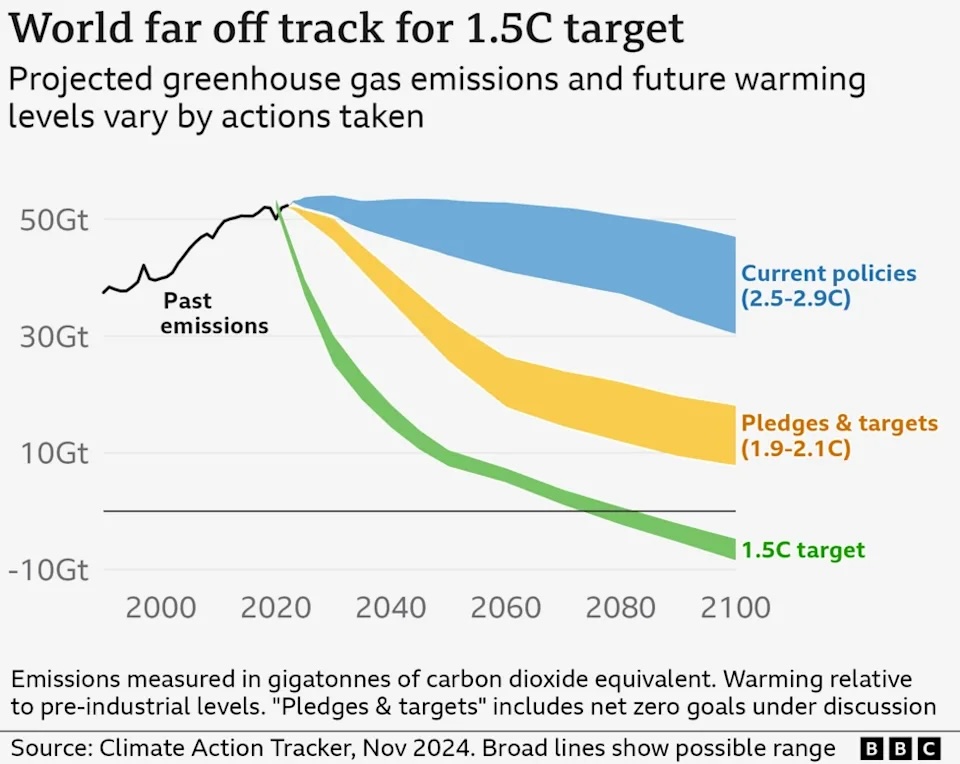
Figure 1 – In charts: ten years since the Paris climate accord
Last week’s blog focused on the abstract search for a reference for collective evil, following a NYT examination of the current Trump administration. I pointed out that such a search would require serious prerequisites in both social sciences (specifically political sciences) and philosophy. My credentials are in neither background; they are more in STEM (science, technology, engineering, and mathematics) fields such as physics and chemistry. One of my most important qualifications for this particular discussion is being a child survivor of the Nazi atrocities that we now refer to as the Holocaust.
Over the 13 years that I have been writing this blog, my writing has focused on this mixed background. However, having a mixed background is not an excuse for analyzing phenomena within topics outside of my field. Recently, things have gotten a bit closer to my area of expertise. Traditionally, physicists have tried to stay away from the study of living systems. We left it to different sciences such as biology, anthropology, some aspects of psychology, all the social sciences, and most of the humanities. Now, mainly because of advances in computing, things have changed. Social physics has become a respected field. Below are a few sentences that start the Wikipedia entry on social physics:
Social physics or sociophysics is an interdisciplinary field of science which uses mathematical tools inspired by physics to understand the behavior of human crowds. In a modern commercial use, it can also refer to the analysis of social phenomena with big data. Social physics is closely related to econophysics, which uses physics methods to describe economics.[1]
Topics such as climate change, network analysis, and data science have become respectable topics for any physicist. While I was teaching, I ended up spending a considerable amount of time learning and researching topics that are legitimate parts of social physics.
However, addressing an issue such as how to quantify evil requires many more prerequisites than I have in my skill set. My deficiencies in addressing the background of this issue were amplified during my search in my personal library, which was mentioned in last week’s blog. As a result of that search, however, I found the small book by Timothy Snider titled On Tyranny.
In addition to Snider’s book, I found two books related to Karl Popper. One book was by Geoffrey Stokes, titled Popper, and the other was the 2nd volume of The Open Society and Its Enemies. I remember reading these books a long time ago. It was mainly in the context of following Popper’s definition of the Scientific Method, but I also followed his position on the advantages of democratic governments. To summarize, he claimed that democracy is the only form of government that allows for the peaceful removal of bad leadership without violence and bloodshed. I fully realized that I don’t have and hadn’t read any writing by Hannah Arendt and that I don’t remember much of Popper’s writings either. Both philosophers, with their backgrounds in Nazi Germany, were obviously much more qualified than I am to address governmental shifts away from democracy. So, I ordered and started to read Arendt’s The Origin of Totalitarianism. I also plan to order her book, On Violence. Meanwhile, I decided to postpone the continuation of my attempts to quantify collective violence and return to the “safer” ground of COP30 that I started two weeks ago.
For background on the COP system, just put the three letters in the search box. The first time that I used the word COP in the title of a blog was with COP21, in the Nov 17, 2015 blog, in which the Paris Agreement was drafted.
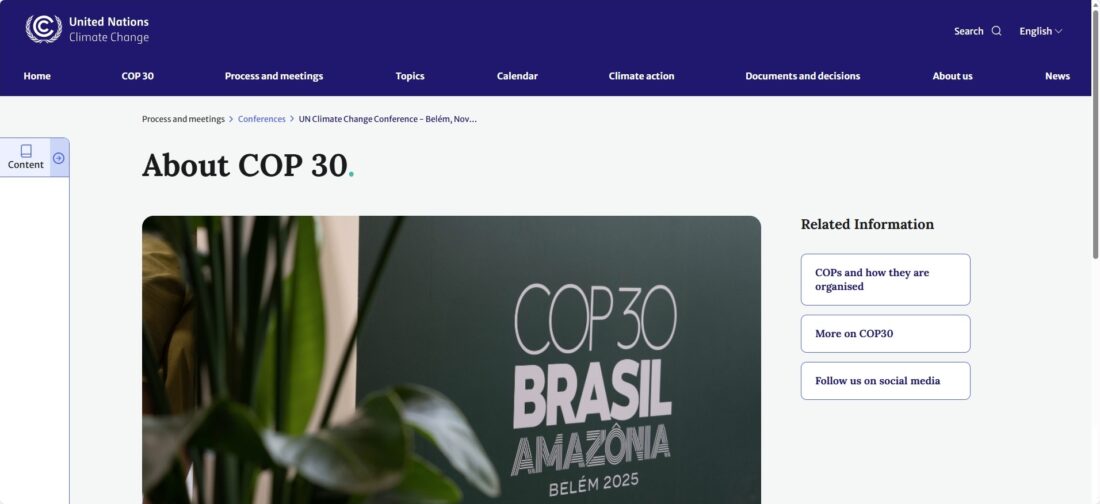
Figure 2 – A screenshot of the COP30 website
The best place to follow the present COP is on the meeting’s website. The landing page of the site is shown in Figure 2. It opens with the following:
COP30 is the United Nations Climate Change Conference taking place in Belém, Brazil from 10 to 21 November 2025.
UN Climate Change Conferences (or COPs) take place every year, and are the world’s only multilateral decision-making forum on climate change that brings together almost every country on Earth.
To put it simply, the COP is where the world comes together to agree on the actions to address the climate crisis, such as limiting the global temperature rise to 1.5 degrees Celsius, helping vulnerable communities adapt to the effects of climate change, and achieving net-zero emissions by 2050.
COP30 will bring together world leaders and negotiators from the member states (or Parties) of the UN Framework Convention on Climate Change (UNFCCC) to further global progress, with business leaders, young people, climate scientists, Indigenous Peoples, and civil society sharing insights and best practices to strengthen global, collective and inclusive climate action.
Officially, COP30 stands for the 30th meeting of the Conference of the Parties (COP) to the UN Framework Convention on Climate Change (UNFCCC), a landmark international treaty agreed in 1992, and parent treaty to the 2015 Paris Agreement.
From there, we move to the News section of the blue strip and can read a transcript of UN Climate Change Executive Secretary Simon Stiell’s opening address for COP30 on November 10th (opening day). In it, he noted that the Paris Agreement has helped bend the curve of emissions downward.
But he didn’t sugarcoat it:
“We must move much, much, faster on both reductions of emissions and strengthening resilience,” he said.
Stiell said strong and clear outcomes on all issues are essential.
“This is how we signal to the world that climate cooperation is delivering results,” he added. “In Belém, we’ve got to marry the world of negotiations to the actions needed in the real economy. Every gigawatt of clean power cuts pollution and creates more jobs. Every action to build resilience helps save lives, strengthen communities, and protect the global supply chains that every economy depends on. This is the growth story of the 21st century – the economic transformation of our age.”
We return to the blue banner to search for the “2025 Synthesis Report of Biennial Transparency Reports,” and get the following:
The Synthesis Report of Biennial Transparency Reports delivers a valuable early picture of implementation progress by countries across mitigation, adaptation, and support. It offers initial insights into diverse national efforts to implement the Paris Agreement — including some of the successes that can be built upon and barriers that must be overcome.
This report synthesizes information from over 100 first Biennial Transparency Reports (BTR1s) and National Inventory Reports submitted by Parties as at 15 April 2025. The submissions include information and data up until 2022 and together represent some 75 per cent of total global GHG emissions in 2020.
The report underscores the critical role of transparency in fostering mutual trust and facilitating ambitious global climate action and support and offers insights into Parties’ diverse national circumstances, institutional arrangements, and capacities for climate-related reporting.
Content of the report
The “official” US presence at this meeting is nonexistent, and the global reaction to this has been generally negative (World leaders punch back at US climate denial ahead of Brazil’s COP30 negotiations | Reuters):
BELEM, Brazil, Nov 6 (Reuters) – Country leaders at a climate summit in Brazil on Thursday bemoaned the fractured global consensus on climate action, taking swipes at the climate-denying U.S. government while trying to assure the world they were still on mission.
U.N. Secretary-General Antonio Guterres tore into nations for their failure to limit warming to 1.5 degrees Celsius, as Brazil hosted world leaders for a summit ahead of the COP30 climate conference in the rainforest city of Belem.
“Too many corporations are making record profits from climate devastation, with billions spent on lobbying, deceiving the public and obstructing progress,” Guterres said in his speech. “Too many leaders remain captive to these entrenched interests.”
Countries are spending about $1 trillion each year subsidizing fossil fuels.
Leaders have two clear options, Guterres said: “We can choose to lead – or be led to ruin.”
Missing from the lineup were leaders from four of the world’s five most-polluting economies – China, the United States, India and Russia – though the European Commission president and China’s vice premier were on site.
The U.S. administration opted to send no one to the talks. Instead, top U.S. officials were in Greece alongside fossil fuel giant Exxon Mobil <XOM.N> on Thursday as it signed a new deal to explore offshore for natural gas.
Colombia’s president criticized the absence of U.S. President Donald Trump, whose country is responsible for releasing the most emissions into the atmosphere.
“Mr. Trump is against humanity. His absence here demonstrates that,” said President Gustavo Petro, who had U.S. sanctions imposed against him last month.
A handful of leaders referenced Trump’s description of climate change as the world’s greatest “con-job”.
Chilean President Gabriel Boric said bluntly through a translator: “That is a lie.”
Ireland’s prime minister questioned the priorities of those skipping the summit.
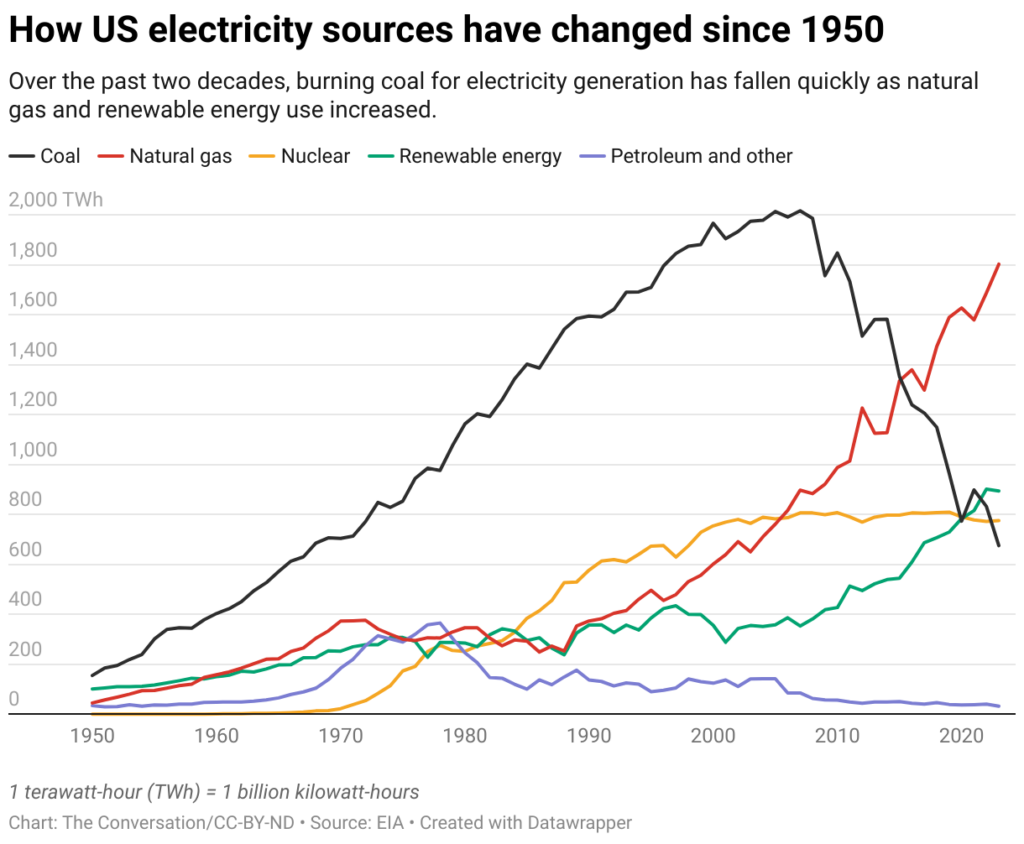
Figure 3 – How US electricity sources have changed since 1950(Chart: The Conversation/CC-BY-ND; Source: EIA via The Invading Sea)
Yet, as can be seen in Figure 3, the sources for US electricity have largely changed from coal to renewables and natural gas over the last few decades (How the US cut climate-changing emissions while its economy more than doubled):
U.S. emissions from many of the activities that produce greenhouse gases – transportation, industry, agriculture, heating and cooling of buildings – have remained about the same over the past 30 years. Transportation is a bit up; industry a bit down. And electricity, once the nation’s largest source of greenhouse gas emissions, has seen its emissions drop significantly.
Next week’s blog will contrast the US absence from the Belem COP30 with the enhanced presence of China and the EU.
You have wonderful gift for making complex ideas accessible