
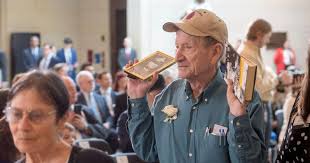
 Me with other Holocaust survivors at the Capitol during a Congressional Gold Medal ceremony honoring Benjamin Ferencz (Source: Times Argus)
Next month, I will be 87. I just returned from a series of meetings in Washington, DC, all organized by the US Holocaust Institute (2026 National Days of Remembrance Commemoration – United States Holocaust Memorial Museum). The first day of these meetings took place on April 13th, 81 years after my liberation by the 30th Infantry Division of the American army in a place called Farsleben, near the city of Magdeburg, Germany.
This year, my liberation coincided with the start of “Yom HaShoah”:
In Hebrew, Holocaust Remembrance Day is Yom HaZikaron laShoah ve-la G’vurah (Holocaust and Heroism Remembrance Day), and is referred to as Yom HaShoah. The date was chosen as it falls within the timeframe of the anniversary of the Warsaw Ghetto Uprising in April-May 1943, which lasted for 29 days.
Congress celebrated Yom HaShoah on Wednesday, April 14th, issuing a gold medal to honor Benjamin Ferencz, who played a key role in the Nuremberg trials of the crimes committed by the Nazi leadership. A few Holocaust survivors were invited to take part in the event, and I was one of them. It took place at the US Capitol, and the above picture was taken of me marching with other survivors. What I held in both hands and wore on my head all symbolized my connections to the Holocaust. I was holding my father’s photograph and my mother’s books on the Warsaw Ghetto and Bergen Belsen. The cap was given to me by the US 30th division, which saved us on April 13, 1945. The events of my life, beginning with the start of this war, have been repeatedly described throughout this blog. I have been busy and 87 years is a long time. This blog is focused on our individual and global physiological changes during our last chapters in life.
American men’s life expectancy is 76.5 (2024). The more general individual physiological changes toward the end of life can be summarized as follows:
The passage of time may be linear, but the course of human aging is not. Rather than a gradual transition, your life staggers and lurches through the rapid growth of childhood and the plateau of early adulthood, to an acceleration in aging as the decades progress. A study identified a turning point at which that acceleration typically occurs: around age 50. After this time, the trajectory at which your tissues and organs age is steeper than the decades preceding, according to a study of proteins in human bodies across a wide range of adult ages – and your veins are among the fastest to decline. “Based on aging-associated protein changes, we developed tissue-specific proteomic age clocks and characterized organ-level aging trajectories,” writes a team led by scientists from the Chinese Academy of Sciences in their paper published in 2025.
The rest of the blog is focused on scaling up and generalizing this type of deterioration to apply to global humanity by describing the localized impacts of climate change, which signal the start of the destructive process that I coined as “self-inflicted genocide” in earlier blogs. I share articles that emphasize the localities of predicted extreme weather, current European attempts to manage the localities of destruction, and the general wisdom of focusing on localities.
I am emphasizing climate change’s impacts in specific localities as an analogy for the progressive destruction of individual life (the last part of life). In both cases we have a better chance of addressing the small disasters than the bigger problem (ending life individually and global extinction collectively).
Localities of Predictions:
The Weather Is Getting Wilder, and Some See a Dire Signal in the Data. Several of the Earth’s systems are changing faster than predicted as global temperatures rise, scientists say. Scientists who study global warming are currently wrestling with a question that, while seemingly technical, is profoundly consequential: Is climate change accelerating?
The debate spilled into the open this month, after new research found that the rate of global warming has nearly doubled over the last decade. The findings set scientific circles buzzing, and not all researchers agree with the conclusion. But while the debate about accelerating global warming remains unsettled, a growing number of scientists do agree on another troubling development: The effects of climate change are intensifying in ways that have surprised even experts. Many of the consequences of global warming — such as more intense storms, warming oceans and melting glaciers — are arriving faster and more powerfully than many scientists had expected.
Localities of Heatwaves
The record-breaking heatwave scorching the US west this week would have been “virtually impossible” if not for the climate crisis, a team of scientists has determined.Millions of Americans from the Pacific coast to the Rockies baked under unseasonably warm and even dangerous temperatures this week, with temperatures up to 30F (17C) above average for the time of year. The climate crisis, caused primarily by the burning of fossil fuels, has made this kind of heatwave four times more likely to occur over the last decade, according to a new rapid analysis released Friday. “These temperatures are completely off the scale for March,” said analysis co-author Ben Clarke, who is an extreme weather and climate change researcher at Imperial College London, in a statement.
Attempts to Manage the localities of the destruction (Phys.org)
When floods, coastal erosion or sea-level rise threaten settlements or infrastructure, European countries manage to retreat more often than previously assumed. Managed retreat refers to the planned, government-supported relocation of people, homes or infrastructure away from areas exposed to flooding and other climate-related hazards. A new German Dutch study led by Kiel University in collaboration with the Dutch research institute Deltares systematically documents the extent and diversity of such measures in Europe for the first time. Even as recently as 2016, the current heatwave would have also been milder, with temperatures about 1.4F (0.8C) cooler, says the analysis by World Weather Attribution, an international consortium of climate researchers.
The Wisdom of Focusing on Localities as a transition to Full Impact – Back to the Guardian piece from March of this year
These findings leave no room for doubt. Climate change is pushing weather into extremes that would have been unthinkable in a preindustrial world,” said Friederike Otto, a climate science professor at Imperial College London, who also worked on the study.
To carry out their rapid analysis, the scientists examined forecasts for a five-day period, from 18-22 March. To quantify the impact of global warming on the week’s extreme temperatures, the researchers analyzed weather and forecast data and also used climate model simulations to compare how heat events have changed in today’s climate. Fueled by an area of high pressure in the atmosphere, the heat dome has shattered temperature records in 140 cities stretching from California to Missouri, according to the Weather Channel, while leaving California, Nevada and Arizona under extreme heat warnings on Thursday.
More heat is in store for the coming days. The mercury is expected to continue ticking upward in the south-west, and the heatwave is expected to creep toward the plains and the south later this week. By the end of the week, 100 cities could set all-time temperature records for the month of March, with temperatures climbing as high as 30F (17C) above average for the time of year, the new analysis says.
Heat is the deadliest form of extreme weather in the US. Weather officials this week raised concerns about an increase in heat-related illnesses, especially among vulnerable populations, and advised people to remain hydrated and stay inside when they can.
The localized impacts of climate change can add up to total destruction—on both personal and global levels. However, they also provide opportunities for healing, details of which we will explore in future blogs.