
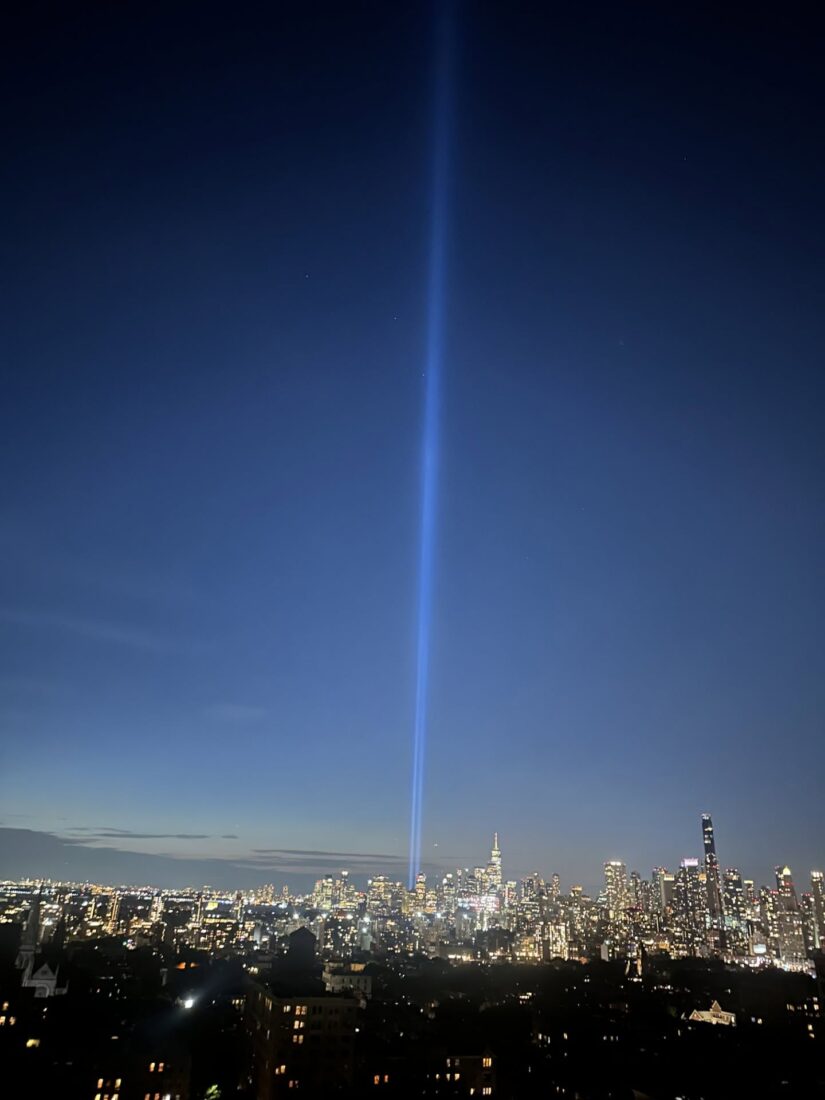
My photo of the lights memorializing September 11th
I am starting to write this blog on Friday, September 11th, one day before the Jewish New Year. The top picture was taken a few days ago to mark the coming 25 years of the September 11 event. A similar light display, coming from the area where the two towers were destroyed, have been visible every year since the event to commemorate the attack. Below is the short summary from the memorial site:
Assembled on the roof of the Battery Parking Garage south of the 9/11 Memorial, the twin beams reach up to four miles into the sky and are comprised of 88 7,000-watt xenon lightbulbs positioned into two 48-foot squares, echoing the shape and orientation of the Twin Towers. The installation can also be viewed from a 60-mile radius around lower Manhattan.
Tribute in Light was conceived by several artists and designers who were then brought together under the auspices of the Municipal Art Society and Creative Time: John Bennett, Gustavo Boneverdi, Richard Nash Gould, Julian LaVerdiere, and Paul Myoda, with lighting consultant Paul Marantz. Learn more about our 25th anniversary Tribute in Light commemoration.
I live in NYC, and with the date, the light beams shift my memory to September 11, 2001. I remember observing the events with burned pieces of paper flowing to where I stood. Initially, I didn’t comprehend what was happening, but it was an election day at a time with many people filling the streets and the realization was quick.
I am an old guy (87 years). I was born in Poland three months before the German invasion of Poland that started WWII. I grew up under the umbrella of the term “Never Again.” Put the phrase into the blog’s search box to see more of my background. Until age 6, I spent my time in the Warsaw Ghetto and the Bergen-Belsen concentration camp. Two thousand, five hundred Bergen-Belsen prisoners, including my mother, my uncle, and myself, were liberated by the American army on April 13, 1945 near Farsleben, a small town near Magdeburg, the capital of the German state of Saxony-Anhalt. We were on a train “trip” from Bergen-Belsen to Theresienstadt, another camp further from the Frontline. This trip was described in an earlier blog (May 21, 2025).
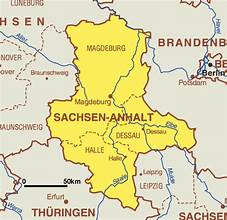
Figure 2 – Map of the state of Saxony-Anhalt
I searched Google for Farsleben and the first link (JewishGen.org) includes the following:
As WWII came to an end, attempts were made to evacuate concentration camps before Allied troops arrived. Three trains were sent from Bergen-Belsen on April 10, 1945, intended for Theresienstadt. This train got as far as Farsleben, near Magdeburg, when US troops freed the prisoners on April 13, 1945. It is estimated that about 2,500 prisoners were aboard this train when it started out on its fateful journey from Bergen-Belsen on April 10, 1945.
An article written in 2008 by Frank W. Towers of the 30th Infantry Division (http://www.30thinfantry.org/holocaust.shtml) gives a very personal overview of the encounter with this train.
So, our liberation is still the top “tourist attraction” in the area.
A few days ago (Sunday, September 6th), an election took place in the State of Saxony-Anhalt:
The AfD won the parliamentary election in Saxony-Anhalt on 6 September, securing 43.8% of the vote – 23 percentage points more than in 2021. This gave the party 39 seats in the 83-seat Landtag. The CDU, which had previously led the state government, won just 17.2% (down 19.9 pp) and 15 seats. Its coalition partner, the SPD, came third with 9.3% (up 0.9 pp), securing eight seats. The Greens also secured eight seats with 8.9% (up 3 pp), while Die Linke won the same number with 8.6% (down 2.4 pp). The Sahra Wagenknecht Alliance (BSW) entered the Landtag with 5.3% of the vote and five seats. The FDP, another member of the outgoing governing coalition, failed to clear the electoral threshold. Turnout reached 77.8% (up 17.5 pp from 2021), the highest level recorded in the state since 1989.
The result will not alter the balance of power in the Bundesrat, where Saxony-Anhalt holds four of the 69 votes. The state constitution sets no specific deadline for electing a new minister-president. If the process reaches a third round of voting, a simple majority will suffice. The new Landtag must convene by 6 October at the latest (see Anything is possible: AfD sets its sights on power in Saxony-Anhalt).
The AfD leadership will seek to form a government, most likely with the support of the BSW, the only party to have declared before the election that it was willing to cooperate with the AfD. Following its crushing defeat, the CDU will focus on maintaining the stability of the federal government, particularly as it faces the prospect of further electoral setbacks. The next test will come in Mecklenburg-Western Pomerania on 20 September, where the AfD leads the polls, followed by Berlin.
The results of this election give AfD (Alternative for Germany) the first post-WWII opportunity to govern a German state. German intelligence declared the party to be a demonstrably “right wing extremist.”
The stated reasons for the big win of AfD in the Saxony-Anhalt election were summarized as follows:
Experts attribute the AfD’s strong showing in the polls largely to the widespread dissatisfaction many people in the state feel with developments in Germany. Many jobs disappeared in the years following reunification, particularly in the lignite mining and chemical industries.
Saxony-Anhalt also faces pronounced demographic challenges. With an average age of 48.3 years, it had Germany’s oldest population in 2024. The state also has a pronounced gender imbalance among younger age groups, with approximately 120,240 men aged 18 to 29 compared with around 103,177 women. At the end of 2025, foreign nationals accounted for about 9% of the population, compared with roughly 15% nationwide. Many young people left the state and never returned.
Many people oppose further immigration, even though the state’s foreign population remains comparatively small. Nevertheless, its size has increased markedly over the past decade. According to the state’s Statistical Office, the number of people without German citizenship has more than doubled since 2015.
It is valid to ask whether Saxony-Anhalt is in the worst shape economically in Germany and what the election results could hold for governance in other states. Table 1 shows how the economy of Saxony-Anhalt looks compared to those of other German states:
Table 1 – The present (2025) economy of the German States and the list of the states that originated in East Germany (now called New Federal States)
| State | GDP (mil€) | GDP per Capita (€) | New Federal States |
| Germany | 4,469,910 | 53,482 | |
| North Rhine-Westphalia | 909,411 | 49,682 | |
| Bavaria | 824,243 | 62,212 | |
| Baden-Württemberg | 667,105 | 59,320 | |
| Lower Saxony | 399,397 | 49,646 | |
| Hesse | 382,411 | 60,567 | |
| Berlin | 218,288 | 59,233 | |
| Rhineland-Palatinate | 185,270 | 44,864 | |
| Hamburg | 168,300 | 90,359 | |
| Saxony | 167,973 | 41,553 | NPR |
| Schleswig-Holstein | 131,247 | 44,347 | |
| Brandenburg | 104,100 | 40,716 | NFS |
| Saxony-Anhalt | 81,755 | 38,282 | NFS |
| Thuringia | 80,639 | 38,394 | NFS |
| Mecklenburg-Vorpommern | 63,585 | 40,407 | NFS |
| Saarland | 43,174 | 42,656 | |
| Bremen | 43,011 | 61,019 |
Economic data came from Wikipedia
States origins data came from (https://en.wikipedia.org/wiki/New_states_of_Germany)
Here are a few comments on the recent history of the German states:
The new states, which were dissolved by the GDR government in 1952 and re-established in 1990, are Brandenburg, Mecklenburg-Western Pomerania, Saxony, Saxony-Anhalt, and Thuringia. The state of Berlin, the result of a merger between East and West Berlin, is usually not considered one of the new states.
Table 1 shows that indeed, in terms of GDP/Capita, Saxony-Anhalt is the poorest state in Germany. However, the difference between its GDP/Capita and that of the richest state in the NFS category (Saxony) is 8.5%. The data can much better be interpreted that the economic differences are still a remnant of the partition of Germany post-WWII. The present German states are not identical to the reintegration states, so some changes for a better integration might help. The prognosis of the governing status of the rest of the NFS states will probably depend how the new government in Saxony-Anhalt does. The next election, on September 20th, is in Mecklenburg, another NFS state where AfD is ahead in the polls.
Next, I asked AI (through Gemini) What is AfD policy on Holocaust memory? Here is what I got:
The Alternative for Germany (AfD) actively rejects Germany’s established culture of Holocaust remembrance, seeking to pivot away from what party leaders call a national “guilt cult.”
Core Criticisms of Remembrance
- The “Guilt Cult” (Schuldkult): AfD leaders, including Alice Weidel, argue that public life and schools focus too much on Nazi crimes. They claim this makes young Germans feel unnecessary shame rather than pride in their country. [1, 2]
- Downplaying the Past: Honorary chairman Alexander Gauland once dismissed the 1933–1945 Nazi era as mere “bird’s droppings” in more than 1,000 years of successful German history. [1, 2]
- The “Monument of Shame”: Björn Höcke, a prominent regional AfD leader, famously called Berlin’s Memorial to the Murdered Jews of Europe a “monument of shame” and called for a complete reversal of German memory policies. [1, 2, 3]
Proposed Policy Changes
- School Curricula: AfD lawmakers have proposed shifting the focus in history classes. Some suggested having “less Hitler” and framing German history in a more positive, balanced light. [1, 2, 3]
- Shifting the Narrative: The party often emphasizes German suffering during World War II—such as Allied bombings or postwar displacement—to place national focus away from exclusive perpetrator guilt. [1]
- Funding Cuts: The party has pledged to reduce or end state funding for art, museums, or projects they view as “anti-German” or overly focused on atonement. [1, 2]
Germany teaches the Holocaust as a mandatory, cross-curricular subject that focuses heavily on the societal and political mechanisms of how a democracy collapses rather than just detailing military battles. [1, 2, 3]
Curriculum and Structure
-
Early Introduction: Education begins around the fifth or sixth grade (ages 10–12) and is revisited with deeper academic rigor in grades 9–12. [1]
-
Cross-Subject Approach: The topic is not confined to history class. It is integrated into German class (reading memoirs and literature from the era), religion/ethics, art (analyzing Nazi classifications of “degenerate art”), and music (studying propaganda). [1, 2]
-
Focus on the “How” and “Why”: Lessons emphasize the collapse of the Weimar Republic, the rise of Adolf Hitler, societal conformity, and the dangers of discrimination and totalitarianism. [1, 2]
-
State Variations: Because education in Germany is managed at the state (Bundesland) level, specific textbooks and exact grade timelines vary slightly by region. [1, 2]
Why the concern?
9/11 took place 56 years after of our liberation from the “Train Near Magdeburg” in Farsleben in Saxony-Anhalt. As mentioned before, I am 87 years old, and was liberated from the camp at age 6. Per definition, I am member of the last generation that directly experienced the Holocaust. Retaining our memory of the Holocaust is important to me and to many others as a reference for the evil carried out by a sovereign state (Germany). Without direct witnesses, it would be easy for people just to claim that the Holocaust never happened. A week after I started this blog (May 7, 2012) I tried to collect the evidence—the proof of these events that will remain after the passing of Holocaust survivors and liberators.
My next blog (May 14, 2012) was titled, “Why Am I ‘Dragging’ the Holocaust into the Climate Change Debate?” I got 62 responses; not all of them were complementary. When Holocaust survivors and liberators disappear, references to these events will depend on what they leave behind. One of the few ways to perpetuate these memories is through education. In an earlier blog titled, “A Call to Immortalize and Generalize ‘Never Again’” (August 13, 2025), I discussed the issue, mentioning that learning about the Holocaust in German schools is mandatory (https://www.dw.com/en/teaching-about-nazis-and-the-holocaust-in-german-schools/a-66526994). In that blog I also mentioned all the global places where the teaching of the Holocaust is mandatory, including many states in the US.
The situation in Germany is similar to that in the US: Germany’s 16 federal states are autonomous regarding the educational curriculum. How—and to what extent—schools teach about the Holocaust varies nationwide. The opening picture in the August 13, 2025 blog shows me giving a lecture to Farsleben’s students on my experiences. I have visited the place often and I have good friends there who occasionally visit my family in NYC.
What will happen, if and when, AfD takes control of the state government in Saxony-Anhalt?
To try to answer the question, I asked AI who in Germany is in control of the infrastructure left after WWII. I got the following response:
(AI Gemini) Who is paying in Germany for the memorials of the concentration camps – States or Federal?
Both the federal government (Bund) and the regional state governments (Länder) share the cost of maintaining concentration camp memorials in Germany. [1, 2]
Federal Funding (Bund)
- National Importance: The federal government funds major concentration camp memorials and national remembrance sites because they hold historic significance for the entire country. [1]
- Shared Foundations: Prominent sites like the Buchenwald, Mittelbau-Dora, Dachau, and Flossenbürg memorials receive significant institutional and project funding from the federal budget. [1]
State Funding (Länder)
- Regional Responsibility: Under Germany’s federal system, cultural affairs and education—including local history and regional memorials—are primarily the legal duty of the individual states (Kulturföderalismus). [1]
- Local Maintenance: The specific state where a memorial is located contributes matching or baseline financial support for daily operations, regional archives, and staff. [1, 2]
Joint Support
-
Co-Financing: Most major memorial sites operate through mixed financing, where the federal government and the respective state government split or combine resources through public foundations. [1, 2]
The situation of keeping the memory of 9/11 fresh is different but has some similarities when it comes to reliance on education. The number of people in the US who were born after September 11, 2001 is about 100 million, almost a third of the population. On September, 11, 2001, a few members of the terrorist organization al-Qaida forced planes to attack targets in NYC, Washington, DC, and Pennsylvania, taking the life of nearly 3,000 people. Here is what AP wrote about the event during the 25th anniversary (https://apnews.com/article/sept-11-25th-anniversary-schools-education-5bbe944901f47ae0b87d09ef3300a608):
Teaching about 9/11 in schools is more important than ever now that about one-third of Americans were born after al-Qaida hijackers crashed planes and killed nearly 3,000 people in New York, the Pentagon and rural Shanksville, Pennsylvania. A growing majority of states — at least 40 — expect or suggest that public schools address 9/11 in some way, but the provisions vary widely in scope, specificity and framing, The Associated Press has found.
There is no Federal requirement to do that.
In my August, 13, 2025 blog that I mentioned earlier, I described a documentary that is being made to help teach students about the Holocaust and the role that a unit of the American army played in our liberation in Farsleben. The movie making is now almost finished and a recent CBS piece provided a more recent short description (Uncovering a Holocaust survival story – CBS News). I hope that the movie comes out soon so the few liberators and survivors who took part in the event will be able to see it and even provide direct testimony about the authenticity of the events.