
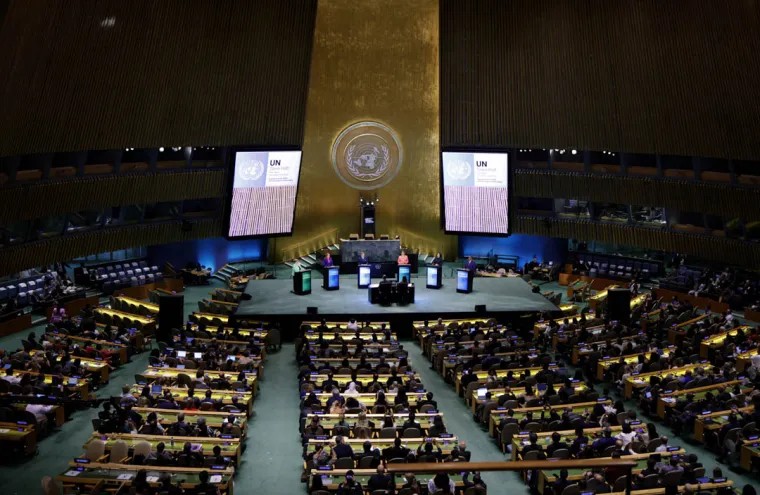
Figure 1 – The UN General Assembly
September is a busy month. This blog is focused on the 2026 yearly meeting of the UN General Assembly. The top picture shows the main hall, full of representatives. A few words about the formation of the UN are appropriate:
As World War II was about to end in 1945, nations were in ruins, and the world wanted peace. Representatives of 50 countries gathered at the United Nations Conference on International Organization in San Francisco, California from 25 April to 26 June 1945. For the next two months, they proceeded to draft and then sign the UN Charter, which created a new international organization, the United Nations, which, it was hoped, would prevent another world war like the one they had just lived through.
Now, more than 75 years later, the United Nations is still working to maintain international peace and security, give humanitarian assistance to those in need, protect human rights, and uphold international law. At the same time, the United Nations is doing new work not envisioned for it in 1945 by its founders. The United Nations has set sustainable development goals for 2030, in order to achieve a better and more sustainable future for us all. UN Member States have also agreed to climate action to limit global warming. With many achievements now in its past, the United Nations is looking to the future, to new achievements.
To many, the world doesn’t seem like a secure place right now, and the UN doesn’t seem to be contributing to changing that. Figure 2 shows a map of ongoing conflicts. I am not listening to all the world leaders’ speeches that are taking place now. I am just following through the public information systems, from which it seems like the participants of the meeting do not want to be present at all the speeches either. When President Trump suggested that he could destroy CUBA, the Cuban delegation left. When he suggested that he could annihilate Iran, the Iranian delegation didn’t leave (they answered during their turn to speak). It was a unique precedent that both sides of the Iran-US conflict attended the same session that took place in NYC. When the Israeli Prime Minister, Benjamin Nethaniahu, tried to justify the war in Gaza and Lebanon, half the participants left. His speech was taken as aimed not at the international audience but voters at home. I gave all these dynamics the name of MMCGA (Make My Country Great Again), without specifying what speakers mean by the words Again and Make. Make seems to be aimed at the local voters.
Some heads of state retained global perspectives but received considerably less coverage in the press. President Macron, for example, may have given other leaders a valuable parting gift: the guts to stand up to Trump.
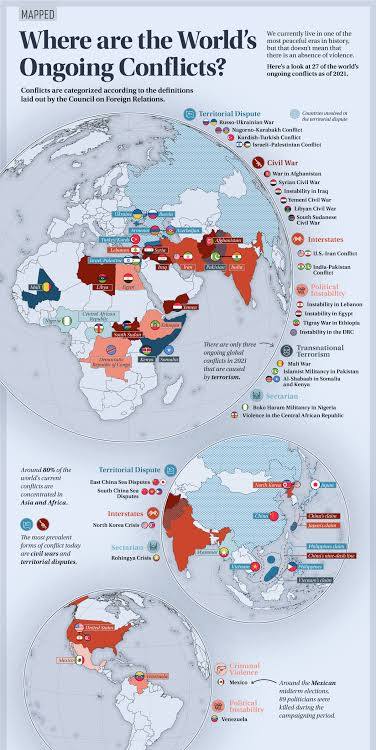
Figure 2 – (Source: Visual Capitalist)
I asked AI (through Gemini), Can you list the countries specifically mentioned by President Trump in his UN speech? This is what I got:
Directly Addressed & Key Focus Countries
- Iran: Received significant focus as he issued warnings regarding their nuclear program and regional involvement, raising options ranging from making a deal to total annihilation. (CBS).
- Venezuela: Highlighted regarding U.S. military actions, the arrest of Nicolás Maduro, and control/access to Venezuelan oil reserves. (PBS).
- Cuba: Called an “absolutely failed state” and criticized for its communist regime, prompting the Cuban UN delegation to walk out during the speech. (CBS)
- Mexico: Explicitly cited as a primary focus regarding border security, drug cartels, and cross-border drug trafficking operations.
- China: Referenced extensively regarding artificial intelligence competition, trade dynamics, and upcoming bilateral talks. (PBS).
- Ukraine: Mentioned in the context of ongoing efforts and proposals to bring an end to the war with Russia. (Guardian).
- Russia: Cited alongside Ukraine regarding conflict resolution negotiations.
Referenced in Strategic or Regional Contexts
-
Denmark & Greenland: Referenced following a newly signed agreement regarding transatlantic security and basing rights. (PBS).
-
Rwanda & Democratic Republic of the Congo (DRC): Noted in relation to regional security discussions and peace efforts in East Africa.
Countries in conflicts that are constantly at the top of the news, such as Israel, Gaza, and Canada, were not mentioned in his “short” speech, according to this AI.
I am not aware that global threats were discussed with one important exception – AI. The danger of a global human extinction facilitated through AI is a “favorite topic.” In earlier blogs (see November 26, 2025) I discussed more general global threats, including climate change, nuclear energy, declining fertility, global electrification, and digitization. AI, which is now at the top of almost everybody’s priority list, can be included as part of digitization and global electrification (data centers fit both).
Global Trends are still being covered by the UN but limited to international refugees. In the US, Congress required the intelligence community to issue periodic reports, which I have covered here in the past (put “Global Trends” into the search box). A recent report by the Union of Concerned Scientists described what the current US administration has done with this requirement:
- The Department of Homeland Security canceled its regularly updated Global Trends report that highlighted, based on intelligence analysis, predicted threats to national security for the next four years. In the most recent edition, published four years ago? The global threats of COVID-19 and climate change.
With all the instability, the stock market (through SP500) this year, went up by 12.4%.
Stay tuned!