
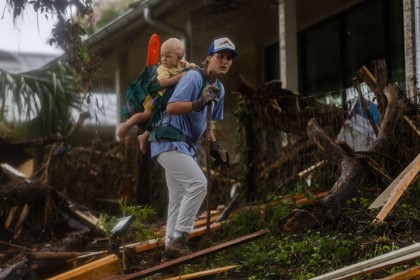
(Source: People Magazine – Texas Floods)
Two blogs ago (September 24) in a blog titled, “Learning from Missiles,” I wrote the following two paragraphs:
Climate change is one of the global threats that has the same components as aerial war threats and vulnerable defense that constantly leads to accelerated destruction. The instigators here are more complex than in wars. Climate change is always a combination of natural forces and human practices (anthropogenic contributions). Separation between these two is not easy and was addressed in previous blogs. Staying on this planet, we cannot protect ourselves against the natural forces, so we need to adapt. We can minimize the impacts of anthropogenic contribution by changing the sources of the fuels that we are using – this is the essence of the energy transition that we are slowly going through.
One of the most important differences is that in war, in many cases, all three components take place at the same time. The US-Israel attack on Iran was one such case. The damage from climate change is increasing over time. In my book, I defined the “end of now” as the projected lifespan of my grandchildren that approximately coincides with the end of the century.
That blog describes the central aspect of the economic consequences of local defenses in Israel. Until recently, missile defense was much more expensive compared to missile offense because it must include fast, and timely, effort to locate the offensive missiles and destroy them in time to prevent the damage that they can inflict. Now there is progress in that balance between defense and offense through development of laser defenses. However, as was mentioned in that blog, the Israeli defense industry is trying to shift the economic defense/offense balance to the price in property and in human casualties that offensive missiles cause that manage to penetrate the defensive wall.
This blog is trying to analyze the possibility of such an economic shift in climate change.
In the political conflicts between deniers and supporters of mitigation or adaptation to climate change through changes in our energy supply, I didn’t find arguments that are based on actual costs of repairing the damage
that climate change inflicts. The issue is anchored in our ill understanding of human contributions, in a timely way, of a particular destructive climate event. There is some academic effort in this area that hasn’t yet penetrated the political agenda. (Periodically, I am trying to address this issue in my blogs, and I will continue to do that in future blogs.)
In the next two citations, I will try to summarize what the communities of people that are starting to form that are directly impacted – survivors of extreme weather events, and organizations that hope to generate political impact – are doing and saying:
Communities of Disaster Survivors
(38% in U.S. Say Extreme Weather Damaged Their Community):
WASHINGTON, D.C. — As extreme weather disasters grow more frequent and costly across the U.S., nearly four in 10 Americans say their community has felt the damage firsthand in the past year.
Almost six in 10 U.S. adults whose communities suffered extreme weather damage in the past year are worried it will happen again in the next year, according to a nationally representative web survey conducted Feb. 26-March 6, 2026, for the Walton Family Foundation-Gallup How Opportunity Takes Root study.
Worry runs highest in the Mountain Census division, where roughly three-quarters of affected residents are concerned about extreme weather damage in the next year, even though the area has one of the lowest rates of reported past damage. This worry likely reflects the severe drought conditions that have persisted in the region.
Organizational Attempts of Disaster Survivors
(Disaster Survivors Sticking Together – The New York Times):
Extreme weather is hitting more people with each passing year. Thirty-eight percent of Americans say their community has been affected by severe storms, floods or fires in the past year, according to Gallup.
In a new story for The New York Times Magazine, I write about a half-dozen individuals from across the country, each of whom is working to recover from a climate-fueled disaster and helping others in turn.
They are all members of a group called Extreme Weather Survivors. It’s partly a support network, partly an advocacy organization and, for some, a new sort of extended family.
Extreme Weather Survivors was co-founded by Chris Kocher and Sierra Lindsey Kos a few years ago. Kocher is a professional social organizer who had helped set up networks for survivors of gun violence and the COVID pandemic. Kos was galvanized by the 2020 Labor Day fires in Oregon, during which her newborn son was hospitalized with a serious illness.
Republicans and Democrats remain deeply divided about how big a problem climate change is, how much harm it’s causing and how to address it.
Most Democrats and Democratic leaners (68%) say climate change is harming people in the U.S. a great deal or quite a bit. And about six-in-ten also say climate change is a very big problem facing the country today.
In contrast, only about two-in-ten Republicans and GOP leaners (22%) say climate change is harming people in the U.S. a great deal or quite a bit. And a majority see climate change as no more than a small problem.
Partisans also remain divided in how much they think the federal government is doing on climate change: 87% of Democrats say it’s doing too little, compared with 31% of Republicans. This gap has been wide – spanning at least 51 percentage points – since we started asking about the federal government’s role in 2018.
Democrats and environmentalists are shifting their approach to climate change, as the economic fallout from war in the Middle East has reshuffled the politics of energy.
With voters worried about spiking gas prices and inflation, some of the party’s leaders argue that they should stop trying to throttle oil and gas, which heat the planet when burned. It’s a rejection of the approach taken during the Biden administration, which treated climate change as an existential threat and tried to stop new drilling and pipelines.
States Sue Trump
A coalition of 21 states and four cities sued the Trump administration on Thursday over its move to erase all limits on planet-warming emissions from power plants.
The lawsuit was filed in the U.S. Court of Appeals for the District of Columbia Circuit. The mostly Democratic-run states and cities, led by New York, contend that the Environmental Protection Agency acted unlawfully when it repealed Biden-era regulations on carbon dioxide emissions from power plants that burn gas and coal.
The electricity sector is America’s second-biggest source of emissions of carbon dioxide, a heat-trapping gas. During the Biden administration, the E.P.A. imposed sweeping rules that would have required the nation’s coal plants to eliminate nearly all their planet-warming pollution by 2039 or shut down. The rules would have also capped emissions from new natural gas plants.
Those regulations were contentious at the time, and multiple electric utilities and nearly two dozen Republican-run states led by West Virginia sued to block them, saying the limits were unachievable and would have destabilized the power grid.
The new terms of “Climateflation” and “Fossilflation” are entering the lexicon:
If you ask an economist why everything is so expensive these days, you will likely get an answer explaining how oil — the lifeblood of the global economy — is currently facing supply bottlenecks in the Strait of Hormuz, thereby bringing up global energy prices.
That explanation is part of the answer, but it doesn’t paint the whole picture. Our new research proposes a new way of thinking about rising costs in our contemporary era, through the lens of what we call “climateflation.”
As a concept, climateflation proposes that the causes, effects and even attempts to mitigate and adapt to climate change are conspiring to make everyday life more expensive.
As ecological political economists, we are concerned not just with how rising costs impact people’s wallets, but also with how it might have spin-off effects in areas such as social inequality, political radicalization, geopolitical instability and environmental degradation.
‘Fossilflation’ and political failure
By burning fossil fuels since the rise of the industrial era, humans have added 495 billion tonnes of carbon to the atmosphere. Those emissions have contributed to global warming, which in turn has increased the likelihood of extreme rainfall events, extreme heat and agricultural drought.
The coming judgment of the US Supreme Court might be the deciding factor in who will take the responsibility for the climate change’s damage (and thus pays the price) – the Federal Government or individual states.
The coming midterm elections might shed some light on changing attitudes about these issues.