
(Source: Wikimedia Commons)

Last week’s blog finished with the following paragraph:
My next blog will be posted after the US elections, and we will also have the results from the elections that are taking place elsewhere in the coming two weeks. Next week’s blog will be the last one on the topic of “Simple Rules.” The title of the blog will be The Simplest “Simple Rule” – Three Letters, One Number and One Symbol. We will find that what is known as the Copernican Revolution that started with Nicolau Copernicus (1473 – 1543) and started modern science preceded Kathy Eisenhardt in our attempt to understand reality using “simple rules.” The language was different (mostly Mathematics) but the objective was the same: to enable us to function in the real world.
The cover of the book that summarizes this approach is shown in figure 2. The cover shows pictures of Copernicus, Galileo Galilei (1564-1642), Johannes Kepler (1571- 1630), Isaac Newton (1643-1727) and Albert Enstein (1875-1955). The book has 1265 pages. It is not “simple”. It includes also an introduction (and editing) by Stephen Hawking (1942-2018). In all cases, the book describes the life and work of these giants.
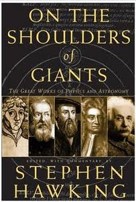
The book was structured to include background of each of the “giants” written by Hawking and writing by the “giants” themselves. The list of writings includes the following:
Nicolas Copernicus – “De revolutionibus orbium coelestium”
Galileo Galilei – “Discorsi e dimostrazioni matematiche intorno a due nuove scienze”
Johannes Kepler – “Harmonies of the Word”
Isaac Newton – “The Mathematical Principles of Natural Philosophy”
Albert Einstein – Original papers from Albert Einstein first published in the “Principles of Relativity.”
I included the Wikipedia site of each of the books to complement Hawking’s efforts, if needed. These five giants are, to a large degree, responsible for our present knowledge of the Universe and are credited with some of the basic science that we try to teach our students, mainly through the discipline of Physics.
In the US, we start to teach Physics to interested students in the 9th grade. In the US, only 3% – 4% of students take Physics in the 9th grade. The estimated number of students that graduate high school who take Physics in the US is 40%. Physics high school classes differentiate based on different Math levels that include Algebra-based and Calculus based.
I will describe the simplification efforts that took place between the work of the “giants” that are responsible for our current understanding of how the Universe works and what we are able to pass on to our future generations, through a comparison of Newton’s Second Law of Motion:
In the book (On the Shoulders of Giants – page 743), Newton’s Second Law of Motion is part of Newton’s book “The Mathematical Principles.” After a short section of definitions comes a section on “Axioms, or Laws of Motion”. In this section we find the three laws of motion followed by Corollaries. Law II states the following:
“The alteration of motion is ever proportional to the motives force impressed; and is made in the direction of the right line in which that force is impressed.”
In schools today, the Second Newton’s Law of Motion is simply F = ma. F is the force; m is the mass; and a is the acceleration. This formula includes three variables, two of them (Force and Acceleration) are vectors that have both magnitude and direction. Acceleration is the rate of change of velocity with time, and velocity is the rate of change of distance with time. Newton was also a co-inventor of Calculus (independently with Leibniz) that is the mathematical discipline of limits. Advanced high school classes that take Calculus are often taught with the use of Calculus, yet Newton used neither Calculus in his book on “Mathematical Principles”, nor units (Meter, Seconds, Kg, etc..) that are now at the foundation of Physics on any level. He mainly used geometrical proportions that for today’s readers and learners seem not to be exactly “simplifications.”
We must remember that the printing press was invented in Germany by Johans Gutenberg around 1440 (). Copernicus’ birth was one generation after the invention of the printing press. The Scientific Method evolved throughout the years, not through the evolution of language but through the evolution of Mathematics. Copernicus didn’t formulate a single mathematical formula or law in Physics. The Heliocentric Theory and the Copernican Principle are simplified statements that Earth, God and Humans are not the center of the Universe.
Describing how the Universe works is certainly not simple. AI Physicist is part of a recent effort to construct an automatic AI model that can do Physics. It is based on training not in words, but in Physics. An introductory abstract to this effort is given below:
As a student, Galileo famously observed a lamp swinging in Pisa Cathedral and timed its swing against his pulse. He concluded that the period was constant and independent of its amplitude. Galileo went on to suggest that a pendulum could control a clock and later designed such a machine, although the first clock of this type was built by Huygens some 15 years after Galileo’s death. In making this discovery, Galileo’s genius was to ignore all the messy details that were otherwise present in the cathedral—air resistance, temperature, flickering light, noise, other people, and so on. He considered a simple model of a swinging lamp using only its period, focusing on the salient detail. For many historians, Galileo’s approach represents the earliest stage in the evolution of the scientific method, the same process that has produced flight, quantum theory, electronic computing, general relativity, and even artificial intelligence.
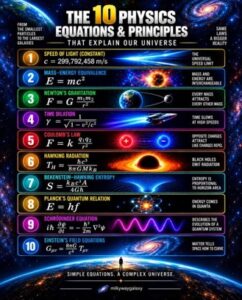
The present state of our understanding of the Universe does not come from a book with thousands of pages but is “simplified” by small mathematical formulas shown on a single Instagram page as in in Figure 3. Formulas no.2 and no.10 are associated with Einstein. Formula 3 is associated with Newton and Formulas 6 and 7 are associated with Stephen Hawking who is now, himself, one of the giants.
The conclusions – the rules of our existence might be “simple” but how humanity arrives at them is complicated and takes time to prove that they are not hallucinations.
(Source : Instagram)