
This blog will be posted on Thursday, November 12, nine days after the midterm elections and three days after the opening of COP31, the United Nations Climate Change Conference. This year, the international meeting is in Antalya Turkey and, as usual, the gathering will talk about climate change and how to try to mitigate it.
Both Kristallnacht and the global COP are repetitive yearly events that are used by schools, and by many of us, to draw conclusions about our current life. Kristallnacht is used to commemorate an event that we do not want to be repeated while the COP system of meetings is used to try to figure out ways to save us from the climate change threat that is getting worse.
The title of this blog mimics my October 29, 2025 blog, with one big exception. The results of the midterm elections are almost completed, and they were defined by most as a “Blue Wave,” with both houses of Congress transferring control to the Democratic Party. With mixed federal control, a freeze of the government is likely. President Trump doesn’t like it, and he is concerned about his legacy. He expressed, after the elections, a wish to work with the Democrats. However, one of the first actions that he took was to replace his Chief of Staff with Stephen Miller, the person most responsible for some of the policies, that even by his own admission, contributed to the Republican loss. To prevent freezing the Federal Government, President Trump must start to bargain. He is supposed to be good at this. “Unpainful” bargaining might be to cooperate in nullifying some of his executive orders. Good starting points are executive orders targeted at the energy transition.
The 2025 blog also summarized the steps that President Trump took before COP30 (last year’s meeting) to put obstacles in the way of energy transition. The energy transition comes with some momentum which includes getting away from fossil fuel, relying more on local sources of energy, increasing energy efficiency, increasing dependence on electricity and increasing sourcing of electricity from sustainable sources and helping the transition in developing countries.
The US was absent from the COP30:
For the first time in three decades, the president of the United States is not sending a delegate to the United Nations Framework Convention on Climate Change (UNFCCC). The 30th annual Conference of the Parties to the UNFCCC, colloquially known as COP30, is currently being held in Belém, Brazil. This summit brings together world leaders, climate scientists, NGOs, and businesses to discuss solutions to human-caused climate change. The decision to remain absent from COP30 reflects the Trump administration’s disregard for the threat climate change poses to humanity and clearly signals to the international community that, as of now, America is not concerned with preventing it. White House Spokesperson Taylor Rogers gave several news outlets, including the LA Times, NPR, and CNN, identical messages regarding the administration’s decision, bluntly stating, “President Trump will not jeopardize our country’s economic and national security to pursue vague climate goals that are killing other countries.” According to Reuters, critics warn that the U.S.’s absence gives China more influence in climate change negotiations, at a time when China’s renewable energy sector is booming. The Trump administration’s decision to boycott COP30 is an ethical faux pas that is disadvantageous to U.S. interests, both environmentally and economically.
Although Trump did not send an official delegate to the annual climate summit, it was not entirely devoid of a U.S. presence. After learning that there was no US delegate to COP30, California Governor Gavin Newsom decided to attend, telling press covering the conference that he is “there because [he doesn’t] want the U.S. to be a footnote” at the conference.
The new US Congress will be sworn in January 2027. One can hope that some of the newly elected officials will realize the futility of this neglect, and will follow Governor Newsom, and show their faces in Turkey this year.
Many years ago, I visited Antalya. It is a lovely place, and it is not far from Israel, which provides an opportunity to get acquainted with another hotspot of the current US administration. In addition, Turkey’s President Recep Tayyip Erdogan is a good friend of President Trump, and it’s a good opportunity for reopening dialog on the topic of climate. In addition, COP30 took place in Brazil. The Brazilian delegation will play an important role in COP31. President Lula from Brazil just got reelected and he plans to be in Antalya as well; it’s another great opportunity for a chat.
Here is the essence of what the Turkish Energy Minister has to say about what to expect from COP31:
ISTANBUL (AP) — The Turkish energy minister has laid out plans for his country to wean itself away from coal and other fossil fuels as it prepares to host the COP31 climate change summit. World leaders are due to arrive next week in the Mediterranean city of Antalya, and Turkey’s hosting of the annual environmental conference has thrown a spotlight on its own coal, oil and gas usage. Turkey is Europe’s largest coal power generator, according to energy think tank Ember. The Turkish Energy Ministry says coal remained its largest source of power last year, accounting for 33% of generation. The share of solar and wind in electricity generation stood at nearly 23%. Energy Minister Alparslan Bayraktar revealed the National Energy Plan 2040 to reporters in a presentation made public Friday, in which he said Turkey would aim to transition from coal to cleaner energy sources — a process known as electrification. This would help it fulfill its pledge to reach net zero emissions by 2053.
The war in Iran has been very good for renewable energy. More than 40 countries have started or accelerated projects involving wind, solar, electric and other low carbon technologies.
South Korea unveiled a plan to spend about $747 billion to develop at least 100 gigawatts of wind and solar power by 2030. Britain and the Philippines saw a massive surge in rooftop solar installations, Thailand introduced a plan for data centers to source at least 60 percent of electricity from clean energy, and Vietnam accelerated the deployment of battery storage systems. Across Europe, Australia and India, demand for electric vehicles surged.
But the pivot to clean energy is only part of the story. The disruption of a once reliable trade of oil and gas in the Middle East has caused much of the world to double down on fossil fuels in a desperate scramble for secure, and immediate, supplies.
Countries are using more coal, the dirtiest fossil fuel. Nations with oil and gas in abundance went to extraordinary lengths to export crude to their customers, investing to strengthen infrastructure and build new trade routes to outlast the current crisis. All along, governments tapped their budgets for billions of dollars used to shield consumers from higher energy costs, money that did nothing to dampen demand.
Previous blogs covered extensively the connection between the Iran war and energy use (put Iran in the Search Box).
The rest of the blog will address the global energy transition in four graphs in areas such as energy use, electricity use, sources of electricity production and emissions.
All quantities will be addressed on a per capita basis, so demographic changes will be taken out of the comparison:
Energy per Capita:
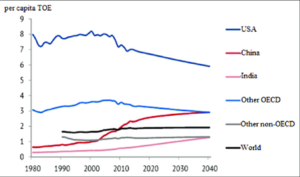
Figure 1
(Source: Recent and short term projected global energy use (in units of TOE (Tons of Oil Equivalent)
Electricity Demands:
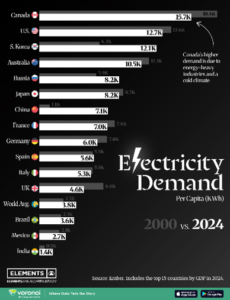
Figure 2
(Source: Global electricity demand)
Sources for Electricity Production:
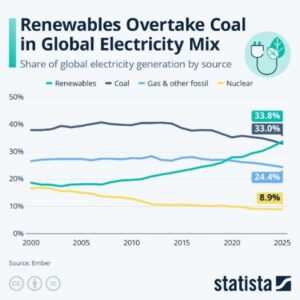
Figure 3
(Source: Share of global electricity generated by source)
Carbon Dioxide Emission:
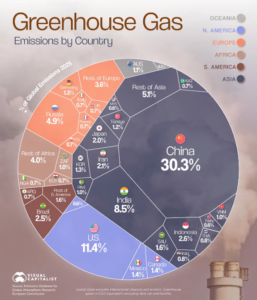
Figure 4
(Source : Global Carbon Dioxide Emission)
Some of the graphs show the changes with time. The sensitivity to the two years of President Trump’s second term is not transparent. However, the trend is clear:
Countries are not doing enough to cut emissions that cause climate change, according to a new report from United Nations scientists. And the United States is a big part of the problem.
The U.S. sticks out as the only major economy where planet-warming pollution increased dramatically last year, the report notes.
Among the world’s largest emitters of greenhouse gases, the U.S. was tied last year with Russia for the most emissions per capita. China emits significantly more total greenhouse gases each year than the US but has more than four times the population.
The US is an outlier among rich nations in slowing climate progress:
The United States’ “abandonment” of a crucial climate pledge has increased the odds that the world will warm more than previously estimated, according to a United Nations scientific report released Wednesday.
The U.N.’s annual Emissions Gap Report is considered a definitive assessment of global progress on climate change. It identified the United States as an outlier among the industrialized nations that are responsible for most planet-warming pollution.
Among the Group of 20 industrialized nations, the report noted, emissions overall had slowed down in 2025, “with the United States of America being the major exception.”
That came after a year of rising electricity demand from the rapid construction of data centers to serve artificial intelligence, as well as a cold North American winter that prompted more fossil fuel use for heating.
It remains to be seen if the present change in governance in the US will have an impact.
My next blog will include the list of President Trump’s executive orders on repealing the energy transition to non-fossil sources and suggestions about how to try to reverse some of these orders.