
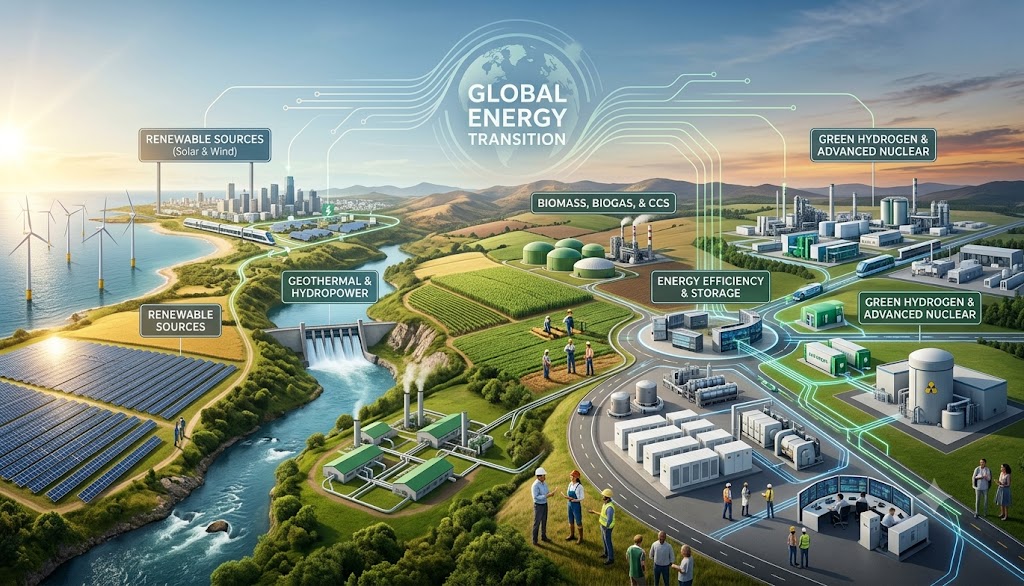
 Figure 1 – AI-generated (Gemini) image response to a request for a picture of different ways for an energy transition
The picture above does not mention climate change or any other trigger. Even so, the picture illustrates the full transition that would serve to mitigate climate change. In the US, however, the Trump administration is advancing policies to ignore climate change and stop the energy transition:
When the Trump administration declared two weeks ago that it would largely disregard the economic cost of climate change as it sets policies and regulations, it was just the latest step in a multipronged effort to erase global warming from the American agenda.
But President Trump is doing more than just turning a blind eye to the fact that the planet is growing hotter. He is weakening the country’s capacity to understand global warming and to prepare for its consequences.
The administration has dismantled climate research, firing some of the nation’s top scientists, and gutted efforts to chart how fast greenhouse gases are building up in the atmosphere and what that means for the economy, employment, agriculture, health and other aspects of American society. The government will no longer track major sources of greenhouse gases, data that has been used to measure the scale and identify sources of the problem for the past 15 years.
Still, anthropogenic global climate change continues to accelerate:
Global warming appears to have shifted into a faster gear. After removing the effects of El Niño, volcanic eruptions, and solar cycles, researchers found that the planet has warmed at roughly 0.35°C per decade over the past ten years, compared with just under 0.2°C per decade from 1970 to 2015. The acceleration, which becomes visible around 2013 to 2015, appeared across five major global temperature datasets with more than 98% statistical certainty.
Presently, not including climate change, the global events with the largest direct impacts on global energy use are the US-Israel-Iran war, the Russia-Ukraine war, and the global energy transition via electrification. Some of my earlier blogs described the impacts of the US-Israel-Iran war on the transport of fossil fuels (March 25, 2026) and the role of data centers in global electrification (May 21, 2026).
Another issue that drives countries to change energy suppliers is the desire for control. Cuba serves as a good example of what can happen to a country that loses control over its energy supply:
Since January 2026, the United States is imposing a fuel blockade on Cuba, causing an ongoing fuel shortage and economic crisis in the latter.[14][15][16][17] As an island, Cuba heavily depends on importing petroleum to meet its energy needs, particularly from nearby Venezuela and Mexico. Following the 2026 United States intervention in Venezuela, in which U.S. forces ousted president Nicolás Maduro, Venezuelan oil exports to Cuba were cut off, leaving the country without adequate supply. In addition, the U.S. enacted a blockade on oil coming into Venezuela a month prior.[18] The United States is reportedly motivated by a desire for regime change in Cuba by the end of 2026.[19]
In all these cases, the solution seems to be the same: get control over your energy supply through internal means. If possible, the word “sovereignty” should apply to your energy supply. The scenario shown in the top figure describes such a transition. It mitigates climate change without referring to climate change. The quote below from Bloomberg summarizes a similar situation:
(Bloomberg) — The world’s hunger for electricity, as demand rises almost everywhere, will lead to solar becoming the dominant source of power early next decade, according to new analysis from BloombergNEF. Surging demand from data centers, population growth, rising incomes and more battery-powered vehicles are all boosting demand for electricity, researchers wrote in BNEF’s annual New Energy Outlook on Tuesday. The report concludes that rapid electrification is set to accelerate the transition to clean energy. “So far this decade, the world has suffered three substantial shocks to the energy system: the Covid-19 pandemic, the war in Ukraine and, most recently, the conflict in the Persian Gulf,” the analysts wrote. “Successive energy market shocks could be a boon for the energy transition as some countries look to decouple from imported fossil fuels and bolster their energy security.”
Recently, a Pew Research Center publication summarized the global energy transition over the past 25 years. Figures 2 and 3 illustrate these trends:
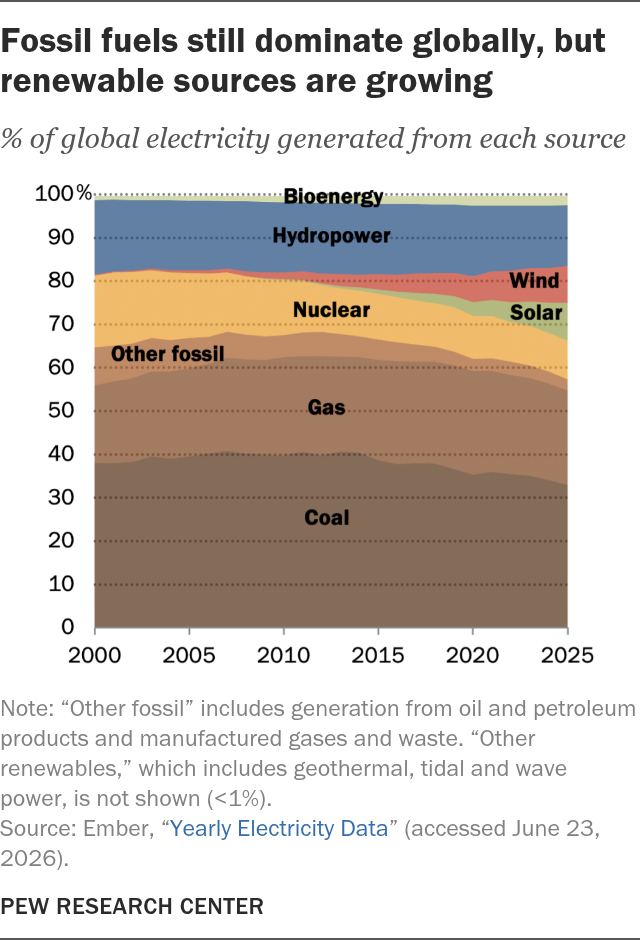
Figure 2
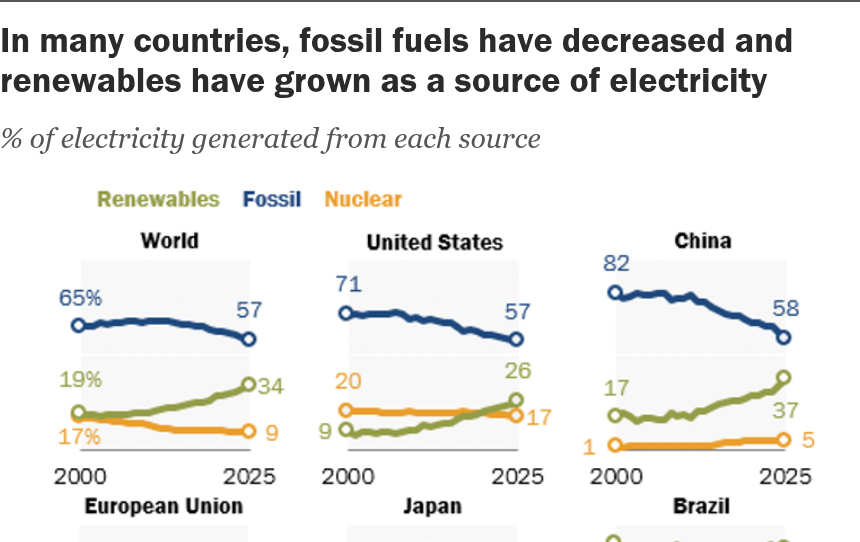
Figure 3
The global trend of converting as much energy use as possible to electricity is illustrated by the attempt to electrify aviation, an application unthinkable until recently:
TAXIING TOWARDS the runway, the propeller stops turning as your correspondent pulls the throttle back to await take-off. On a single-engine light aircraft, that is usually a worrying sign of engine failure. Yet this plane is powered by an electric motor and, just as when you come to a halt in a Tesla, the motor stops until it is needed again. On advancing the throttle the propeller springs back to life and the aircraft is soon briskly climbing, in an eerily quiet manner. The two-seater Pipistrel Velis Electro is the first electric aircraft to be certified for pilot training. Besides its low noise, it has other unusual features. Instead of the lengthy series of engine checks a combustion-engine plane requires before take-off, the Electro is ready to go with the flick of four switches. Since it has few moving parts, it is also cheaper to maintain. And without directly producing any nasty emissions it can claim to be green, especially if recharged with renewable power. Topping up the battery takes just over an hour.
Statista illustrates the progress of global electrification with Figure 4 and the paragraph below:
Ten years after the Paris Agreement was opened for signature by member states at the UN Headquarters in New York on April 22, 2016, the global energy transition is beginning to reshape the electricity mix. As data from Ember’s Global Electricity Review 2026 shows, renewables have now overtaken coal as the world’s largest source of electricity generation. In 2025, renewables accounted for 33.8 percent of global power output, slightly ahead of coal at 33.0 percent — a symbolic milestone in the shift toward low‑carbon energy.
The trend reflects a steady but uneven rise of renewables over the past twenty‑five years, from less than 19 percent in 2000 to nearly 34 percent in 2025. Growth was relatively modest in the early 2000s, with the share hovering below 20 percent until 2010, then accelerating markedly over the past decade as wind and especially solar power expanded rapidly. In 2025, this momentum strengthened further, with the entire increase in global electricity demand met by clean energy sources. Solar power alone accounted for 75 percent of the net increase, adding 636 TWh of generation during the year.
Over the same period, the role of fossil fuels in electricity generation has followed a two-phase trajectory. Between 2000 and the mid-2010s, their combined share initially edged up, peaking at around 69 percent in 2012, as growing global demand was largely met by coal and gas. Since then, however, the trend has reversed. Coal’s share has seen the most pronounced decline, falling from about 41 percent at its peak to 33 percent in 2025, while gas and other fossil fuels have decreased more gradually from roughly 28 percent to 24.4 percent. Despite this progress, fossil fuels still account for a majority of global electricity generation (around 57 percent in 2025), highlighting the scale of the challenge ahead in meeting climate targets.
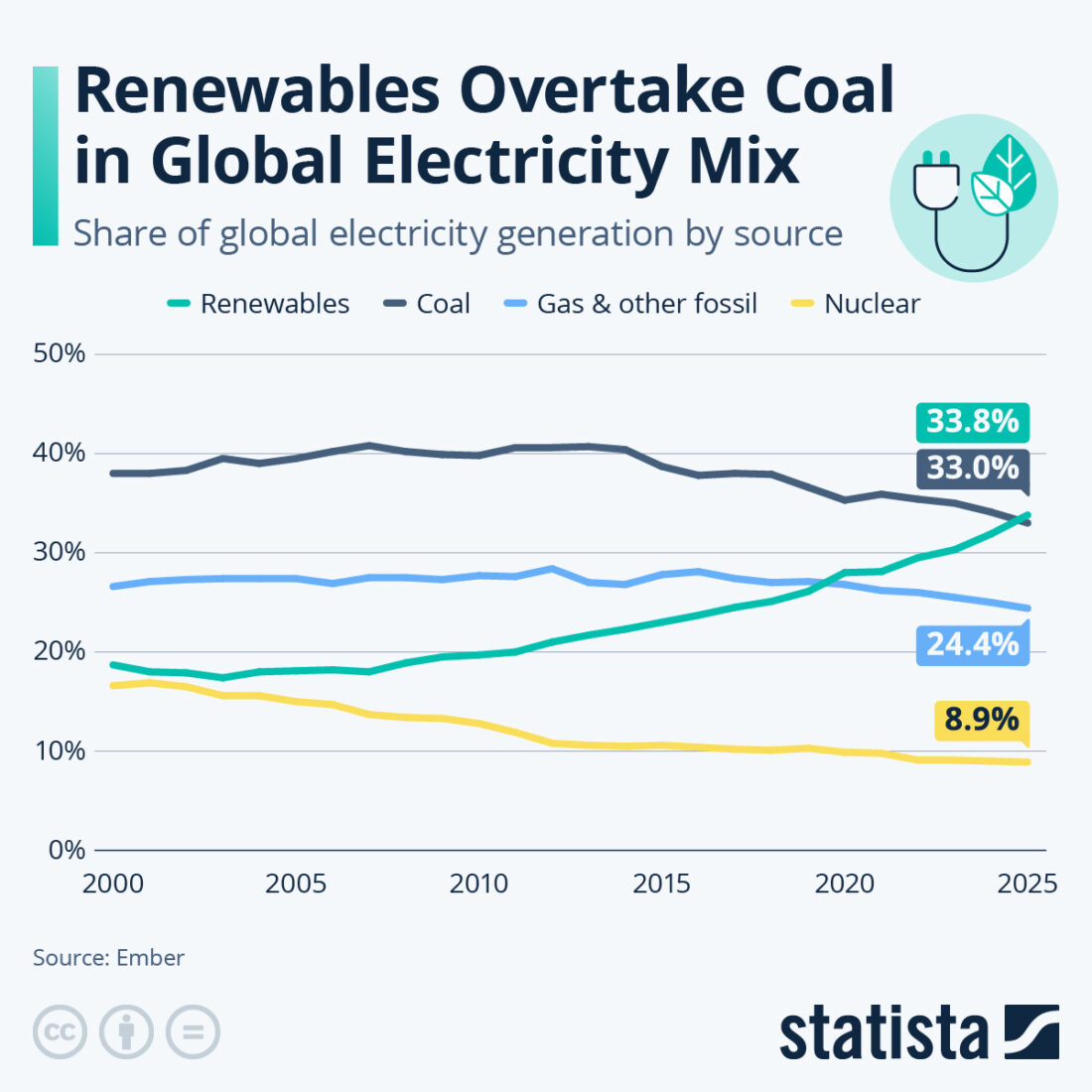
Figure 4 (source: Statista)
The interesting development in the energy transition’s shift to sovereign states is that while it is not always anchored in developed countries, it can shift sovereignty away from rich countries:
Several ambitious international initiatives that aim to deliver access to clean, modern energy services to underserved populations in developing countries have recently taken root, including the UN Sustainable Energy for All initiative, the Energy+ Partnership, and Power Africa. The scale of the challenge is great: today, 1.3 billion people lack access to electricity, yet extending the electrical grid is not a cost-effective solution in many rural, low-income areas. The International Energy Agency estimates that to achieve universal access to electricity by 2030, more than 50 percent of new electricity connections will be through distributed energy solutions, and more than 90 percent of those will use renewable energy sources. To meet the scale of the challenge, policy and regulation will need to be designed in ways that recognize the potential of distributed renewable energy to contribute to energy access goals, especially given recent technological and business model innovations of enterprises delivering these solutions. International initiatives investing in clean energy access can work with national governments and local actors to inform policy and regulation that supports distributed renewable energy enterprises. This Issue Brief collects the perspectives of some of these enterprises on policy and regulatory barriers and opportunities to scaling up clean energy access, and synthesizes these perspectives into two recommendations:
There is a growing realization that the global energy transition to mitigate climate change coincides with energy security, but both need local control. However, neither affordability nor local control is assured.
The idea of energy security and local control is really interesting, especially as more systems move toward cleaner and more efficient solutions. The same focus on reliable energy can also apply to everyday appliances, and a candy service center can help keep them working properly, while a candy service center Sharjah offers professional maintenance and repair when needed.
Your exploration of varied energy transition pathways resonates deeply. I recently joined a community initiative focused on local renewable projects, which opened my eyes to the importance of tailored solutions. It’s refreshing to Doodle Baseball see discussions like this one that encourage diverse perspectives!
I really enjoyed reading this post and found the discussion about different approaches to the energy transition very insightful. It clearly shows why practical, flexible strategies are important for building a cleaner and more sustainable energy future.
This post offers such valuable insights into energy transitions! I’m curious, how do you envision the impact of community-led initiatives on larger policy changes? Any examples from your research that stand out? hollow knight
I enjoyed your take on the many energy transition paths! It reminded me of how my community is adopting solar panels, despite the upfront price. Navigating all of these alternatives is difficult, and I find myself feeling scratch games overwhelmed at times.