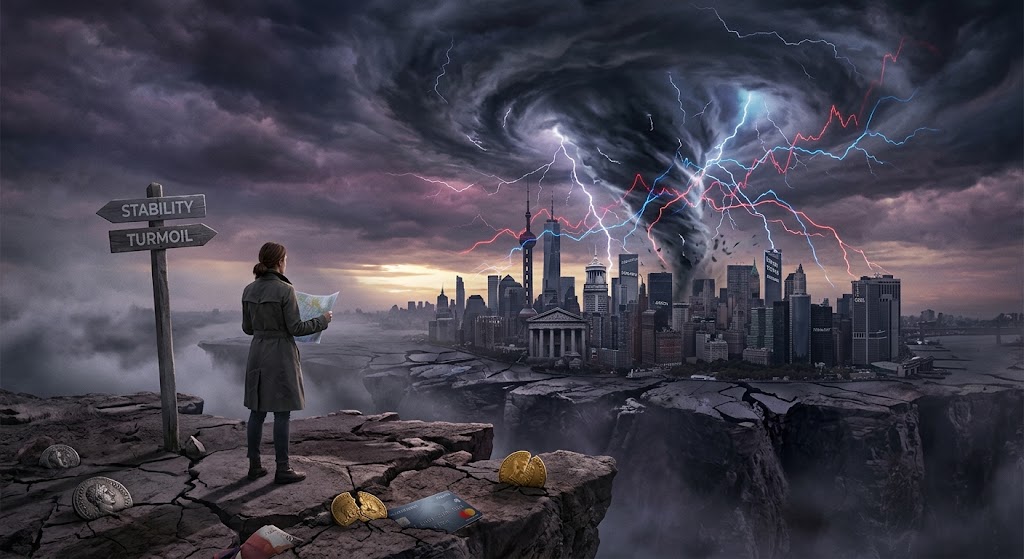
 Figure 1 (AI through Gemini) Can you suggest a Picture that will reflect the uncertainty of the global economy?
As labeled, the top picture was created by AI (the red label shows my prompt). The only writing consists of two words: stability and turmoil. Turmoil and stability are antonyms. Can they operate together on a collective global scale? The lady in the picture seems to be looking at the future and thinking that they can. AI showed a modern city representing stability, and a huge tornado representing turmoil and chaos. I live in a place (NYC) that looks stable right now, but I follow President Trump’s policies. Many of them are triggering turmoil both globally and nationally, however they do not seem to be affecting the performance of the stock market in the same way, even though it is on a similar scale. My thoughts are shifting to the uncertainty principle:
uncertainty principle, statement, articulated (1927) by the German physicist Werner Heisenberg, that the position and the velocity of an object cannot both be measured exactly, at the same time, even in theory. The very concepts of exact position and exact velocity together, in fact, have no meaning in nature.
Any attempt to measure precisely the velocity of a subatomic particle, such as an electron, will knock it about in an unpredictable way, so that a simultaneous measurement of its position has no validity. This result has nothing to do with inadequacies in the measuring instruments, the technique, or the observer; it arises out of the intimate connection in nature between particles and waves in the realm of subatomic dimensions.
I am trying to address the question of scale. The uncertainty principle describes reality on the quantum scale: the fundamental property of reality on the smallest scale. Can I transform the concept to the human collective scale, with stability and turmoil describing a mixed reality, similar to position and momentum (product of mass and velocity) on a quantum scale? This blog describes my attempt. Specifically, the progress in AI is described by some as a fast track to an ideal world. They see President’s Trump actions and announcements in his second term as the ultimate turmoil and the stock market as the actual consequence.
I will start with AI. A recent interview with Yuval Noah Harari (YNH) about AI got the honor of front placement in a recent issue of The Economist. Two key paragraphs summarize his perspective (Yuval Noah Harari on the economic and political perils of AI):
In a wide-ranging interview for The Economist’s Insider show, Mr Harari warns that AI’s biggest impact may be the way it reshapes trust, “the most important asset in the world”. Much of modernity is underpinned by systems that allow trust to operate at scales unimaginable in the prehistoric world. Money is a “very creative, imaginative way to build trust between strangers”: people happily hand over valuable goods in exchange for nothing more than a promise that someone else will do the same in turn. “Bankers, if they are good bankers doing their job, they build trust.”
Handing powerful AI control of the financial system looks almost inevitable, Mr Harari reckons. AI systems will soon be capable of understanding the totality of the global economy in far greater detail than a human ever could. The pressure for humans to place more trust in AIs will thus grow over the next few years, Mr Harari expects. He points to the rise of cryptocurrencies—“AI money”, as he puts it. Many people have more faith in the bitcoin algorithm than even in those good bankers. As people lose faith in the media, he adds, they happily consume algorithmically curated feeds on digital platforms (think TikTok or Instagram)
YNH is an Israeli historian-philosopher who many (including me) follow (see previous blog titled “Working For the Future,” January 10, 2017). The time scale that he describes as “present” is 10 years, but Figure 3 shows us that a lot is already happening. A previous blog describes Elon Musk’s picture of the near future (March 11, 2026) (A World Where All Is Free? That’s Elon Musk’s Theory of ‘Sustainable Abundance.’ – The New York Times):
The Tesla and SpaceX chief has told his followers that they will live in a world where robots will take care of every need and people do not have to work, in what has become his latest slogan.
His picture and timeline are not much different than those of YNH, but he is also the richest man in the world and is putting his money behind his beliefs
All this optimism coincides with daily declarations from President Trump. Last Sunday, the Opinion section of the NYT produced a long list of actions that President Trump took that the writers saw as his attempts to;take the country from a democracy to an autocracy (Opinion | Trump’s Election Interference Is Eroding American Democracy – The New York Times). Below, I list only the actions that have already put us more than halfway through this transition:
Persecuting political opponents
Bypassing the legislature
Declaring false emergencies
Vilifying marginalized groups
Creating a cult of personality
Using power for personal profit
My interests are slightly different. Since the US is the richest country in the world and one way or another, major technical innovations start here, I wanted a list that would give me a summary of President Trump’s second-term actions that had a global impact. The only politically “neutral” answer that I could get came from AI. The response is shown below is from AI (Gemini). I asked for a: Summary of Trump’s global impact in his second term:
Military Escalation and Regional Conflicts
- War with Iran: In early 2026, the U.S. and Israel launched coordinated, major airstrikes on Iranian nuclear facilities to derail their weapons program, precipitating a dangerous, ongoing military standoff. [1, 2, 3]
- Strait of Hormuz & Fuel Crisis: The strikes on Iran triggered a severe blockade in the Strait of Hormuz, causing a massive global fuel shortage and economic fallout. [1, 2]
- Venezuela Regime Collapse: In a dramatic escalation, the U.S. bombed Venezuela, capturing its socialist leader Nicolás Maduro on narco-terrorism charges and placing the nation under de facto U.S. influence managed by Secretary of State Marco Rubio. [1, 2, 3]
- Global Counterterrorism Spree: The administration has authorized expanded bombing campaigns and counterterrorism operations in Yemen (targeting Houthi militants), Syria, Nigeria, and Somalia. [1, 2, 3]
🌐 Global Trade and Economic Disruption
- Aggressive Tariff Regime: Relying heavily on tariffs as a primary economic tool, the administration has disrupted international supply chains and sparked friction with key global trading partners. [1, 2]
- Stalled Peace Initiatives: Despite initial brokered ceasefires—including an early deal between Israel and Hamas—the broader global architecture remains unstable, with unresolved conflicts stretching from Ukraine to the Middle East heading into the U.S. midterm elections. [1, 2]
🌍 Withdrawal from International Treaties
- Multilateral Exits: Consistent with his first term, Trump has once again ordered the United States to withdraw from major international bodies and global frameworks:
The timescale of the impacts of these activities is often considerably shorter than that of AI that was mentioned earlier. We still have about 2.5 years of President’s Trump second term if he follows the Constitutional mandate of a two-term limit. We will see if the 2028 election results in a significant shift from the current administration.
How to measure economic impact is a valid question. President Trump’s favorite indicator is the stock market. Figure 2 shows the behavior of the stock market, (through the Dow Index), since 1900, as a function of the geopolitical events since that time. The only significant perturbation seen there is the 1929 crash. Since then, the line is approximately straight, almost independent of all the geopolitical events. However, there are two issues that directly impact this graph. First, the vertical scale is logarithmic. To those who need a reminder of logarithmic scale, a short look at Wikipedia (https://en.wikipedia.org/wiki/Logarithmic_scale) might help:
A logarithmic scale is nonlinear, and as such numbers with equal distance between them such as 1, 2, 3, 4, 5 are not equally spaced. Equally spaced values on a logarithmic scale have exponents that increment uniformly. Examples of equally spaced values are 10, 100, 1000, 10000, and 100000 (i.e., 101, 102, 103, 104, 105) and 2, 4, 8, 16, and 32 (i.e., 21, 22, 23, 24, 25).
The second issue is that it isn’t corrected for inflation. Both these issues tend to reduce volatility. A straight line on such a scale indicates a constant return on investment. The return on the line shown in Figure 2 is about 11%. A return of this magnitude requires a doubling time of around 6 years. Taking inflation into account reduces the yield to about 8%, with a doubling time of around 9 years.
Figure 2 – Historic Dow Jones variations (Source: Carson Group)
Changing the scale and incorporating inflation will show an increase volatility but the growth will continue to be independent of the geopolitical events. However, we must remember that
roughly 58% of U.S. adults own stock, either directly or through mutual funds, index funds, or retirement accounts like a 401(k) or IRA, according to data from Gallup [1] . This means the stock market cannot act as a sole representative of the economy, and elections are much more inclusive. The next federal election in the US is on November 4th. These are not presidential elections, but they should be more informative about the collective thinking of whether stability or turmoil currently rules our life.
A few days ago, an extraordinary event took place in China: an Olympiad of humanoid robots, a photo of which is shown in Figure 3. Global human records were broken. Superhuman digitized society will not wait 10 years. It’s happening now. Whether the changes it signifies will lead to stability or chaos remains to be seen.
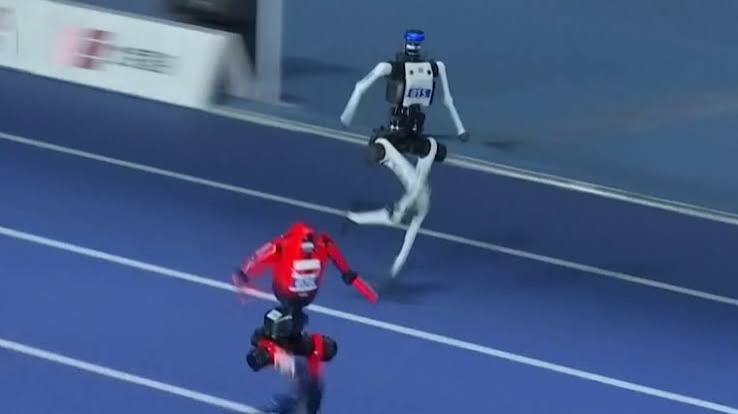
Figure 3 – From the Olympiad of Humanoid Robots in China (Source: NBC News)