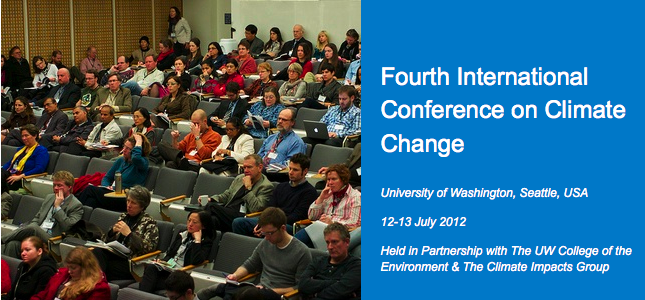
Fourth International Conference on Climate Change July 12 &13

I have just returned from a climate change conference in Seattle, Washington where I have presented some of our group’s work. I would like to share with you a list of the main themes of the conference to illustrate the broad scope and cross-disciplinary nature of this topic.  I will have more to add on the matter next week.

Theme 1: Scientific Evidence

What is evidence is there of climate change?

  • Paleoclimatology: the earth’s climate in a long view
  • Climate change today: examining the data
  • Ice cap reduction and glacial melt
  • Sea level change
  • Floods, drought, forest fires, hurricanes and other sporadic events
  • Albedo or measuring the earth’s reflectiveness
  • Meteorology and climate informatics
  • Equilibria and disequilbria: change processes and countervailing tendencies
  • Climate measurement processes, methodologies and technologies
  • Reading complex, dynamic and unstable systems
  • Developing local and global climate models
  • Change scenarios: slow, rapid, abrupt or episodic

Theme 2: Assessing Impacts in Divergent Ecosystems

What are the impacts of climate change on natural environments?

  • Ocean currents and el Niño
  • Riverine ecosystem impacts
  • Mountain ecosystem impacts
  • Coastal ecosystem impacts
  • Marine ecosystem impacts
  • Forest and grassland ecosystem impacts
  • Impacts on wilderness and protected areas
  • Impacts on specific biomes
  • Impacts on biodiversity, potential extinctions
  • Hardiness zone migration
  • Regional variations: temperature and rainfall

Theme 3: Human Impacts and Impacts on Humans

What evidence is there that human activity has contributed to climate change, and what are the impacts of climate change on human life?

  • Anthropogenic factors in climate change: determining the relative contribution of natural and human causes
  • Impacts of carbon dioxide and other greenhouse gases
  • Land use patterns, agriculture and livestock husbandry and deforestation as factors in climate change
  • Impacts on humans: agriculture, fish stocks, food supply, health
  • Human settlements and sea level rise
  • Impacts on humans: water supply, desertification
  • Impacts on humans of intense weather events, natural disasters and ecological surprises
  • Impacts of climate change in the developing world

Theme 4: Technical, Political and Social Responses

How do scientists, technologies, policy makers and community members respond to climate change?

  • Environmental policies in response to climate change
  • Controversy and denial: politics, the media and scientists with dissenting views
  • The international politics of climate change
  • The past, present and future of international agreements
  • Education and awareness for management of global climate change
  • Protected areas and preservation of biodiversity: ‘corridoring’ and other strategies
  • Strategies for sustainability
  • Human adaptive strategies
  • Technologies of mitigation: carbon dioxide sequestration, solar shades and other processes
  • Alternative and renewable energy sources: technologies, policies and strategies
  • Carbon taxes, offsets and trading
  • Emission standards
  • Climate ethics and the precautionary principle
  • Eco-development, eco-efficiency


Posted in Climate Change | Tagged , | 5 Comments

We Need to Do Some Serious Work if We Want to Democratize Climate Change Decisions.

A survey that was published in a recent OECD report has found that only 5% of American students expect to pursue a career in the sciences by age 30.

We are in good company – countries such as Brazil, UK, Canada and the Netherlands have similar statistics. Estonia is the highest (among the countries that were surveyed – at around 30%). Unfortunately, the survey probably never questioned the students on their understanding of what science entails. If they have similar attitudes to students that I know, science for them is associated with disciplines such as Physics, Chemistry and Biology that require a lot of math – many of them have decided that they hate math and don’t want to be associated with it any longer than they absolutely must. Presumably, nobody told them that they are now part of the physical world and if they want to participate in the decision-making process of governing the place that they and their families live in – they had better change their attitude about science. The “Two Cultures” (C.P. Snow – see the previous blog) cannot stay separated.

One of the questions that was surveyed by the National Science Foundation (NSF) to probe factual knowledge among the American public was, “Human beings, as we know them today, developed from earlier species of animals – true or false?” 47% of Americans surveyed had the correct answer (true). For comparison, they also provide the score for international respondents: South Korea (64%), EU (70%), Japan (78%), India (56%), China (69%) and Russia (44%).

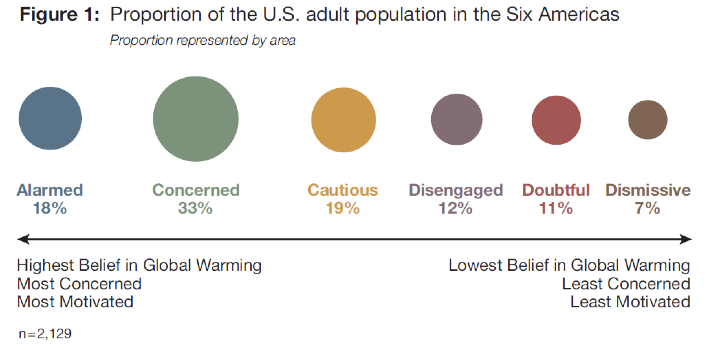
Recent reports by Yale University on American Global Warming Beliefs and Attitude found that Americans can be divided into six “distinct” groups in terms of their attitudes to climate change. The groups are shown in the figure below, together with the relative proportion of responses in each group (2009).

In the “Alarmed” group, 88% of the respondents believe that humans are the main culprits. In the “Concerned” group, that belief in mostly human culpability is reduced to 79%.

Interestingly, but not surprisingly, a similar survey that was conducted among frequent visitors to Science and Technology museums found that 45% of the frequent visitors are in the “Alarmed” category and 29% in the “Concerned” category. In total, 66% of the frequent museum visitors understand that global warming is mostly caused by humans.

The Christian-Science Monitor has recently reported on a survey that asked whether the respondents believe aliens have visited Earth – 36% of those who were surveyed responded that they do, 48% aren’t sure, and 17% said they don’t believe so. This means that more than three in four Americans (77%) think there are signs that suggest aliens have visited the Earth, whether or not they’ve made up their minds about the question.

With some margin of error, the percentage of ignorance in all three questions is about the same. However, the consequences are very different. As long as we keep people who don’t believe in evolution and people who believe in visits from extraterrestrials away from teaching (not an easy task) the damage is mostly personal. Nobody is asked to “vote” on these issues.

The climate change issue requires real remedies in the form of changes to the way that we and our children and grandchildren conduct our individual and collective lives. It also requires spending large sums of money that otherwise would go to address different needs. In democratic societies, these actions require public support.  The public is repeatedly required to make informed choices. If the public cannot make informed choices based on first principles, it will search for “epistemological lawyers”. Climate scientists would like to serve in this role (see my May 21 blog) but they are not the only ones – it becomes a hotly debated political issue that in most cases leads to inaction. Even many “skeptics” admit that in the near future (“end of now”) we will need to change our energy choices to ones that do not result in human-induced climate change because of irreversible changes in the chemistry of the atmosphere. They just question the timing (not now – later). We are starting to find out that the necessary changes are so fundamental that to accomplish them we require basic changes in our educational system.

Some movements in this direction will be discussed in the next blog.


Posted in Climate Change | Tagged , , , , , , , , | 6 Comments

Climate Change and the Tragedy of the Commons.

Garrett Hardin was a professor of Biology in Santa Barbara, California. In June 1968 he delivered a presidential address before the Pacific Division of the American Association for the Advancement of Science (AAAS). The lecture was on the future of nuclear war – drawing the conclusion that: “It is our considered professional judgment that this dilemma has no technical solution. If the great powers continue to look for solutions in the area of science and technology only, the result will be to worsen the situation.” A few months later, he  expanded on this topic in an article in Science titled, “The Tragedy of the Commons.” It became an almost instantaneous hit and an effective lasting teaching material. Googling the title today produces more than 400,000 hits. Combining it with “Climate Change” results in 85,000 hits. I use it regularly in classes on environmental issues and in talks on Climate Change.

Two paragraphs from the paper are sufficient to demonstrate the connection:

The class of “no technical solution problems” has members. My thesis is that the “population problem,” as conventionally conceived, is a member of this class. How it is conventionally conceived needs some comment. It is fair to say that most people who anguish over the population problem are trying to find a way to avoid the evils of overpopulation without relinquishing any of the privileges they now enjoy. They think that farming the seas or developing new strains of wheat will solve the problem-­technologically. I try to show here that the solution they seek cannot be found. The population problem cannot be solved in a technical way, any more than can the problem of winning the game of tick-tack-toe. In reaching this conclusion, I have made the usual assumption that it is the acquisition of energy that is the problem. The appearance of atomic energy has led some to question this assumption. However, given an infinite source of energy, population growth still produces an inescapable problem. The problem of the acquisition of energy is replaced by the problem of its dissipation… The arithmetic signs in the analysis are, as it were, reversed; but Bentham’s “The Tragedy of the Commons” develops in this way. Picture a pasture open to all. It is to be expected that each herdsman will try to keep as many cattle as possible on the commons. Such an arrangement may work reasonably satisfactorily for centuries because tribal wars, poaching, and disease keep the numbers of both man and beast well below the carrying capacity of the land. Finally, however, comes the day of reckoning, that is, the day when the long-desired goal of social stability becomes a reality. At this point, the inherent logic of the commons remorselessly generates tragedy. The goal is still unobtainable.

The National Parks present another instance of the working out of the tragedy of the commons. At present, they are open to all, without limit. The parks themselves are limited in extent–there is only one Yosemite Valley–whereas population seems to grow without limit. The values that visitors seek in the parks are steadily eroded. Plainly, we must soon cease to treat the parks as commons or they will be of no value anyone. (Hardin, G.  Science 162, 3859 (1968))

It doesn’t take a fertile imagination to extend the concept of the National Parks to the Planet as a whole. It is a bit more complicated to show that the “common pasture” issue,  so central now in game theory to debate a winning strategy that will benefit all the owners without harming the individual players, is equivalent to the NIMBY (Not In My Back Yard) phenomena that is a major challenge in addressing all environmental issues, including climate change. The NIMBY challenge, in the context of climate change will be addressed in future blogs.

Hardin’s world was different than ours. The world’s population was approximately half the present population (7 billion in October 2011) and systematic measurements of man’s contributions to changes in the chemistry of the atmosphere and the resulting changes in the energy balance with the Sun, were just begining. We were in the middle of the Cold War, less than one generation removed from Hiroshima and Nagasaki with MAD (Mutually Assured Destruction) as the dominant theory to prevent global suicide.

Science was connected to all of this only through attempts to design better destruction tools- not to solve any problems. This was the time that followed C.P. Snow’s  1959 publication of “The Two Cultures” (C.P.Snow,  The Two Cultures. London: Cambridge University Press (2001)). This small book that has recently emerged as one of the most influential books since WWII has made the point that one of the “cultures” is scientists and the other one is everybody else and that they don’t know how to talk to each other. This small book, like Hardin’s paper, came out also of a lecture (in Cambridge University).

What I understand in Hardin’s “no technical solution” is something that science can not solve. Both Hardin and Snow were scientists, although with broader interests, that have tried to build some bridges. Snow was advocating developing a common language. Hardin, in my view, was desperate and believed that if there are no “technical solutions” there are no solutions. Natural Science and Social Science in their time were separate. They are still separate in most universities, but as I have tried to show in the previous blog, Climate Change is forcing us to recognize that they are not separate any more. Building bridges now is not only the right thing to do but it is essential.

More about this – next week.


Posted in Climate Change | Tagged , , , , , , , , , , , | 9 Comments

Climate Change and the Nature of Science: The Carbon “Tipping Point” is Coming

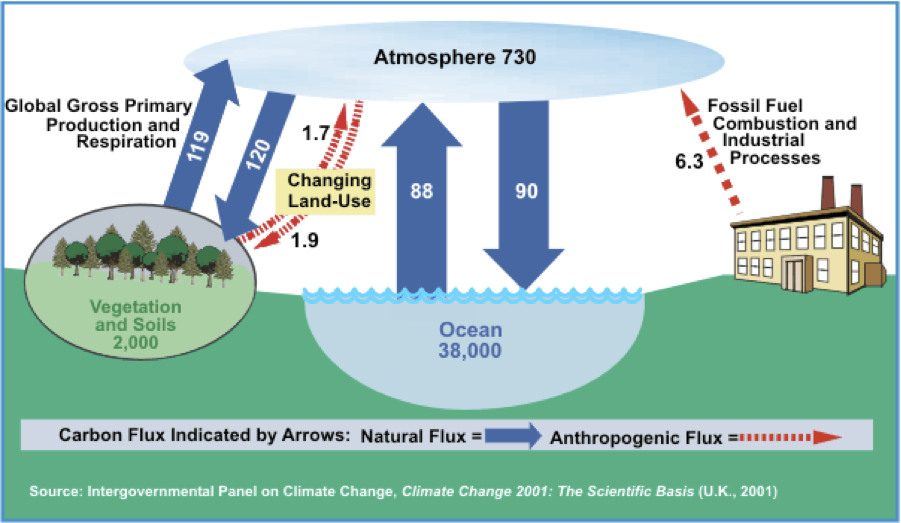
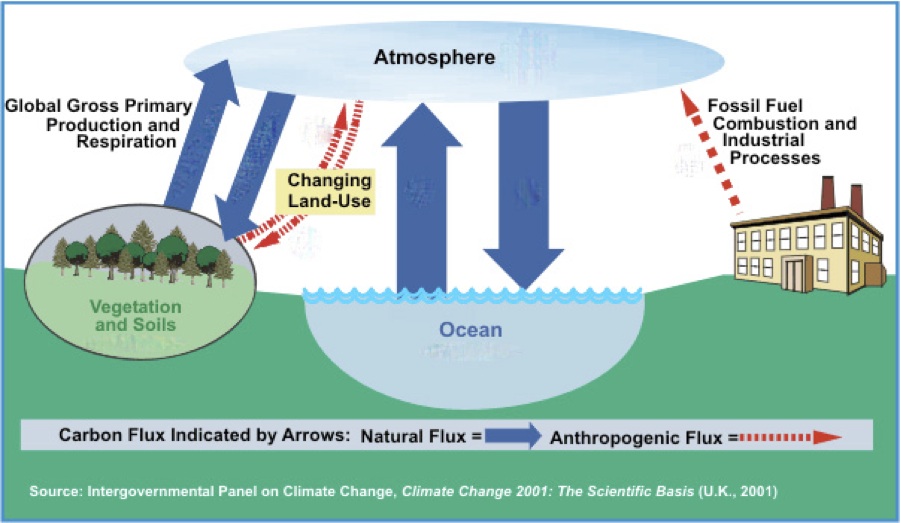
The two attached pictures are schematic diagrams of the circulation of carbon on Earth (IPAA Report (2001) – the Carbon Cycle).  If I Google “Carbon Cycle Diagram” in the image mode, I get close to a million entries.  Most of these entries look like the second image – not the first.  What is the difference?  The second one doesn’t have numbers (photoshopping on my part).

The numbers in the arrows of the first image represent fluxes of carbon per year in units of billion tons of carbon.  The numbers outside the arrows represent quantities in the same units of billion tons of carbon. The man-made (anthropogenic) contributions are shown by the dashed red arrows.

Scientifically, it is very difficult to argue with the second diagram.  I have to make qualitative statements like, “I don’t believe that carbon is exchanging between the atmosphere and the oceans.”  It is much easier to argue – scientifically – with the first diagram.  If I have the background and tools, I can either try to follow the original measurements or to take the measurements myself.  It doesn’t really matter if the job is too big; the fact that, in principle, I can do it, makes the first diagram science, while the second figure is obviously a good qualitative description but is not actually science.

Back to deniers and skeptics: I have been approached by friends (some of them with good science backgrounds) and students, who tell me (nicely) that since carbon dioxide is a “natural” product, it cannot be bad, so the EPA (Environmental Protection Agency) should not have to identify it as a pollutant.  Sometimes the conversations have gone on to suggest that if I want to avoid global warming, I should simply stop breathing (since they know that we exhale carbon dioxide).  They have asked me kindly to get off their backs and stay away from commenting upon their energy usage.  In the cases where conversations got more heated and evolved to include other greenhouse gases, the suggestions went as far as, “Well, why don’t we regulate cows so they’ll stop farting.”

Well, here is where science comes in.  When it comes to the carbon cycle, we can analyze the numbers.  We can add up the amount of carbon that is going from the earth to the atmosphere, and subtract that which is doing the reverse – entering the earth from the atmosphere.  (The carbon in theses fluxes mainly takes the form of carbon dioxide.)

The result? It shows that there are 3.1 billion tons of extra carbon being added to the atmosphere.  Since carbon dioxide is a very stable compound, it will stay in the atmosphere for many years.  If we assume that this same kind of flux will be more or less maintained from now until the end of the century (the “end of now” time-frame that I talk about in my book), the atmospheric concentrations of carbon will grow by close to 50%. This is a major difference that directly affects our energy balance with the sun.

3.1 billion tons is less than half of what we emit into the atmosphere (red broken arrows in the picture).  The difference means that both the earth and its oceans have now become net “sequesters,” or absorbers of the excess carbon dioxide that we produce.  Vegetation and soil, in the form of enhanced growth because of the carbon dioxide that fertilization contributes, and areas of the ocean that absorb carbon dioxide, contribute as well.  As the temperature rises, the capacity of these methods of compensation is expected to decrease, until they reach the point where both the earth and our oceans no longer absorb the carbon dioxide, but instead reverse themselves to be net emitters.  Some would call this a “tipping point.”

This makes us part of the physical system that we investigate, and negates, at least in my mind, the option of waiting with remedies until the consequences of these changes are absolutely certain.  Science tells us that the danger exists, so the remedies should be approached as an insurance premium.

We are now busy searching for planets outside the solar system.  We are particularly interested in finding planets in the habitable zone of stars- an area defined as a zone around a star, within which it is possible for a planet to maintain liquid water on its surface.  We have, up to now, been able to identify more than 700 exoplanets; last December, NASA announced the its discovery of the first exoplanet in a habitable zone of another star.  It is a narrow zone, but it offers the best chance so far to find life forms outside our own planet.  We are doing well, but we have a long way yet to go in that quest.  On a cosmological scale – destruction of a habitable zone is not very difficult – Venus can serve as a good example. The pace of the atmospheric changes that we are inducing, meanwhile, might lead to the first observable instance of the destruction of a habitable zone.  For a far away civilization, it will be scientific observation.  For us it will be a collective suicide.

Posted in Climate Change | Tagged , , , , , , , , , , | 58 Comments

Democratization and Decision Making: My Four Climate Change Challenges

In the following set of blogs, I will try to outline four major challenges to the democratization of the decision making process that, in my view, are needed to address the challenges that anthropogenic changes in the chemistry of the atmosphere will pose (see the previous two blogs).  These challenges are: climate change and the nature of science; science “hatred”; we are not prophets; and NIMBYism.  I’ll outline each briefly:

Climate Change, the Nature of Science and What Impacts and Constitutes the     “Physical World”

Climate change is a scientific issue. Merriam-Webster defines science (among other definitions) as “knowledge or a system of knowledge covering general truths or the operation of general laws especially as obtained and tested through scientific method” and “such knowledge or such a system of knowledge concerned with the physical world and its phenomena”.  Encyclopedia Britannica defines science as “any system of knowledge that is concerned with the physical world and its phenomena and that entails unbiased observations and systematic experimentation. In general, a science involves a pursuit of knowledge covering general truths or the operations of fundamental laws”.

I can argue with both definitions but especially with the Britannica statement that science involves a  “pursuit of knowledge covering general truths…”  I subscribe to the Popperian definition of the scientific method that is based on refutability and denies the existence of “general truths.”  A theory is “true” until it is refuted by observations; if it cannot be refuted – it is not science.  I will get back to the refutability issue shortly. Right now, I want to focus on the part common to both definitions – science is a “system of knowledge that is concerned with the physical world and its phenomena”.

As was mentioned in previous blogs, I was born in 1939.  The approximate world population at that time was 2.3 billion people.  In October 2011, we reached the 7 billion population milestone.  During my lifetime, almost 5 billion friends were added to my earth family – and I am still kicking.  My expanded family is not only considerably bigger, but also considerably richer in the aggregate.  These developments are changing the nature of the part of the physical world that we live in.  We are now an important part of the physical world on planet earth.  I will quantify this further in future blogs, but when we try to investigate global phenomena such as climate change, we have to include “us” in the system that we investigate.  In medical or legal terms, this process is called self-diagnosis or self-defense.  A common saying is that a lawyer that serves as his own legal adviser has a fool for a client.  The same holds true for a doctor that tries to treat himself when a serious medical issue is involved.  Doctors and lawyers have the option to hire somebody else.  The global human population doesn’t have these options.  We haven’t yet identified an exoplanet that can help.

“Hatred of Science”

Many of us say we “hate” science and students that take my courses, which are identified as science courses, tell me with great pride that they “despise” math.  Most of us either don’t want to or can not afford to study science.  Yet now, we have only two choices: we must either learn science in order to  knowledgeably participate in decisions that will revolve around climate change or quietly suffer the consequences of governmental and other decision making that is centered on scientific issues that affect our daily life.

We Are Not Prophets

The Popperian scientific method is based on refutability.  We develop a hypothesis and/or theory based on everything that we know, and we should be able to test the theory based on predictions for observations that we haven’t yet made.  If the tests fail, we change the theory.  This amounts to prediction of future results.  Since we are part of the system, failure might mean closing the window that allows us to survive.  The science we’re talking about here is more like medicine – we have to make a rational diagnosis about the changes that take place in the physical world, but if our predictions might result in a harmful impact, we will need to act. On this scale, actions to restore equilibrium must become part of the science that we practice.

NIMBYism  (Not In My Backyard)

Climate Change is a global, collective phenomenon that all of us contribute to and that, sooner or later, will affect us all.  There’s no “backyard” that we can try to protect or hide in.  The required remedies are global.  Non-participants tend to freeze the global response and potentially put everybody in danger.

All of these challenges have a single common denominator; all of them can be – and must be – addressed through the educational system.  This is an enormous task and it is global and not simply confined to schools.  In later blogs, I will elaborate on possible networks that can be used and the available time to do that.  It will take a few generations (my definition of the “End of Now” in my book is within the lifetime of my grandchildren).

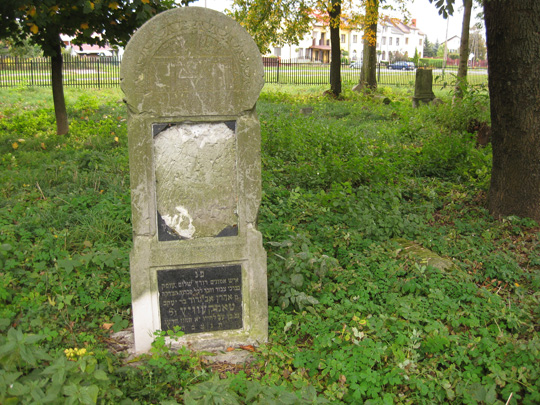
The Tombstone of Aharon Avigdor Tomkiewicz in Wysokie Mazowieckie, Poland

I had a recent, very personal, “End of Now” experience.  I have just returned from a trip to Poland where I visited the village of Wysokie Mazowieckie, situated between Warsaw and Bialystok.  Before WWII, about 70% of the population was Jewish.  The village was burned by the Nazis and most of the people were murdered, yet, about six years ago, a young local history teacher uncovered one of the two Jewish cemeteries.  He had his students clear the place and find whatever tombstones they could.  The most prominent tombstone found, that now stands erect in the middle of the cemetery and is shown here, is that of Aharon-Avigdor Tomkiewicz, my great-grandfather, who was a shop keeper in the town and died in 1913 – about 100 years ago.  This was my historic “End of Now.”  A great deal has happened since then and a great deal can happen going forward – but we will have to work on it.

Posted in Climate Change | Tagged , , , , , , , , , | 5 Comments

Turning Holocaust “Paper Clips” Into Environmental “Paper Clips”

The story of the Holocaust “Paper Clips” project (read the last blog post) not only
moved me, but inspired me to action.

The book that I wrote – “Climate Change: the Fork at the End of Now”
Momentum Press (2011) – was written as “textbook for the general public,”
In academic terms: no prerequisites!

Yet, in my terms, it also means no preaching.  The book is structured so that
there is almost equal weight and focus on the scientific issues and the social
issues that impact climate change, like population, economics and politics.  The book
is anchored on data from organizations such as the World Bank, the Energy
Information Administration (EIA), oil company databases (mainly BP), the
International Energy Agency (IEA) American and International agencies such as
IPCC, NSF, World Bank, etc.

I tried to set up the book so that students could learn how to extrapolate to
the future without requiring that they be familiar with the details of exponential
growth (no prerequisites!!!) using concepts such as doubling time.  They could
then actually use this skill to try to imagine what the world might be like when,
for example, an “average” Chinese citizen would be as “rich” as an “average”
American, based on current growth patterns.  A chapter titled “What Can I Do?”
that appears toward the end of the book includes mainly activities like creating
personal energy audits and doing carbon footprint calculations.

At the time that the Hudson Falls meeting took place, where I saw “Paper Clips”
for the first time, the book was in print.  It came out in June 2011 and since then,
I have been able to use it for two semesters in two kinds of courses.  One is an “Energy
Use & Climate Change” course that is part of our Second Tier General Education
program.  The other is a second year Honors College Seminar targeted at providing
Honors students with a taste of scientific issues and structured so that half
the time is spent in classroom education and the other half is spent on group
research (typically, three students per group) that focuses on issues in New York
City.

In both courses, the students were asked to read the book cover to cover during
the first half of the semester and were then tested on the material in the midterm
examinations.  The second half of the semester, in both cases, was focused on
related current events.

After I saw the “Paper Clips” movie, I started to think about how I could
individualize climate change and make it more personal for the students.

My first thought was that the best candidate that I had for an
environmental “Paper Clips” equivalent was the personal energy audits and
calculations of carbon footprints.  I did try it in both courses.

The first hurdle that students had to overcome was to understand and handle the
broad spectrum of energy units that our energy bills contain.  Once they learned
to handle the unit conversions, they could add up the amounts of energy from
various energy sources to figure out their total energy use and compare it with
the energy use of their friends and neighbors and with relevant averages in their
City, State, Country and, yes, even the world.

The second issue that they encountered was how to overcome the complexities
of the variety of living arrangements found in a city such as New York.  To get
the appropriate information, they had to interact with their parents, landlords and
whoever actually pays all the electric bills.  For the carbon footprint calculations,
they were not encouraged to go to the internet to get the “carbon coefficients” of
the various fuels.  Instead, despite the fact that many of them had never taken
any chemistry courses (remember, no prerequisites), they had to learn the basic
principles of chemical equations.  This included learning the concept of mole
and how to calculate the carbon coefficients from the basic chemical reactions
of burning the three most common forms of fossil fuels.  They learned what
electricity is, the differences between primary and secondary energy sources,
and why a unit of electrical energy costs about three times more than a unit of
heat energy that we derive by a direct burning of fossil fuel.  (Yes – they learned
the two laws of thermodynamics, but didn’t know they were doing it).

At the end of all this, they learned how and where they could save energy and
how much money those savings would produce.  Now, they can also critically
evaluate advertising that promises them wonders by switching from one fuel
to another or one light source to another.  I am now trying the concept on high
school students and eventually I hope to try it on middle school students, starting
with Whitwell, Tennessee.

These are my environmental “Paper Clips,” and I feel sure that learning how to
do energy audits made my students feel somewhat empowered and that they
were, in a real sense, helping to mitigate the effects of climate change, albeit on
a small scale.

My “dream” (likely unrealizable) is to try to follow Peter Finch in Sidney Lumet’s
film “Network” where, through the broadcasting network, he was able to incite
everybody to stand in front of the window or the terrace and shout, “I’m mad as
hell and I’m not going to take this anymore.”  In the process, he gave a huge boost to the
rating of the network.

In today’s terminology, he was able to create what Richard Dawkins called
a “meme.”  This was a “desperation” meme.  I would like to use it to create
a “meme of hope.”  The transmission of this meme will not be monopolized by
networks but will go through the educational systems – both formal and informal.
In my “dream,” the end result is similar – this meme of hope will be shouted from
the rooftops, windows, and terraces, from the tents, and from any other dwellings
throughout the world.  In all languages, including braille and sign language,
people will be able to shout, “I can do my energy audit and calculate my carbon
footprint (zero is ok) and I am doing it right and helping the planet.”

Once we get even closer to this situation, it will be much easier to achieve the
global and local environment that Gernot Wagner so desires in terms of global
and local regulatory systems.  In the process, everybody learns and we all gain.

With your help we will explore it further.

Posted in Climate Change | Tagged , , , , , , , | 7 Comments

Holocaust “Paper Clips”- A Possible Guide for Democratization of Climate Change?

(Continued from last time)

Whitwell, Tennessee is a small town (approx. 1600) in the Sequatchie Valley, a short drive from Chattanooga.  The Principal of the local middle school, Linda Hopper and David Smith, the Vice Principal at the time (now principal of the elementary school), realized that, when their students graduated, many would go on to universities and/or jobs in different places with a more heterogeneous population.  The vast majority of the school’s students and the teachers were white, Anglo-Saxon and Protestant.  There were almost no people of color, no foreign or immigrant students, and no Catholics, Muslims or Jews.

David Smith went to a conference in Chattanooga (1998) and on his return suggested a way to try to give students a lesson in diversity by teaching the 8th graders about the Holocaust.  The idea was accepted.  They decided that the class would be voluntary and the students’ parents were informed and gave their consent.  Sandra Roberts, the local language arts teacher was chosen to teach the subject.   (Interestingly, she had to learn the subject from the Internet.)

In one of the first classes, Ms. Roberts mentioned that 6 million European Jews, two thirds of European Jews at the time, were slaughtered just because they were Jews.  The expectation was that the children would be shocked – they were not.  A few of them simply asked, “Ms. Roberts, how much is six million?”

Most of them could write the number but none of them realized what it meant to translate the number to individual people (too big to comprehend – see Wagner’s Op-Ed in the previous post).

Almost immediately, the school realized that the challenge was to try to convert an abstract, collective, concept – such as this very big number – into something that the students would grasp.  They decided to collect six-million paper clips to see how big that collection would be.  The process of gathering the paper clips is one of the most fascinating aspects of the whole story  (“Six Million Paper Clips – The Making of a Children Holocaust memorial” by Peter W. Schroeder and Dagmar Schroeder-Hildebrand, Kar-Ben Publishing, 2004) and (“Paper Clips” a movie written and directed by Joe Fab).

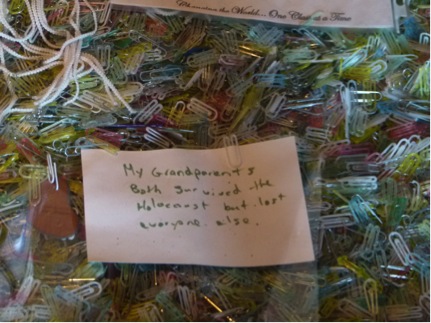
They quickly realized that they didn’t have enough paper-clips locally and that they needed some influx from the outside.  They started to publicize (no blogs at that time) the project and the need for paper clips locally, then nationally and eventually globally.  They got paper clips with names and stories of Holocaust victims attached and the students were able to associate individual paper clips with individual people that had stories to tell.  They counted all the clips. It took some time – but they did pass the six million mark.  A German couple, the Schroeder’s, the same couple who  eventually wrote the book about the effort, heard the story and decided to try to do something to help.  They started to search for an old railcar – just like the railcars that were used to transport the victims to the death camps and concentration camps.  They finally were able to locate one and transported it to Withwell, where the full community collaborated to create a small museum that is centered on the railcar that now houses the paper clips.

The clips keep coming to this day.

By the time that we visited the place, a few months ago, the number approached 20 million and the students still count them and get an opportunity to explore the full horrors of the Nazi terror.

When I saw the movie about the project for the first time, it was in a liberators-survivals reunion in Hudson Falls NY at one of the conferences that Matt Rozell (see my first blog) organized.  Joe Fab was there to show the movie – and my first thought was, “How can I learn from this experience to be able to individualize the climate change story and refute Wagner’s thesis that individual efforts don’t count?”


Posted in Climate Change | Tagged , , , , , , , | 6 Comments

Vacation Notice

I’m on a short vacation, so there will be no new post today.  Please do come back next Monday, when I promise to continue our discussion.

Posted in Climate Change | 1 Comment

Climate Change: How Do We Democratize the Process?

Before I start this post, I’d like to thank all the people who have commented on my previous entries. I started blogging in order to join the climate change conversation, and I feel like I’ve landed smack in the middle of that conversation.

One of the things I’m slowly learning is that, in the world of blogging, one must be flexible and go where the conversation sometimes naturally takes you.  So, I’m scrapping blog entry “Proof, Part 2” in order to journey elsewhere.

Recently, the Wall Street Journal found itself at the fulcrum of the climate change debate.  Two op-eds were the focus.  The first one titled “No Need to Panic About Global Warming” and signed by 16 scientists, appeared on January 26.  A “response” titled “Check with Climate Scientists for View on Climate“, signed by 20 scientists, was published on February 1st.  Part of the response by the “scientists” is worth quoting here: “Do you consult your dentist about your heart condition? In science, as in any area, reputations are based on knowledge and expertise in a field and on published, peer-reviewed work.  If you need surgery, you want a highly experienced expert in the field who has done a large number of the proposed operations”.  To put it a bit differently (my words) – hire yourself an epistemological lawyer before you vote and for good measure, check his list of publications before you hire him.

On a similar but different front in, an op-ed, published in the New York Times on September 7, 2011 and titled “Going Green but Getting Nowhere,” Gernot Wagner (an economist at the Environmental Defense Fund) wrote, “You reduce, reuse and recycle.  You turn down plastic and paper.  You avoid out-of-season grapes.  You do all the right things.  Just know that it won’t save the tuna, protect the rainforest or stop global warming.  The changes necessary are so large and profound that they are beyond the reach of individual action.”

His main point is that individual action doesn’t work even if you are the Pope with more than a billion adherents.  (Most of them are adherents only to a point and will not exactly follow your wishes.)  He believes that individual action detracts from the need for collective action and that individual action doesn’t add up to enough.  He says, “Self interest – not self sacrifice is what induces noticeable change,” and that the correct economic policies will do the trick.  Wagner notes that, “Getting people excited about making individual environmental sacrifices is doomed to fail.”   (In terms of climate change he favors Cap and Trade legislation).

The call for individual effort he calls “planetary socialism at its worst: we all pay the price because individuals don’t.  It wouldn’t change until a regulatory system compels us to pay our fair share to limit pollution.”

The question that he doesn’t raise is who will elect the government that will change the regulatory system to Mr. Wagner’s specifications?  Here we’d need a Platonian Philosopher King.  While government absolutely has a role in all this, simply waiting for the “correct” elected officials to do the “correct” thing is sort of like “Waiting for Godot” – it will probably never happen as it really needs to happen.

So, who, in a democracy, “decides” which actions are right on climate change?  Scientists?  Policy makers?  And how do we democratize those actions?

While I agree that all of us should be part of larger collective action on climate change, should we individually sit on our hands and do nothing?  Do we really have to choose between collective action and individual action?

Climate change on a grand scale can feel so overwhelming, that it often seems that no action – either collective or individual – can really make a difference.  I know this is true because many, many of my students have told me so.  They can feel helpless and, because the problem is so huge, they have a hard time finding a way to incorporate this big story into their seemingly small lives.

In the process of looking for ways to personalize climate change and make it relevant to individual lives, I found an amazing Holocaust project in Tennessee that started as a way to get students to find a personal way to relate to the Holocaust, but wound up becoming a much larger collective action that impacted thousands… (more for next time!)

Posted in Climate Change | 22 Comments

“Why Am I ‘Dragging’ the Holocaust into the Climate Change Debate?”

I had originally planned to make my next post a continuation of the last one, and call it “Proof, Part 2.”  However, my last blog post stirred up a lot of debate and reaction, including recognition from New York Times environmental reporter/blogger Andrew Revkin.  So, I thought I’d take a slight detour and address some of the issues raised by that post.

Many thoughtful comments on this blog (thanks!!) have focused on my so-called “dragging” the Holocaust into the climate change debate.  The claims were that I am “cheapening” the Holocaust, that I am not able to distinguish between deniers and skeptics and/or that I am accusing climate change deniers of using “Nazi methods” simply by using the term deniers in the context of climate change.

First of all, I could not and would not “cheapen” a genocide that killed most of my family and deprived me of my childhood between the Warsaw Ghetto and Bergen-Belsen.  I was born three months before the start of this genocide in which we were targeted for annihilation because we belonged to a group that the Germans did not think had a right to exist.

But, of course, I am using the term “denier” to make a point.  In 1933, very few people believed that Hitler would seriously try to accomplish what he preached and almost no one could imagine the consequences of his deadly reign.  Although there was evidence available – Hitler was clear about what he wanted to do in Mein Kampf – why did people not pay attention?  These “deniers” might as well have been called skeptics in their day.

I make my “climate change denier” claim for one reason.  It’s easy today to teach students to condemn the Holocaust, but it’s much more difficult to teach them how to try to prevent future genocides.  There are different kinds of genocides and they don’t repeat themselves; they come to us in different ways.  I am not suggesting that the Holocaust is just like climate change.  But what I am suggesting is that it’s hard to see a genocide – any genocide – coming.  The future is hard to predict, but we can see this one coming.  This genocide is of our own making, and it will effect everyone, not just one group or country.

Even if people don’t believe this or are skeptical – remember Germany as Hitler came to power – why don’t we act now?  Why wait?  And what, exactly, are we waiting for anyway?  Are we waiting for “the answer?”  Since, as I’d said earlier, the future is not totally predictable, we may never get “the answer.”

I don’t want my grandchildren to die in a climate change genocide that we could have helped head off because we were waiting for some unattainable certainty about climate change.

The preventive actions that need to be undertaken are outlined in various credible scientific reports and will be expanded upon right here in the near future. They will have to be applied on a multigenerational time scale (End of Now in my book- see the first blog).

These actions that we can take now are not meant to be “the answer” to a certain scenario. They were always meant to be an insurance policy that we can afford to pay and that we must pay.  In my opinion, most of those actions can be summarized like this: at a minimum, we must require that by the “end of now” (my grandchildren’s life-span), half of our global energy use must not result in the emission of greenhouse gases to the atmosphere and fossil fuels must not be coal based.  (There’s more on all of that in my book.)

Ultimately, my main objective in “dragging” the Holocaust into this debate is that, in my opinion, long-term solutions to our climate change problem can only be attained through the educational system.

Holocaust studies and commemorations are now widespread.  Here’s just one example: “United Nations General Assembly resolution 60/7 on Holocaust remembrance called for the establishment a programme of outreach on the subject of the ‘Holocaust and the United Nations’ and measures to mobilize civil society for Holocaust remembrance and education in order to help to prevent future acts of genocide.”  Millions of children, mainly in Europe, North America, Australia, Israel, and even in China study the events.  Holocaust museums are opening in places that are not directly connected with the event.

A valid question, one that probably only a person with a background similar to mine can ask is, why?  The UN resolution provides a reasonable response – “to prevent future acts of genocide.”  The Spanish-American philosopher George Santayana wrote that, “Those who cannot remember the past are condemned to repeat it,” to which the English writer and cartoonist Max Beerbohm replied, “History does not repeat itself.  The Historians repeat one another.”

Teaching the Holocaust to achieve this objective requires not only the study of past events, but it also must attempt to analyze future situations that might lead to genocides – man-on-man and self-inflicted – through destruction of the physical environment.

I belong to the last generation of Holocaust survivors.  The interest in study of the Holocaust is increasing, and the demand for people like me to appear before school children to tell our stories and answer their questions, is increasing.  This is an opportunity that I choose to use to remind everybody within our reach that we need to pay attention to the prevention of future genocides through analysis of situations that might lead to one.

Posted in Climate Change | 61 Comments