Holocaust “Paper Clips”- A Possible Guide for Democratization of Climate Change?

(Continued from last time)

Whitwell, Tennessee is a small town (approx. 1600) in the Sequatchie Valley, a short drive from Chattanooga.  The Principal of the local middle school, Linda Hopper and David Smith, the Vice Principal at the time (now principal of the elementary school), realized that, when their students graduated, many would go on to universities and/or jobs in different places with a more heterogeneous population.  The vast majority of the school’s students and the teachers were white, Anglo-Saxon and Protestant.  There were almost no people of color, no foreign or immigrant students, and no Catholics, Muslims or Jews.

David Smith went to a conference in Chattanooga (1998) and on his return suggested a way to try to give students a lesson in diversity by teaching the 8th graders about the Holocaust.  The idea was accepted.  They decided that the class would be voluntary and the students’ parents were informed and gave their consent.  Sandra Roberts, the local language arts teacher was chosen to teach the subject.   (Interestingly, she had to learn the subject from the Internet.)

In one of the first classes, Ms. Roberts mentioned that 6 million European Jews, two thirds of European Jews at the time, were slaughtered just because they were Jews.  The expectation was that the children would be shocked – they were not.  A few of them simply asked, “Ms. Roberts, how much is six million?”

Most of them could write the number but none of them realized what it meant to translate the number to individual people (too big to comprehend – see Wagner’s Op-Ed in the previous post).

Almost immediately, the school realized that the challenge was to try to convert an abstract, collective, concept – such as this very big number – into something that the students would grasp.  They decided to collect six-million paper clips to see how big that collection would be.  The process of gathering the paper clips is one of the most fascinating aspects of the whole story  (“Six Million Paper Clips – The Making of a Children Holocaust memorial” by Peter W. Schroeder and Dagmar Schroeder-Hildebrand, Kar-Ben Publishing, 2004) and (“Paper Clips” a movie written and directed by Joe Fab).

They quickly realized that they didn’t have enough paper-clips locally and that they needed some influx from the outside.  They started to publicize (no blogs at that time) the project and the need for paper clips locally, then nationally and eventually globally.  They got paper clips with names and stories of Holocaust victims attached and the students were able to associate individual paper clips with individual people that had stories to tell.  They counted all the clips. It took some time – but they did pass the six million mark.  A German couple, the Schroeder’s, the same couple who  eventually wrote the book about the effort, heard the story and decided to try to do something to help.  They started to search for an old railcar – just like the railcars that were used to transport the victims to the death camps and concentration camps.  They finally were able to locate one and transported it to Withwell, where the full community collaborated to create a small museum that is centered on the railcar that now houses the paper clips.

The clips keep coming to this day.

By the time that we visited the place, a few months ago, the number approached 20 million and the students still count them and get an opportunity to explore the full horrors of the Nazi terror.

When I saw the movie about the project for the first time, it was in a liberators-survivals reunion in Hudson Falls NY at one of the conferences that Matt Rozell (see my first blog) organized.  Joe Fab was there to show the movie – and my first thought was, “How can I learn from this experience to be able to individualize the climate change story and refute Wagner’s thesis that individual efforts don’t count?”


Posted in Climate Change | Tagged , , , , , , , | 6 Comments

Vacation Notice

I’m on a short vacation, so there will be no new post today.  Please do come back next Monday, when I promise to continue our discussion.

Posted in Climate Change | 1 Comment

Climate Change: How Do We Democratize the Process?

Before I start this post, I’d like to thank all the people who have commented on my previous entries. I started blogging in order to join the climate change conversation, and I feel like I’ve landed smack in the middle of that conversation.

One of the things I’m slowly learning is that, in the world of blogging, one must be flexible and go where the conversation sometimes naturally takes you.  So, I’m scrapping blog entry “Proof, Part 2” in order to journey elsewhere.

Recently, the Wall Street Journal found itself at the fulcrum of the climate change debate.  Two op-eds were the focus.  The first one titled “No Need to Panic About Global Warming” and signed by 16 scientists, appeared on January 26.  A “response” titled “Check with Climate Scientists for View on Climate“, signed by 20 scientists, was published on February 1st.  Part of the response by the “scientists” is worth quoting here: “Do you consult your dentist about your heart condition? In science, as in any area, reputations are based on knowledge and expertise in a field and on published, peer-reviewed work.  If you need surgery, you want a highly experienced expert in the field who has done a large number of the proposed operations”.  To put it a bit differently (my words) – hire yourself an epistemological lawyer before you vote and for good measure, check his list of publications before you hire him.

On a similar but different front in, an op-ed, published in the New York Times on September 7, 2011 and titled “Going Green but Getting Nowhere,” Gernot Wagner (an economist at the Environmental Defense Fund) wrote, “You reduce, reuse and recycle.  You turn down plastic and paper.  You avoid out-of-season grapes.  You do all the right things.  Just know that it won’t save the tuna, protect the rainforest or stop global warming.  The changes necessary are so large and profound that they are beyond the reach of individual action.”

His main point is that individual action doesn’t work even if you are the Pope with more than a billion adherents.  (Most of them are adherents only to a point and will not exactly follow your wishes.)  He believes that individual action detracts from the need for collective action and that individual action doesn’t add up to enough.  He says, “Self interest – not self sacrifice is what induces noticeable change,” and that the correct economic policies will do the trick.  Wagner notes that, “Getting people excited about making individual environmental sacrifices is doomed to fail.”   (In terms of climate change he favors Cap and Trade legislation).

The call for individual effort he calls “planetary socialism at its worst: we all pay the price because individuals don’t.  It wouldn’t change until a regulatory system compels us to pay our fair share to limit pollution.”

The question that he doesn’t raise is who will elect the government that will change the regulatory system to Mr. Wagner’s specifications?  Here we’d need a Platonian Philosopher King.  While government absolutely has a role in all this, simply waiting for the “correct” elected officials to do the “correct” thing is sort of like “Waiting for Godot” – it will probably never happen as it really needs to happen.

So, who, in a democracy, “decides” which actions are right on climate change?  Scientists?  Policy makers?  And how do we democratize those actions?

While I agree that all of us should be part of larger collective action on climate change, should we individually sit on our hands and do nothing?  Do we really have to choose between collective action and individual action?

Climate change on a grand scale can feel so overwhelming, that it often seems that no action – either collective or individual – can really make a difference.  I know this is true because many, many of my students have told me so.  They can feel helpless and, because the problem is so huge, they have a hard time finding a way to incorporate this big story into their seemingly small lives.

In the process of looking for ways to personalize climate change and make it relevant to individual lives, I found an amazing Holocaust project in Tennessee that started as a way to get students to find a personal way to relate to the Holocaust, but wound up becoming a much larger collective action that impacted thousands… (more for next time!)

Posted in Climate Change | 22 Comments

“Why Am I ‘Dragging’ the Holocaust into the Climate Change Debate?”

I had originally planned to make my next post a continuation of the last one, and call it “Proof, Part 2.”  However, my last blog post stirred up a lot of debate and reaction, including recognition from New York Times environmental reporter/blogger Andrew Revkin.  So, I thought I’d take a slight detour and address some of the issues raised by that post.

Many thoughtful comments on this blog (thanks!!) have focused on my so-called “dragging” the Holocaust into the climate change debate.  The claims were that I am “cheapening” the Holocaust, that I am not able to distinguish between deniers and skeptics and/or that I am accusing climate change deniers of using “Nazi methods” simply by using the term deniers in the context of climate change.

First of all, I could not and would not “cheapen” a genocide that killed most of my family and deprived me of my childhood between the Warsaw Ghetto and Bergen-Belsen.  I was born three months before the start of this genocide in which we were targeted for annihilation because we belonged to a group that the Germans did not think had a right to exist.

But, of course, I am using the term “denier” to make a point.  In 1933, very few people believed that Hitler would seriously try to accomplish what he preached and almost no one could imagine the consequences of his deadly reign.  Although there was evidence available – Hitler was clear about what he wanted to do in Mein Kampf – why did people not pay attention?  These “deniers” might as well have been called skeptics in their day.

I make my “climate change denier” claim for one reason.  It’s easy today to teach students to condemn the Holocaust, but it’s much more difficult to teach them how to try to prevent future genocides.  There are different kinds of genocides and they don’t repeat themselves; they come to us in different ways.  I am not suggesting that the Holocaust is just like climate change.  But what I am suggesting is that it’s hard to see a genocide – any genocide – coming.  The future is hard to predict, but we can see this one coming.  This genocide is of our own making, and it will effect everyone, not just one group or country.

Even if people don’t believe this or are skeptical – remember Germany as Hitler came to power – why don’t we act now?  Why wait?  And what, exactly, are we waiting for anyway?  Are we waiting for “the answer?”  Since, as I’d said earlier, the future is not totally predictable, we may never get “the answer.”

I don’t want my grandchildren to die in a climate change genocide that we could have helped head off because we were waiting for some unattainable certainty about climate change.

The preventive actions that need to be undertaken are outlined in various credible scientific reports and will be expanded upon right here in the near future. They will have to be applied on a multigenerational time scale (End of Now in my book- see the first blog).

These actions that we can take now are not meant to be “the answer” to a certain scenario. They were always meant to be an insurance policy that we can afford to pay and that we must pay.  In my opinion, most of those actions can be summarized like this: at a minimum, we must require that by the “end of now” (my grandchildren’s life-span), half of our global energy use must not result in the emission of greenhouse gases to the atmosphere and fossil fuels must not be coal based.  (There’s more on all of that in my book.)

Ultimately, my main objective in “dragging” the Holocaust into this debate is that, in my opinion, long-term solutions to our climate change problem can only be attained through the educational system.

Holocaust studies and commemorations are now widespread.  Here’s just one example: “United Nations General Assembly resolution 60/7 on Holocaust remembrance called for the establishment a programme of outreach on the subject of the ‘Holocaust and the United Nations’ and measures to mobilize civil society for Holocaust remembrance and education in order to help to prevent future acts of genocide.”  Millions of children, mainly in Europe, North America, Australia, Israel, and even in China study the events.  Holocaust museums are opening in places that are not directly connected with the event.

A valid question, one that probably only a person with a background similar to mine can ask is, why?  The UN resolution provides a reasonable response – “to prevent future acts of genocide.”  The Spanish-American philosopher George Santayana wrote that, “Those who cannot remember the past are condemned to repeat it,” to which the English writer and cartoonist Max Beerbohm replied, “History does not repeat itself.  The Historians repeat one another.”

Teaching the Holocaust to achieve this objective requires not only the study of past events, but it also must attempt to analyze future situations that might lead to genocides – man-on-man and self-inflicted – through destruction of the physical environment.

I belong to the last generation of Holocaust survivors.  The interest in study of the Holocaust is increasing, and the demand for people like me to appear before school children to tell our stories and answer their questions, is increasing.  This is an opportunity that I choose to use to remind everybody within our reach that we need to pay attention to the prevention of future genocides through analysis of situations that might lead to one.

Posted in Climate Change | 61 Comments

Proof: Part 1

The figure above is the first exhibit in a new memorial to the Bergen-Belsen concentration camp where I spent two years between 1943 and 1945 (see my previous blog for relevance).

It shows the superimposition of two aerial photographs, showing the camp “then” and “now,” to try to convince the skeptics that the camp was in the same place. The rest of the exhibition tries to document the atrocities that took place in the camp through testimonies of survivors, detailed documentation that was kept by the perpetrators and the various artifacts that were associated with the period. The aerial photographs are there to “prove” that all of this is real. Deniers have an impact – there are not many Holocaust deniers around, but the availability of modern communication tools amplifies their voice. A significant fraction of the extensive Holocaust teaching that takes place is targeted at a response.  Sixty-seven years have passed since I was liberated by the American army at Farsleben.  Simple arithmetic indicates that almost all the survivors today were children during the Holocaust, and our numbers are dwindling. Denying the Holocaust today, with all the available factual information, requires denying of all of history. There is no question that the deniers deserve their label.

But most of our history is based on flimsier evidence, and climate change deniers like to say that using scientific “theories” to explain climate change is not really “proof.”  We use scientific theories all the time to explain phenomena that we know exist but can’t readily “see” –  like gravity, for example.  We know gravity exists because we can feel its effects; we can also see climate change’s effects, but the deniers continue to insist it isn’t really proof.

Examples of this refusal to use scientific theories and current climate change evidence abound, unfortunately.

A student of mine at Brooklyn College in a general education course on Energy Use and Climate Change forwarded to me a letter that was published in the on-line publication Business Insider (April 11, 2012). The letter was signed by 49 former NASA employees that included seven Apollo astronauts and two former directors of NASA’s Johnson Space Center calling NASA to move away from climate model predictions and to limit its stance to what can be “empirically proven.” The letter specifically targets James Hansen – Director of NASA Goddard Institute (GISS) (Hansen and the GISS have been acting as the “the canary in the coal mine,” warning, for years, about the consequences of relying on fossil fuels as our main source of energy.) The letter states that, “We believe the claims by NASA and GISS, that man-made carbon dioxide is having a catastrophic impact on global climate change are not substantiated.”  The reason for the doubt includes that.”NASA is relying too heavily on complex climate models that have proven scientifically inadequate in predicting climate only one or two decades in advance” and that “There’s a concern that if it turns out that CO2 is not a major cause of climate change, NASA will have put the reputation of NASA, NASA’s current and former employees, and even the very reputation of science itself at risk of public ridicule and distrust.” This is backwards; it’s the letter that should be held up to public ridicule.

A recent program on Discovery Channel – “Frozen Planet” – shows beautiful photography of the clearly melting poles, disruptions to the life cycle of penguins, and the misery of polar bears trying to cope with the unseasonal melting of their environments. Unbelievably, the reason – the scientific reason – for these changes is not being discussed. Why the omission? The program’s producer (reported by Brian Stelter in the NYT, April 21 2012), is quoted as saying that “including scientific theories would have undermined the strength of an objective documentary, and would then have become utilized by people with political agenda.  I feel that we are trying to educate mass audiences and get children involved, and we didn’t want people saying don’t watch this show because it has a slant on ‘climate change.'”  How can this program, which shows such devastating scenes, fail to mention the probable mechanism for the destruction and science supporting it?  And how does refusal to mention “scientific theories” qualify as education?  What’s going on here?

Consequences of man-made changes in the chemistry of the atmosphere result in changes in our energy balance with the sun that leads to climate change. This is “simple” physics that doesn’t need sophisticated computer work. Future impact is always uncertain.

But, if the climate change deniers have their way, by the time that we find out “for certain” whether the IPCC, NASA, GISS, the World-Bank, NSF and other credible organizations that issue detailed reports about the consequences of climate change, are right in every detail, most of the people who are now discussing these issues will be dead. Our children and grandchildren will live to face the consequences. Business -as-usual- scenarios have a high probability of leading to major disruptions that will lead to loss of life on a global scale -a self-inflicted genocide (see my first blog for a Webster definition).

We know what needs to be done to lower the probability of such consequences. We also know how long such a transition will take. Ignoring the issue for the reasons that the Discovery Channel producer used will lead to very dangerous, expensive and unnecessary inaction.

More on this in Part 2.

Posted in Climate Change | 62 Comments

First Post

It’s with excitement and some trepidation that I write my very first blog post today. As a trained scientist, it really isn’t in my nature to write short blips about weighty subjects like climate change.

But I’ve taken up this challenge – today, on the 42nd anniversary of Earth Day – because I simply couldn’t stand by and watch while climate change “deniers” continue to try to take center stage and to keep all of us from doing what’s necessary to head off the impending climate change disaster.

As a professor, a scientist, a Holocaust survivor and someone who has just written a book on climate change, I think I am uniquely positioned to tell the climate change story. I know that once people really grasp the science behind climate change and how each person really can help us reverse course, they take action and feel hopeful. I’ve seen it happen. Despite everything, I feel hopeful too.

So please, read on, leave comments and let’s start a discussion.

Climate Change and the Holocaust

“Deniers.”

The term itself triggers angry responses and, recently, it’s been used in a tumultuous series of climate change opinion pieces, responses and blog posts – now numbering in the hundreds – a recent focal point was an exchange in the editorial page of the Wall Street Journal (WSJ) published under the title “No Need to Panic About Global Warming,” an opinion piece signed by 16 scientists that appeared in the January 26th edition.

Even Physics Today, got into the fray, and published this on their blog recently:

Any time somebody publishes the words “denier” “climate” “Mann” “Santer” and “Trenberth” in an online article, they might as well be blowing a dog whistle that attracts a swarm of obsessive, inarticulate, scientifically-illiterate human comment-bots. They always say the same thing (probably cutting-and-pasting from elsewhere), bringing up Holocaust deniers “we’re not that” and Lysenko “yes you are”. This discourse is at the intellectual level of a playground. This is probably the first Physics Today article they have ever read.

The comment reflects the undeniable fact that the term “deniers” has a direct association specifically with Holocaust deniers and captures much of the intellectual spirit and tone of this debate.

We are now painfully aware that the Holocaust deniers were dead wrong and that there was a planned systematic genocide. But what about climate change deniers? Can we really compare the two, the Holocaust and climate change? Does this have anything to do with science?

I am probably one of the very few who can write with some authority on both topics.

I was born in Warsaw, Poland in May, 1939. The first three years of my life were spent in the Warsaw Ghetto, as the Nazis developed their plans for systematic Jewish genocide. Before the destruction of the Ghetto in 1943, I was hidden for a time on the Aryan side by a family friend, but a Nazi “deal” to provide foreign papers to escape Poland resulted in my mother bringing me back to the Ghetto. Then a Nazi double-cross sent the remnants of my family not to safety in Palestine, but to the Bergen Belsen concentration camp as possible pawns in exchange for German prisoners of war. As the war was nearing an end, in April 1945, we were put on a train headed to Theresienstadt, a concentration camp further from the front lines. American tank commanders with the 743rd tank battalion of the American 30th Division intercepted our train near Magdeburg in Germany, liberating nearly 2500 prisoners. Within the year, my mother and I began building new lives in Palestine.

I am now a professor of Physics, studying the causes of global warming. I have just published a book on the topic: Climate Change: The Fork at the End of Now (June 2011 by Momentum Press). I publish literature regularly on climate change and energy, founded the Environmental Studies undergraduate program at Brooklyn College of CUNY, and have taught climate change on various levels for the last 15 years or so.

The last chapter of my book is titled “The Future, the Past and the ‘Just World’ Hypothesis,” where I make an attempt to understand the intensity of the climate change debates and try to answer the question, “Why do we tend to underestimate risks relating to natural hazards, when a catastrophic event has not occurred for a long time? If the catastrophic events are preventable, can this lead to catastrophic inaction?”

The Webster Dictionary defines genocide as “the deliberate and systematic destruction of racial, political or cultural groups.” There is no question that the Holocaust was a genocide. Genocides do not repeat themselves exactly. They come in different guises. Despite the deniers, it is straightforward to teach students to condemn the Holocaust, but it is more difficult to teach them how to prevent future genocides. One of the most difficult parts is to see them coming. Despite the fact that Hitler published the first volume of his manifesto, Mein Kampf, in 1925, where he laid out his philosophy, he was, nevertheless, democratically elected as German Chancellor in 1933. Few people believed in 1933 that he would seriously try to accomplish what he preached or anticipated the consequences that resulted from his actions.

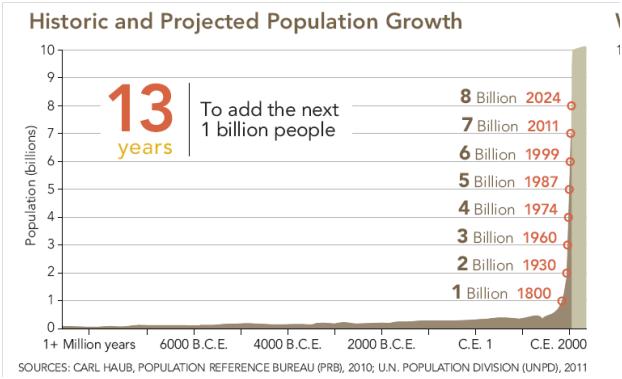
Predictions by the Intergovernmental Plan on Climate Change (IPCC) and most scientists, strongly suggest that we may be creating our next genocide ourselves; a “business as usual” scenario over the next 70 years (the expected lifespan of my grandchildren – my definition of “Now” in the book) will result in doubling of greenhouse gas emissions. Emissions at these levels would result in major extinctions around the globe, with more than 40% of ecosystems destroyed. The belief that we are not part of the ecosystems is a dangerous hubris. We have just passed the 7 billion population mark and even if we take the 40% prediction with a large grain of salt, we are talking about the potential genocide of billions of people.

Arnold Toynbee wrote that civilizations die from suicides, not murder. Even if the predicted consequences of “business as usual” environmental scenarios over the next 70 years turn out to be wrong in some details and even slightly wrong in timing, it’s clear that once we pass a critical point in the ability of the planet to adapt to the accumulation of greenhouse gases in our atmosphere, the consequences amount to global suicide – a self-inflicted genocide. We know what we must do to mitigate this possible future genocide, but we need our collective will to do so. We can’t allow the deniers to win again.

Thank you for reading this and please let me know what you think.

-Micha Tomkiewicz

Posted in Anthropogenic, Climate Change, Education, Sustainability | Tagged , , , , , , , , , , , , , , , , , , , , , , , , , , , , , , , , , , , , , , , , , , , , , , , , , | 84 Comments