
Declaration of Victory and Exit Strategy

The title of my previous blog was “Declaration of War.” I wrote:

In the next few blogs I will try to expand this notion to include non-military action, with a specific focus on climate change. My objective is to look into how we can define a victory, as well as be able to outline an exit strategy.

I didn’t elaborate whom the war and victory were directed against, so I will try to do so now.

Anthropogenic (human-caused) climate change is a global phenomenon to which all of us contribute, and whose consequences all of us, particularly future generations, will suffer. In this sense, it is a global civil war of man against man and man against his physical environment. My use here of the term global is not restricted to humans but includes the physical environment, since the issue will affect our entire ecosystem. This complements my expanded definition of Science (June 25) that now includes human behavior. As in any other war, victory will be declared when we can stop fighting the physical environment by making our lifestyle compatible, thus ending the struggle.

I obviously have to be much more specific. The four figures below illustrate two possible scenarios out of the more than 40 on which the IPCC is reporting. We can declare “victory” and exit the battlefield if by toward the end of the century we can derive more than half of our global energy from non-fossil sources, a development that would approximately follow the dynamics of B1 in Figure 4.

IPCC Ecosystem Risks Fork

Figure 1IPCC projections of future impact of climate change based on two different scenarios
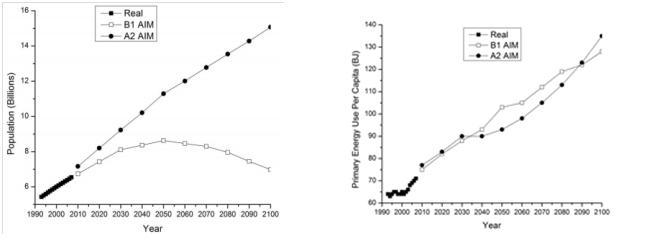
 

                               Figure 2                                                                 Figure 3

Projections of Population and primary energy use based on the IPCC AIM B1 and A2 scenarios (Micha Tomkiewicz, Sustainability, 2, 204-214 (2010)).
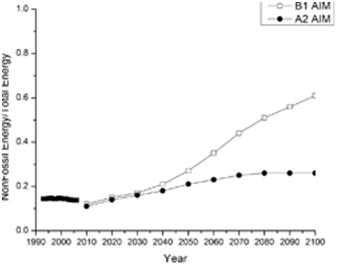
 

Figure 4

Projections of the fraction of non-fossil energy use based on the IPCC AIM B1 and A2 scenarios (Micha Tomkiewicz, Sustainability, 2, 204-214 (2010)).

Figure 1 shows the projected temperature increase and the environmental consequences of two future scenarios marked as A2 and B1. These are just two of the more than 40 scenarios that IPCC is reporting on, with the explicit statement that none of them is any more likely than the others. Our outcome depends on our choices. All 40 of these scenarios lead to a higher standard of living. The present (2000) average global GDP per capita is about $5,000. Toward the end of the century, the A2 scenario projects a GDP per capita of $16,000 while the B1 reaches an astonishing number of $47,000 (SRES. 2002. “The SRES Emissions Scenarios.” http://sedac.ciesin.org/ddc/sres ). Both numbers reflect dollar values that have been adjusted for inflation. Thus, the B1 scenario implies an average global standard of living equal to that presently found in the US.

From Figure 1, the A2 scenario reflects the projected outcome of a “business as usual” scenario: a boundless increase in temperature. The figure goes on to note some of the expected consequences of such circumstances. In the B1 scenario, the impact stabilizes to a global temperature increase of roughly 2.5oC (4.5oF). An increase that leads to saturation at this level can be handled through adaptation policy (particularly with the available wealth in this scenario). There are two major differences between the two scenarios: population and the fraction of energy derived from non-fossil sources. Figure 2 addresses population: in A2, the projected global population toward the end of the century reaches around 15 billion, while B1 peaks around 8 billion mid-century, then declines back to the present population of 7 billion by 2100. Figure 4 describes the fraction of energy derived from non-fossil sources: A2 increases slightly to 25% toward the end of the century while B1 increases to close to 60%. Amazingly, the two scenarios project the same energy use per person (Figure 3), a factor that continues to increase, driven by the projected global increase in the standard of living. The total energy use in A2 is obviously much larger compared to B1 because of the larger projected population. The difference in projected populations between the two scenarios looks to be very large; however, it amounts to less than 1% global population growth. Such is the power of exponential growth.

As has been proven time and again, population growth is impossible to control politically from top down. Repeatedly it is being proven that the most effective mechanisms for birth control are educational opportunities and health care availability, especially for women. Both usually accompany the projected increase in the standard of living.

Based on such scenarios, the remedy is available through collective decision making, i.e. – the political system, the extent to which we use non-fossil fuels to generate our energy, etc.

Achievement on the line described in Figure 4 amounts to a global energy transition. For a global impact, such a shift implies a considerably enhanced shift in developed countries. Aiming for something close to such a shift amounts to an exit strategy; achieving it would count as a tremendous victory. The next blogs will discuss various aspects of the policy changes and technical issues that such a shift involves.
Posted in Climate Change | Tagged , , , , , , , , , , , , , | 11 Comments

Declaration of War

“After the end of [the] Persian Gulf War in 1991, Colin Powell, then chairman of the Joint Chiefs of Staff, outlined his vision for efficient and decisive military action.” This vision is now known as the Powell Doctrine. The last condition for the Powell Doctrine is that “there must be a clear exit strategy from the conflict in which the military is engaged.”

In the next few blogs I will try to expand this notion to include non-military action, with a specific focus on climate change. My objective is to look into how we can define a victory, as well as be able to outline an exit strategy.

A presidential election campaign is a referendum on how best the nation should proceed. The next two months should provide a strong indication as to our collective willingness to make peace with our physical environment. My last blog (September 10) tried to draw some inspiration from the two presidential candidates’ concluding speeches of their respective conventions. We did find some abbreviated information on their intended action but the information took the form of slogans.

Two other sources that came to light during the conventions were the party’s platforms and a set of science related questions from the organization ScienceDebate, to which the candidates provided written responses. This blog will summarize the climate-change related information in these documents.

From the 2012 Republican Platform

Coal is a low-cost and abundant energy source with hundreds of years of supply. We look toward the private sector’s development of new, state-of-the-art coal-fired plants that will be low-cost, environmentally responsible, and efficient. We also encourage research and development of advanced technologies in this sector, including coal-to-liquid, coal gasification, and related technologies for enhanced oil recovery.

The current Administration – with a President who publicly threatened to bankrupt anyone who builds a coal-powered plant – seems determined to shut down coal production in the United States, even though there is no cost-effective substitute for it or for the hundreds of thousands of jobs that go with it as the nation’s largest source of electricity generation. We will end the EPA’s war on coal and encourage the increased safe development in all regions of the nation’s coal resources, the jobs it produces, and the affordable, reliable energy that it provides for America. Further, we oppose any and all cap and trade legislation.

We encourage the cost-effective development of renewable energy, but the taxpayers should not serve as venture capitalists for risky endeavors. It is important to create a pathway toward a market-based approach for renewable energy sources and to aggressively develop alternative sources for electricity generation such as wind, hydro, solar, biomass, geothermal, and tidal energy. Partnerships between traditional energy industries and emerging renewable industries can be a central component in meeting the nation’s long-term needs. Alternative forms of energy are part of our action agenda to power the homes and workplaces of the nation.

From the 2012 Democratic Platform

We know that global climate change is one of the biggest threats of this generation—an economic, environmental, and national security catastrophe in the making. We affirm the science of climate change, commit to significantly reducing the pollution that causes climate change, and know we have to meet this challenge by driving smart policies that lead to greater growth in clean energy generation and result in a range of economic and social benefits.

President Obama has been a leader on this issue. We have developed historic fuel efficiency standards that will limit greenhouse gas emissions from our vehicles for the first time in history, made unprecedented investments in clean energy, and proposed the first-ever carbon pollution limits for new fossil-fuel-fired power plants. As we move towards lower carbon emissions, we will continue to support smart, energy efficient manufacturing. Democrats pledge to continue showing international leadership on climate change, working toward an agreement to set emission limits in unison with other emerging powers. Democrats will continue pursuing efforts to combat climate change at home as well, because reducing our emissions domestically—through regulation and market solutions—is necessary to continue being an international leader on this issue. We understand that global climate change may disproportionately affect the poor, and we are committed to environmental justice.

Answering a Written Question from ScienceDebate:

2. Climate Change. The Earth’s climate is changing and there is concern about the potentially adverse effects of these changes on life on the planet. What is your position on cap-and-trade, carbon taxes, and other policies proposed to address global climate change—and what steps can we take to improve our ability to tackle challenges like climate change that cross national boundaries?
Barack Obama:Climate change is the one of the biggest issues of this generation, and we have to meet this challenge by driving smart policies that lead to greater growth in clean energy generation and result in a range of economic and social benefits. Since taking office I have established historic standards limiting greenhouse gas emissions from our vehicles for the first time in history. My administration has made unprecedented investments in clean energy, proposed the first-ever carbon pollution limits for new fossil-fuel-fired power plants and reduced carbon emissions within the Federal Government. Since I took office, the U.S. is importing an average of 3 million fewer barrels of oil every day, and our dependence on foreign oil is at a 20-year low. We are also showing international leadership on climate change, reaching historic agreements to set emission limits in unison with all major developed and developing nations. There is still more to be done to address this global problem. I will continue efforts to reduce our dependence on oil and lower our greenhouse gas emissions while creating an economy built to last.   Mitt Romney:I am not a scientist myself, but my best assessment of the data is that the world is getting warmer, that human activity contributes to that warming, and that policymakers should therefore consider the risk of negative consequences. However, there remains a lack of scientific consensus on the issue — on the extent of the warming, the extent of the human contribution, and the severity of the risk — and I believe we must support continued debate and investigation within the scientific community.Ultimately, the science is an input to the public policy decision; it does not dictate a particular policy response. President Obama has taken the view that if global warming is occurring, the American response must be to slash carbon dioxide emissions by imposing enormous costs on the U.S. economy. First he tried a massive cap-and-trade bill that would have devastated U.S. industry. When that approach was rejected by Congress, he declared his intention to pursue the same course on his own and proceeded through his EPA to impose rules that will bankrupt the coal industry.Nowhere along the way has the President indicated what actual results his approach would achieve — and with good reason. The reality is that the problem is called Global Warming, not America Warming. China long ago passed America as the leading emitter of greenhouse gases. Developed world emissions have leveled off while developing world emissions continue to grow rapidly, and developing nations have no interest in accepting economic constraints to change that dynamic. In this context, the primary effect of unilateral action by the U.S. to impose costs on its own emissions will be to shift industrial activity overseas to nations whose industrial processes are more emissions-intensive and less environmentally friendly. That result may make environmentalists feel better, but it will not better the environment.

So I oppose steps like a carbon tax or a cap-and-trade system that would handicap the American economy and drive manufacturing jobs away, all without actually addressing the underlying problem. Economic growth and technological innovation, not economy-suppressing regulation, is the key to environmental protection in the long run. So I believe we should pursue what I call a “No Regrets” policy — steps that will lead to lower emissions, but that will benefit America regardless of whether the risks of global warming materialize and regardless of whether other nations take effective action.

For instance, I support robust government funding for research on efficient, low-emissions technologies that will maintain American leadership in emerging industries. And I believe the federal government must significantly streamline the regulatory framework for the deployment of new energy technologies, including a new wave of investment in nuclear power. These steps will strengthen American industry, reduce greenhouse gas emissions, and produce the economically-attractive technologies that developing nations must have access to if they are to achieve the reductions in their own emissions that will be necessary to address what is a global issue.

I couldn’t find any direct mention of climate change in the Republican platform. Instead, I quote the related detailed description of their energy policy, which is targeted at continuing the use of coal as a fuel to power our electricity supply, with a shift to alternative energy sources only once they become cost effective. Governor Romney’s response to the question on the topic from the ScienceDebate team, however, does reference climate change directly. Based on this response, Governor Romney fits my definition of a DNNer (Three Shades of Deniers).

Both the Democratic platform and President Obama’s response to the ScienceDebate questions recognize climate change as “one of the biggest threats of this generation” and list the steps that were taken during the last three years of the Democratic administration to minimize the threats and promise to lead an international effort to minimize the threat. There is no mention, however, of what it will take to win this war.

I will try to expand on this in future blogs.

For another look at this topic, you can visit this Skeptical Science blog post.


Posted in Climate Change | Tagged , , , , , , , , , , , , , | 8 Comments

The Conventions

I watched both the Republican and Democratic conventions.  I was listening for information about where the parties and the candidates stand on the issue of climate change.

In advance of the conventions, the candidates did, in fact, provide written responses to science related questions posed by ScienceDebate, an organization that debates scientific issues, including climate change. The candidates’ written responses to the ScienceDebate questions were summarized in a Scientific American document.

I thought that the comments in the candidates’ speeches would tell us the most about their real position on climate change because of the “ownership” that the candidates had to assume once they agreed to include them

So, today I will focus on the speeches. I will cover the relevant sections in the platforms and in the ScienceDebate responses in my next blog.

In his August 30th acceptance speech in Tampa, FL, the Republican candidate Mitt Romney, mentioned climate change and the essence of his energy policy in two brief sentences:

And unlike the President, I have a plan to create 12 million new jobs. It has 5 steps: First, by 2020, North America will be energy independent by taking full advantage of our oil and coal and gas and nuclear and renewables.

…President Obama promised to begin to slow the rise of the oceans and heal the planet. My promise…is to help you and your family.

President Barack Obama, the Democratic candidate, in his acceptance speech in Charlotte, NC on Thursday, September 5th had this to say:

You can choose the path where we control more of our own energy. After thirty years of inaction, we raised fuel standards so that by the middle of the next decade, cars and trucks will go twice as far on a gallon of gas. We’ve doubled our use of renewable energy, and thousands of Americans have jobs today building wind turbines and long-lasting batteries. In the last year alone, we cut oil imports by one million barrels a day – more than any administration in recent history. And today, the United States of America is less dependent on foreign oil than at any time in nearly two decades.

Now you have a choice – between a strategy that reverses this progress, or one that builds on it. We’ve opened millions of new acres for oil and gas exploration in the last three years, and we’ll open more. But unlike my opponent, I will not let oil companies write this country’s energy plan, or endanger our coastlines, or collect another $4 billion in corporate welfare from our taxpayers.

We’re offering a better path – a future where we keep investing in wind and solar and clean coal; where farmers and scientists harness new biofuels to power our cars and trucks; where construction workers build homes and factories that waste less energy; where we develop a hundred year supply of natural gas that’s right beneath our feet. If you choose this path, we can cut our oil imports in half by 2020 and support more than 600,000 new jobs in natural gas alone.

And yes, my plan will continue to reduce the carbon pollution that is heating our planet – because climate change is not a hoax. More droughts and floods and wildfires are not a joke. They’re a threat to our children’s future. And in this election, you can do something about it.

Both responses include a desire for energy independence. I will discuss my opinion as to the wisdom of such a goal at a later date. Here, I would like to focus on Governor Romney’s comments about his preference to “help you and your family” as “opposed” to President Obama’s preference to “slow the rise of the oceans and heal the planet.”

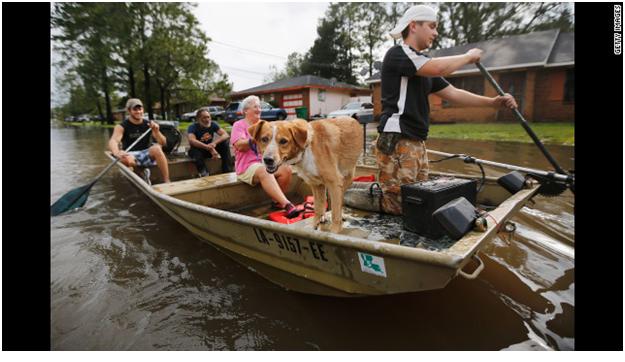
The picture below was taken (Google photo – no attributes) at the same time as the Republican Convention and in close proximity to Tampa, Florida, where the Republican convention took place. It illustrates evacuation efforts from the flooding caused by Hurricane Isaac.

In my interpretation, the young boat drivers are taking care of the family. Governor Romney might help by providing a more efficient transportation means to get the family back to their home as quickly as possible. President Obama (through Governor Romney’s interpretation) might instead put his effort toward preventing the flooding in the first place.

I would rather provide people with boats than watch them drown, but the flooding is indicative of a much larger weather trend.  The record droughts, prevalent hurricanes, and incredibly hot summer, paint a picture of the most immediate and dramatic effects of climate change.  Some percentage of this is anthropogenic (human contributed). That said, what do we plan to do about it?  It is helpful in the short term to have the rescue boat available, but what happens after that?  Our country needs to decide which path to take.  We have options; we simply have to evaluate them.


Posted in Climate Change | Tagged , , , , , , , , , , , , | 4 Comments

Three Shades of Deniers

I wish I had a better name for deniers of climate change.

I don’t like the association with deniers of the Holocaust for reasons that I have mentioned before (May 14 blog) where I have tried to make the case that the analogy exists with the pre-1933 period but not with the post-1945 period. I also don’t like the designation of “skeptics” (August 20 blog) for the reason that the refutability requirement of the Popperian description of the scientific method makes most of us skeptics (that’s probably the reason that most climate change deniers prefer this designation).

I will try to develop something different here and hopefully can do so without unnecessarily offending anybody.

From my own limited experience, I can divide climate change deniers to three different groups that mostly do not communicate with each other:

(1) Deniers of the science. This group basically states that the science is wrong, so there is no need to do anything to counter the impact that scientists predict. Their general tactic is to disagree with some specific piece of the data and then use that as “proof” that the science is wrong in its entirety.

(2) The fatalists. This group fully agrees with both the science and its predicted impact, but believes that since the task of preventing it is so enormous as to be practically undoable, they might as well enjoy life for as long as it lasts. Unfortunately, many in this group are good scientists.

(3) The NIMBY group. I discussed the NIMBY and BANANA phenomena in my last blog. Again, this group believes the science and the predicted impact, but does not want to take responsibility for the steps necessary to mitigate the problem, preferring to pass the task off onto others.

The common denominator in all three groups is the unwillingness to do anything to reduce the likelihood of the predicted impact. In that regard, I suggest we refer to the group using the term DNN, which stands for “Do Nothing Now” (my invention). This is, of course, not to be confused with the “Know Nothing” party of 1850, which doesn’t enjoy a stellar reputation. My only hope is that the term DNNers will not be associated with anything else, so I can use the term until something better comes along.

Among all the DNNers that I am familiar with, the emphasis is not on the science but on the action necessary in order to mitigate the consequences, and the time frame in which that must happen (ie, never, it’s already too late, or now, as long as someone else does it).

One of my favorite exam questions for my courses on climate change reads as follows:

The argument has been made (Dissenting voice in http://climatedebatedaily.com/) that since the projections say that future generations will be much richer than ours, they should pay for the future impacts of climate change. Argue for and against this position.

I don’t ask students to demonstrate any preference, requiring only that they present detailed argument for and against both positions; however, most students show preference against postponing action. The main reason that students provide is that most of the actions possible are time dependent, and the feasibility of remediation quickly decreases the longer we wait.

One of the most famous DNNers, who managed to make a career out of skepticism, is Bjorn Lomborg, author of the The Skeptical Environmentalist. When the book, Taking Sides: Clashing Views on Environmental Issues poses the question “Is Global Warming a Catastrophe That Warrants Immediate Action?” Lomborg’s answer is a definite no. He agrees that climate change is a problem, but adds that he does not see it as the end of the world. He argues that the impact, such as sea level rise, will not be as severe as some have projected and that society can deal with that impact as it comes (I will discuss adaptation in future blogs). He further argues that:

Neither a tax nor Kyoto nor draconian proposals for future cuts move us closer toward finding better options for the future… Instead, we need to find a way that allows us to ‘develop the science and technology in a beneficial way,’ a way that enables us to provide alternative energy technologies at reasonable prices.

In future blogs, I will try to comment on the concept of “energy at reasonable prices,” with the understanding that the concept of “reasonable” in the US is very different from that of “reasonable” in India and other developing countries.

One of the best analogies that I have read about prioritizing remedies came from an address by Luiz Inácio Lula da Silva, the former (2003-2010) president of Brazil, in a reported comment on the European fiscal crisis: “Let’s be frank: if Germany had resolved the Greek problem years ago, it wouldn’t have worsened like this. I’ve seen people die of gangrene because they didn’t care for a problematic toenail.”

In my upcoming blogs, I plan to discuss how we can care for our “problematic toenails” through the development of alternative energy sources, so that we can prevent the spread of gangrene in the form of uncontrolled global climate change.

Posted in Climate Change | Tagged , , , , , , , , , , , , | 14 Comments

Learning From the Olympics: Changing the Competition from NIMBYism to Doing Our Best

The last obstacle to the democratization of decision making on climate change (June 18 blog) is NIMBYism. I have already expanded on the first three obstacles (climate change and the nature of science, science “hatred,” and we are not prophets) in my previous blogs, so I will discuss NIMBYism here. NIMBYism is derived from NIMBY, which stands for “Not In My Backyard.” The essence of the phenomenon is local opposition to proposed new developments, in spite of agreement that they would benefit society at large. In the context of climate change, the most famous examples are wind farms that would replace sources fed by fossil fuels with sustainable power sources. NIMBYism can delay installation for many years and dramatically reduce incentives to implement remedies to a common threat such as climate change. A close “relative” to NIMBY, which goes by the acronym of BANANA (Build Absolutely Nothing Anywhere Near Anything), basically claims that any additional development is an affront to current residents. In the case of wind farms the most common objection, especially if the project is an off-shore installation, such as the one proposed for the Nantucket Sound in Massachusetts, is based on the belief that the large wind turbines will spoil the pristine view. NIMBY, by definition (unlike BANANA), includes a general recognition that the construction is needed by society at large, so an effective way to combat NIMBYism is to appeal to the individual conscience. By promoting and explaining the presumed societal benefits while at the same time trying to refute specific objections (in the case of wind farms: subjectivity of aesthetics, noise, killing birds, etc…), the goal is to emphasize that the overall project will have more positive than negative effects.

Here is what Garrett Hardin wrote as part of his seminal paper “The Tragedy of the Commons” [Hardin, G. Science 162, 3859 (1968)] (see also my July 2 blog in a similar context):

 The long-term disadvantage of an appeal to conscience should be enough to condemn it; but has serious short-term disadvantages as well. If we ask a man who is exploiting a commons to desist “in the name of conscience,” what are we saying to him? What does he hear?- not only at the moment but also in the wee small hours of the night when, half asleep, he remembers not merely the words we used but also the nonverbal communication cues we gave him unaware? Sooner or later, consciously or subconsciously, he senses that he has received two communications, and that they are contradictory: (1) (intended communication) “if you don’t do as we ask, we will openly condemn you for not acting like a reasonable citizen”; (II) (the unintended communication) “if you do behave as we ask, we will secretly condemn you for a simpleton who can be shamed into standing aside while the rest of us exploit the commons.”

The issue goes well beyond local objections to necessary remedies. Climate change is a global issue, and the heat-trapping gases which cause it are emitted by energy sources that constitute 85% of the global energy supply. Any remedy will require a global shift in energy sources, and will have massive economic and socio-economic ramifications. Such a shift requires global implementation to be based on binding agreements between sovereign states. NIMBYism here means “not in my state”. As last year’s Copenhagen attempt showed, the international community is not yet up to the task.

Recently, an unexpected source may have presented new insight into this issue. The xxx Olympiad finished and the Paralympics is about to start, both taking place in London, England.

The Olympic motto is Citius, Altius, Fortius, which is Latin for “Faster, Higher, Stronger”. It was a spectacular show that more than 200 million people watched in the US, in addition to probably more than a billion viewers worldwide.

After the August 12th closing, Mervyn King, the Governor of the Bank of England, was reported as saying this:

For many years, our financial sector sustained the illusion that it was possible to become a millionaire overnight by buying and selling pieces of paper, but we have seen how paper fortunes in financial markets can disappear overnight. Things need to change.

As recent scandals have shown, banks could learn a thing or two about fair play from the Olympic movement. First, and most important, we have been reminded that an objective that is worth attaining, like a gold medal, requires years of hard work. Success does not come overnight.

What he didn’t explicitly say was that most gold medals don’t come with large monetary or publicity rewards. Instead, the athletes get to satisfy the healthy competitive spirit that was immortalized in the song, “Anything you can do, I can do better.”

The NIMBY and BANANA phenomena are competitions for doing nothing. It would be nice to find a substitute and create an Olympics in how best to contribute to the general good. We need countries to compete for finding and implementing solutions, instead of trying to shunt off responsibility to others. If we can get the excitement about scientific breakthroughs to come close to matching that surrounding the Olympics, we will be off to a tremendous start.

Posted in Climate Change | Tagged , , , , , , , , , , , | 4 Comments

We Are Not Prophets II – Back to Deniers and Skeptics and Forward to Insurance.

The issue is not so much the accuracy of the prediction as the magnitude of the impact when the predictions are coming to roost. Our difficulties in predicting the future do not guarantee that the future will be better, there is probably equal chance that the future will come out worse than predicted (from the August 13 blog).

Up to now, the most intense reactions to my blog came in response to my comparisons between climate change deniers and Holocaust deniers. Climate change deniers have expressed resentment toward this analogy, wanting to be labeled skeptics instead. I sympathize with this sentiment, and over the last few blogs I have tried to stop using the term. Here I am returning to this issue – the main reason is that over the last blog I have tried to make the case that we are not prophets and nobody is certain about trying to predict the future. In a sense – we are all skeptics.

Let me frame this as a global insurance issue, by directly quoting a few paragraphs from the last chapter of my book [“Climate Change: The Fork at the End of Now”; Momentum Press – 2011].

Can we insure the survival of the planet as a habitable environment? If the answer is yes, then who will pay the premium?  If climate-change is just a big catastrophic event, then the mechanism of financial preparation should not be much different than the insurance of present catastrophic events. The trouble is that we are not very good at insuring catastrophic events. The present situation of flood insurance is a good example. In the United Kingdom, flood insurance is provided by private insurance, but in the United States it comes through a federally backed insurance system. In France and Spain flood insurance is bundled with other natural perils into a national pooling arrangement, and in Holland it is completely unavailable. The insurance industry is heavily involved in the debate on climate change. “Climate Change is a clear business opportunity for the insurance industry,” declared Shinzo Abe, former Prime Minister of Japan, at the Geneva Association meeting in Kyoto on 29 May 2009 [The Geneva Reports, www.genevaassociation.org, “The Insurance Industry and Climate     Change – Contributions to the Global Debate”, No. 2, July 2009].

The main reason is defensive – the worst thing that can happen to the insurance industry is to grossly underestimate risk. If the planet is becoming progressively more risky after the policy is drafted, then the industry will lose. The objective of insurers is to form a community of the insured where premium payments are sufficient to cover the cost of repairing the damage. The profitability of the insurance industry critically depends on its ability to assess risk, defined as

                        loss potential x occurrence frequency.

To illustrate the risk-premium dynamics of the insurance business, famous Swiss reinsurance company Swiss Re [Peter Zimmerli; Natural Catastrophe and Reinsurance”, Swiss Re Documents (2003)] uses a dice game analogy. The number on the die is the severity of the loss; the frequency is how often the number is rolled.  “Catastrophe” is defined as the point at which 6 is rolled 10 consecutive times or more. We can calculate the probability exactly for such an event to take place, but are we willing to pay against such a low probability event? Insurance is against future losses, not past losses. For past losses we rely on sympathy.

Natural catastrophes such as major floods or earthquakes remain unpredictable in spite of huge technical and scientific advances. According to Swiss Re there is a tendency to underestimate risks relating to natural hazards when a catastrophic event has not occurred for a long time (Just World Hypothesis again).

The loss potential (i.e., direct human loss not planetary loss) of climate change is a direct function of population growth and GDP growth and thus predictable (Special Report on Emission Scenarios [SRES] scenarios). The issue, however, is the frequency of the occurrence. One prediction of the climate change model is the increased intensity of extreme events. Is this prediction solid enough to put our money on (or rather strong enough for the insurance and Re-Insurance companies to put our money on?). Local catastrophic losses can be put in a pool along with a large number of  separate geographical locations with the assumption that the frequency of occurrence in these locations is independent. They must include willingness to pay by policy holders in the pool formation.  If there is a tendency to underestimate risks relating to natural hazards when a catastrophic event has not occurred for a long time, then it is difficult to find payers. One possible solution is differentiated-premium pricing even on a global scale. With sovereign states in control, how this will work within the confines of a regulated insurance environment remains an issue.

The insurance premium is being paid here to take the appropriate steps to minimize the odds for the catastrophic event to take place (in climate change lingo we call this remediation) and not to collect the insurance after the event. It is an insurance we transfer to our grandchildren.


Posted in Climate Change | Tagged , , , , , , | 4 Comments

We Are Not Prophets

We are not prophets. None of us are, but like biblical prophets, we stand on the top of the hill and warn about a coming Armageddon (remember the “self-inflicted genocide” in my first blog post). The tools that we use to try to predict the future are different: the biblical prophets used divine inspiration while we use computer simulations. One attribute that we have in common is that the prophecies are for a relatively distant future beyond the lifetime of the prophets.

In a sense, the Poperian interpretation of the scientific method is about prophecies (see the June 18 blog). It is based on refutability. We develop hypotheses and theories based on everything that we know, then we test these theories. If the tests fail, we change the theory. This amounts to prediction of future results.

One of the best demonstrations of the scientific method came spectacularly to light only recently. On July 4th, the European Organization for Nuclear Research (CERN) announced the experimental observation of the decay of a new particle that resembles the Higgs boson. The Higgs boson was predicted to be the evidence for the existence of the Higgs field, a precursor to today’s elementary particles. The particle and the field are named after Peter Higgs, who predicted the mechanism and the existence of the particle in 1964. At about at the same time, two other teams published papers predicting similar mechanisms. For almost 50 years, experimentalists tried to find such a particle until CERN announced that they found what “looks to be” the long sought particle. The results are still being analyzed to determine the particle’s properties.

Throughout the 50-year wait, many well known physicists made bets about the existence of these particles. A recent article in the New York Times reports on the settlement of some of the debts: Stephen Hawking admits that he lost his $100 bet with Gordon Kane. Guido Tonelli, a CERN physicist that was in charge of one of the groups that did the experiment, said that if he were to collect on all the bets that he made, he would be a rich man. Janet Conrad, a physicist at MIT, admitted to losing her own bet with Frank Wilczek from the same institute. The bet was for 10 chocolate Nobel coins that you can buy in the Nobel store in Stockholm, Sweden.

These are all cute bets on future results, but the stakes are very low. If the Higgs boson had not been found, eventually a new theory would have developed, with different predictions, to occupy the productive time of more physicists. Peter Higgs would probably not have gotten his well deserved Nobel Prize (my “safe” prediction for next year’s prize) but some other well deserving physicist would have been the beneficiary.

I already mentioned another kind of payout in a previous blog (May 7) that describes a letter that was published in the on-line publication Business Insider on April 11, 2012, and signed by 49 former NASA employees. This list included seven Apollo astronauts and two former directors of NASA’s Johnson Space Center, all of whom called NASA to move away from climate model predictions and to limit its stance to that which can be empirically proven. The letter states that, “We believe the claims by NASA and GISS, that man-made carbon dioxide is having a catastrophic impact on global climate change are not substantiated.”  The writers cite reasons for this doubt:

NASA is relying too heavily on complex climate models that have proven scientifically inadequate in predicting climate only one or two decades in advance…There’s a concern that if it turns out that CO2 is not a major cause of climate change, NASA will have put the reputation of NASA, NASA’s current and former employees, and even the very reputation of science itself at risk of public ridicule and distrust.

The emphasis here is the last sentence. If the predictions turn out wrong – we lose face.

In my opinion, the only way to address future uncertainty of the impact of global climate change is through the “purchase” of a global insurance policy that will put resources in mitigation and adaptation. This is not so different from insuring ourselves against fire, theft, or flood. The difference is mainly in scope and the singularity of the threat. I will try to discuss it in future blogs.

The issue is not so much the accuracy of the prediction as the magnitude of the impact when the predictions come to roost. Our difficulties in predicting the future do not guarantee that the future will be better; there is probably an equal chance that the future will come out worse than predicted. This does not relieve us of responsibility, however – in fact, it makes it all the more important that we take steps to minimize possible negative impact – the same as we do with any other insurance policy that we purchase.

Posted in Climate Change | Tagged , , , , , , , , , , , | 4 Comments

Is Algebra Necessary? – Yes It Is!!!

I’ve been living with this question for a long time – starting with my own son when he attended Middle School (he is now 45, a Managing Director in Greenwich Capital, with his own Middle School aged children).

On Sunday, July 29, the question got a renewed focus with an article titled “Is Algebra Necessary?” in the cover Op-Ed of the New York Times, written by Prof. Andrew Hacker, a colleague of mine from the City University of New York.

I am spending my time trying to democratize the issue of Climate Change by writing a book that I have designated as a textbook for the general public; writing this weekly blog; teaching General Education courses on the topic and founding an undergraduate program designed to lower the communication barriers between the Natural Sciences and the Social Sciences.

The common thread in all these activities is an attempt to democratize the necessary decision making process required to address these climate issues that are so essential to continued human existence. I make the point that the main stumbling block we face is the need to expand science education to the general public, so that decisions that are based on interactions between humans and the physical environment will adhere to a common set of principles.

Suddenly, Professor Hacker tells me in his opinion piece that I must do this without algebra. Here are his arguments:

My question extends beyond algebra and applies more broadly to the usual mathematics sequence, from geometry through calculus. State regents and legislators — and much of the public — take it as self-evident that every young person should be made to master polynomial functions and parametric equations.

This debate matters. Making mathematics mandatory prevents us from discovering and developing young talent. In the interest of maintaining rigor, we’re actually depleting our pool of brainpower. I say this as a writer and social scientist whose work relies heavily on the use of numbers. My aim is not to spare students from a difficult subject, but to call attention to the real problems we are causing by misdirecting precious resources.

According to the data in the article, one quarter of ninth graders fail to finish high school. In South Carolina, it is 34% and in Nevada 45%. Algebra, according to this account (based on chats with educators) is the main culprit. Furthermore, he states:

Another dropout statistic should cause equal chagrin. Of all who embark on higher education, only 58 percent end up with bachelor’s degrees. The main impediment to graduation: freshman math. The City University of New York, where I have taught since 1971, found that 57 percent of its students didn’t pass its mandated algebra course. The depressing conclusion of a faculty report: ‘failing math at all levels affects retention more than any other academic factor.’ A national sample of transcripts found mathematics had twice as many F’s and D’s compared as other subjects.

The article makes an argument that not teaching algebra to everybody does not mean not teaching quantitative reasoning:

Quantitative literacy clearly is useful in weighing all manner of public policies, from the Affordable Care Act, to the costs and benefits of environmental regulation, to the impact of climate change. Being able to detect and identify ideology at work behind the numbers is of obvious use. Ours is fast becoming a statistical age, which raises the bar for informed citizenship. What is needed is not textbook formulas but greater understanding of where various numbers come from, and what they actually convey.

He suggests that we replace algebra with “citizen statistics” that will include topics such as personal finance and how to compute the “Consumer Price Index.”   The notion is that we should teach skills to students that will be useful in the job market and should not teach difficult abstract concepts that make them want to drop out of school.

Hacker is talking about the heart of elementary algebra: variables that represent numbers and the rules that apply to these variables. To use a relevant example – any estimate of environmental impact requires an estimate of future growth of quantities such as population and economic activities. With a constant growth rate, this is calculated as exponential growth, and involves calculation with exponential functions related to logarithmic functions. These functions are usually taught in schools in pre-calculus, a level that is more advanced than elementary algebra and only selectively required, depending on the track that students are taking. Many students that take environmental courses have never taken pre-calculus. One can teach exponential growth without relying on exponential functions by instead using the concept of doubling time. However, one needs to manipulate simple one variable equations in order to be able to estimate the needed information. The simplest graphing requires ability to work with slopes, intercept and scale – you cannot do that without elementary algebra.

Even simple things such as unit conversion and percentage calculations need elementary algebra.

Political decisions will need to be made based on interactions with the physical environment. These will require a kind of literacy test for the ability to understand the data on which the decisions are being made. To exclude anybody from mastery of these skills means to give up on them. We don’t want to go in this direction.

There is no question that the teaching of mathematics, perhaps more than any other subject, can be improved. But the “improvement” cannot be done by excluding students that have difficulties. No, we have to redouble our efforts so as to reach these students.

Posted in Climate Change | Tagged , , , , , , , , , , | 8 Comments

Climate Change as a Bridge Maker

For many years, I made my living by teaching Physics and focusing my research activities on alternative (to fossil fuels) energy sources. My primary focus was on solar energy, occasionally straying into nuclear waste disposal, energy storage and related topics. When I went to parties or other activities that involved random close encounters with strangers, conversations often started with the typical prompt of, “What do you do?” I used to respond that I taught Physics. The usual responses were: “Oh! You must be very smart…” or “I always had difficulties with Physics…” These responses almost always had the effect of shifting the chats to safer (less science-y) grounds.

In 1998, the year that marked a large heat wave in Europe and massive death of the Great Barrier Reef corals, I completely shifted my research and most of my teaching to focus on climate change.

Now, the casual conversations start with the same question but they proceed on different tracks. Everybody has an opinion on climate change. The topic is in the news and in the political debate, with deniers, skeptics and action advocates speaking with almost equal, what I call, “messianic fervor.”  It’s a great opportunity to bridge the “two cultures”.

Two weeks ago I returned from a scientific conference on Climate Change in Seattle.  I published the main themes of this conference here, in order to emphasize the interdisciplinary aspects of the field. At that conference I presented two papers.

One of them I am going to briefly describe here: For about five years I have collaborated with Lori Scarlatos, a Professor at Stony Brook University that specializes in game design with educational objectives. Our “game” was initially called “Intelligent Energy Choices”, a name that morphed several times over the project’s various iterations. In this “game” the world is represented by the 25 most populated countries and players take the roles of said countries’ “Heads of State.”  Their job is to advance the well being of their countries without endangering the planet in the process. They do this job mainly through the purchase of energy to support their GDP (Gross Domestic Product) growth. The initial conditions of this “world” are derived from real data taken mainly from the World Bank in a fixed reference year. The reference year we used was 2003 so as to give students the opportunity to compare the world of their design with the evolution of the real world through comparison of their countries’ data with the World Bank data after 2003.

In academic settings (as opposed to commercial settings), we generally present the work in various conferences as we go along, so as to benefit from feedback. We presented aspects of this work in an Energy Conference that took place at Stony Brook. A comment from a conference participant was very revealing and rewarding. He said, “This approach can be used in any field that involves complex societal issues that are anchored on science.”  His particular interest was health care policy.

The Seattle conference on Climate Change was obviously not the only scientific conference on Climate Change that is being held in 2012. Googling “Climate Change conferences 2012” produces 115,000,000 results. I obviously didn’t check for repetitions and relevance, but going through the first 20 entries clearly showed the wide scope of the field, with many entries advertizing themselves as “working at the intersection of environment and human needs”.

The Seattle meeting was organized by an organization called “Common Ground Publishing.”  Common Ground takes:

Some of the pivotal ideas and challenges of our time and builds knowledge communities which cut horizontally across legacy knowledge structures. Sustainability, diversity, learning, the future of the humanities, the nature of interdisciplinarity, the place of the arts in society, technology’s connections with knowledge, the changing role of the university—these are deeply important questions of our time which require interdisciplinary thinking, global conversations, and cross-institutional intellectual collaborations. (From the Program of the conference)

The conference itself was, by the standard of such conferences, rather “intimate.”  It included 250 registered participants from 35 different countries. There were no “skeptics” or “deniers.”  There were no policy makers and there was no press of any sort. There were only “like minded” participants that came from different directions and backgrounds. There was a lawyer from Berkeley who was trying to sue the US for contributing to the drowning of a Pacific island; there were speakers who were trying to map vulnerable locations inhabited by Native Americans in Alaska and the Northwest. There were Intermediate and High School teachers that described efforts to use Climate Change to teach STEM (Science, Technology, Engineering and Mathematics) topics in the corresponding schools, etc…

There were no loud voices or “messianic fervor” – but it was a great time and a good opportunity for extensive networking.


Posted in Climate Change | Tagged , , , , , , , , , | 5 Comments

Dislike of Science – Who Is To Blame and What Is Being Done About It?

As was mentioned in previous blogs (see for example the June 18 blog), one of the main challenges to democratization of the climate change issue is the public dislike of science. As a result, public ignorance of the driving forces of climate change and the consequences of inaction constitute a serious threat. Our contributions to chemical changes in the atmosphere alter the energy balance with the sun, and hence, the climate (see July 9 blog); it is dangerous that people cannot recognize this.

To democratize complex issues such as climate change, the global voting public needs to be educated in the fundamentals of science and be comfortable dealing with data and numbers. The alternative is to hire epistemological lawyers that make decisions for us. Many scientists would like to serve in this role (see May 21 blog) – but we can do better.

This is a big job that will take a long time. It can be done through the educational system but we have to remember that climate is global so it has to include everybody. But we also have to remember that the global illiteracy rate is more than 10% (2011). This includes overly populated countries such as India (24%) and Bangladesh (44%). We saw (July 9 blog) that even in developed countries such as the US (14% lack Basic Prose Literary Skills), close to 50% of the population do not believe in evolution or climate change, but 77% do believe in the possibility that extraterrestrials have visited earth. In my (optimistic?) estimate it will take a few generations to accomplish the educational objectives that will allow informed, individualized, decision making that will formulate collective policies such as efforts for mitigation and adaptation to climate change. We cannot give up and we have to start now.

Given the sorry state of science education and the general failure of many education models, we simply have to do better, and we have to engage more people in this effort, We have to start to build bridges. Fortunately, the need for this is getting some recognition. This blog, and others like it, are a manifestation that technology is a big help.

My audience here is the World and I am getting feedback in form of comments, emails and tweets from all over the world. A few years ago, the only “audience” that I could approach was my students and my family. I am paid to enable my students to learn, but with my family I have to be careful- I cannot cross the line into preaching. I cannot even attempt to give them the skills necessary to make the judgment by themselves; I can only hope that the school system will do the job. With students, it’s a bit easier because they are paying me to provide them with the skills.

In this respect, teaching science is more difficult than teaching any other subject because it’s more vertical. One set of skills is being supported by a different set of skills that need to be mastered first. In academic lingo we call these prerequisites.

Here is how bridges can be built:

  • Professionals will have to learn how to be “bilingual” – in other words, scientists will have to learn how to talk to non-scientists without scientific jargon. An AP report by Karl Ritter quotes US climate scientist Robert Corell speaking to his fellow scientists at a meeting in Copenhagen on the melting of the Arctic ice: “Stop speaking in code. Rather than ‘anthropogenic,’ you could say ‘human caused”.

“There’s a kind of frustration on the part of many scientists about not being able to get points across to the public,” said NAS president Ralph Cicerone; as examples, he pointed to Earth’s age, biological evolution, the teaching of evolution, and climate change. Arthur Lupia, a political science professor at the University of Michigan, said scientists must revise their approach to communication in order to compete for the attention of their audience. “Failure is common in attempts to communicate on science with the public. Attention is scarce, and working memory is very limited in capacity,” he said. “We don’t get a free pass because we are experts.” His advice to educators is to appeal to the core values, fears, and aspirations of the listener, “not by dumbing things down, but by smartening up how we convey what we know.” Doing that requires using concrete examples that the audience cares about, not abstractions.

  • Colleges, universities, and even high schools, will have to learn how to be both thematic and disciplinary, covering topics like climate change, evolution, cosmology, the history of the atomic bomb, etc. in addition to traditional physics, chemistry, political science, history, etc. Many colleges and universities, including my own, include general education requirements for the entire student population. The general education includes science requirements. In the discussion about what kinds of courses to include, there is often tension between disciplinary and interdisciplinary topics. One of the arguments against interdisciplinary courses is that students need to master the disciplines before they can approach the interdisciplinary topics. On the other hand, there is an opportunity to use these general education courses as a recruiting ground for the disciplines that constitute the basic departments of all of our schools. I will expand on this issue in future blogs.
  • Public communication tools such as newspapers, TV, radio, books, internet, blogs, etc. will have to learn how to avoid sentences such as “many scientists say….” and will instead hire people that can explain issues from first principles without the use of code words.

In a recent opinion page in the New York Times, David Leonhardt writes about the difficulty of relying on either carbon tax or cap-and-trade policies to promote a switch to different energy sources. He speaks of the necessity of combining methods- raising the price of “dirty” energy, while fostering new solutions. Maybe there is an alternative way to achieve the objective:

Those others things, in the simplest terms, are policies intended to help find a breakthrough technology that can power the economy without heating the planet. “Our best hope,” says Benjamin H. Strauss, a scientist who is the chief operating officer of Climate Central, a research group, “is some kind of disruptive technology that takes off on its own, the way the Internet and the fax took off.”

It might just be that the “disruptive technology” could be educating the general public to accept higher energy prices if they are needed to prevent irreversible atmospheric chemical changes that might lead to catastrophic climate consequences. There is no law that I know about that says energy prices must remain as low as they are now in the US. They are already much higher in most of the world.

Posted in Climate Change | Tagged , , , , , , , , | 1 Comment