Happy New Year: We are Now Part of Nature

My intention was for this to be a very positive blog, focusing on what I have learned during 2012 from my students and all the commentators that posted their comments on this blog, emailed me directly their comments or expressed them in any other form. There has been a lot for which to be thankful. I started this blog in April— I was reluctant to engage and totally inexperienced. The staff of LCG Communications  has encouraged me and held my hand along the way. Some of my students have added their comments here on issues that that were discussed in class, while another class, which was focused on adaptation to Climate Change in New York City, presents their findings on a web page.

A few days ago, my focus changed. I got an unsolicited email from an organization called Science and Environmental Policy Project (SEPP).

This organization was founded by Fred Singer in 1990 and is privately financed. It can be “safely” categorized as a denier site, even with all the reservations for the term that I wrote about in earlier blogs. The email was basically a solicitation for a contribution. I would have ignored it, however it started with a “quote of the week,” given below:

Quote of the Week:

Is this what science has become? I hope not. But it is what it will become, unless there is a concerted effort by leading scientists to aggressively separate science from policy. The late Philip Handler, former president of the National Academy of Sciences, said that “Scientists best serve public policy by living within the ethics of science, not those of politics. If the scientific community will not unfrock the charlatans, the public will not discern the difference-science and the nation will suffer.” Personally, I don’t worry about the nation. But I do worry about science.

Michael Crichton [H/t Gordon Fulks]

The quote, from Michael Crichton, refers to a quote from Gordon Fulks. Michael Crichton was a productive and great writer. He is a writer of bestsellers such as The Andromeda Strain (1969), Jurassic Park (1990), Rising Sun (1992), Timeline (1999) and Prey. I have read most of his books and greatly enjoyed them. He was a Medical Doctor that graduated from Harvard and did his postdoctoral training at the Salk Institute.  He died on November 2008. In 2004 he wrote The State of Fear, in which he accused scientists of being alarmists about Climate Change in order to increase their research grants. I have recommended that my Climate Change students read this book as an enjoyable entry to the deniers’ world. Crichton taught Anthropology and Writing, but he was not a practicing scientist.

Gordon Fulks was a physicist who served as an academic adviser to the Cascade Policy Institute. The following sentence, which caught my attention, is attributed to him: “Scientists best serve public policy by living within the ethics of science, not those of politics. If the scientific community will not unfrock the charlatans, the public will not discern the difference – science and the nation will suffer.” I don’t want to interpret the statement as a declaration that the ethics of scientists are “naturally” superior to those of politicians so I will interpret it as a call for the two to be separated. This presents a serious problem – if the call is to separate the two – why should the politicians fund the scientists?

One might argue that Michael Crichton  and/or Gordon Fulks have questionable qualifications to speak for science.

Well – I am member of a professional society whose members claim to be the ultimate culmination of science – the American Physical Society. A few weeks ago, I posted a blog (December 10) which described some of the reactions that I got from Physics faculty members during a seminar that I gave on Climate Change. A comment to this post suggested declaring that I would not consider a thoughtful response from anybody that hadn’t published at least two articles on Climate Change in peer reviewed publications. Such a “policy” would create a serious problem. I have argued before (May 7) that the last thing we need is to appoint climate scientists to be our epistemological lawyers. Physicists, regardless of their publication record, should have opinions on such issues and, like everybody else; they have a full right to be listened to.

I will climb higher: The American Physical Society (APS) is the professional home to about 50,000 physicists, me included. On November 18, 2007 they issued a statement about Climate Change, shown below.

Emissions of greenhouse gases from human activities are changing the atmosphere in ways that affect the Earth’s climate. Greenhouse gases include carbon dioxide as well as methane, nitrous oxide and other gases. They are emitted from fossil fuel combustion and a range of industrial and agricultural processes. The evidence is incontrovertible: Global warming is occurring.

If no mitigating actions are taken, significant disruptions in the Earth’s physical and ecological systems, social systems, security and human health are likely to occur. We must reduce emissions of greenhouse gases beginning now. Because the complexity of the climate makes accurate prediction difficult, the APS urges an enhanced effort to understand the effects of human activity on the Earth’s climate, and to provide the technological options for meeting the climate challenge in the near and longer terms. The APS also urges governments, universities, national laboratories and its membership to support policies and actions that will reduce the emission of greenhouse gases.

Similar statements came from other scientific professional societies to constitute the evidence that “most” scientists do agree with the spirit of the statement.

Most is not all. Some very prominent physicists did not agree. Among them are such towering (but retired) physicists as Freeman Dyson and the Nobel winner Ivar Giaever, who left the Society as a result of the statement. This led to a petition to either retract the statement or to seriously modify it. The petition was overwhelmingly rejected by the membership (One blogger gave it 0.45% acceptance by the membership). However, as a direct result of this interest, a new division of the Society was formed that is dedicated to Climate Change. The new division is the “Topical Group on the Physics of Climate” (GPC). The following paragraph is a centerpiece of the guidelines to this new group:

The objective of the GPC shall be to promote the advancement and diffusion of knowledge concerning the physics, measurement, and modeling of climate processes, within the domain of natural science and outside the domains of societal impact and policy, legislation and broader societal issues. The objective includes the integration of scientific knowledge and analysis methods across disciplines to address the dynamical complexities and uncertainties of climate physics. Broad areas of initial scientific inquiry are described in the Areas of Interest below. These are expected to evolve with scientific progress, while remaining entirely within the domain of natural science.

The first sentence in this paragraph is for me the key to the thinking:  “The objective of the GPC shall be to promote the advancement and diffusion of knowledge concerning the physics, measurement, and modeling of climate processes, within the domain of natural science and outside the domains of societal impact and policy, legislation and broader societal issues” – in other words, ignore the human impact – concentrate on the science. This emphasis is being enforced in the guideline for submission of talks in a conference – “Contributed talks should focus on climate physics, without reference to issues of policy, legislation, or society. The Focus Session may include one or more invited presentations (from email distributed to members).”

This still, in my vocabulary, puts them in the deniers category (September 3 blog).

The high point in this saga can probably be found in the December issue of the journal “Physics Today,” the membership journal of the American Institute of Physics. To summarize 2012, the editors have tried to answer the question, “Which items on Physics Today’s website were the most popular in 2012?”.

Here is the direct quote from the email that I received as a member before delivery of the journal:

“The most popular item on Physics Today’s website in 2012 was not our coverage of the discovery of the Higgs boson or the announcement of the year’s Nobel Prize in Physics. The top spot went instead to David Kramer’s short news story, “NASA announces a new Mars mission,” which appeared on 22 August in the Politics and Policy department. Apparently, the story owes its popularity to being picked up by Reddit, a social news site. Of course, the story is also a concise and informative summary of a future mission!

Science controversies past and present

Besides the capriciousness of what gets picked by social media or online aggregators, online popularity lists also reveal what people care most about. The second most-viewed item in 2012 was a feature article from October 2011. In “Science controversies past and present,” Steven Sherwood placed anthropogenic climate change in the same category as Nicolaus Copernicus’s Sun-centric solar system and Albert Einstein’s theory of general relativity—that is, as a once-controversial idea that would later become widely accepted. The possibility that anthropogenic climate change might be empirically vindicated riled some online readers enough to comment extensively on the article and to share it with their skeptical friends, acquaintances, and colleagues. The article continued to attract (mostly hostile) comments for months after it had originally appeared.

Richard Somerville and Susan Hassol’s feature article, “Communicating the science of climate change,” appeared in the same issue as Sherwood’s and was the third most viewed article of 2012. The most recent comment was posted last month! In fifth place came Steven Corneliussen’s Science and the Media column about a news story in the 27 April issue of Science magazine. The story’s topic was a claim, published in Physical Review Letters, that the classic formula for the Lorentz force is inconsistent with Einstein’s special theory of relativity. Corneliussen is not a physicist, but evidently his journalistic nose for provocative science proved acute.

More climate change

“You should resign, and if you don’t, I’ll work to see that you are fired” is one example of the threats that climate scientists have received for claiming, on the basis of their experiments, simulations, and theories, that humanity’s emission of greenhouse gases is warming Earth’s troposphere. Physics Today’s Toni Feder reported on those threats and the impact they’re having on climate scientists’ lives for February’s Issues and Events department.

Her story was the sixth most-viewed item in 2012. Like the magazine’s other coverage of climate change, it attracted vitriolic comments, including this one, which, while seeking to downplay the story, inadvertently exemplified the hostility that climate scientists face:

“Oh, puleeeeze…”

I think that being put into the same category as “Nicolaus Copernicus’ Sun-centric solar system and Albert Einstein’s theory of general relativity” is a great place to start 2013.

Posted in Climate Change | Tagged , , , , , , , , , , , , , , , , | 1 Comment

A Stuttering Energy Transition


Figure 1

The EIA (Energy Information Administration) data (see October 15 blog) clearly shows that the US is in the midst of an energy transition. It may not be exactly the one needed to mitigate climate change – but we’re certainly on our way there through some fortunate, market driven, intermediaries. In this case, the transition has mostly been from heavy reliance on coal to a dominant use of natural gas. Parallel to this transition we see a more welcome, not yet market driven, transition away from fossil fuels. Considering that the estimated lifetime of a power plant is about 40 years, we still have many coal power plants to retire, but we at least have time to do so. Such is the nature of a transition. However I don’t expect such a transition to be particularly smooth, consisting of regular replacement of fossil energy sources with less polluting ones. I expect it to be a stuttering transition that requires our full collective ingenuity. Let me try to describe here some of this stuttering.

Recently, the British government did the “right thing.” They announced changes in energy regulations (New York Times – 11/24/2012) that are intended to encourage use of alternative energy sources and nuclear energy while at the same time ensuring that enough power will be supplied to satisfy future energy needs. As reported, the changes increase the levies on consumers and business to help support electricity generation, based on low carbon sources to a total of £9.8 billion by 2020 from the present £2.35 billion. This is, by any other name, a carbon tax that is being collected on top of the Cap and Trade policy that they already share with the rest of the European Union, but with a specification of how the money is intended to be used. This should add about 2% to an average electrical bill. The British government is concerned that the European Union (EU) will raise objections because the EU is against any government support of mature technology (in this case – nuclear).

Direct solar energy, such as photovoltaic and photothermal, don’t show up in the American electricity production in Figure 1. Its share, while still too small to register, is growing fast. Figure 2 shows changes in cost per kWh (kilowatt hour) from 2005 with projections to 2031. The Figure also shows the projected intersection with projected average electricity cost around 2020. Figure 3 shows a major consequence of the price decrease: the global increase in solar cell production over the last 12 years. However, Figure 4, taken from the same source as Figure 3, shows the global distribution of the production effort in 2010. Close to half of the production has originated in the People’s Republic of China.

Figure 2

Figure 3

Figure 4

This distribution and price structure has major consequences.

Solyndra, a California-based solar panel manufacturer, declared bankruptcy in August 2011 after having received $528 million in federal loan guarantee (Story in NYT – 11/30/2012). The loan guarantee was part of the 2009 stimulus package, designed in part to help create jobs in new, non-carbon-based, energy industries. It became one of the loudest focal points of the 2012 presidential elections and subject to congressional investigations that focused on the hazards of the government picking winners and losers in the alternative energy industries. The main reason for the bankruptcy was the sharp drop in price – partially created by the lower cost of Chinese cells, which flooded the market with considerable help from the Chinese government. Solyndra and the American taxpayers were not the only casualties. Figure 5 shows the stock price of one of the better-known American solar cell companies – First Solar. Those who bought the stock at around $50 in February, for example, didn’t do so well – for the same reasons that Solyndra went bankrupt.

Figure 5  

Did the Chinese do better? As it turns out, China’s manufacturing capacity in photovoltaics and wind turbines soared even faster than the world’s demand did, creating a large over-supply and a consequent price drop. Great for a global energy transition, but not so great for the manufacturers, their employees and the State and the banks that helped to finance them (New York Times 10/5 20012).  In the current situation, many of the manufacturers end up loosing $1 for every $3 they sell. The lower costs are still considerably higher per-energy unit when compared to the energy generated by the plentiful coal in China – thus contributing to a global energy transition, but not necessarily to a transition in China.

The dynamics of replacing coal with wind power (another form of solar energy that does show up in Figure 1) went through similar setbacks to those I have explored for photovoltaics. Since the numbers here were greater (and the manufacturers were located in more competitive states for the presidential election), the US has decided to impose 30% duties on Chinese turbines – thus increasing their price and most likely slowing the transition.

Since, to quote Governor Romney, Climate Change is being referred to as Global Warming and not American Warming, price competition in energy sources designed to remedy the situation should be welcomed as important contributions to a solution and not developed primarily as a job creation activity. The same holds for the aspiration, expressed by both parties, for energy independence.

Posted in Climate Change | Tagged , , , , , , , , , , , , , , | 41 Comments

Vive La France

The Festival of Lights in Lyon, France, expresses gratitude to Mary, mother of Jesus, on December 8 every year.

My French 2nd cousin who lives in Paris emailed me that this year, one central display, shown below, was being powered by electrical power generated by visitors exercising on specially equipped exercise bicycles.

The two photographs below were taken from here.

Festival of Lights – 2012 – Lyon – France

What a great idea! I immediately thought about Times Square in NYC, where I live, and how to apply the same concept. My second though was – we need some numbers.

Times Square, NYC

A photograph of a power generating exercise bicycle is shown below. I didn’t do market research, but a superficial inquiry informed me that there are few American manufacturers of such bikes, and presently their main use is as exercise bikes with the generated electricity delivered back to the electrical network to compensate for some of the equipment costs.

 Power generating exercise bike

A top shape athlete can generate up to 500 Watts on one of these bikes, while an “average” patron can generate 200 Watts.

I went to Times Square in NYC for an estimate of what it would take to illuminate some of the displays there. On a previous occasion, for a different use, I tried to find out the electrical consumption of the advertising displays in Times Square. I was not able to get the information. So, for the present objective I have tried to estimate the needs.

The power requirement of a P10 Outdoor SMD LED display is 1200 Watts/m2  (111.5Watts/ft2). A logical place to put the bicycles would be in the heart of Times Square between 45th and 47th streets, along 7th avenue. Since most of this area is traffic free, it could easily accommodate the bikes. The length of this stretch is about 500 ft. If we covered the area with a continuous stretch of 100m2 (1076ft2) displays of 4/3 aspect ratio (37.7ft length and 28.5 ft height) we will need 27 displays. This will amount to 29,050ft2 of display area that will require 3.2MW (Megawatts or million watts) power. This is the approximate power that can be generated by one large wind turbine or 16,000 active, “mediocre” exercise bikers. This is a large crowd for this stretch of New York City. The bikers would have the obvious incentive that exercise would enable them to see a popular great site illuminated, while at the same time keeping themselves in shape and reducing the carbon footprint on the environment.

If I need such a large crowd of sweating bikers for Times Square – how can Lyon pull it off?   My French cousin went to work to get additional information. He was able to contact a person in Lyon’s City Hall, who provided some enlightenment. For the animation, which is named “Magic Cube,” 30 bikes were wired to the cube. Over four days, 10,000 visitors used the bikes. The Cube, like any other display, was plugged into the electrical network, and draws its power from a “conventional” (in France more than 70% powered by nuclear power) grid – not the bikes. The bikes are used instead to change/modify the colors of the Cube.

I found this a bit disappointing, but if nothing else, it re-emphases the need to get more data on what is currently possible, and what could become possible for the future.

Posted in Climate Change | Tagged , , , , , , , , , , , | 3 Comments

Two Shades of Audience

Over the last two weeks, I was invited to give two different talks. One was to take place as part of another school’s Physics Department’s seminar program, and the other as part of an Economics Student Club at my own school. The economics meeting, which was organized by students, was a joint presentation with an Economics professor and was designed to show two perspectives in the need for an energy transition from “green to business” model.

I decided to think about the two talks as a single unit with some symmetry, and design them accordingly. My impression was that the audience at the Physics Department talk would consist of physics students and faculty, while the audience in the Economics Student Club would naturally be comprised mainly of students majoring in economics. I wanted the message to the physicists to be that career opportunities in physics extend well beyond textbook ideas of physics; that they can aspire broadly to be involved in any activity – it is their quantitative outlook that differentiates them from workers with a different background. To do that, I decided to bring my own career choices, present research activities, and life experiences to the forefront. I was also trying to demonstrate to the economics students that they should devote some of their time to the study of the language and fundamentals of the sciences. Given the consistently increasing interactive role humans have in the physical environment (Climate Change is a prime example here—see my June 25 blog), the physical environment will, in turn (in my opinion), take an increasing role in the economic decisions that society must make.

As often happens on such occasions, the reality turned out to be a bit different. The talk for the Physics Department started with the two figures below.

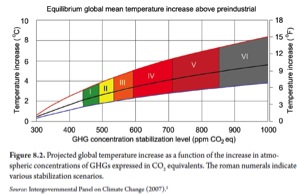
IPCC Equilibrium global mean temperature increase above preindustrialIPCC Ecosystem Risks ForkThese are often used figures that were taken from the last IPCC report (the second figure was already mentioned in my September 24 blog) (I showed much more recent figures, taken from the November 2012 World Bank sponsored report, later in the talk). I regularly use them as a quantitative introduction to my frequent discussion of our much-needed energy transition.

In this particular talk I didn’t go much further in talking about them. I was expecting familiarity with the figures and wanted to get quickly to what I considered the focus of the talk. (I was also working with the probably unconscious expectation that I was not dealing with an audience of deniers) I mentioned the data in the first figure as “simple spectroscopy” – a familiar branch in physics. I did emphasize the uncertainty that is visible in the band of the temperature response to atmospheric consequences of carbon dioxide. The purpose was to differentiate this figure from the second one, which is based on two specific scenarios and represents a projection of the future.

Well – I got a bucket thrown at me (figuratively speaking). The essence of the comments was that this is bad science: much worst science than what physicists are doing for example in figuring out properties of semiconductors— bad science because it cannot be described by a set of differential equations. I was told that in two hours, one of the physicists could come up with his/her own scenario – implying the arbitrary nature of analyzing a future based on projected scenarios. Surely, science with such uncertainty should not form the basis for action that could result in a reduction of our standard of living.

Since I included my Holocaust background (May 14 blog) later in my talk, it was strongly suggested to me to disconnect the two issues, because denying the climate change might lead to denying of the Holocaust.

I ended up in a completely defensive mode that I was not prepared for. In fact, I strongly suspect that what I achieved with the students that were present was the exact opposite of what I had intended.

The dynamics of the second talk were different — calmer. My colleague’s perspective was based on a more general perspective (shared by many economists) that the future, and our ability to predict it, needs to be taken with a large grain of salt. As evidence, he mentioned my data from papers by M. King Hubbert (that I discussed in my October 29 blog post), which showed not only the projected oil supply in the US but also a possible energy transition out of the projected shortage. My colleague did mention the recent advances in technology (Fracking) to drill for natural gas and oil, which are now causing a major shift in our energy usage. An issue that was of great interest to the students was the recent article by Justin Gillis (New York Times, December 5, 2012) titled “To Stop Climate Change, Students Aim at College Portfolios.” I was ambivalent about the tactic, mainly because of its dotted history, but I was admiring the students’ dedication to promote this issue, whose values I share. As far as encouraging studying science, it remains to be seen how effective I was.

Since my objective is to democratize the climate change issue as best I can, it is imperative, at least on my part, to continue to engage with diverse audiences and adapt my response accordingly. This means I will probably meet with varying responses and levels of success in the future, depending on my audience. In any case, it will be a learning experience, hopefully for both my audience and me.

Posted in Climate Change | Tagged , , , , , , , , | 9 Comments

Tackling Environmental Justice: Sovereign State against the Individual.

Last week, I started the discussion of how developing countries can contribute to alleviating anthropogenic (human caused) climate change.  The main goal is to mitigate climate change by achieving a global agreement to transition to more sustainable energy choices. I made mention of the important role efficiency could play for developing countries in using energy resources to enhance their GDP. (Interestingly, the same date that I posted last week also marks the beginning of the COP18 Doha Climate Change Conference to start the continuing efforts to reach global agreements on mitigation and adaptation policies.) Following Sandy’s impact on the most populated region in the States, and President Obama’s recent reelection, there is now some optimism that the United Stated might show heightened leadership in the struggle against climate change. I started the November 26 blog with Governor Romney’s response to a ScienceDebate question about his thoughts on Climate Change. I will repeat the quote here in order to emphasize a different issue:

The reality is that the problem is called Global Warming, not America Warming. China long ago passed America as the leading emitter of greenhouse gases. Developed world emissions have leveled off while developing world emissions continue to grow rapidly, and developing nations have no interest in accepting economic constraints to change that dynamic. In this context, the primary effect of unilateral action by the U.S. to impose costs on its own emissions will be to shift industrial activity overseas to nations whose industrial processes are more emissions-intensive and less environmentally friendly. That result may make environmentalists feel better, but it will not better the environment.

I would like to explore this claim that compares China to the United States in terms of overall responsibility to reduce its carbon footprint by shifting its energy sources. It is important because Governor Romney’s statement can be understood as advocating that as long as China does not reduce its carbon footprint, the US will follow suit, focusing only on R&D in order to not sacrifice economic advantages to China. The argument has a NIMBY (Not In My Backyard) flavor that I discussed in a previous blog (June 18) – we recognize the need to act, but as long as China and other developing countries refuse to get involved, we will deny our own duty.

In the table below I ask undergraduates from my course (General Education – no prerequisites) to use primary sources to collect some relevant data about four countries and the World, and to answer a few questions by evaluating this data. I have filled in part of the table with the appropriate data for 2008 – the last year that data were available for the indicators in which I was interested.  

Fill up the following table:

Rank the four countries in terms of total energy use and CO2 emissions.

  1.   Compare (in %) the top user and emitter with World use and emission.
  2.   Rank the four countries in terms of energy use and CO2 emission per capita, and compare the numbers with global data.
  3.   If the GDP growth continues – how many years will it take China to catch up to the US?
  4.   If the GDP/Capita growth continues – how many years it will take China to catch up to the US?
  5.   What will the World’s GDP be at that time?
  6.   What will the World’s population be at that time?
  7.   If you assume that the last three terms of the IPAT equation will not change – what will the World’s CO2 emission be at that time?
  8.   Assume that only half of the emissions will stay in the atmosphere and that the Climate Sensitivity is 2.50C for doubling the concentration of CO2 compared to the pre-industrial levels – what will the climate consequences of 8 be?

Problems started with the first question – Half of the class has ranked both energy use and Carbon Dioxide emission in the following order – US, Germany, China and India.

Now – try it yourself and make a comment.

Large outcry was heard when answering the second question – “Professor – how it can be that the top energy user (US) is using 417% of the World’s total usage? Isn’t the US part of the World?”

Good question – yes it is. When Governor Romney uses carbon emissions from China and the US as criteria for needed efforts to curtail these emissions – what number should he be using – the number per person or the number per country? For me, it is a simple issue of Environmental Justice – every person is equal in his or her right for economic development, and comparisons should be based on people, not countries.

Posted in Climate Change | Tagged , , , , , , , , , , , | 7 Comments

Tackling Environmental Justice: a Global Perspective.

In a previous blog (November 5) I wrote about Governor Romney’s response to a direct question from ScienceDebate about his thoughts on Climate Change. The elections are now over, but the issues are still with us. I want to discuss here one important and very relevant aspect of his response. I am quoting it below:

The reality is that the problem is called Global Warming, not America Warming. China long ago passed America as the leading emitter of greenhouse gases. Developed world emissions have leveled off while developing world emissions continue to grow rapidly, and developing nations have no interest in accepting economic constraints to change that dynamic. In this context, the primary effect of unilateral action by the U.S. to impose costs on its own emissions will be to shift industrial activity overseas to nations whose industrial processes are more emissions-intensive and less environmentally friendly. That result may make environmentalists feel better, but it will not better the environment

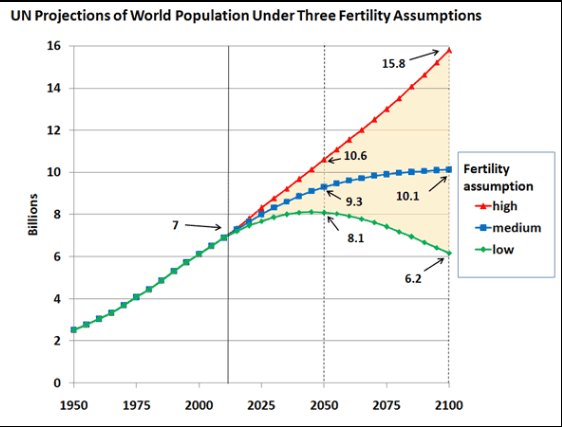
This statement needs to be analyzed carefully, because it holds the key to offering a solution. A year ago (last October) the World population surpassed 7 billion; when I was born in 1939, the world population was about 2 billion. The median UN estimate for 2050 predicts a global population of 9.2 billion, with about 85% of the people residing in what we identify now as developing and less developed countries (this includes China, as singled out by Governor Romney) (Science 333, 540 (2011)).

Here are the 2008 relevant data for China and the US: Carbon Dioxide emissions (in thousands metric tons) – China – 7.031 million; US – 5.461 million; Carbon Dioxide per person (in metric tons) – China 5.3; US – 18; GDP (in current US $) – China – 4.5 trillion; US – 14.2 trillion; GDP per person (US $) – China – 3,414; US – 46,760; GDP growth (in %) – China – 9.6; US – (- 0.4).

I chose 2008, because this was the latest year that World Bank data was available for all the indicators that I chose to post here (I realize that 2008 was the start of a financial crisis in the US and other countries, but not in China).

There is a useful identity that correlates the environmental impacts (greenhouse gases, in Governor’s Romney statement) with the other indicators. The equation is known as the IPAT equation (or I=PAT), which stands for Impact Population Affluence Technology. The equation was proposed independently by two research teams; one consists of Paul R. Ehrlich and John Holdren (now President Obama’s Science Adviser), while the other is led by Barry Commoner (P.R. Ehrlich and J.P. Holdren; Bulletin of Atmospheric Science 28:16 (1972). B. Commoner; Bulletin of Atmospheric Science 28:42 (1972).)

The identity takes the following form:

Impact = Population x Affluence x Technology

Almost all of the future scenarios for climate change make separate estimates of the indicators in this equation. The difference factor of 15 in GDP/Person (measure of affluence), between the average Chinese and average American makes it clear that the Chinese and the rest of the developing world will do everything they can to try to “even the score” with the developed world. The global challenge is how to do this while at the same time minimizing the environmental impact.

The figure below, taken from my book, shows the dependence of the GDP/Person on Energy Use/Person for 26 countries, including both developing and developed countries. The data for this graph were taken from the 2002 CIA World Factbook.

On superficial observation, the dependence in the graph looks linear. Linear dependence indicates that the energy intensity, defined as the ratio of GDP/Energy Use, is constant and independent of the GDP of a country. The energy intensity is a true measure of the efficiency of energy use. The approximate independence of the energy intensity to GDP, directly contradicts the often-heard perception that developed countries use their energy more efficiently than developing countries.

More careful observation shows (Yevgeniy Ostrovskiy, Michael Cheng and Micha Tomkiewicz; “Intensive and Extensive Parametrization of Energy Use and Income in US States and in Global Environments”; International Conference on Climate Change: Impacts and Responses; 12 – 13 July 2012; Seattle Washington) that the energy intensity is weakly dependent on the GDP (inverse square root dependence), not because developed countries are more efficient in their use of energy, but because service starts to play bigger and bigger roles in developed countries and is considerably less energy dependent as compared to heavy industry.

In the next few blogs I will focus on the difficulties in reaching an international agreement on limiting the use of fossil fuel, what China and other developing countries are doing to change their energy use, and how the USA is reacting to these developments.

Posted in Climate Change | Tagged , , , , , , , , , , | 6 Comments

Tackling Environmental Justice: a Local Perspective.

About a week ago, I went to Stony Brook University, where I am collaborating with Prof. Lori Scarlatos from the Department of Technology and Society, in constructing a simulation/game. Its aim is to allow students (and everybody else) to find out how the world would change based on certain key decisions, and then compare the results with the actual world. The simulation/game incorporates 25 autonomous country agents, interacting with a single world entity. Populated with data from the World Bank, British Petroleum, and the US Energy Information Administration, these countries represent 75% of the world’s population, living in both developed and developing countries around the world. The players are the “rulers” of their respective countries and are engaged in their energy management.

To get to Stony Brook, I took the LIRR (Long Island Rail Road) train. On my way (from Brooklyn) I had to change trains twice. I take this trip frequently, approximately at the same departing time and on the same day of the week. On my way, I noticed that the volume of passengers was considerably higher than I used to observe. It might have been completely anecdotal, but my physicist training was trying immediately to correlate it with recent events. I did make an effort to get real data from the MTA (Metropolitan Transportation Authority), which runs the trains, but I didn’t get any response. My immediate next thought was to correlate the volume of passengers with the aftermath of Sandy, which had hit the North East about 10 days earlier and had a major impact on all modes of transportation in the region. One of the longer lasting impacts was the fuel shortage, which forced the governors of New York and New Jersey to ration fuel by imposing odd/even day filling times based on the last digit of cars’ license plates. The order immediately had soothing effects on the length of the lines around gas stations.

My cause/effect association was that people that had difficulty getting gas decided instead to take public transportation. My thinking followed with the “dreadful” and “frightening” thought that such a policy might be considered even in calm times as a possible weapon to fight Climate Change.

About the same time, I read a New York Times (November 9, 2012) article by Casey B. Mulligan titled, “Gasoline Lines are Unnecessary.” The following paragraphs from the article summarize the perspective:

Waiting in line is a waste of time. The people there were certainly not helping bring more gasoline to the region and could instead be helping rebuild or could be productive in other ways.

Economists on the right and on the left agree that market prices – prices that reflect both supply and demand location by location – are much better at allocating scarce resources in extreme situations like the storm’s aftermath. But state and local government regulations, in the form of antigouging laws, effectively outlawed market pricing.

If officials had allowed the price system to work, it would have alleviated lines in a number of ways. As suppliers seek the maximum profit, temporary and extraordinary prices encourage them (and make it affordable for them) to go to extraordinary lengths to get the electricity and fuel needed to have gasoline available to customers where it is needed the most.

Were they permitted, high prices would also have encouraged customers to economize creatively on their usage and acquisition of gasoline. If it had cost $10 or $15 a gallon, some people on those lines might have been willing to delay vehicle usage, leaving more for people who were willing to pay that price or who had no other choice.

The net result from both mechanisms to shorten the gas lines should have produced similar outcome. The makeup of the affected populations, however, would have been different. In the first case, people that didn’t want to be bothered with detailed planning and that could freely choose between public transportation and driving, would have shifted to public transportation. In the second case, people that couldn’t afford to pay the higher gas prices, would have had to shift regardless of planning.

The EPA (Environmental Protection Agency) defines Environmental Justice as:

Environmental Justice is the fair treatment and meaningful involvement of all people regardless of race, color, culture, national origin, income, and educational levels with respect to the development, implementation, and enforcement of protective environmental… laws, regulations, and policies.

The policy advocated by Prof. Mulligan is a clear example of environmental injustice.

New York City is at the forefront of urban areas when it comes to formulating policies that are designed to monitor the effects of Climate Change. In 2007, the city launched PlaNYC2030, to coordinate sustainability planning. It combines 25 city agencies, in preparation for population increase, strengthening the local economy  and mitigating Climate Change. As part of this effort, a panel was created to evaluate NYC’s adaptation needs with regards to Climate Change. The report was issued in 2010. My students are now trying to determine how the city is implementing these recommendations. It is a semester long effort that can be followed online.

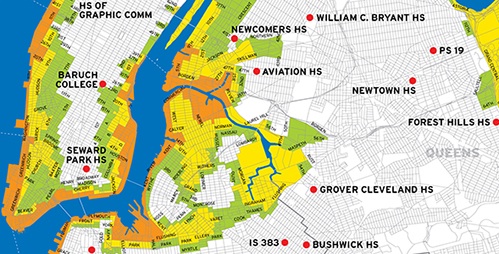
A quick search of PlaNYC2030’s regard for Environmental Justice issues came up wanting. Recently (August 2012), the New York City Council, with support from the Mayor, recognized this omission. In response, they voted in favor of a new bill that would enlarge the purview of the Climate Change Panel and the Climate Change Task Force to focus not only on infrastructure development, but also on populations that are especially vulnerable to extreme weather events – such as the elderly, children and the poor. That legislation also makes the Panel and the Task Force permanent.

In the next blog I will try to show that dealing with Environmental Justice issues on a global scale is not only the right thing to do but is also the key to finding solutions to these problems that affect us all.

Posted in Climate Change | Tagged , , , , , , , , , , , , , , | 1 Comment

Man’s Power Versus Nature’s Power: the Wrong Distinction

I wrote this blog on Wednesday: immediately following the election, a full week after Sandy (I live in NYC – we’ve been trying to fix some of the damage) and in the middle of a new Northeaster that was dumping snow all around me. In the most recent iteration of the battle between “old white men” and the “world,” the “world” won – but just barely. The “world” here specifically includes both the majority of countries outside the United States, which have overwhelmingly supported President Obama (with two notable exceptions: Israel and Pakistan), and the non- “old white men” in the USA (for details see NYT front page November 8). I am an “old white man.” I voted for Obama, but I still don’t break the stereotype – I speak with a foreign accent.

The coincidence of timing between Sandy and the election might have helped Obama, but the most popular reaction that I have heard was focused on the contrast in human power: how powerless we are when confronting Mother Nature, and in contrast, how powerful we are when deciding who will lead us and “solve” some of the most pressing issues on our collective (perhaps global) mind.

Questions were raised as to the insignificance of the issues that we are being called to vote on, when compared to the fury and misery that nature can and does inflict.

Such a contrast in the scope of issues was on my mind in another important occasion. In my younger days I was a soldier on active duty, fighting in a real war; one we viewed as an existential war, especially before the fighting actually started. At that time there was a break in the activities that was used by families for a field visit. My wife came and we started to chat about what was happening in our circles back home. I still remember the disconnect that I felt at the time: how could we worry about these “trivialities” compared to the life and death situations that we were all facing. It didn’t take me long to remind myself that the two coexisting scales of concern were equally real, and that I had better pay attention to both of them, or risk losing both. The visit ended smoothly. I am sure that many veterans that are now, or have recently returned, from a war zone, have experienced a similar disconnect, followed by a similar return to equilibrium.

I can think of three main ways to correlate policy initiatives with mitigation and/or adaptation to extreme weather conditions such as hurricanes:

1. I had a class on Election Day and we were discussing some of these issues. One student showed me a newspaper article with two keywords: “Bill Gates” and “Hurricane.” It caught his attention because Bill Gates was trying to patent a way for humans to fight hurricanes. I had never heard of this attempt but I was curious about this new suggestion to geo-engineer the planet.

Simplified models of the working of hurricanes present them as heat engines that operate between the warm temperature of tropical oceans and the much cooler temperature of the upper atmosphere. They derive their energy from the latent heat of condensation of water. The remedy proposed by Gates et al was to simply pump the deeper cooler water to the surface. This would reduce the surface temperature and thus mitigate the storm. Sounds fine. It makes sense that if hurricanes operate as heat engines between the warm ocean water and a cooler upper atmosphere, the temperature of the water becomes an important factor in its magnitude. Indeed, usually when the hurricane reaches land or moves to cooler water it loses much of its intensity. The problem is that a quick calculation reveals that the energy that a major hurricane stores approaches 200 times the global electric generating capacity. This, in addition to the uncertainty of predicting the storm’s track, would make such an effort challenging.

2. One major impact that has come out in all the recent computer models is the increasing frequency of extreme storms. Since it has also been agreed upon that extreme storms have been around since before human influence on the chemistry of the atmosphere was noticed, it is very difficult, and probably impossible, to determine how much direct human influence can account for in any given weather event. People are trying to do that, and they will probably try even harder in the aftermath of Sandy. They might even come out with some numbers (these might be important for future lawsuits that request compensation from oil companies). Statistical techniques such as the one that was recently published by James Hansen et al show that the frequency of extreme events, whatever their cause, is on the rise. Once Sandy was on the move, an intense debate surfaced over all the communication channels – could Sandy be blamed on climate change, or was it “natural?” One can follow some of this debate in a condensed series of blogs by Andrew Revkin, the New York Times blogger of Dot Earth, which took place over the week between Sandy and Election Day. One of these blogs hit the mark. The title was “On Sandy and Humanity’s ‘Blah, Blah, Blah Bang’ Disaster Plans” and the first two paragraphs state the following:

For millions of people in the New York metropolitan region and adjacent areas flooded, scorched, and pummeled by the extraordinary hybrid storm once known as Sandy, arguments about how much of the storm’s ferocity was human-created are secondary.

Arguments about how to discuss such extreme events in the context of climate policy — while important — are down the list, as well, even with a presidential election days away. After all, that debate is perennial. (Go here for a valuable 2009 discussion of this question in relation to climate change and African megadroughts; plug in hurricanes where you see drought and the pattern will feel familiar.)

Whether “natural” or man-made, adaptation needs to accommodate the increasing frequency of these occurrences. The main issue, as I mentioned in a previous blog (September 24), is that without an effective mitigation policy, the average weather will become extreme— unfit for human habitation.

3. Adaptation: as was mentioned by Mario Cuomo, the Governor of New York, when what should be a hundred-year storm shows up every two or three years – we need to be prepared. We have examples to follow from places that are more vulnerable than New York City: The Netherlands, Post Katrina New Orleans, etc. It is expensive!!

My undergraduate class at Brooklyn College has a class research project to evaluate what New York City can actually do to implement an adaptation policy for climate change that was drafted and published more than two years ago. I will keep you posted on their results.

All three responses are expensive and will require rethinking of policy priorities. Some of them are more practical than others. Doing nothing is also an option, however, as Sandy is showing (so far estimated at 50 billion dollars), this option has its own costs.

Posted in Climate Change | Tagged , , , , , , , , , | 14 Comments

Global Warming and Energy Independence

I have no idea who will win the presidential election tomorrow. The fact is that climate change went almost unmentioned in both campaigns, and was not discussed at all in any of the three presidential debates. Some blame the moderators for thinking that the topic is not a priority for voters, and therefore not raising the issue, but the silence regarding science in the debates didn’t come from a lack of opportunities to raise the issue. As John M. Broder mentioned (New York Times – October 26, 2012) in his The Agenda article titled “Both Romney and Obama Avoid Talk of Climate Change”:

Both President Obama and Mitt Romney agree that that the world is warming and that humans are at least partly to blame. It remains wholly unclear what either of them plans to do about it.

Such a statement needs some support. I have summarized the candidate’s positions, based on their convention speeches and direct responses to a pointed question from ScienceDebate in a previous blog (September 17). The most direct support can be found in the candidates’ responses to the ScienceDebate question, which was re-published in the Scientific American. I will repeat relevant segments here:

2. Climate Change. The Earth’s climate is changing and there is concern about the potentially adverse effects of these changes on life on the planet. What is your position on cap-and-trade, carbon taxes, and other policies proposed to address global climate change—and what steps can we take to improve our ability to tackle challenges like climate change that cross national boundaries?
Barack Obama: Climate change is the one of the biggest issues of this generation, and we have to meet this challenge by driving smart policies that lead to greater growth in clean energy generation and result in a range of economic and social benefits. Since taking office I have established historic standards limiting greenhouse gas emissions from our vehicles for the first time in history. My administration has made unprecedented investments in clean energy, proposed the first-ever carbon pollution limits for new fossil-fuel-fired power plants and reduced carbon emissions within the Federal Government. Since I took office, the U.S. is importing an average of 3 million fewer barrels of oil every day, and our dependence on foreign oil is at a 20-year low. We are also showing international leadership on climate change, reaching historic agreements to set emission limits in unison with all major developed and developing nations. There is still more to be done to address this global problem. I will continue efforts to reduce our dependence on oil and lower our greenhouse gas emissions while creating an economy built to last.   Mitt Romney: I am not a scientist myself, but my best assessment of the data is that the world is getting warmer, that human activity contributes to that warming, and that policymakers should therefore consider the risk of negative consequences. However, there remains a lack of scientific consensus on the issue — on the extent of the warming, the extent of the human contribution, and the severity of the risk — and I believe we must support continued debate and investigation within the scientific community. Ultimately, the science is an input to the public policy decision; it does not dictate a particular policy response. President Obama has taken the view that if global warming is occurring, the American response must be to slash carbon dioxide emissions by imposing enormous costs on the U.S. economy. First he tried a massive cap-and-trade bill that would have devastated U.S. industry. When that approach was rejected by Congress, he declared his intention to pursue the same course on his own and proceeded through his EPA to impose rules that will bankrupt the coal industry.Nowhere along the way has the President indicated what actual results his approach would achieve — and with good reason. The reality is that the problem is called Global Warming, not America Warming. China long ago passed America as the leading emitter of greenhouse gases. Developed world emissions have leveled off while developing world emissions continue to grow rapidly, and developing nations have no interest in accepting economic constraints to change that dynamic. In this context, the primary effect of unilateral action by the U.S. to impose costs on its own emissions will be to shift industrial activity overseas to nations whose industrial processes are more emissions-intensive and less environmentally friendly. That result may make environmentalists feel better, but it will not better the environment.

There is an intrinsic contradiction here that needs further explanation. The contradiction is embedded in the last quoted paragraph in Mr. Romney’s approach:

The reality is that the problem is called Global Warming, not American Warming… Developed world emissions have leveled off while developing world emissions continue to grow rapidly, and developing nations have no interest in accepting economic constraints to change that dynamic.

From here, both candidates have been very vocal about their commitment to use every resource at their disposal to pursue future plans not for a global shift from fossils to renewable and/or nuclear, but instead to ensure American energy independence.

For me, the most disturbing aspect of this strategy came during the second debate, and it came from President Obama:

MS. CROWLEY (the moderator): I — OK. We’ll — you certainly will have lots of time here coming up. I — because I want to move you on to something that — sort of connected to cars here, and go over — and we want to get a question from Philip Tricolla.

Q: Your energy secretary, Steven Chu, has now been on record three times stating it’s not policy of his department to help lower gas prices. Do you agree with Secretary Chu that this is not the job of the Energy Department?

PRESIDENT OBAMA: The most important thing we can do is to make sure we control our own energy.

So here’s what I’ve done since I’ve been president. We have increased oil production to the highest levels in 16 years. Natural gas production is the highest it’s been in decades. We have seen increases in coal production and coal employment.

The debate went on to explore what Obama did or didn’t do to further US independence of its energy supply. If Climate Change is a global issue, why is pursuing energy independence the answer? One of the most disturbing aspects of the President’s reply to this question was not that he didn’t answer the question, but that he didn’t even mention Secretary Chu in his response. The President forgot that Secretary Chu, a physicist and a Nobel Laureate, works for him, and that it’s his job to execute the President’s policy. This omission stood up in another context in this debate – the President’s response to a question about the recent killing of four Americans in the American Consulate in Benghazi, Libya:

PRESIDENT OBAMA: Well, let me, first of all, talk about our diplomats, because they serve all around the world and do an incredible job in a very dangerous situation. And these aren’t just representatives of the United States; they’re my representatives. I send them there, oftentimes into harm’s way. I know these folks, and I know their families. So nobody’s more concerned about their safety and security than I am.

The President continues on this issue:

And when it comes to this issue, when I say that we are going to find out exactly what happened, everybody will be held accountable, and I am ultimately responsible for what’s taking place there, because these are my folks, and I’m the one who has to greet those coffins when they come home, you know that I mean what I say.

Why American diplomats are his representatives and Secretary Chu is not, remains unanswered. The President knew that the energy secretary was referring to two issues in the statements mentioned: that gas prices are determined by international oil prices, in which the federal government plays a minor role, and that the government’s principal tool for shifting demand to more sustainable energy sources is to increase the price of fossil fuels. Price increase of gasoline, aimed at encouraging a reduction of its consumption, is one of the main available policy tools. The President, however, decided not to mention any of this.

As I wrote this blog, Sandy came and went, leaving a great deal of damage in its wake. Anthropogenic climate change resurfaced in the public consciousness, along with its predictions of the increased frequency of extreme events. I have no idea how long this renewed interest will last, or whether it will be followed by concrete actions. To a degree, this will depend on the choices that we make tomorrow.

Posted in Climate Change | Tagged , , , , , , , , , , | 2 Comments

The Limit to Growth – The Two Shades

I was scanning the internet, trying to find other advocates for what I have recently started to call the 4th Industrial Revolution (October 22) — a revolution that will be fueled by sustainable energy sources, replacing the ones that pollute the atmosphere and cause unsustainable climate change with catastrophic effects. I came across a blog titled “Our Finite World,” run by Gail Tverberg. The blog strongly reminded me of my own blog in its mission to save the world from its own mindlessness, through the use of the educational system. A long comment on that blog redirected my attention once again to M. King Hubbert. I have mentioned Hubbert in my book and in my previous blog, but only in the context of his detailed calculations of the available oil resources in the USA and the emergence of the now famous Hubbert peak. This peak depicts these resources in the form of a bell-shaped curve, or as I called it in my previous blog, a wavelet. In terms of the US reserves, the Hubbert peak is in agreement with future estimates.

The blog has refocused my attention to other parts of Hubbert’s work, which focus on longer-term issues of what to do about the projected decline of these reserves.

In one aspect, Hubbert agrees with Robert J. Gordon’s analysis, in terms of the uniqueness of the present. In his 1962 very detailed report titled “Energy Resources,” submitted to the Committee on Natural Resources, he was trying to extend his Hubbert Peak analysis both backward and forward, 5000 years. The result of this analysis is shown in Figure 1.

Figure 1

This was not the end of the story, either in that report or in his later writings.

Figures 2 and 3 were taken from a short paper titled “Exponential Growth as a Transient Phenomena in Human History,” that was published in 1976 as part of a collection to celebrate the United States’ 200th birthday.

Figure 2- Three types of growth (Hubbert, 1974)

Figure 3- Human affairs in historical perspective from 5,000 years in past to 5,000 years in future (after Hubbert, 1962)

Both figures include various future scenarios, which are clearly marked in Figure 3.

Here is Hubbert’s definition of the three scenarios, taken from the 1962 report that describes an earlier version of these scenarios:

Today, one can obviously argue about the role nuclear energy plays in Hubbert’s scenarios. His words can be repeated today and redefined as the 4th Industrial Revolution. While climate change didn’t actually play any role in Hubbert’s analysis, he would have been justifiably alarmed to have a front row seat watching us expedite the time scale needed for implementation of this revolution.

Posted in Climate Change | Tagged , , , , , , , , , , , | 13 Comments