
Proof: Part 1

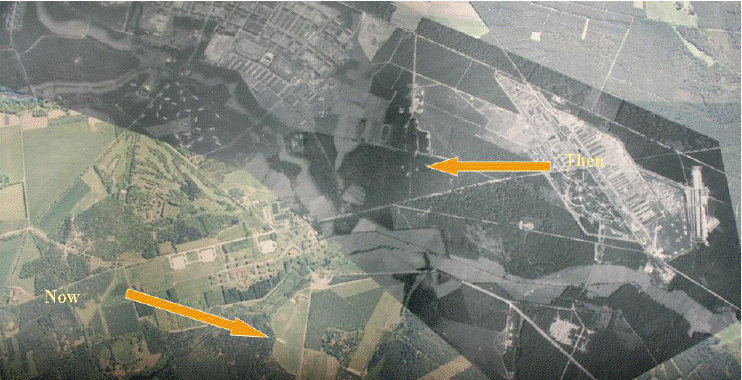
The figure above is the first exhibit in a new memorial to the Bergen-Belsen concentration camp where I spent two years between 1943 and 1945 (see my previous blog for relevance).

It shows the superimposition of two aerial photographs, showing the camp “then” and “now,” to try to convince the skeptics that the camp was in the same place. The rest of the exhibition tries to document the atrocities that took place in the camp through testimonies of survivors, detailed documentation that was kept by the perpetrators and the various artifacts that were associated with the period. The aerial photographs are there to “prove” that all of this is real. Deniers have an impact – there are not many Holocaust deniers around, but the availability of modern communication tools amplifies their voice. A significant fraction of the extensive Holocaust teaching that takes place is targeted at a response.  Sixty-seven years have passed since I was liberated by the American army at Farsleben.  Simple arithmetic indicates that almost all the survivors today were children during the Holocaust, and our numbers are dwindling. Denying the Holocaust today, with all the available factual information, requires denying of all of history. There is no question that the deniers deserve their label.

But most of our history is based on flimsier evidence, and climate change deniers like to say that using scientific “theories” to explain climate change is not really “proof.”  We use scientific theories all the time to explain phenomena that we know exist but can’t readily “see” –  like gravity, for example.  We know gravity exists because we can feel its effects; we can also see climate change’s effects, but the deniers continue to insist it isn’t really proof.

Examples of this refusal to use scientific theories and current climate change evidence abound, unfortunately.

A student of mine at Brooklyn College in a general education course on Energy Use and Climate Change forwarded to me a letter that was published in the on-line publication Business Insider (April 11, 2012). The letter was signed by 49 former NASA employees that included seven Apollo astronauts and two former directors of NASA’s Johnson Space Center calling NASA to move away from climate model predictions and to limit its stance to what can be “empirically proven.” The letter specifically targets James Hansen – Director of NASA Goddard Institute (GISS) (Hansen and the GISS have been acting as the “the canary in the coal mine,” warning, for years, about the consequences of relying on fossil fuels as our main source of energy.) The letter states that, “We believe the claims by NASA and GISS, that man-made carbon dioxide is having a catastrophic impact on global climate change are not substantiated.”  The reason for the doubt includes that.”NASA is relying too heavily on complex climate models that have proven scientifically inadequate in predicting climate only one or two decades in advance” and that “There’s a concern that if it turns out that CO2 is not a major cause of climate change, NASA will have put the reputation of NASA, NASA’s current and former employees, and even the very reputation of science itself at risk of public ridicule and distrust.” This is backwards; it’s the letter that should be held up to public ridicule.

A recent program on Discovery Channel – “Frozen Planet” – shows beautiful photography of the clearly melting poles, disruptions to the life cycle of penguins, and the misery of polar bears trying to cope with the unseasonal melting of their environments. Unbelievably, the reason – the scientific reason – for these changes is not being discussed. Why the omission? The program’s producer (reported by Brian Stelter in the NYT, April 21 2012), is quoted as saying that “including scientific theories would have undermined the strength of an objective documentary, and would then have become utilized by people with political agenda.  I feel that we are trying to educate mass audiences and get children involved, and we didn’t want people saying don’t watch this show because it has a slant on ‘climate change.'”  How can this program, which shows such devastating scenes, fail to mention the probable mechanism for the destruction and science supporting it?  And how does refusal to mention “scientific theories” qualify as education?  What’s going on here?

Consequences of man-made changes in the chemistry of the atmosphere result in changes in our energy balance with the sun that leads to climate change. This is “simple” physics that doesn’t need sophisticated computer work. Future impact is always uncertain.

But, if the climate change deniers have their way, by the time that we find out “for certain” whether the IPCC, NASA, GISS, the World-Bank, NSF and other credible organizations that issue detailed reports about the consequences of climate change, are right in every detail, most of the people who are now discussing these issues will be dead. Our children and grandchildren will live to face the consequences. Business -as-usual- scenarios have a high probability of leading to major disruptions that will lead to loss of life on a global scale -a self-inflicted genocide (see my first blog for a Webster definition).

We know what needs to be done to lower the probability of such consequences. We also know how long such a transition will take. Ignoring the issue for the reasons that the Discovery Channel producer used will lead to very dangerous, expensive and unnecessary inaction.

More on this in Part 2.

Posted in Climate Change | 62 Comments

First Post

It’s with excitement and some trepidation that I write my very first blog post today. As a trained scientist, it really isn’t in my nature to write short blips about weighty subjects like climate change.

But I’ve taken up this challenge – today, on the 42nd anniversary of Earth Day – because I simply couldn’t stand by and watch while climate change “deniers” continue to try to take center stage and to keep all of us from doing what’s necessary to head off the impending climate change disaster.

As a professor, a scientist, a Holocaust survivor and someone who has just written a book on climate change, I think I am uniquely positioned to tell the climate change story. I know that once people really grasp the science behind climate change and how each person really can help us reverse course, they take action and feel hopeful. I’ve seen it happen. Despite everything, I feel hopeful too.

So please, read on, leave comments and let’s start a discussion.

Climate Change and the Holocaust

“Deniers.”

The term itself triggers angry responses and, recently, it’s been used in a tumultuous series of climate change opinion pieces, responses and blog posts – now numbering in the hundreds – a recent focal point was an exchange in the editorial page of the Wall Street Journal (WSJ) published under the title “No Need to Panic About Global Warming,” an opinion piece signed by 16 scientists that appeared in the January 26th edition.

Even Physics Today, got into the fray, and published this on their blog recently:

Any time somebody publishes the words “denier” “climate” “Mann” “Santer” and “Trenberth” in an online article, they might as well be blowing a dog whistle that attracts a swarm of obsessive, inarticulate, scientifically-illiterate human comment-bots. They always say the same thing (probably cutting-and-pasting from elsewhere), bringing up Holocaust deniers “we’re not that” and Lysenko “yes you are”. This discourse is at the intellectual level of a playground. This is probably the first Physics Today article they have ever read.

The comment reflects the undeniable fact that the term “deniers” has a direct association specifically with Holocaust deniers and captures much of the intellectual spirit and tone of this debate.

We are now painfully aware that the Holocaust deniers were dead wrong and that there was a planned systematic genocide. But what about climate change deniers? Can we really compare the two, the Holocaust and climate change? Does this have anything to do with science?

I am probably one of the very few who can write with some authority on both topics.

I was born in Warsaw, Poland in May, 1939. The first three years of my life were spent in the Warsaw Ghetto, as the Nazis developed their plans for systematic Jewish genocide. Before the destruction of the Ghetto in 1943, I was hidden for a time on the Aryan side by a family friend, but a Nazi “deal” to provide foreign papers to escape Poland resulted in my mother bringing me back to the Ghetto. Then a Nazi double-cross sent the remnants of my family not to safety in Palestine, but to the Bergen Belsen concentration camp as possible pawns in exchange for German prisoners of war. As the war was nearing an end, in April 1945, we were put on a train headed to Theresienstadt, a concentration camp further from the front lines. American tank commanders with the 743rd tank battalion of the American 30th Division intercepted our train near Magdeburg in Germany, liberating nearly 2500 prisoners. Within the year, my mother and I began building new lives in Palestine.

I am now a professor of Physics, studying the causes of global warming. I have just published a book on the topic: Climate Change: The Fork at the End of Now (June 2011 by Momentum Press). I publish literature regularly on climate change and energy, founded the Environmental Studies undergraduate program at Brooklyn College of CUNY, and have taught climate change on various levels for the last 15 years or so.

The last chapter of my book is titled “The Future, the Past and the ‘Just World’ Hypothesis,” where I make an attempt to understand the intensity of the climate change debates and try to answer the question, “Why do we tend to underestimate risks relating to natural hazards, when a catastrophic event has not occurred for a long time? If the catastrophic events are preventable, can this lead to catastrophic inaction?”

The Webster Dictionary defines genocide as “the deliberate and systematic destruction of racial, political or cultural groups.” There is no question that the Holocaust was a genocide. Genocides do not repeat themselves exactly. They come in different guises. Despite the deniers, it is straightforward to teach students to condemn the Holocaust, but it is more difficult to teach them how to prevent future genocides. One of the most difficult parts is to see them coming. Despite the fact that Hitler published the first volume of his manifesto, Mein Kampf, in 1925, where he laid out his philosophy, he was, nevertheless, democratically elected as German Chancellor in 1933. Few people believed in 1933 that he would seriously try to accomplish what he preached or anticipated the consequences that resulted from his actions.

Predictions by the Intergovernmental Plan on Climate Change (IPCC) and most scientists, strongly suggest that we may be creating our next genocide ourselves; a “business as usual” scenario over the next 70 years (the expected lifespan of my grandchildren – my definition of “Now” in the book) will result in doubling of greenhouse gas emissions. Emissions at these levels would result in major extinctions around the globe, with more than 40% of ecosystems destroyed. The belief that we are not part of the ecosystems is a dangerous hubris. We have just passed the 7 billion population mark and even if we take the 40% prediction with a large grain of salt, we are talking about the potential genocide of billions of people.

Arnold Toynbee wrote that civilizations die from suicides, not murder. Even if the predicted consequences of “business as usual” environmental scenarios over the next 70 years turn out to be wrong in some details and even slightly wrong in timing, it’s clear that once we pass a critical point in the ability of the planet to adapt to the accumulation of greenhouse gases in our atmosphere, the consequences amount to global suicide – a self-inflicted genocide. We know what we must do to mitigate this possible future genocide, but we need our collective will to do so. We can’t allow the deniers to win again.

Thank you for reading this and please let me know what you think.

-Micha Tomkiewicz

Posted in Anthropogenic, Climate Change, Education, Sustainability | Tagged , , , , , , , , , , , , , , , , , , , , , , , , , , , , , , , , , , , , , , , , , , , , , , , , , | 84 Comments