
China – Air Quality

My last two blogs described some of China’s largest cities’ attempts to limit their number of cars. A lot of this had to do with reducing the terrible air pollution in these cities. Pollution is one of the key reasons why many of those who can afford to leave China settle in other countries. Air pollution is also a huge obstacle for Beijing when it comes to not only hosting international events, but attracting foreign visitors to spend their money in China. All of these are important reasons for the Chinese government to take action, but perhaps the most important reason to address this issue is the damage that the polluted air is causing the residents of Chinese cities. A recent analysis by western researchers ends with the following paragraph:

During our analysis period, 92% of the population of China experienced >120 hours of unhealthy air (US EPA standard), and 38% experienced average concentrations that were unhealthy. China’s population-weighted exposure to PM2.5 was 52 μg/m3. The observed air pollution is calculated to contribute to 1.6 million deaths/year in China (0.7 – 2.2 million death/year at 95% confidence), roughly 17% of all deaths in China.

Of course, the most visible manifestation of the air pollution in China is the haze in the air that one encounters when visiting any of the major cities.

The photograph below (Figure 1) shows the haze I saw in Shanghai during my recent visit.

Hazy air from from the 100th floor of the Shanghai World Financial center

Figure 1 – Haze in Shanghai – photograph taken from the 100th floor of the World Financial Center.

The haze is usually a reliable way to convey air pollution. In China, it is often paired with photographs of people walking the streets with surgical masks on their face.

The photograph below shows a street photograph in Lhasa, Tibet.

Lhasa, Tibet

Figure 2 – Street photograph in Lhasa, Tibet.

Lhasa is the smallest city that we visited; its industrial base is tiny. In fact, the city’s car statistics didn’t even show up on any of the charts that I presented over the last two weeks. The air there is not hazy; nor is it particularly polluted by any other measure, yet the number of people wearing masks was the largest that we saw in China. In fact, many of the visitors to the monasteries that we visited in Tibet were wearing masks as well. The air in these monasteries is not polluted either. Instead, it became evident that the masks often serve more as cultural markers than indicators of air pollution.

Such use of masks is popular in parts of China, Korea and Japan. In these countries it is common for people to wear the masks if they think that they are getting sick and might infect others. In that case, people are wearing the masks to try to protect others, not themselves. However, anybody that is watching the consequences of the two recent explosions in Tianjin will notice the prevalence of masks in that area as well. The chemistry of the hazardous materials that caused the explosion has yet to be revealed. Whatever the initial combination, the air there is now loaded with cyanide, a powerful toxin, so the masks that people wear in the area are to protect themselves, not others. As we will see shortly, the Chinese environmental warnings include entries about recommendations to wear masks.

The best quantitative indicator for air pollution is the Air Quality Index (AQI). Here is how the index is defined:

An air quality index (AQI) is a number used by government agencies [1] to communicate to the public how polluted the air currently is or how polluted it is forecast to become.[2][3] As the AQI increases, an increasingly large percentage of the population is likely to experience increasingly severe adverse health effects. Different countries have their own air quality indices, corresponding to different national air quality standards

As is evident from this definition, the index depends on national standards, meaning that comparisons between countries are not always appropriate. Yet the index is almost always accompanied by the corresponding scale for its impact on health. Here is a “typical” map of an hourly AQI that the US Environmental Protection Agency (EPA) published few days ago for the region of the US where I live.

US EPA AQI of Region 1 from August 18, 2015Figure 3 – EPA published AQI for August 18, 2015 in region 1 (USG stands for unhealthy for Sensitive Groups).

Even in the US, we get warnings from our weather sites almost on a daily basis that advise us to stay indoors whenever possible because the AQI exceeds 100. Well, in our recent trip to China, the AQI in almost all the big cities that we visited exceeded 150. Figure 4 shows the data for Beijing and a few other cities.

Beijing AQI vs other citiesFigure 4 – Beijing air pollution report

The website even gives you more information about which masks are most efficient and where to buy them.

The amazing part of Figure 4 has less to do with Beijing’s AQI number and label of “very unhealthy”; far more impressive is the fact that it is being published in the first place, especially with so much accurate detail. In my second blog about China (August 4), I discussed how the Chinese government has tried to censor any information that might be interpreted as critical of China. Since a number of foreigners live in China and breathe the same air, the American Embassy in Beijing decided to take independent measurements and publish them. Figure 5 shows the results. Aside from an understandable small shift in timing, the results are identical. It is difficult to come up with better confirmations.

Beijing AQI China EPA vs US embassyFigure 5 – Comparison of Beijing air quality by the Chinese Environmental Protection Agency and the US embassy.

The common availability of real information about the polluted air is, perhaps, the strongest indication that the government of China recognizes the seriousness of the threat and is trying to devise ways to mitigate it.

It’s no secret where all of this air pollution came from: a combination of heavy fossil fuel consumption (mainly for the copious amount of cars), and the use of coal to generate electricity. Economic development took priority over health considerations. My last two blogs detailed what a few cities, including Beijing, are now doing to limit the number of cars. I plan to spend more time discussing the country’s use of coal and its eventual energy transition in future blogs.

Posted in Climate Change | Tagged , , , , , , , , , , , , , , , , , , , , , , , | 2 Comments

Cars in China – Cap and Pay

Last week’s blog ended with the following promise: “… a few of the largest cities in China are now taking drastic steps to limit car ownership – a fact that I was completely unaware of until my visit.” Time to unveil the mystery and go to some detail. Cities such as Shanghai, Beijing, Guangzhou and now Shenzhen have decided to limit car ownership – not through any direct regulation or by imposing a tax on car ownership, but instead by making the license plates very expensive. I was told about the practice by our Chinese guide when we visited the first two cities and I was shocked. I was told that the licensing fee can cost as much as the car itself (it also applies to motorcycles). I had never heard about the practice, but immediately recognized its benefits to limiting the number of automobiles in a city. Also, as long as you don’t differentiate between imported and domestically manufactured cars you are not running up against any international trade agreements. The data for the first three cities is given in the three figures below:

Car ownership in Beijing Shanghai and GuangzhouFigure 1 – The number of registered automobiles (in 10,000’s) of Beijing, Shanghai and Guangzhou

Shanghai license plate quota average price and biddersFigure 2 – The quota, average price and bidders for Shanghai licence plates (2002/01-2013/06)

Beijing license plate quota and lottery success rateFigure 3 The quota and lottery success rate in Beijing (2011/01-2013/07)

Figure 1 shows the rise in car ownership per resident in the three cities. It shows an uninterrupted growth from the time of my first visit (1992). The attempt to restrict car ownership through limiting the numbers of new license plates started at the tail end of this graph, between 2008 and 2011. Many cities in the developed world use policies including construction of more efficient public transportation to curb the use of cars. Once the Chinese realized that such measures were not sufficient for their purposes, some of its cities started to implement more austere restrictions. For various reasons, including the country’s accelerated urbanization and the perceived status enhancement associated with the purchase of a car, people have kept buying them as they acquire the financial means to do so.

Unsurprisingly, the attempts to limit car ownership through license plate restrictions started in Shanghai and Beijing – China’s two largest cities (details are taken from the Feng and Li article that I cited previously). Shanghai was the first city to implement a policy to control car ownership through an auction process. The policy started in 1986 but only reached full force by early 2000.

The auction opens to the public once a month. In recent years the quota has fluctuated between 8,000 and 9,000 license plates per month. The number of quotas/bidders together with the average price in the Shanghai bidding is shown in Figure 2. While the auction mechanism clearly limits the number of license plates, it also inherently restricts car ownership to rich owners.

During the 2008 Olympic Games in Beijing, driving restrictions were put into place in Beijing based on license plate numbers: the right to drive on any given day alternated according to odd or even numbers on the plates. After the Olympics the policy was modified to require that every car (again, based on its license plate number) be off the road at least one day a week. In the beginning of 2011 Beijing decided to expand the restrictions and follow Shanghai in implementing a quota, but tried a different tactic – namely, distributing the quota by lottery. Figure 3 shows the quota success rate in Beijing – it documents a steady rise in applications coupled with a steady decline in the success rate.

Two clear trends are visible through these descriptions: the decision process over how best to limit car ownership is local, and as result the various cities’ methods serve as experimental examples of the most effective (and fair?) mechanisms to limit car ownership in cities. Unfortunately, another impact of this highly localized approach is that it leaves itself open to work-arounds and fraud.

Some of these schemes are described in the Feng and Li article, while others are described elsewhere. Here are some of the techniques, as well as attempts that are being taken to mediate their impact.

  1. Since the license plate restriction policy only applies in a few cities, people register in another city and drive from there to their final destination/residence. In response, Shanghai (and presumably the other three cities as well) have started to restrict the driving of cars (mainly during peak hours) with non-local registration plates.
  2. It is not surprising that since license plates are becoming expensive and scarce a very active secondary market is developing in these cities. To try to cut down on the quick turnaround, Shanghai, for example, requires that license plate owners keep them for three years before selling them.
  3. One reported scam that tries to work around the restrictions is a collusion between the owner and buyer of secondary cars. The two parties construct an imaginary debt that the seller “owes” the buyer for which the car is used as “collateral.” The seller “defaults” on the loan. They both go to court and the “debtor,” who is actually the car owner, is ordered to hand over the car to the “lender,” the car’s buyer. Along with this transfer of ownership comes the already registered license plate.
  4. Another option is to obtain temporary plates by leasing them from a car rental companies. Rental agencies can charge sums equivalent to $500/month for the rent.

Revenues from the taxes are used to improve mass transit and transportation infrastructure.

In principle, if not in detail, China’s new techniques resemble the more widely known structure of cap-and-trade with regards to pollution rights. The key in both techniques is to set a fixed number of cars that that can be driven or total acceptable emissions.

China’s cities have a lot of reasons to want to avoid exceeding the “saturation range” that I discussed in last week’s blog. These include their inability to manage heavier traffic and increasing demands on parking, as well as their desire to minimize China’s contributions to greenhouse gas emissions overall. Meanwhile, from China’s perspective, one of the most urgent driving forces is the need to minimize its infamously bad air pollution. I will discuss this topic in next week’s blog.

Posted in Climate Change | Tagged , , , , , , , , , , , , , , , , , , , , , , , , , , , , , , , , , , , , , | 15 Comments

China – How Many Cars Can a City Handle?

Right now, China has the largest global market for new cars. According to the last count by the International Organization of Motor Vehicles Manufacturers, there are 833 million light vehicles currently (2015) in use worldwide. About 10% of these cars (around 83 million) were bought in 2014. Out of that 83 million, 21 million went to China, while the US, the second largest buyer, bought close to 16 million. In other words, China – which still counts as a developing country (see July 28th blog) – bought about one quarter of all cars sold throughout the world. These numbers put China’s share of automobiles roughly in line with its current share of the global GDP, which is approximately 13%.

I visited several Chinese cities and was astounded at how much the traffic flow differs from that in New York City, where I live. The traffic is heavy but in most instances it flows smoothly; the roads are great and the traffic control systems work better than I have ever seen elsewhere.

Shanghai traffic

Shanghai (these photos are from my trip)

Traffic in Xian

Xian

I visited both of these two cities as well as Beijing 20 years ago – at which time the dominant traffic on the roads was made up of bicycles – so this dramatic change has taken place within the span of less than a generation. What changes will develop within the next generation?

In a report by China SignPost, a western consulting firm, we find a bit more detail. The two figures below show a summary of private car ownership in 36 Chinese cities in comparison to some major cities in developed countries outside of China. My home city, NYC, is on the list. As we will see in a future blog, the definition of “selected metro areas” especially in China, is open to discussion (e.g. where exactly the borders are). I checked the original reference for NYC, which only counts those residents within the five boroughs – a population of 8.4 million people. Beijing’s population is 11.5 million on the same basis (excluding suburbs, etc.). The figure also shows Houston, TX, with its population of 2.2 million for comparison. NYC has one of the lowest car ownership ratios per person in the US – largely due to the extent of the public transportation system. Figure 2, from the same source, provides the per-capita numbers for car ownership. Again, when calculating that 22% of NYC residents own cars, refer to the city itself, not to the entire metropolitan area. This stands against 21% car ownership in Beijing, 18% in Xian, and 11% in Shanghai. The figure also adds a horizontal band that stretches between 25-30% cars per person and indicates a “saturation point,” at which car ownership plateaus. The assumed plateauing seems to be independent of quality of the road, traffic management or availability of affordable alternative transportation modes. The main issue that I want to address in these next few blogs is the steps China is taking to actively keep the number of cars in its cities from growing further.

Figure 1 – Private passenger car ownership by selected metro area in China and abroad (in thousands of vehicles)

The numbers that I got on the ground, from speaking with the locals in some of these cities we visited, were considerably higher than demonstrated above. Meanwhile, the compilation of 36 cities in Figure 1 only represents about 30% of China’s total car ownership, which includes a fleet of 93 million private passenger cars.

Car Ownership per 100 Residents, By Metropolitan AreaFigure 2 – Car ownership per 100 residents, by metropolitan area.

City after city is now starting to conclude that enough is enough. My Chinese friends have long predicted that the growth rate, at least in terms of private cars in their cities, cannot continue at its present pace. Many of China’s major cities are taking similar steps to those being taken by developed countries – e.g. building the best public transportation systems that they can. I “tested” the underground system in Shanghai and found it competitive with the best systems that I have seen elsewhere.

Hong Kong is now part of China, but I will cover it separately in future blogs. It is one of the richest cities in the world, and was only recently re-incorporated into China as a result of an agreement with the British government. The latest accounting of the city’s transportation issues shows that Hong Kong has 500,000 private cars for a population of about 7.5 million people. This comes out to 6.6% of the population, which would fall within the far left side of Figure 2. Meanwhile, however, a few of the largest cities in China are now taking drastic steps to limit car ownership – a fact that I was completely unaware of until my visit. The details of what these cities are doing are important to all of us; I will explore some of these steps next week.

Posted in Climate Change | Tagged , , , , , , , , , , , , , , , , , , , , , , , , , | 1 Comment

China – The Price of Progress: Inequality and Transparency

While I was in China (see last week’s blog), one of the questions that I asked most often – especially of those who mentioned that they have small children – was how people imagine China 20 years from now. This question stemmed, in large part, from the immense changes that I saw since my first visit in 1992. Invariably, people answered they expect economic progress to continue at roughly the same pace as it has over the last 20 years. This prognosis is worth examining further because it has strong implications about the future of the world and it is thus relevant to all of us.

Last week I looked at China’s progress from 1992 to 2012 using data from The World Bank database (more recent data were not available). The World Bank also has country reports. Here is a paragraph from its recent entry about China:

Since initiating market reforms in 1978, China has shifted from a centrally planned to a market based economy and experienced rapid economic and social development. GDP growth averaging about 10 percent a year has lifted more than 500 million people out of poverty. All Millennium Development Goals have been reached or are within reach.

With a population of 1.3 billion, China recently became the second largest economy and is increasingly playing an important and influential role in the global economy.

Yet China remains a developing country (its per capita income is still a fraction of that in advanced countries) and its market reforms are incomplete. Official data shows that about 98.99 million people still lived below the national poverty line of RMB 2,300 per year at the end of 2012. With the second largest number of poor in the world after India, poverty reduction remains a fundamental challenge.

Rapid economic ascendance has brought on many challenges as well, including high inequality; rapid urbanization; challenges to environmental sustainability; and external imbalances. China also faces demographic pressures related to an aging population and the internal migration of labor.

It is worth mentioning here that RMB 2,300 is approximately equivalent (in today’s exchange) to $1US/day. China has two especially large challenges to rapid economic growth: the increase in income inequality and the environmental impact, but I will save the latter for another time.

Before starting on increased income inequality, I have to put my writing into perspective. I am obviously a very biased observer: an American tourist with enough resources to see the world from the balcony of five star hotels for the duration of my month-long visit, almost all of which was focused within Chinese megacities (cities with populations that exceed ten million people). This is not the view that one acquires from the residences of inhabitants who live off of $1US/day. To get some semblance of reality and balance, I will rely strongly on literature published by somewhat more objective observers.

Over the years, I have spoken frequently in this blog about the role of income inequality in the global response to climate change (see January 7, August 19, and September 9, 2014). There are various ways of measuring inequality; one of the most common is the use of the Gini coefficient:

The Gini coefficient (also known as the Gini index or Gini ratio) (/dʒini/ jee-nee) is a measure of statistical dispersion intended to represent the income distribution of a nation’s residents, and is the most commonly used measure of inequality. It was developed by the Italian statistician and sociologist Corrado Gini and published in his 1912 paper “Variability and Mutability” (Italian: Variabilità e mutabilità).[1][2]

The Gini coefficient measures the inequality among values of a frequency distribution (for example, levels of income). A Gini coefficient of zero expresses perfect equality, where all values are the same (for example, where everyone has the same income). A Gini coefficient of one (or 100%) expresses maximal inequality among values (for example, where only one person has all the income or consumption, and all others have none).[3][4] However, a value greater than one may occur if some persons represent negative contribution to the total (for example, having negative income or wealth). For larger groups, values close to or above 1 are very unlikely in practice.

Yu Xie and Xiang Zhou recently published a paper called, “Income Inequality in Today’s China,” in the Proceedings of the National Academy of Science (PNAS). PNAS is one of the most prestigious and selective scientific publications in the United States. It accepts papers for publication only through recommendations of members of the US National Academy and requires scrupulous reviewing before publication. Here is a segment from the paper’s introduction:

In this paper, we wish to address two research questions. How high is income inequality in today’s China and why is it so high? The first question appears to be simple fact that could be answered by government statistics. Unfortunately, this is not true for China. For a variety of complicated reasons, ranging from politics to practical difficulties, government statistics on Chinese well-being have been questioned for their accuracy. This concern is exacerbated by the long-standing concealment practices of China’s National Bureau of Statistics (NBS), responsible for constructing and releasing government data on China, such that no original microlevel data are accessible to any independent researcher that could be used to corroborate the macro level statistics it releases. In the case of income inequality, the NBS stopped releasing the Gini coefficient after it reached 0.41 in 2000. It was not until an economist claimed that the Gini coefficient had reached the shockingly high level of 0.61 that the NBS, in early 0.61, released the Gini coefficients for recent years, which were slightly under 0.5.

The paper itself cites multiple supporting references, emphasizing the need to use multiple data sources to get the necessary information and not to rely on an “obvious” source – in this case, China’s National Bureau of Statistics (NBS) – as the sole source. Please note that the World Bank data that I quoted last week originated in China’s governmental sources, so the skepticism that the PNAS paper expresses should fully extend to last week’s post.

We found the challenges China faces in its efforts to release only selected information to public consumption directly visible in our experiences during our short visit. Connectivity to applications such as Google, Facebook, ESPN, Bloomberg and The New York Times were all but nonexistent throughout mainland China, but one could circumvent most of the search restrictions by searching with Yahoo, Bing and Baidu and the news restrictions by going through the Huffington Post and other outlets. Once we crossed into Mongolia or Hong-Kong, suddenly all the applications were available as clearly as at home. The logic of all of this will probably never make sense to me, but I strongly suspect that with time, the government will become a bit more familiar with modern communication capabilities and many of these attempts of at needless and futile censorship will disappear.

The two most important findings in the PNAS paper are shown in the two figures below:

Gini coefficient trends - family income China & US

GDP per capita and Gini coefficients - family income in China vs 136 countriesAmong the conclusions we can draw from the two figures are:

  1. The sharp increase in inequality (rising Gini coefficient) started shortly after China’s 1978 shift to a market based economy.
  2. Around 2000, China’s Gini coefficient surpassed that of the United States, even as the GDP/Capita stayed well below that of most developed countries (see last week’s blog for more data, but keep in mind the disclaimer about the World Bank’s sources).

The second graph tries to demonstrate that the increase in GDP is not solely to blame for the rising Gini coefficient. It plots the Gini coefficients of 136 countries against their GDPs/Capita (in logarithmic scale – see August 6, 2012 blog). The data roughly fit (with a great deal of noise) the Kuznets curve, a hypothesis that states that after a certain threshold the Gini coefficient should start to return to a more equal distribution. It is obvious that China doesn’t follow the curve.

The PNAS authors offer data to show that the two biggest social determinants that factor into this high inequality are regional disparities and rural-urban gap. I will return to some of these issues in future blogs.

Posted in Climate Change | Tagged , , , , , , , , , , , , , , , | 1 Comment

Back From China

In a previous blog (December 3, 2012) I described a common exercise that I give to students to highlight the important skill of scenario building:

In the table below I ask undergraduates from my course (General Education – no prerequisites) to use primary sources to collect some relevant data about four countries and the World, and to answer a few questions by evaluating this data. I have filled in part of the table with the appropriate data for 2008 – the last year that data were available for the indicators in which I was interested.

Fill up the following table:

Table for EJ States vs Individual

Rank the four countries in terms of total energy use and CO2 emissions.

  1. Compare (in %) the top user and emitter with World use and emission.
  2. Rank the four countries in terms of energy use and CO2 emission per capita, and compare the numbers with global data.
  3. If the GDP growth continues – how many years will it take China to catch up to the US?
  4. If the GDP/Capita growth continues – how many years it will take China to catch up to the US?
  5. What will the World’s GDP be at that time?
  6. What will the World’s population be at that time?
  7. If you assume that the last three terms of the IPAT equation will not change – what will the World’s CO2 emission be at that time?
  8. Assume that only half of the emissions will stay in the atmosphere and that the Climate Sensitivity is 2.50C for doubling the concentration of CO2 compared to the pre-industrial levels – what will the climate consequences of 8 be?

In my February 17, 2015 blog I essentially repeated this exercise, focusing on India. Since I was already planning a vacation this summer, I used some of my time to try the exercise in real life with a focus on China. I left for China with my wife on June 28th and we just came back. I will try to describe some of our experiences within the next few blogs.

The figure below maps the places that we visited:

Map of places visited in China

The last time I visited China was in August of 1992. I was on the organizing committee of a solar energy conference that took place in Beijing and I followed up the conference with visits to Xian and Shanghai. This 23 year gap is approximately equal to the span of a new generation. Here are some of the changes that took place in China over this period, as compared to their parallels in the US at the same time. The data is from the World Bank database.

China & US indicators 1992-2012

*The World Bank doesn’t supply data for “prevalence of undernourishment” for any developed country. The assumption is that there is none.

According to the World Bank and the GDP/Capita data it gives in the table, China has “graduated” over this period from being a Low Income Country to Lower Middle Income Country. However, looking at other indicators and paying attention to factors such as school enrollment, improved sanitation, internet users high technology export, fixed broadband subscriptions, life expectancy and fertility rates suggests a much sharper transition. Of course, indicators tracked in statistical comparisons are markedly different from the anecdotal impressions that accompany an actual visit.

China’s population now constitutes close to 20% of the world’s population. The urban population in China now (2012) makes up around 52% of the total (World Bank), as compared with the US, whose urban population comes to 81%. In 1992 the urban population in China was 28%; that in the US was 72%, so the growth in China’s urban population by 2012 was more than three times faster than that in the US in the same time. In short, a visit to some of China’s megacities is important. Of course, what stands out most to a visitor is far different than what is reflected in the table. You notice the heights of the buildings, the number of passenger cars in the cities, the quality of the roads, the extent of public transportation, the infrastructure of the power delivery, the quality of the air, and the availability of goods – from essentials to global luxuries. Probably the most important test of progress in economic development is: what happens if you have a highly developed area in close contact with an underdeveloped one? What steps must be taken to prevent people from moving illegally across the border in order to improve their economic wellbeing? Such an experiment actually exists in the form of Hong Kong and Shenzhen.

In the next few weeks I will try to focus my blogs on the various aspects of China’s efforts toward further development and the implications that these efforts hold for a global transition to more sustainable energy sources.

Posted in Climate Change | Tagged , , , , , , , , , , , , , , , , , , , , , | Leave a comment

Vacation Notice

This week I am taking a break from the blog, so there will be no post. Please do come back next Tuesday, when I promise to continue our discussions.

Posted in Climate Change | Tagged | Leave a comment

The Drop in Oil Price and What it Means

The test of any major transition is in its response to a sharp perturbation. Often such disturbances come in the form of a major war. Fortunately, the present global energy transition is being tested in a much more peaceful manner. As I have mentioned in previous blogs, economics have been the main driving force behind a successful transition from fossil-fuel-dominated energy sources to sustainable ones that do not result in carbon emissions. Attempts to make sustainable energy sources competitive with fossil fuels focused in large part on making the sustainable energy sources price competitive with fossil fuels. These attempts were trying to either make fossil fuels more expensive through instruments such as carbon tax or cap and trade or to lean in the other direction, making the sustainable energy sources cheaper through subsidies of one form or another. In the summer of 2014 a major trend started to shake the marketplace as it disrupted the balance between supply and demand. Prices of fossil fuels dropped by more than 50% in 6 months or so. I have discussed this sharp decline before (see my January 13, 2015 blog) and showed an earlier version of the figure below to demonstrate the price changes

Historical chart of Brent Crude Oil prices 2012-2016Figure 1 – Recent price change in crude oil

The price of Crude Oil Brent reached below $50 a barrel in January, and has risen to the mid-$60 range now – that’s a climb of about 30% but is still more than 40% below its peak at the beginning of 2014. The January blog came a bit too early to investigate the effects of the price drop; initial reports about possible impacts are just now coming in.

One of the most informative new pieces of data on global energy use is the annual BP (British Petroleum) Statistical Review of World Energy. The 2015 report just came out and among its key findings is a comparative summary of global energy consumption growth in 2014 (shown in Figure 2).

BP Energy Growth - Non fossil fuelsFigure 2 – Global Energy Consumption and Renewable Energy Growth in 2014

The figure on the left demonstrates a marked decrease of fossil fuel use in 2014, with little or no decrease in renewable power. The figure on the right, meanwhile, depicts the recent changes that have been taking place in renewable power, including a decreasing usage of wind energy and an increase in the use of solar (in this case meaning photovoltaic because wind, biofuels and hydro are also solar-derived energy sources).

A direct comparison and breakdown of the 2014 installation of photovoltaics devices in the US is shown in Figure 3.

SEIA - Annual US Solar PV Installations 2000-2014 Figure 3 – Annual U.S. Solar PV Installations 2000-2014 Q4

Unfortunately, not everything in the picture is bright and cheery. Some expected negative impacts are also being reported. The aptly named Justin Doom (Bloomberg) reports a 15% drop in clean energy spending which is has already reached the lowest level since 2013:

About $50.5 billion was invested in the first three months of 2015, the least since the first quarter of 2013 when spending on clean energy totaled $43.1 billion, according to research released Friday by Bloomberg New Energy Finance. The figure a year earlier was $59.3 billion.

Lawrence Ultrich of the New York Times likewise reports a significant drop in purchase of gasoline saving vehicles such as hybrids and electric cars:

In all, 55 percent of hybrid and electric vehicle owners are defecting to a gasoline-only model at trade-in time — the lowest level of hybrid loyalty since Edmunds.com began tracking such transactions in 2011. More than one in five are switching to a conventional sport utility vehicle, nearly double the rate of three years ago.

Predictions for future trends are difficult. The supply-demand balance in fossil fuels is presently resisting significant changes, so a return to $100 or so per barrel seems unlikely in the foreseeable future. Additional midterm and longer term impacts will become more visible with time. Stay tuned.

Posted in Climate Change | Tagged , , , , , , , , , , , , , , , , , , , , , , , , , , , , , , , , , , , , , , , , | 1 Comment

Predicting the Future and its Impacts

In the last blog (June 30th) I started to investigate the impact of the recent large drop in global oil prices on the global energy transition from fossil fuels to sustainable energy sources. The sharp decline in oil prices has disrupted the balance between supply and demand. Prices of fossil fuels dropped by more than 50% in 6 months or so. The price of Crude Oil Brent reached below $50 a barrel in January, and has risen to the mid-$60 range now – that’s a climb of about 30% but is still more than 40% below its peak at the beginning of 2014.

Among the impacts so far has been 2014’s particularly sharp decline in the growth of fossil-fueled-energy. It is interesting to note that there has been no corresponding decline in renewable energy growth, although much of the new market has shifted from wind energy to solar (photovoltaics). In fact, there has been a marked increase in photovoltaic installations as compared to 2013. At the same time, however, there has been a 15% decrease in clean energy spending and a significant decrease in purchase of hybrid and electric vehicles. This is a confusing picture because it seems like counterintuitive timing.

A different set of scenarios for future changes in the price of oil is shown in Figure 1:

EIA - Average annual Brent spot crude oil prices in three cases 1987-2040Figure 1

The scenarios in Figure 1 where issues by our most credible source of information on the statistics of oil prices. None of them reflect what is taking place now.

These changes (based on similar predictions) were probably at work well before the sharp drop in oil prices in the summer of 2014. After all, constructing power plants – whether sustainable or fossil-fuel-based – takes time. A good example is the Agua Caliente Solar Project:

The Agua Caliente Solar Project is a 290 megawatt (MW) photovoltaic power station, built in Yuma County, Arizona using thin-film technology based CdTe PV panels manufactured by First Solar. The project was completed in April 2014.

39 MW was online as of December 2011 and 100 MW was completed as of April 2012. 200 MW was completed as of July 2012, and 247 MW in August 2012, when the 10th section was completed. The addition of more panels has halted until 2013, with crates of panels covered to protect them.

Perhaps a better yardstick for the impacts of major interruptions to the energy transition is the stock market. Discounting short term speculations, trading in stocks reflects our commitment to gambling on what we think will happen in the future to the particular business that we are interested in.

Figure 2 shows what happened to the energy stock index (dominated by fossil fuel companies), as compared to other commodity indexes, immediately after the start of the drop in oil prices.

 Components of the Goldman Sachs Commodity Index (2004)Figure 2

Figure 3 shows a similar index that was compiled for the S&P Global Clean Energy Index.

IShares S&P Global Clean Energy 2014-2015Figure 3

Clearly, clean energy investors are still expecting a good return.

Stay tuned, but do not forget Niels Bohr’s dictum: “Prediction is very difficult, especially if it’s about the future.”

Posted in Climate Change | Tagged , , , , , , , , , , , , , , , , , , , , , , , , , , , , , , , , , , , , , , , , , | 2 Comments

NIMBY as a Business Strategy

The June 9, 2015 blog focused on traditional NIMBY arguments in the context of attitudes toward wind farms. The main issue I raised was that if we are making the statement that we object to wind farms because they are an ugly view from our window, we need to clarify what we are comparing them to in terms of unsightliness. The acronym NIMBY stands for Not In My Back Yard and refers to placement – we recognize that the wind farms are needed – that the power they generate is essential – but we want it to be placed somewhere else that doesn’t inconvenience us personally. I want to discuss how we can try to expand this concept (and how to combat it) to a more general business strategy.

Why didn’t I raise this issue in a blog that immediately followed my June 9th post? As you probably noticed, the June 16th blog was a guest blog by the incredibly talented Sofia Ahsanuddin that provided a parallel insight to a previous guest blog by the similarly talented Denis Ladyzhensky. His looked at application of the Jewish tradition of blessing food to blessing the more general environment as we extract resources for human benefits. Guest bloggers operate with their own time constrains that we have to accommodate if we want to benefit from their input. Following Sofia’s blog came Pope Francis’ sweeping (and timely) encyclical. Now I am safely in China, happily removed for four weeks from pressing immediate events to focus on.

Back to NIMBY and business. The issue came up when I read a short article on Berkshire Hathaway:

In a strategy document written by SVP Brent Gale for a legal conference in July, Berkshire Hathaway Energy outlined its position on net metering, saying it should be scrapped in favor of a system that recognizes utility fixed-grid costs and utilizes distributed generation at times when it’s needed most.

So, Berkshire Hathaway Energy is in favor of scrapping net metering. The large picture behind this short paragraph quickly emerged.

First, though, what is net metering?

Net metering is a billing mechanism that credits solar energy system owners for the electricity they add to the grid. For example, if a residential customer has a PV system on the home’s rooftop, it may generate more electricity than the home uses during daylight hours.

I discussed some aspects of this issue in a previous blog (December 9, 2014), with regards to the energy transition in Germany. It is one of the most crucial tools that policy makers can implement to move energy sources from the present large dependence on fossil fuels to a more sustainable mix of wind and solar. The main difficulty here is that these sources are intermittent, so matching supply to demand through load leveling requires major effort. The required matching, as applied to photovoltaic cells, can be viewed in the figure below.

Diagram of Net MeteringFigure 1 – Typical photovoltaic daily power production and consumption

Significant power generation takes place in midday while significant use takes place during the morning or evening. This matching can be accomplished in one of two ways: either store the surplus energy from midday to be used when supply is not available by using batteries or use your utility company as your battery by transferring the excess power and be paid by the utility for this power usually requiring the utility to pay the same price as consumer pays for getting the power. This is net metering.

The map below shows that most states in the US now require the utilities to allow net-metering.EIA - Net Metering by StateFigure 2 – Net metering requirements across the US

Net metering is very convenient for customers because it doesn’t require them to buy and assemble storage facilities but it is just as inconvenient for electric utility companies.

Here is one good example of the ramifications :

Tesla Chief Executive Elon Musk introduced a new family of batteries designed to stretch the solar-power revolution into its next phase. There’s just one problem: Tesla’s new battery doesn’t work well with rooftop solar—at least not yet. Even Solar City, the supplier led by Musk, isn’t ready to offer Tesla’s battery for daily use.

The new Tesla Powerwall home batteries come in two sizes—seven and 10 kilowatt hours (kWh)—but the differences extend beyond capacity to the chemistry of the batteries. The 7kWh version is made for daily use, while its larger counterpart is only intended to be used as occasional backup when the electricity goes out. The bigger Tesla battery isn’t designed to go through more than about 50 charging cycles a year, according to SolarCity spokesman Jonathan Bass.

Here’s where things get interesting. SolarCity, with Musk as its chairman, has decided not to install the 7kWh Powerwall that’s optimized for daily use. Bass said that battery “doesn’t really make financial sense” because of regulations that allow most U.S. solar customers to sell extra electricity back to the grid.

German electric utility companies made the same kind of complaints when strategies for adaptation came up; arguments which subsequently became the source of Berkshire Hathaway Energy’s objections. A quick look at Berkshire Hathaway reveals broad ownership of utility companies, energy companies and insurance companies, so net metering strikes close to home. Warren Buffett, who runs Berkshire Hathaway, is one of the most open minded chief executive billionaires in terms of global thinking, and is known as the “Oracle from Omaha” for his investment skills:

The word “oracle” comes from the Latin verb ōrāre “to speak” and properly refers to the priest or priestess uttering the prediction. In extended use, oracle may also refer to the site of the oracle, and to the oracular utterances themselves, called khrēsmoi (χρησμοί) in Greek.

Oracles were thought to be portals through which the gods spoke directly to people. In this sense they were different from seers (manteis, μάντεις) who interpreted signs sent by the gods through bird signs, animal entrails, and other various methods.

The most important oracles of Greek antiquity were Pythia, priestess to Apollo at Delphi, and the oracle of Dione and Zeus at Dodona in Epirus.

The moniker implies an ability to clearly see the future which most of us lack. If he truly is the Oracle from Omaha, one might think that he can also clearly analyze the future impacts of climate change. But trying to pinpoint his positions regarding climate change through his various announcements calls to mind the notoriously blurred predictions of Greek oracles, and one starts to realize that his predictions are carefully tailored to serve his present business interests – with a classic NIMBY slant.

Posted in Climate Change | Tagged , , , , , , , , , , , , , , , , , , , , , , , , , , , , , , , , , , , , , , , , , , , , , , , | Leave a comment

Fortissimo

For those of us who aren’t fluent in music or Italian, fortissimo meansvery loud —used especially as a direction in music.” My own kind of scientific fortissimo came unexpectedly, but quite pleasantly, in the last few weeks.

It started for me in April while at a survivors-liberators meeting in Nashville, Tennessee (described in the April 28 blog).  I was “assigned” to start the concluding meal with the Jewish blessing for the food. During the blessing, it occurred to me that if,  according to Jewish tradition, the blessing is a request for permission from God to use parts of the physical world to satisfy our nutritional needs, wouldn’t it logically follow that we should also ask permission to extract things such as coal, gas, oil and all other natural resources that we use constantly? And then I thought, what would happen if these blessings to use natural resources were required? Wouldn’t “God’s servants on Earth” have to not only grant the request, but also be required to familiarize themselves with – and think carefully about – the consequences to God’s creation once the resources were extracted?

I also fully realized that I am not really qualified to answer this question and on returning to my school, I asked Denis Ladyzhensky, a physics student in my class, with much more extensive education in the Jewish religion, to write a guest blog on the topic. He gladly agreed and the result was posted on April 28th. Then I thought, why limit the discussion to the Jewish religion? I asked Sofia Ahsanuddin to present a Muslim perspective on the issue. She thought that the best timing for such a blog would be just before the month of Ramadan, with the resulting fascinating piece posted in last week’s blog. Almost immediately, Denis posted a great comment citing additional Muslim sources.

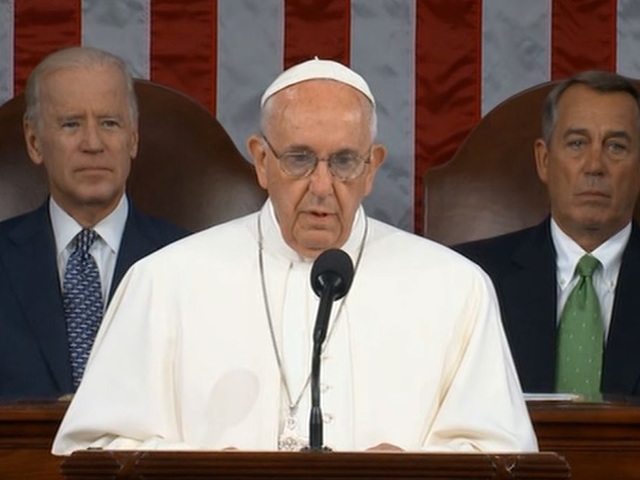
So now, among the three large monotheistic religions, Christianity’s take was missing. Well, it is not missing anymore and it has nothing to do with me. It came in the grandest and most influential way possible; a grand fortissimo.

It came officially on June 18th, and, unofficially, a few days earlier through leaks to the press. It came in the form of a 184-page Encyclical Letter by Pope Francis. Here is how Wikipedia defines the word encyclical:

An encyclical was originally a circular letter sent to all the churches of a particular area in the ancient Roman Church. At that time, the word could be used for a letter sent out by any bishop. The word comes from Latin encyclicus (from the Greek ἐν κύκλῳ en kykloi) meaning “general” or “encircling”, which is also the origin of the word “encyclopedia”.

For the modern Catholic Church, a Papal encyclical is a kind of letter concerning Catholic doctrine sent by the Pope addressed to bishops, patriarchs, primates, and archbishops who are in communion with the Holy See. The form of the address can vary widely, and may concern bishops in a particular area, or designate a wider audience. Papal encyclicals usually take the form of a papal brief due to their more personal nature as opposed to the formal papal bull.

The unofficial release was leaked to an Italian newspaper in Italian. Newspapers in the US that caught the events went quickly to Google Translate to get some quick translations of “key” paragraphs. Those of us who waited for the official release got it in nine different languages; here it is in its entirety.

Below, I quote directly from the encyclical’s 1st two paragraphs, the heading of the chapters, and a prayer from the end:

ENCYCLICAL LETTER
LAUDATO SI’
OF THE HOLY FATHER
FRANCIS
ON CARE FOR OUR COMMON HOME

  1. “Laudato si’, mi’ Signore” – “Praise be to you, my Lord”.  In the words of this beautiful canticle, Saint Francis of Assisi reminds us that our common home is like a sister with whom we share our life and a beautiful mother who opens her arms to embrace us. “Praise be to you, my Lord, through our Sister, Mother Earth, who sustains and governs us, and who produces vari­ous fruit with coloured flowers and herbs”. 1
  1. This sister now cries out to us because of the harm we have inflicted on her by our irre­sponsible use and abuse of the goods with which God has endowed her. We have come to see ourselves as her lords and masters, entitled to plunder her at will. The violence present in our hearts, wounded by sin, is also reflected in the symptoms of sickness evident in the soil, in the water, in the air and in all forms of life. This is why the earth herself, burdened and laid waste, is among the most abandoned and maltreated of our poor; she “groans in travail” (Rom 8:22). We have forgotten that we ourselves are dust of the earth (cf. Gen 2:7); our very bodies are made upof her elements, we breathe her air and we re­ceive life and refreshment from her waters.

Nothing in this world is indifferent to us

1 Canticle of the Creatures, in Francis of Assisi: Early Documents, vol. 1, New York-London-Manila, 1999, 113-114

###

CHAPTER ONE

WHAT IS HAPPENING TO OUR COMMON HOME

CHAPTER TWO

THE GOSPEL OF CREATION

CHAPTER THREE

THE HUMAN ROOTS OF THE ECOLOGICAL CRISIS

CHAPTER FOUR

INTEGRAL ECOLOGY

CHAPTER FIVE

LINES OF APPROACH AND ACTION

CHAPTER SIX

ECOLOGICAL EDUCATION AND SPIRITUALITY

###

A prayer for our earth

All-powerful God, you are present in the whole universe
and in the smallest of your creatures.
You embrace with your tenderness all that exists.
Pour out upon us the power of your love,
that we may protect life and beauty.
Fill us with peace, that we may live
as brothers and sisters, harming no one.
O God of the poor,
help us to rescue the abandoned and forgotten of this earth,
so precious in your eyes.
Bring healing to our lives,
that we may protect the world and not prey on it,
that we may sow beauty, not pollution and destruction.
Touch the hearts
of those who look only for gain
at the expense of the poor and the earth.
Teach us to discover the worth of each thing,
to be filled with awe and contemplation,
to recognize that we are profoundly united
with every creature
as we journey towards your infinite light.
We thank you for being with us each day.
Encourage us, we pray, in our struggle
for justice, love and peace.

###

My book on the topic of climate change, Climate Change: The Fork at the End of Now, (Momentum Press (2011)) starts with the following two quotations:

If thou does well, shalt thou not be accepted? And if thou does not well, sin lieth at the door. And unto thee shall be his desire, and thou shalt rule over him.  –   Genesis 4:7

Any system in chemical equilibrium, as a result in the variation in one of the factors determining the equilibrium, undergoes a change such that, if this change had occurred by itself, it would have introduced variation of the factor considered in the opposing variation.  –  Henry Le Chatelier

I was delighted to scan through the encyclical, although I have not yet been able to go through the document with the full attention that it deserves.

The Papal Encyclical fascinates me to such a degree that I am now inclined to use it as a “textbook” in my fall climate change course, supplemented, of course, by the science of climate change. Once it’s done, all of us will get involved in addressing the issues that the encyclical raises, but in a much more relaxed way. I am fully aware of the pitfalls of using a religious document as one of the main guiding texts in a science course. I have two months to ponder and reconsider. The prospect of a Jewish physicist teaching a course on climate change through the eyes of a Catholic Pope, while in the middle of an American election year, should serve the students well!

The political hoopla over the encyclical has already started. Many of the Republican Presidential candidates are Catholic. Two of the leading ones, Ex-Governor Jeb Bush and Senator Marco Rubio are from Florida. The New York Times documented some of these reactions, including one from Mr. Bush and another one from a Republican activist:

“I hope I’m not going to get castigated for saying this by my priest back home, but I don’t get economic policy from my bishops or my cardinals or my pope,” Mr. Bush said. “And I’d like to see what he says as it relates to climate change and how that connects to these broader, deeper issues before I pass judgment. But I think religion ought to be about making us better as people and less about things that end up getting in the political realm.”

But Michael McKenna, a Republican energy lobbyist and political consultant who described himself as a conservative Catholic, pointed out that there was already a backlash by conservative Catholics against the pope’s efforts on climate change and other progressive policies. “For practicing conservative Catholics, the folks who sit in the pews on Sunday, this is not going to be an indictment of guys like Rubio and Jeb,” Mr. McKenna said. “Those guys have already made up their minds on climate change. For the real churchgoers, this is going to be an indictment of the pope. This pope is selling a line of Latin American-style socialism,” he continued. “This guy is not in sync with the American Catholic Church. Guys like Jeb and Rubio are more in line with the American Catholic Church than the pope.”

The New York Times article came before the official release of the Papal Encyclical. Aside from the name calling, special attention should be focused on Mr. Bush’s last sentence in the quoted paragraph: “But I think religion ought to be about making us better as people and less about things that end up getting in the political realm.” My interpretation is that Mr. Bush is claiming that the political realm is not functioning to make us better people.

###

Note:  This will be my last blog before taking a month-long vacation in China. Following my agreement with my editors, I am “allowed” to take a one week break from blogging, but must write blog posts in advance for the rest of the time that I’ll be gone. I am doing that, but my “vacation blogs” will be lowering the volume on the Papal Encyclical in order to deal with the other big event that is taking place: the large drop in the price of oil over the last year, and its consequences.

Stay tuned.

Posted in Climate Change | Tagged , , , , , , , , , , , , , , , , , , , , , , , , , , | Leave a comment