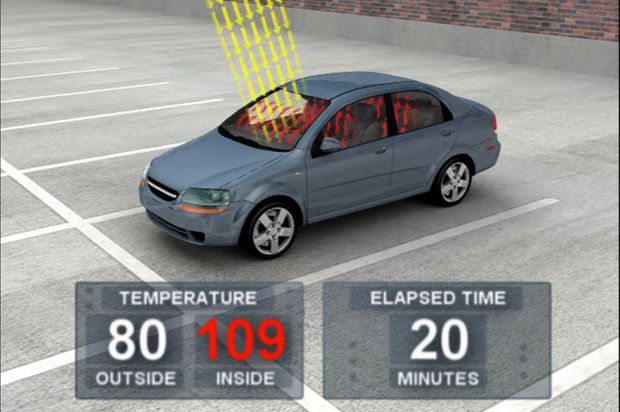
Inserting Climate Change into our Collective Thinking

(Source: SafeKids Worldwide)

Last week’s blog focused on collective crimes, collective blame, and collective wisdom. A timely question relevant to my teaching and to this blog is how we “fertilize” collective wisdom to prevent or mitigate global disasters such as climate change. This issue is directly connected to another topic that I dealt with extensively in a series of blogs called “Educating in the Anthropocene.” The last blog that summarized previous entries on this topic was posted on February 21, 2023. The focus of that blog was on reorganizing the educational programs in universities to expand various forms of interdisciplinary programs.

As we saw in last week’s blog, “fertilizing” global collective wisdom on climate change requires much more than changing the structures of higher education institutions. It requires attempts to educate everybody. For many reasons, including from a personal perspective, April is a good month to think about such issues. I am approaching the end of the semester and am currently in the middle of Spring Break, which means holidays, visitors from around the world, and beautiful cherry blossoms all around. All of this is a great environment to start thinking about the future. This is also the time when I am often invited to give talks focused on climate change to audiences with little technical background on the issue. I find the picture that opens this blog to be the most effective in introducing the topic. In an earlier blog, (April 17, 2018) I described in detail the potential threats of heat exposure to small children or animals in a locked car. On many levels, this situation, in which the child or animal lacks the ability to open doors or windows to equilibrate the inside temperature of the car with that outside can be likened to the global impact of climate change. It also links to the role that our energy use has played in facilitating global heating and its consequences.

If we want to “fertilize” collective reasoning on the topic that will lead to preventive action in the form of mitigation and adaptation, we have to focus on the young, if for no other reason than because they are going to suffer most from the impact—directly and indirectly through their growing families. To impact collective reasoning on such a topic in audiences without some technical prerequisites is not easy but we are now in the process of learning how to do it. This blog will summarize some initial efforts in this direction in various settings.

Higher Ed Institutions:

Here’s one example of using private donations to start enriching academic institutions with relevant facilities:

John Doerr, one of the most successful venture capitalists in the history of Silicon Valley, is giving $1.1 billion to Stanford University to fund a school focused on climate change and sustainability. The gift, which Mr. Doerr is making with his wife Ann, is the largest ever to a university for the establishment of a new school, and is the second largest gift to an academic institution, according to the Chronicle of Higher Education. Only Michael R. Bloomberg’s 2018 donation of $1.8 billion to his alma mater, Johns Hopkins University, ranks higher. The gift establishes the Doerrs as leading funders of climate change research and scholarship, and will place Stanford at the center of public and private efforts to wean the world off fossil fuels. “Climate and sustainability is going to be the new computer science,” Mr. Doerr, who made his estimated $11.3 billion fortune investing in technology companies such as Slack, Google and Amazon, said in an interview. “This is what the young people want to work on with their lives, for all the right reasons.”

Doerr clearly believes that the new Stanford Center on Climate Solutions will prompt something like the intellectual explosion of studying computer science. The difference is that although computer science is involved in almost everything, it serves a similar purpose as a language. Indeed, while in the beginning, there was a balance between software and hardware majors in computer science studies, students’ interest shifted the focus much more on the software part. Areas directly concerned with climate change are now leaning more toward the study of “everything,” meaning they resemble the ancient study of philosophy.

Status in K12 schools:

There are certain barriers to including climate change in school curricula, although they differ by age group. Within middle schools:

Climate change is set to transform where students can live and what jobs they’ll do as adults. And yet, despite being one of the most important issues for young people, it appears only minimally in many state middle school science standards nationwide. Florida does not include the topic and Texas dedicates three bullet points to climate change in its 27 pages of standards. More than 40 states have adopted standards that include just one explicit reference to climate change.

Barriers to inclusion in early grades mostly come down to implementation:

“Nobody really knows yet at what age kids can understand climate change,” said Gary Evans, an environmental and developmental psychologist at Cornell University who is conducting a study of children in kindergarten through third grade to find out what they know about climate change and how it makes them feel. “Anyone who tells you that they know the best way to talk to young kids about climate change is doing so without the guidance of data.”

That said, it’s not all bad: some places are starting to include climate change in curricula:

New Jersey public school students will be the first in the country required to learn about climate change while in the classroom starting this school year. “Climate change is becoming a real reality,” New Jersey first lady Tammy Murphy, who spearheaded the initiative, told “ABC News Live” on Thursday. The new standards were adopted by the state’s board of education in 2020, but because of the pandemic, the roll out was halted, giving educators and districts more time to prepare the lesson plans for all students in grades K-12. “The districts themselves are able to design whatever it is that the way they want to implement and interpret this new education standard,” said Murphy. Lessons will focus on how climate change has accelerated in recent decades and how it’s impacted public health, human society, and contributed to natural disasters.

General communications to audiences with no prerequisites:

There are plenty of examples of anthropogenic (man-made) impacts that are readily available for use in schools—and outside of schools—on many levels:

The U.S. Geological Survey (USGS) water cycle diagram is still used by hundreds of thousands of students in the United States and worldwide. It’s also the basis for many, many spin-off diagrams. Today, the agency released a new diagram for the first time in more than 20 years, this time with humans as showrunners. Although people have long siphoned water from groundwater and diverted rivers into farm fields and industrial plants, the new diagram is the first time humans have been included in what was presented until now as a “natural” cycle. The change reflects the latest 20 years of research uncovering humanity’s central role in the cycle and how to communicate it visually. “We need to change how we think about these things to be able to live and use water sustainably for our future,” said Cee Nell, a data visualization specialist at the USGS VizLab, which designed the diagram. In addition to natural processes like ocean evaporation, precipitation over land, and runoff, the new diagram features grazing, urban runoff, domestic and industrial water use, and other human activities. Each label in the chart comes from data tracking the significant paths and pools of water worldwide.

Surmounting political opposition

Based on my own experiences of teaching the topic at Brooklyn College, we almost always include “denier” perspectives as part of the conversation. This is not just so that we comply with state mandates but also part of good teaching, which involves looking at all angles of an argument:

Ohio college and university instructors could be barred from teaching climate science without also including false or misleading counterpoints under a sprawling higher education bill that received its first hearing Wednesday. Senate Bill 83, or the Higher Education Enhancement Act, seeks to police classroom speech on a wide range of topics, including climate change, abortion, immigration, and diversity, equity and inclusion — all of which would be labeled “controversial.” On these and other subjects, public colleges and universities would need to guarantee that faculty and staff will “encourage and allow students to reach their own conclusions” and “not seek to inculcate any social, political, or religious point of view.” Colleges and universities that receive any state funding would be barred from requiring diversity, equity and inclusion training and have to make a commitment to “intellectual diversity” that includes “divergent and opposing perspectives on an extensive range of public policy issues.” The bill also includes provisions for annual reviews and reports, requirements for “intellectual diversity” in recruiting invited speakers, disciplinary sanctions for interfering with that diversity, a prohibition against faculty strikes, and more.

In many aspects, the slow introduction of complex topics such as climate change into the collective background of the general public, through its inclusion in curriculum, follows (from my own perspective) the slow introduction of the Holocaust into school curricula. As part of the last generation of survivors, I often participate in such efforts and often connect this effort with the probable future impact of climate change. As I mentioned in my earliest blogs (April 2012), this inclusion has been met with mixed reactions.

Posted in Climate Change | 1 Comment

Collective Guilt, Collective Blame, and Collective Wisdom

(Source: Spreaker)

A few days ago I was notified by our Judaic Studies Department about a new film that came out about the history of  German reparations to the Jewish people for the atrocities now known as the Holocaust. I saw the film, followed by a panel discussion with panelists who all looked to be born well after the signing of the Reparations Agreement on September 1952.

I have discussed my history with the Holocaust throughout the 11 years that I have been writing this blog, starting with the first posting (April 22, 2012). When the Reparations Agreement was signed, I was 13 years old, growing up in Israel. The signing followed major debates in Germany and Israel, and among Jews that lived outside Israel. The main issue in Israel was “money for blood,” an argument that boiled down to how anybody could set a price for the government-initiated genocide of six million people. The German government’s intent was to eradicate Jews (among other groups) from the face of the Earth; the toll only stopped at six million European Jews because the Germans lost the war. The main issue that the Jewish negotiators insisted on was that the reparations agreement not be confined to material reparations but rather expand to a public admission of collective German responsibility and sincere regret for the committed crimes, including an official apology to the victims. The main opposition argument in Germany was that the reparations and the moral admission constituted “collective punishment,” both material and moral. Collective punishment for crimes is still an open issue that continues to be discussed:

Collective punishment is a punishment or sanction imposed on a group for acts allegedly perpetrated by a member of that group, which could be an ethnic or political group, or just the family, friends and neighbors of the perpetrator. Because individuals who are not responsible for the wrong acts are targeted, collective punishment is not compatible with the basic principle of individual responsibility. The punished group may often have no direct association with the perpetrator other than living in the same area and can not be assumed to exercise control over the perpetrator’s actions. Collective punishment is prohibited by treaty in both international and non-international armed conflicts, more specifically Common Article 3 of the Geneva Conventions and Additional Protocol II.[1][2]

When collective punishment has been imposed it has resulted in atrocities. Historically, occupying powers have used collective punishment against resistance movements. In some cases entire towns and villages believed to have harboured or aided such resistance movements have been destroyed. Occupying powers have claimed that collective punishment can be justified by necessity as a deterrent. Another view is that it is a retaliatory act prohibited under the laws of war.

Shortly after the agreement was signed, I grew up and entered high school. My high school got involved in the discussion, including in the form of a mock trial. I volunteered to be the defense coordinator for the trial, advocating for acceptance of the agreement. Our main argument was that we should look at the agreement not as money for blood but as a necessary step to build a strong Jewish state to make sure that the history of the Holocaust would not be repeated. I had to synchronize my position with a personal attitude. My mother and I were entitled to the reparations. My mother accepted but I rejected them. The reason for my mother’s acceptance was simple: she badly needed the money. The reason for my rejection, in addition to the fact that I really didn’t need the money, was a bit more complicated. Acceptance required that I produce a medical certification that I was “harmed” by the experience. Almost every physician in Israel would have issued me such a certificate, once he heard my family’s history, but my main effort in life at that time was to show that in spite of the experience I was growing up as a normal kid, meaning that any failure on my part was of my doing and not because of my earlier experiences. When my mother passed away some 20 years later, I inherited all her savings, so my “honorary” refusal became inconsequential.

As was mentioned earlier in the Wikipedia entry, most legal codes are anchored on individual responsibility. However, collective guilt and punishments are often invoked as “deterrents” or “accelerators.”  These border lines remain fuzzy. A relevant case that again is connected to the Holocaust and the fate of my family is the role of Polish citizens in the murder of 3 million Polish Jews during the Nazi occupation of their country. Below is an example of recent writing on the issue:

The framework of categories introduced by Raul Hilberg—perpetrators, victims, and bystanders—once conventionally employed in understanding the destruction of European Jewry has started to fall out of fashion among historians of the Holocaust. In the case of East Central Europe, particularly Poland, the people situated at the edges of the volcanic eruption of genocide have invariably begun their slide from “bystanders” to “perpetrators” in the recent turn in scholarship since the publication of Jan T. Gross’ Neighbors. Apart from the national debate unleashed in Poland in 2001, the major contribution of the book to the historiography was to banish a view of ethnic Poles solely as victims of Nazi Germany and to substantiate a long-standing claim found in Jewish survivor testimonies that Poles sometimes acted as perpetrators of Judeocide. The Jedwabne pogrom of July 11, 1941, has become the cornerstone of discussions about collaboration and perpetrators at the grassroots level in East Central Europe.

Throughout this blog and in other writings, I have invoked potential collective guilt in labeling the existential end-of-the-century threat of accelerating climate change “self-inflicted genocide” (see again the first blog in April 2012 and the two blogs that follow).

In a working legal system (to differentiate from a system that works to serve power), to convict an individual, you need to provide convincing evidence of the individual’s guilt. Can you do the same with collective guilt? One way is to prove that the collective education system and public communication are biased to encourage the crimes that are committed. In many cases, this involves cherry-picking of instances. Recently, a controversial technology has developed in which one can “chat” with a “collective” in the form of cumulative internet learning machines. These sites, such as OpenAI’s ChatGPT, Microsoft’s Bing Chat, and Bard by Google, provide detailed, well-written, answers that represent collective internet “wisdom.” I tried this technology, asking it to answer a general question in one of my recent blogs (December 14, 2022). Below I quote from an NYT Op-ed in which three “deep thinkers” write about this technology:

In 2022, over 700 top academics and researchers behind the leading artificial intelligence companies were asked in a survey about future A.I. risk. Half of those surveyed stated that there was a 10 percent or greater chance of human extinction (or similarly permanent and severe disempowerment) from future A.I. systems. Technology companies building today’s large language models are caught in a race to put all of humanity on that plane.

Drug companies cannot sell people new medicines without first subjecting their products to rigorous safety checks. Biotech labs cannot release new viruses into the public sphere in order to impress shareholders with their wizardry. Likewise, A.I. systems with the power of GPT-4 and beyond should not be entangled with the lives of billions of people at a pace faster than cultures can safely absorb them. A race to dominate the market should not set the speed of deploying humanity’s most consequential technology. We should move at whatever speed enables us to get this right.

More recently, an interesting exchange was presented in the NYT between the author/journalist Kevin Roose and Sundar Pichai, the CEO of Google. I cite below the relevant two paragraphs from this interview. The first question shown here relates to the issue of approaching AGI (AI that surpasses human intelligence). “Human intelligence” is not defined. Presently, we have 8 billion humans on this planet. Which of them is being used as a comparison? There is no escaping from the conclusion that the intelligence that we are referring to is our collective intelligence, in which case, AI is only the tool for extracting it. The interview blames this tool for imperfections and dangerous consequences. This blame should more appropriately be directed at our “collective wisdom.” The second paragraph puts the AI feedback to the collective concern with climate change:

On whether he’s worried about the danger of creating artificial general intelligence, or A.G.I., an A.I. that surpasses human intelligence:

When is it A.G.I.? What is it? How do you define it? When do we get here? All those are good questions. But to me, it almost doesn’t matter because it is so clear to me that these systems are going to be very, very capable. And so it almost doesn’t matter whether you reached A.G.I. or not; you’re going to have systems which are capable of delivering benefits at a scale we’ve never seen before, and potentially causing real harm. Can we have an A.I system which can cause disinformation at scale? Yes. Is it A.G.I.? It really doesn’t matter.

On why climate change activism makes him hopeful about A.I.:

One of the things that gives me hope about A.I., like climate change, is it affects everyone. Over time, we live on one planet, and so these are both issues that have similar characteristics in the sense that you can’t unilaterally get safety in A.I. By definition, it affects everyone. So that tells me the collective will will come over time to tackle all of this responsibly.

Recently ChatGPT was banned in Italy over privacy concerns.

I am trying the AI systems now as extra credit for my students in my Cosmology course who are trying to probe the “wisdom” of the collective to answer deep personal, cosmological questions and their concluding opinions about the quality of such probes.

Stay tuned.

Posted in Climate Change | 1 Comment

Politicizing ESG Means Politicizing Our Future

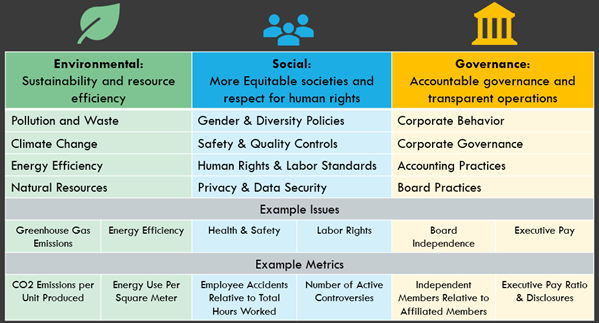
I have raised the issue of ESG (Environmental, Social, and Governance) investments in earlier blogs. A blog from this summer (August 16, 2022) delves into the details of the acronym, shown again in Figure 1. That blog also describes how the concept has started to penetrate global markets.

Figure 1 – Details of ESG

As with many other parts of our life, the concept is now being seriously polarized—to the degree that now both houses of Congress have passed a law forbidding pension funds from considering ESG as a factor for investment:

Often known as E.S.G. investing, this approach takes its name from the environmental, social and governance factors that are used by millions of people in countless investment, business, lifestyle and government policy decisions every day.

In the financial world, trillions of dollars have been placed in investments that take E.S.G. issues into account. “E.S.G. investing is now totally mainstream,” said Jon Hale, head of sustainable investing research for Morningstar. “It’s part of the thinking of every major investment company because, at its core, it’s just common sense.”

Yet as this approach has grown in popularity, it has set off a powerful political backlash. That was evident in Congress this past week, when the House and Senate approved bills aimed at restricting E.S.G. investing in workplace retirement accounts in the United States.

The White House has said President Biden will veto the legislation, so what happened in Congress won’t have immediate effects.

The Republican party was solid in voting for the law in both the House and the Senate and two Democratic senators joined them in facilitating its passage. President Biden promised to block the law and followed through:

More than halfway through his term, US president Joe Biden had yet to use his veto power. But that changed after the US Senate voted earlier in March to block a US Labor Department rule that would have allowed retirement plans to consider environmental, social, and governance (ESG) factors in their investments.

Democrats argued that the Labor Department rule was neutral: Retirement funds could either choose to invest in ESG funds, or not. But Republican opponents have turned ESG into a political lightening rod, deriding it as a form of “woke” capitalism at odds with the needs of average Americans.

US pension funds manage over $20 trillion dollars (pdf) in assets and retirement savings, according to the OECD.

Congressional override of the presidential veto has failed. Joe Manchin, one of the two Democratic senators that joined the Republicans in passing the law, responded to the president’s veto:

Sen. Joe Manchin (D-WV) blasted President Joe Biden’s veto of a congressional resolution to cancel a Labor Department rule allowing retirement fund managers to consider environmental, social, and governance guidelines when making investment decisions.

Manchin said Biden’s ESG policy “prioritizes politics over getting the best financial returns for millions of Americans’ retirement investments.”

“Despite a clear and bipartisan rejection of the rule from Congress, President Biden is choosing to put his Administration’s progressive agenda above the well-being of the American people,” Manchin said in a statement.

“This ESG rule will weaken our energy, national and economic security while jeopardizing the hard-earned retirement savings of 150 million West Virginians and Americans,” he said.

The law basically forbids those in charge of investing public funds from considering the issues mentioned in Figure 1 as factors in future profitability. To state it differently, investors can only consider present profitability and must ignore probable future impacts of broader issues that directly impact all aspects of our lives. This decision is being made when the world— in so many ways—is in upheaval.

The economic impacts of the Russian invasion of Ukraine and the global impacts of COVID-19 were discussed often in recent blogs. The resulting global inflation and its direct impacts on interest rates are a bit more recent.

Over the last two weeks, instabilities and outright defaults of banks both in the US and Europe have brought the smell of disaster to many of us. An op-ed in the NYT comments on the mess:

We were hours away from the failure of two regional banks and, more precisely, the new widespread recognition that deposits in excess of $250,000 might not be safe, setting off a chain reaction. Customers at other regional banks who thought their deposits were risk-free were suddenly questioning whether they should move their cash to safer havens. Withdrawals began, and as a result, previously remote risks of failure became real.

Unfortunately, the bipartisanship of last weekend has faded, and the blame game has begun. Progressives claim that greater regulation would have prevented the failure. Others claim that the failures were the result of a shift in regulatory focus from prudence to socially oriented directives.

Both claims are off base. Worse, this opportunistic political rhetoric may distract us from both the risks of the moment and, as we look forward, the critical role banks play in our society.

France is up in arms because its government is taking the “drastic” step of increasing its retirement age from 62 to 64 (see March 7, 2023 blog). Israel is up in arms because the new administration, nervous about how long it can hold power, has decided to make drastic changes to the structure of government (while it still can) by giving the Knesset control over the judiciary.

Figure 2 shows a self-portrait of my high school roommate (5 years after the establishment of the State of Israel) in front of what has become a weekly demonstration. He wasn’t even the oldest there—a group of ladies over 90 years of age—some of whom took part in the War of Independence—were also among the demonstrators, often with their kids and grandchildren.

Figure 2 – A recent demonstration in Israel through the eyes of a friend

Michael Bloomberg’s comments on the immediate impact of the instabilities on the Israeli economy are shown below:

Under the new coalition’s proposal, a simple majority of the Knesset could overrule the nation’s Supreme Court and run roughshod over individual rights, including on matters such as speech and press freedoms, equal rights for minorities and voting rights. The Knesset could even go as far as to declare that the laws it passes are unreviewable by the judiciary, a move that calls to mind Richard Nixon’s infamous phrase “When the president does it, that means that it is not illegal.” Prime Minister Benjamin Netanyahu’s government is courting disaster by trying to claim that same power, imperiling Israel’s alliances around the world, its security in the region, its economy at home and the very democracy upon which the country was built.

The economic damage is already being felt, as the pummeling of the shekel has shown. A large number of business leaders and investors have spoken out against the government’s proposal, publicly and privately. And in a disturbing sign, some people have already begun pulling money out of the country and re-evaluating their plans for future growth there. As the owner of a global company, I don’t blame them.

These are trying times for all of us. Stay tuned.

Posted in Climate Change, Sustainability | Leave a comment

Guest Blog by Phil Gallagher: Going Solar 2

This week, we have a follow-up guest post from my friend Phil Gallagher updating us on his “going solar” journey.

It’s been about seven months since I reported on the solar panels we installed last April 15; time for an update. Last July I noted that we received our first invoice from Con Edison: we were paying about $21 for delivery of electricity and $0.00 for electricity itself. Since we spent 110 days at our Maine hide-away between mid-June and early October, that first Con Edison bill didn’t really tell us much—we weren’t using their electricity because we weren’t here in Brooklyn.

We’ve been home in Brooklyn for a little over 5 months so we’re back to using Con Ed’s electricity once the sun goes down and on very cloudy days. As Con Ed’s invoice and net metering report for the period from December 5, 2022 to January 5, 2023 shows, we used more energy from the grid than in brighter months with longer days; during the winter we’ve been largely drawing on what was generated and ‘banked’ in the 110 days when we weren’t here. Bottom line: our monthly Con Ed payment is still less than $21.

In analyzing the net value of our solar panel installation there are a number of factors to consider; I’ll mention just two of the most important. Starting in late November and continuing to the present (March 10, 2023), we’re using 30% less natural gas from National Grid to heat the house. This is partially due to the fact that we’ve been using our LG mini-split system to heat individual rooms.  Since the outside temperature has gotten into the low 40s and 30s we’ve been using our gas-driven circulating hot-water heating system for only 30 minutes most mornings to warm the house; we’re using our electricity-driven mini-split system to keep specific rooms at 72 degrees throughout the day. We have mini-split units in 4 rooms; each can be controlled separately, enabling the heating of the kitchen or the living room or my wife’s office or the master bedroom without heating rooms that are unoccupied. Another factor keeping energy use less than in previous years has been the weather: this has been a warm winter so far. To fully analyze our savings in energy costs we’d have to have data from a number of years.

By late spring I hope to have additional data from both electric and gas bills.  Another type of data may also be available: the money we’re getting back from federal, state, and NYC tax incentives.  We’ll see our tax accountant soon. By early June there should be more data on which to judge the overall results of our solar panel installation.  Until then this report can only be considered a report in progress, but it’s encouraging. As for the future, I can announce that we are retiring our ‘restaurant’ gas stove (a Garland) which we’ve had for about 40 years and have ordered a fully electric LG induction range which we should receive by early April. Stay tuned.

Posted in Guest Blog | Tagged , | 3 Comments

Population Decline: Remedies

Starting on February 28th of this year, I’ve posted a series of blogs mentioning proposed remedies to the local implications of the global population’s declining trend and consequential societal aging. These include seppuku (voluntary suicide of the old) suggested by a Yale, Japanese-born professor (February 28th) as well as some more “practical” approaches in Japan:

In 2020, Japan’s health ministry launched eight “living labs” dedicated to developing nursing-care robots. Yet in a way, the entire country is one big living lab grappling with the repercussions of a rapidly aging society. In business, academia, and communities around Japan, countless experiments are under way, all aiming to keep the old healthy for as long as possible while easing the burden of caring for society’s frailest.

Also on the books are a modest increase in retirement age in France and various experiments in Russia to use payments to encourage families to have children (March 7th blog). While these are state-led measures, other approaches are more individualistic. For instance, a more recent trend in Russia, directly connected to the Russian invasion of Ukraine, is the increase in “baby tourism”:

These are just some of the Russian women who posted on popular forums for “baby tourism” – a phenomenon that has been growing since the Kremlin launched an invasion of Ukraine in February 2022.

Since then, authorities say thousands of young Russians have flown to South America, Argentina in particular, where they don’t need a visa to enter the country, and where their babies are guaranteed a less restrictive foreign passport.

The Moscow-Buenos Aires route is also an easier way for the mothers to acquire local nationality. But now officials are concerned about the sheer scale of the problem after one Ethiopian Airlines flight landed in February with 33 pregnant Russian women on board.

A Euronews investigation has uncovered the network of Russian travel agencies and support services that charge up to $35,000 (€32,840) to pregnant Russian women and make false promises that lawyers say are tantamount to criminal activity.

On the other end of the life cycle, recent trends in China suggest attempts by certain segments of the population to make money on what they consider to be unavoidable trends resulting from the aging process (Analysis: As China ages, investors bet they can beat retirement home stigma):

HONG KONG/SHANGHAI, March 3 (Reuters) – Investors are betting big on a major attitude shift among elderly Chinese – that they will warm up to retirement homes as the world’s most populous country ages and smaller families struggle to support parents and grandparents.

Who takes care of the elderly in China, where pensions are tiny, is one of the major headaches policymakers face as they deal with the first demographic downturn since Mao Zedong’s Cultural Revolution.

Costly nursing homes are out of reach for most elderly and are generally frowned upon, with many judging the use of such facilities as a sign children are not fulfilling their duties.

But the hope of companies investing in the sector in China is that those attitudes will change soon, and fast – at least among the small percentage of elderly who got rich before they got old. China’s 1980 to 2015 one-child policy means smaller families are expected to support the old folk, some of whom would have no choice but to seek professional elderly care, investors say.

In the US, frightening and unlawful trends are being exposed of companies relying on populating the labor force with unaccompanied migrant child workers:

These workers are part of a new economy of exploitation: Migrant children, who have been coming into the United States without their parents in record numbers, are ending up in some of the most punishing jobs in the country, a New York Times investigation found. This shadow work force extends across industries in every state, flouting child labor laws that have been in place for nearly a century. Twelve-year-old roofers in Florida and Tennessee. Underage slaughterhouse workers in Delaware, Mississippi and North Carolina. Children sawing planks of wood on overnight shifts in South Dakota.

Largely from Central America, the children are driven by economic desperation that was worsened by the pandemic. This labor force has been slowly growing for almost a decade, but it has exploded since 2021, while the systems meant to protect children have broken down.

This brings us to the issue of immigration.

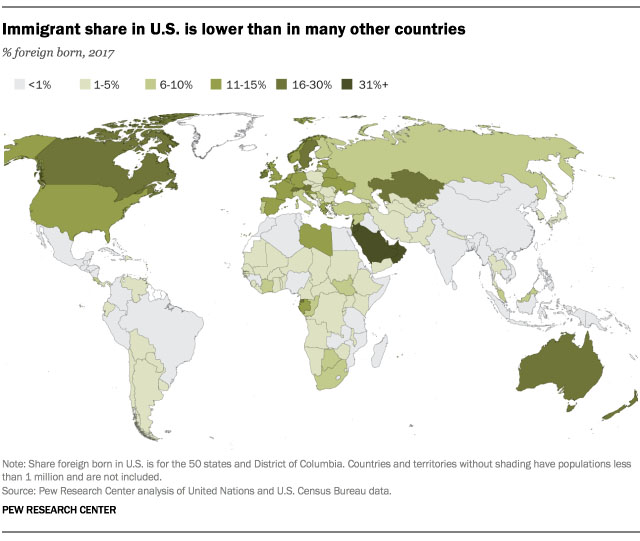
Figure 1 in last week’s blog showed that now, while there is a global trend of population decrease, the slow-down of population growth and the aging of the population are much more pronounced in developed, rich countries, than in developing ones. This dynamic opens the door for increased immigration from developing countries to developed ones. As shown in Figure 1 below, this trend is being quantified through increases in foreign-born residents in rich countries compared to developing countries. The situation in Russia in Figure 1 is a bit misleading, however, because it presumably contains many people who were born in the Soviet Union and became “foreign-born” after the USSR’s break-up in 1990.

Figure 1 – Percent of immigrants throughout the world (2017)
(Source: Pew Research Center)

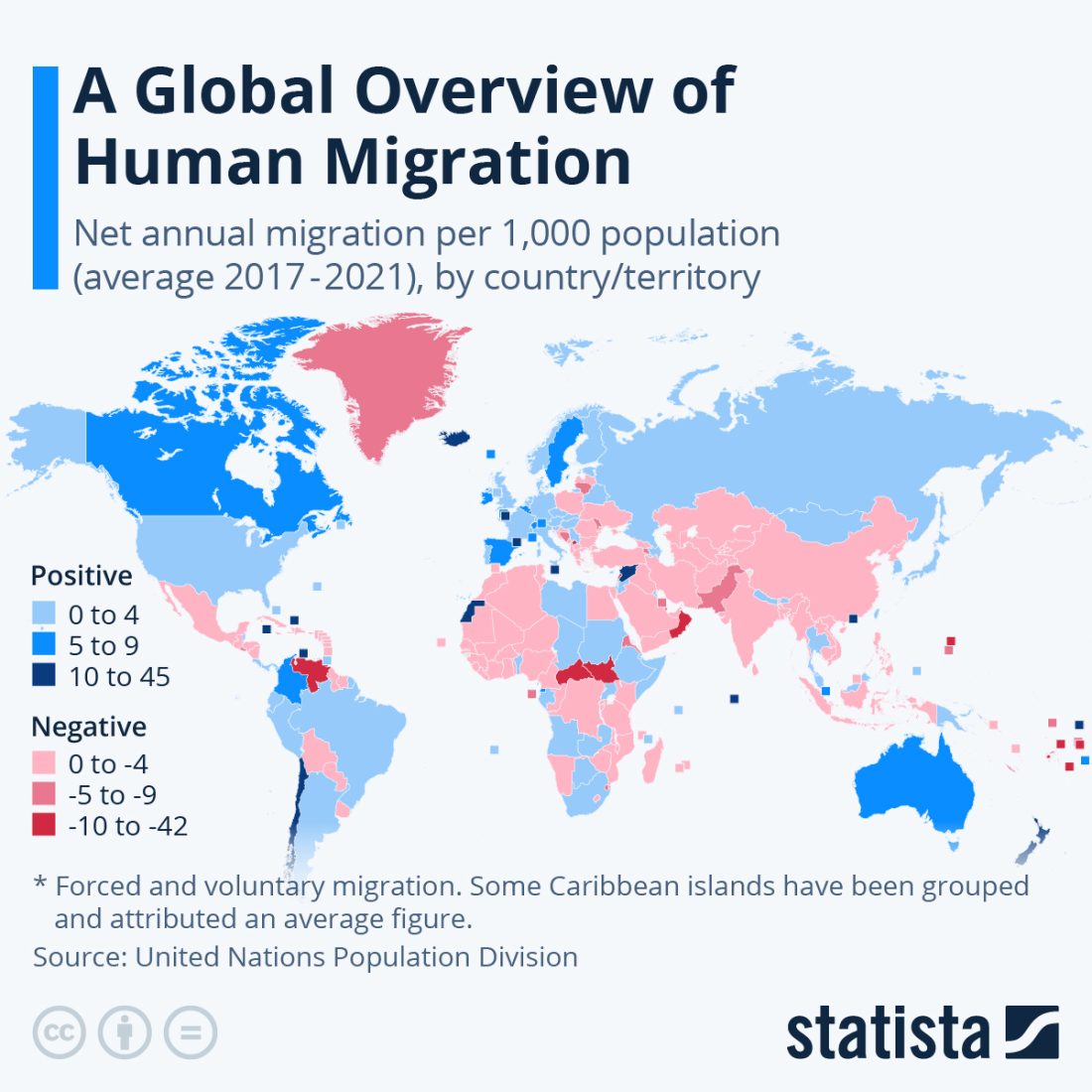
The number of foreign-born occupants shown in Figure 1 integrates over the lifetime of the immigrants. These numbers apply to anyone born elsewhere, regardless of how long they’ve lived in their current country. Figure 2, on the other hand, shows recent trends of integration, counting only those who moved over the last five years as separate; native-born and six-year immigrants are grouped together. The two show similar trends, with some noticeable differences (Saudi Arabia, the US, Canada, etc.).

Figure 2 – Global migration (Source: Statista)

Statista, the same reference from which I took Figure 2, summarizes the recent immigration situation in the following way:

This map provides an overview of the migration trends in the world. It shows the annual net migration (arrivals minus departures) of all countries and territories, relative to their population size. Between 2017 and 2021, the regions of the world that lost the largest share of people via emigration were the Marshall Islands and American Samoa in the Pacific Ocean, followed by Lebanon and Venezuela. During this period, these four territories, some of which are experiencing severe economic hardship, experienced an average net loss of 28 to 42 inhabitants per 1,000 people per year.

In contrast, the regions that attracted the most migrants relative to their population size were the New Zealand-administered Tokelau Archipelago, the Caribbean tax haven of the Turks and Caicos Islands and, in Europe, Malta. For these three places, the average annual net migration was between 22 and 45 additional persons per 1,000 inhabitants.

The site quotes 281 million international immigrants in 2020 (3.6% of the global population). The immigration issue is complicated. Put the word “immigration” into the search box above and you will get many blog posts. However, the unfortunate reality is that globally the immigration process has become highly politicized. It’s transformed some democratic countries into “illiberal” ones where bigots float “replacement” concepts that claim immigrants leave their countries to “replace” richer native-born citizens. For a long time, immigration policies were tailored to attract young professionals that were in shortage in the target country. Canada often serves as an example of a more holistic immigration policy:

In recent years, Canada has become an even more attractive destination for immigrants after policies enacted under U.S. President Donald Trump severely restricted access to the United States. Yet, Canada is also experiencing a labor shortage exacerbated by a dearth of skilled workers. Its immigration system faces an array of other challenges as well, including a surge in asylum claims, rising deportations, and labor abuses against temporary-visa holders.

I will return to these issues often in future blogs.

Posted in immigration | Leave a comment

Population Decline: Impacts

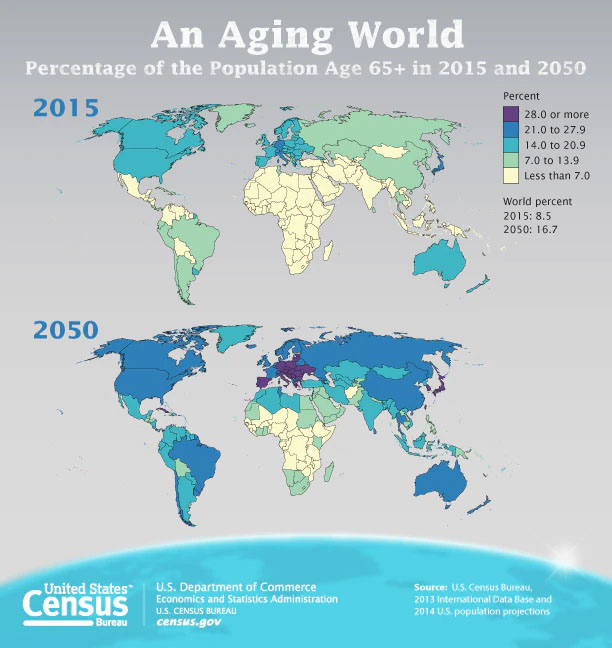
Last week’s blog focused on the dynamics of global population changes, which are determined by the balance of births and deaths. The global population is still growing because births are still outpacing deaths but the near-term (one-generation) trends predict a coming reversal when the global population will reach a maximum beyond which it will start to shrink. An important impact of these changes is the global increase in median age: the world is aging. However, the timing of these global trends is not universal. Figure 1 shows the present distribution of older people (>65) in 2015 with its projections in the near future (2050).

Figure 1 – Percentage of elderly by country (Source: US Census)
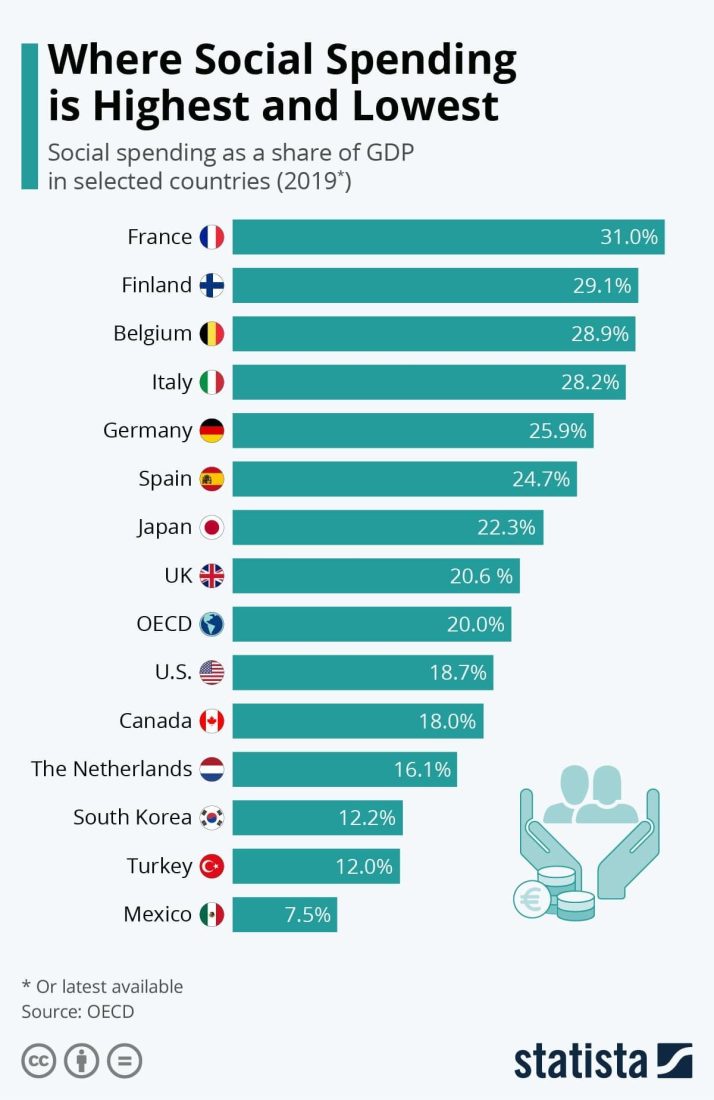
An aging, shrinking world requires overcoming shrinking economic activity that often scales with population and increase in social spending. The OECD list of social spending by (mostly) developed countries is shown in Figure 2. It is a substantial fraction of these countries’ GDP. That fraction increases with the aging of the population.

Below is a list of three major countries that are experiencing these trends and some steps that they are trying to take to mitigate the situation. I will expand the list in next week’s blog, where I will put the emphasis on immigration:

France

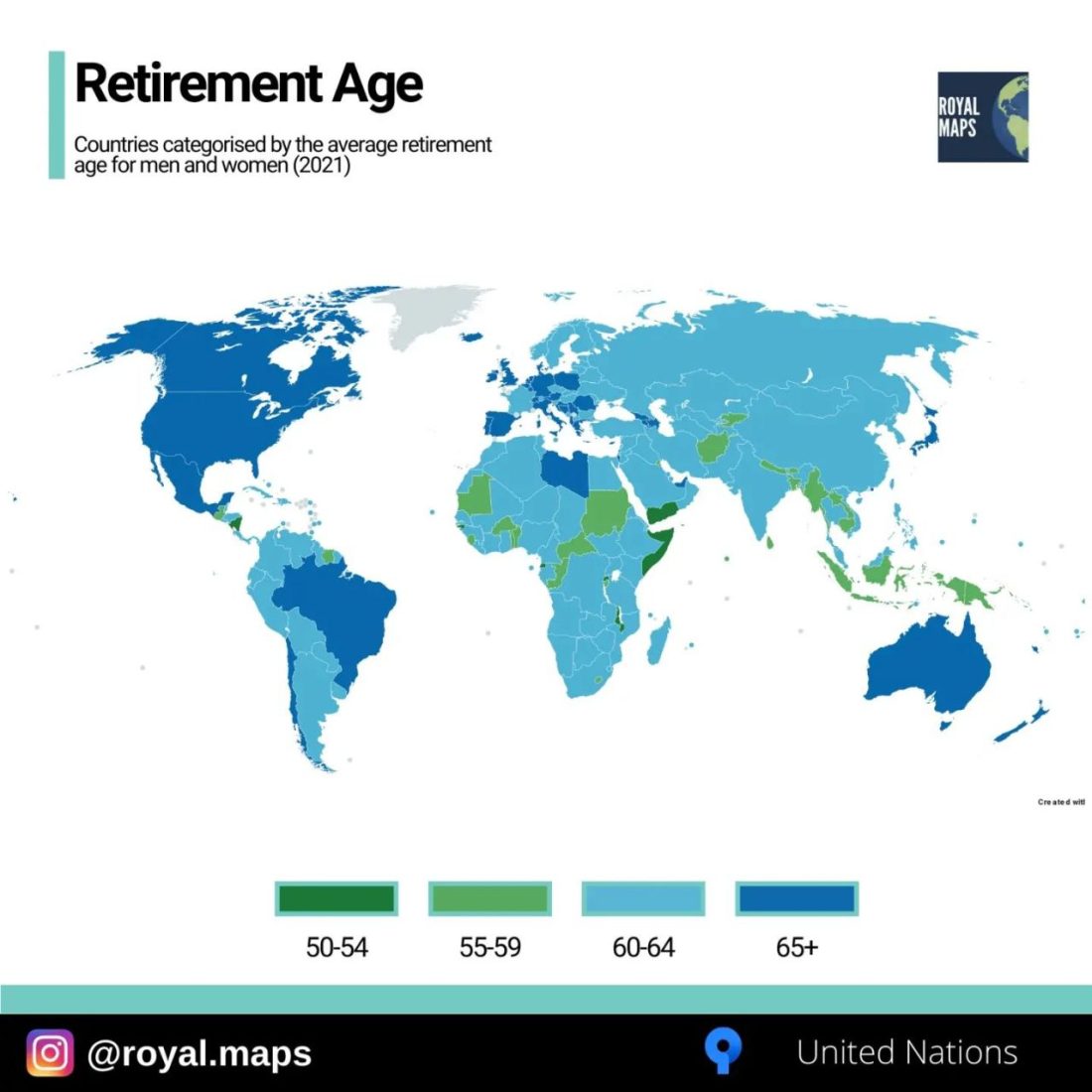
Figure 1 shows that France is not in the worst position in terms of the aging of its population, but Figure 2 shows that it is at the top of the list in terms of social spending. Figure 3 shows that it has one of the lowest retirement ages in Europe (Ukraine and Russia have traditionally had lower retirement ages but we have yet to see how these will change after the war). Yet, the French government is now proposing to remedy this situation by raising the retirement age from 62 to 64. Major demonstrations are now taking place to block this “major” adjustment:

PARIS, Feb 7 [2023] (Reuters) – Public transport, schools and refinery supplies in France were disrupted on Tuesday as trade unions led a third wave of nationwide strikes against President Emmanuel Macron’s plans to make the French work longer before retirement.

Tuesday’s multi-sector walkouts come a day after pension reform legislation began its bumpy passage through parliament and are a test of Macron’s ability to enact change without a working majority in the National Assembly.

The government says people must work two years longer – meaning for most until the age of 64 – in order to keep the budget of one of the industrial world’s most generous pension systems in the black.

The French spend the largest number of years in retirement among OECD countries – a deeply cherished benefit that a substantial majority are reluctant to give up, polls show.

The French love to demonstrate; we will see how this will play out.

Figure 2 – Social spending by country (source: Statista via World Economic Forum)

Figure 3 – Retirement age by country (Source: Royal Maps via Maps on the Web)

South Korea

South Korea is among the record holders, in terms of both shrinking and aging population:

South Korea’s statistics agency announced in September that the total fertility rate — the average number of babies born to each woman in their reproductive years — was 0.81 last year. That’s the world’s lowest for the third consecutive year.

The population shrank for the first time in 2021, stoking worry that a declining population could severely damage the economy — the world’s 10th largest — because of labor shortages and greater welfare spending as the number of older people increases and the number of taxpayers shrinks.

Many young South Koreans say that, unlike their parents and grandparents, they don’t feel an obligation to have a family. They cite the uncertainty of a bleak job market, expensive housing, gender and social inequality, low levels of social mobility and the huge expense of raising children in a brutally competitive society. Women also complain of a persistent patriarchal culture that forces them to do much of the childcare while enduring discrimination at work.

Russia

Russia is now at the center of the news because of its invasion of Ukraine but its decline in its population started way before that:

Crippling disruptions from the war are converging with a population crisis rooted in the 1990s, a period of economic hardship after the Soviet breakup that sent fertility rates plunging. Independent demographer Alexei Raksha is calling it “a perfect storm.”

As mentioned above, the decline in the Russian population started with the breakup of the Soviet Union in 1990. The government started experimenting with various payments to encourage families to have children, and has continued the policy. More recent promises came out to a few thousand dollars. President Putin came to power in 2000. I traveled to Russia in 2006. Part of the itinerary was to take a river cruise from St. Petersburg to Moscow. Many of our guides on the cruise were young Russian ladies. I asked some of them if the incentives offered by the president would encourage them to have children. They laughed and said that if President Putin promised them an apartment, they would start a conversation.

In next week’s blog, I will discuss a new angle on this topic that has emerged since the Russian invasion of Ukraine.

Posted in Population | Tagged , , , | Leave a comment

Population Decline – Background

Figure 1 (Source: World Economic Forum)

While I was busy over the last few blogs talking about living and dying in the Anthropocene, a few major changes in the demography of the planet took place. These changes drove me to return to these issues, to try to analyze their consequences and impacts.

In a guest blog about 9 years ago, Jim Foreit, a noted professional demographer, addressed important demographic global developments that were in focus at that time (January 14, 2014). I wrote a thank-you comment to his blog that is probably still the longest comment of the 11 years that this blog has been running. A few key lines from my response are repeated below:

“The nature of exponential growth or decline are such that left unchecked they will lead to disasters. As Jim’s blog made clear, we have yet to develop some understanding how to stabilize populations on any level. The UN fiat of stabilizing the population at replacement rate without suggesting what policies have a chance of accomplishing it, is untenable.”

Nine years later, in November 2022, probably the most important marker in global population took place when the global population passed the 8 billion mark (it was 2 billion when I was born)

Another important marker that took place in the last few months is that China lost its “crown” of being the most populous country in the world, to India:

They are among hundreds of thousands of Chinese couples who turn to assisted reproductive technology every year after exhausting other options to get pregnant. They travel from all corners of the country to big cities like Beijing in the hopes of beating the odds of infertility. Many wait in long lines outside hospitals before sunrise, just for the possibility of a consultation.

Now, the Chinese government wants to make the technology [IVF], which it made legal in 2001, more accessible. It has promised to cover some of the cost — typically several thousand dollars for each round — under national medical insurance. It is one of more than a dozen policy measures that Chinese officials are throwing at what they see as a very big problem — a fertility rate so low that China’s population has started to shrink.

However, there is only one mechanism for the global population to change – changing the balance between births and deaths.

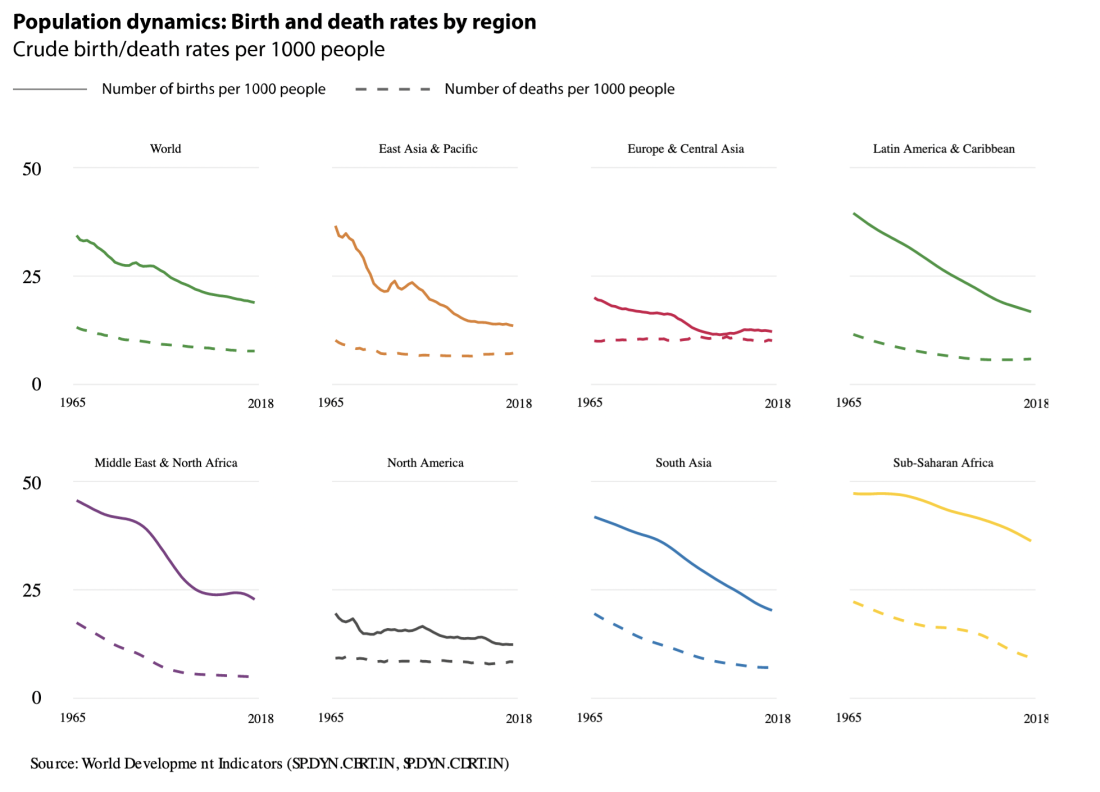
Figure 2 (Source: World Bank)

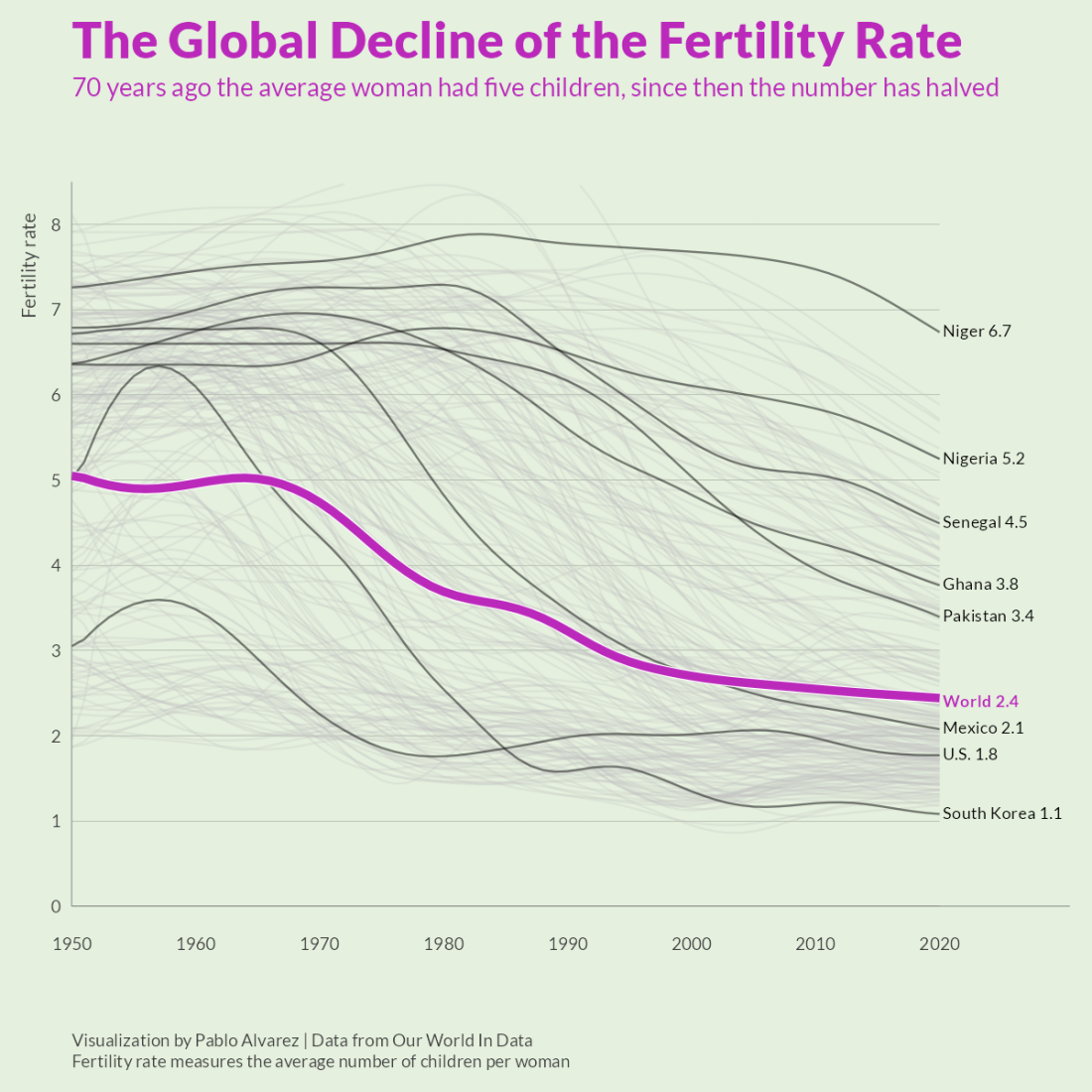
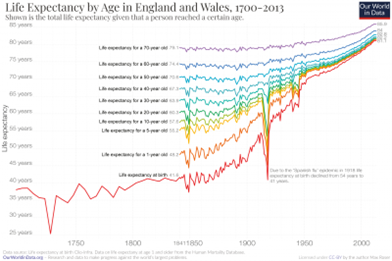
Figure 2 shows that almost all over the world, births still exceed deaths. In Europe and Central Asia (I’m not sure what exactly is included in that category), the two dynamics have trended toward each other. The world population is still growing. However, in almost all the regions, the decrease in deaths is much slower than the decrease in births. Figure 1 shows the reason: fertility rates are decreasing almost everywhere, while the death rate is staying at a more constant rate (Figure 3).

Figure 3 (Source: Our World in Data)

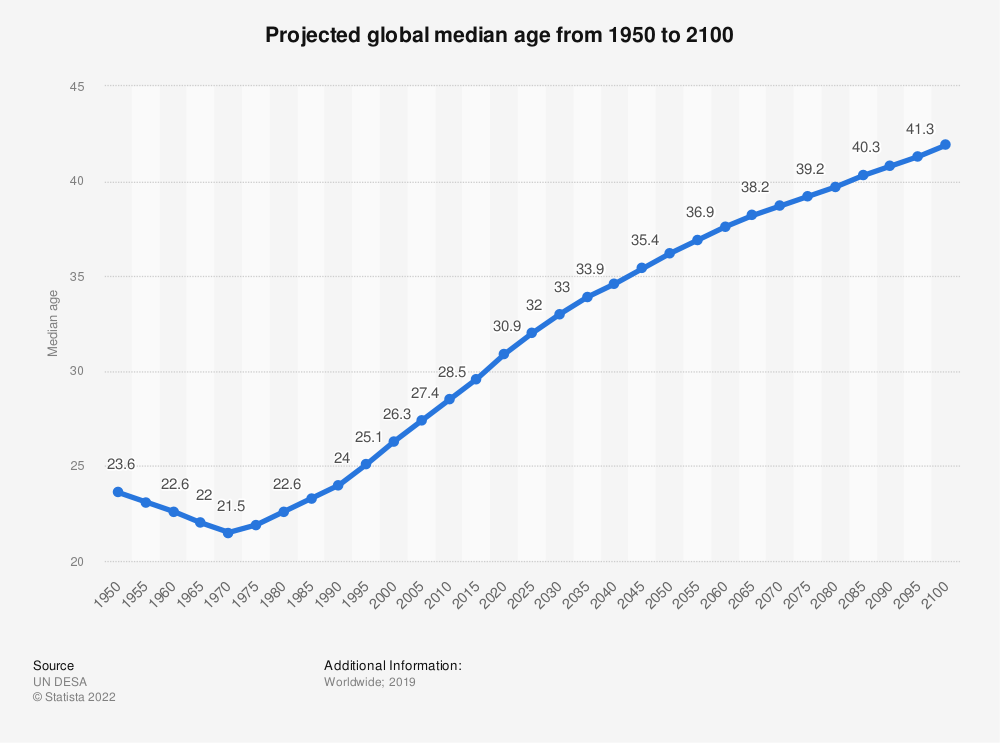
Figure 4 (Source: Statista)

Figures 3 and 4 both illustrate the trend. Figure 3 shows the convergence of global life expectancy with age and Figure 4 shows the steady increase in the global median age. As these data show, globally, birth rates still exceed death rates but both trends show that in a few years, the death rate will surpass birth rates and the global population will start to shrink. Figure 4 also shows that the population is aging significantly, with the median age doubling from 1970, almost coinciding with the start of the Anthropocene. What are the consequences of these shifts and are we prepared to face them? Below are two paragraphs from a report that the UN wrote about the transition:

“Population ageing is a defining global trend of our time,” the UN Department for Economic and Social Affairs writes in its World Social Report 2023, calling it a “major success story” that brings both challenges and opportunities. One of the main challenges for countries with ageing populations is to ensure that the economy can support the consumption needs of a growing number of older people, be it by raising the legal retirement age, removing barriers to voluntary labor force participation of older people or by ensuring equitable access to education, health care and working opportunities throughout the lifespan, which can help to boost economic security at older ages.

Especially countries in the early stages of the demographic shift have the opportunity to plan ahead and implement the right measures ahead of time, to effectively manage the challenges that come with an ageing population.

Japan has one of the world’s lowest fertility rates (1.37). Here is what a recent National Geographic article said about the situation there:

Japan’s path foreshadows what’s coming in many areas of the world. China, South Korea, Italy, and Germany are on a similar trajectory; so too is the United States, although at a slower pace. Five years ago, the world reached an ominous milestone: For the first time in history, adults 65 and older outnumbered children under five years old.

If Japan is any guide, aging will change the fabric of society in ways both obvious and subtle. It will run up a huge tab that governments will struggle to pay. Meeting the challenge won’t be easy, but the future isn’t necessarily all downhill. Japan’s experience, with its characteristic attention to detail and design, suggests extreme aging—a world in which an increasing share of the population is old—may inspire an era of innovation.

In 2020, Japan’s health ministry launched eight “living labs” dedicated to developing nursing-care robots. Yet in a way, the entire country is one big living lab grappling with the repercussions of a rapidly aging society. In business, academia, and communities around Japan, countless experiments are under way, all aiming to keep the old healthy for as long as possible while easing the burden of caring for society’s frailest.

Here is how one Yale Professor (Born in Japan and educated at MIT) suggested dealing with the Japanese aging issue:

In interviews and public appearances, Yusuke Narita, an assistant professor of economics at Yale, has taken on the question of how to deal with the burdens of Japan’s rapidly aging society.

“I feel like the only solution is pretty clear,” he said during one online news program in late 2021. “In the end, isn’t it mass suicide and mass ‘seppuku’ of the elderly?” Seppuku is an act of ritual disembowelment that was a code among dishonored samurai in the 19th century.

Since Japan is an early indication of what is awaiting all of us, we should hope that we can find a better alternative that lets us learn to live in a declining, aging world population. I’ve said that climate change amounts to self-inflicted genocide but that doesn’t mean I endorse mass suicide. The next few blogs will focus on symptoms of population changes, more realistic remedies, and scaling (different rates of decline in different places).

Posted in Anthropocene | 1 Comment

Back to Educating in the Anthropocene

(Source: The Lancet)

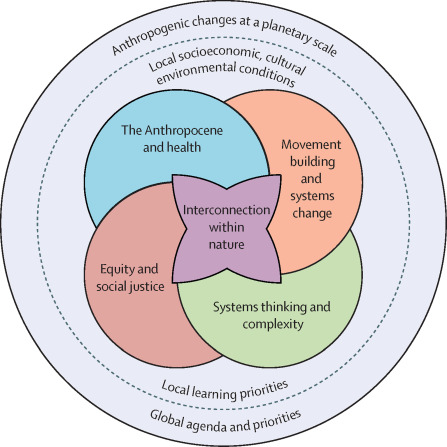
The original caption of this figure reads “The Planetary Health Education Framework.” However, it is similar to the Venn diagram that I discussed in a previous blog (August 4, 2020), which includes climate change, equity, Covid-19, population, and jobs.

Previous series of blogs on the topic of this blog include some of the following (February 25 – March 25, 2013 and May 24June 14, 2016). Additionally, 5 blogs, starting on July 19, 2022 and ending on October 4, 2022 (with some interruptions) have titles that include “Campus as Lab.” This topic is obviously close to my heart and is big enough to withstand frequent revisits. I often mention the need to expand our educational programs in interdisciplinary topics. For reasons that I have mentioned in previous blogs, my involvement with attempts to apply this idea within my school has often gotten me into direct confrontation with campus politics. In many cases, departments view such expansion as competition for resources.

In this blog, I would like to focus on alternatives to interdisciplinary education that do not directly compete with the departmental underpinning of campus structure. All the examples in this blog will come from the school that I am most familiar with, the City University of New York (CUNY). CUNY is a multi-campus consortia institution that I’ve described earlier (September 20, 2022 or just put CUNY into the search box). CUNY’s sustainability efforts were also described earlier.

Like most other academic institutions, the faculty is responsible for all academic matters (The quote below comes from the AAUP, which stands for “American Association of University Professors”):

The faculty has primary responsibility for such fundamental areas as curriculum, subject matter and methods of instruction, research, faculty status, and those aspects of student life which relate to the educational process.4 On these matters the power of review or final decision lodged in the governing board or delegated by it to the president should be exercised adversely only in exceptional circumstances, and for reasons communicated to the faculty. It is desirable that the faculty should, following such communication, have opportunity for further consideration and further transmittal of its views to the president or board. Budgets, personnel limitations, the time element, and the policies of other groups, bodies, and agencies having jurisdiction over the institution may set limits to realization of faculty advice.

As the quote emphasizes, the academic responsibility of faculty comes with an important caveat: the administration is responsible for the budget. Since everything that can be done depends on the availability of budget support, this policy negates the exclusivity of faculty in decisions on academic affairs. It also negates the administration’s ability to implement academic decisions that the faculty opposes.

As I have mentioned at many previous opportunities, the Anthropocene describes the major changes that the world is now experiencing. Many of us think that academic institutions should be at the forefront of preparing students to function effectively through these changes. This realization is not yet embedded in the political reality of most countries, though. Below is a commentary from The New York Times about this moment and what the President of the United States did or did not say in the recent State of the Union:

In his State of the Union address, Biden offered no ambitious plans to fix America’s ailing schools. The Republican Party can’t utter a complete sentence on the subject of school reform that doesn’t contain the initials C.R.T. (Critical Race Theory). What we’re seeing here is a complete absence of leadership — even in the midst of a crisis that will literally bend the arc of American history.

This moment of disruption should be a moment of reinvention. It should be a moment when leaders rise-up and say: Let’s get beyond stale debates over charters, vouchers, gender neutral bathrooms and the like. We’re going to rethink the nuts and bolts of how we teach in America.

The consortia structure of CUNY makes it convenient to pioneer changes within the school that reflect the real changes around us. The multi-campus structure enables us to experiment with the impacts of individual changes on a trial basis before instituting any mandates for change throughout the whole university. CUNY is a public university, and like all public institutions, it has to follow the policies of its governing bodies and at the same time lead the academic changes that are in force all around us. It can do this only in a cost-effective way that is consistent with the budgetary priorities of its governing institutions.

One effective way to accomplish these changes in a cost-effective way is to cooperate with the community that surrounds us; that includes the business community:

University-business cooperation has risen to one of the top priorities for many higher education institutions, with its importance mirroring attention from scholars and policy makers worldwide. Despite prolific research in this area, however, few have investigated curriculum-related university-business cooperation or its facilitators. Hence, this study investigates five mechanisms as drivers of business engagement in the design and delivery of the curriculum and the alignment of the curriculum with business needs. Results of a European-wide survey of higher education institution managers show the positive impact of senior management engagement, alumni networks and external communication of university-business cooperation, particularly on business engagement in curriculum design and the curriculum meeting industry needs. The higher education institution’s dedication of resources emerged as irrelevant in this context. The conceptual model is validated across higher education institutions with different levels of curriculum-related cooperation with business and across three countries, leading to implications for management and future research directions.

Below are two examples from my environment that are presently in force:

1.    Joint programs between STEM (Science, Technology, Engineering, and Math), Social, and Business

Below is an example of the degree programs of our (Brooklyn College) Department of Business and other departments:

The department has pioneered several multidisciplinary programs with other departments within the college. Business students may pursue a program in earth and environmental sciencesfilmphilosophy, or Puerto Rican and Latino studiesModern language majors in French, Italian, Russian, and Spanish may take a joint program in language and business. In conjunction with the Department of Computer and Information Science, the Department of Business Management also offers a Bachelor of Science in information systems. The department works closely with the Brooklyn College Magner Career Center to provide students with internships, identify job opportunities, and prepare students for their job search.

  1. School Programs that mutually serve students and communities:

I will mention here two successful programs that enjoy community support:

The Science and Resilience Institute at Jamaica Bay (SRIJB):

The Institute is a partnership among the National Park Service, the City of New York, and the City University of New York (CUNY) acting on behalf of a Consortium of seven other research institutions: Columbia University, Cornell University, Rutgers University, Stony Brook University, New York Sea Grant, Stevens Institute of Technology, and the Wildlife Conservation Society.

Our mission is to produce integrated knowledge that increases biodiversity, well-being, and adaptive capacity in coastal communities and waters surrounding Jamaica Bay and New York City.

The Institute is hosted and supported by Brooklyn College working closely with other CUNY colleges.

The Aquatic Research and Environmental Assessment Center (AREAC)
Below is an example of student activities in this program:

A few months ago, a student walked into AREAC and announced his desire to elevate his interest in vermiculture into a full-fledged research project. Self-motivated students are always welcome in AREAC, and Jorge will be conducting growth rate experiments on Tilapia using Red Wiggler worms to supplement their diet. This is an effective means to recycle food waste and turn it back into food production, and the use of worms as a diet supplement in urban aquaponics systems has already been demonstrated. Jorge hopes to calculate the nutrient and carbon recapture from this practice.

This will be the last blog in my attempts to analyze the needed societal changes to the emerging Anthropocene. Many more examples are at stake here (one suggested in the opening picture is the global healthcare aspect). I will return to this coverage once we have some progress in the formal labeling of our new epoch.

Posted in Anthropocene, Education | Tagged , , , , , , , | Leave a comment

Dying in the Anthropocene: A Global Perspective

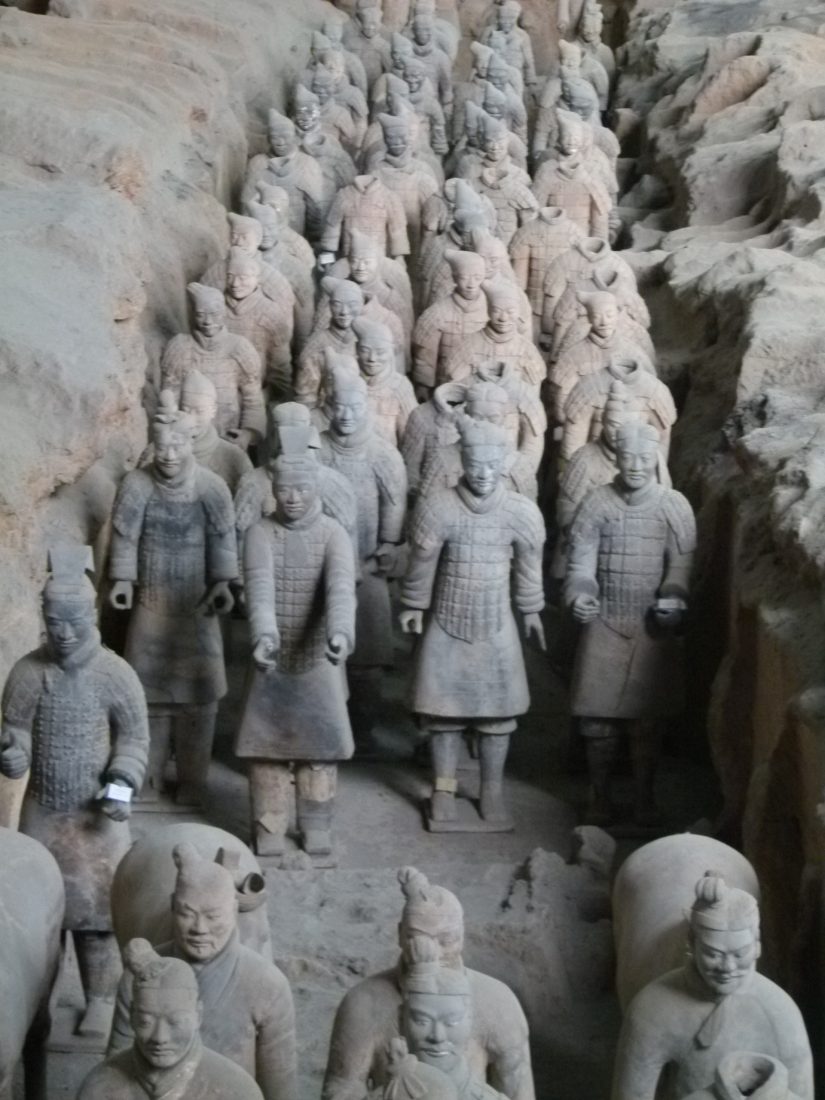
Figure 1 – Terracotta Soldiers in Xi’an

Figure 2 – Petra (Source: Britannica)

Last week’s blog focused on the finite availability of burial land and the unfulfilled wish of many of us to leave behind our stories without crowding the planet with even more stone memorials. Most of last week’s blog focused on the practices of the rich world. That blog ended with the promise that this blog would expand the coverage to include many more practices, with a particular emphasis on the global distinctions between cremation and burial. Below is a Wikipedia summary of global cremation rates:

This article is a list of countries by cremation rate. Cremation rates vary widely across the world.[2] As of 2019, international statistics report that countries with large Buddhist populations like Bhutan, Cambodia, Hong Kong, Japan, Myanmar, Nepal, Tibet, Sri Lanka, South Korea, and Thailand have a cremation rate ranging from 80% to 99%,[2] while Roman Catholic majority-countries like Italy, France, Ireland, Latvia, Poland, Spain, and Portugal report much lower rates.[2] Factors include both culture and religion; for example, the cremation rate in MuslimEastern OrthodoxOriental Orthodox, and Roman Catholic majority-countries is much lower due to religious sanctions on the practice of cremation, whereas for HinduJain, and Buddhist majority-countries the cremation rate is much higher.[2] However, economic factors such as cemetery fees, prices on coffins and funerals greatly impel towards the choice of cremation.

However, burial practices are as old as civilization. Two of the most famous ones, still among the most active tourist attractions, are shown in Figures 1 and 2. I took Figure 1 during a visit to China in 2015, and Figure 2 comes from a Britannica entry. Below are two short descriptions of the Terracotta Soldiers in Xi’an. The travel guide includes a more general description of burying practices in China.

Wikipedia:

The Terracotta Army is a collection of terracotta sculptures depicting the armies of Qin Shi Huang, the first emperor of China. It is a form of funerary art buried with the emperor in 210–209 BCE with the purpose of protecting the emperor in his afterlife.

The figures, dating from approximately the late third century BCE,[1] were discovered in 1974 by local farmers in Lintong County, outside Xi’anShaanxi, China.

China Highlights:

Since ancient times (roughly from the Shang Dynasty, lasting from 1,556 B.C. to 1,046 B.C.), Chinese people believed that the souls of the dead lived in another world: the nether world and graves were their earthly residences. Death of course brings boundless grief to the living, but the living have traditionally held grand, even extravagant funerals to see off the dead. Today, funerals are much more simple and economical.

Besides the grand funeral, people would bury some funeral objects for the dead, such as gold, silver, bronze wares, pottery, and other precious things. That’s why China has so many historical relics hidden underground and why grave robbery has been so prosperous in Chinese history.

Take the mausoleum of Emperor Qin, the largest underground mausoleum in the world for example. The mausoleum covers an area of 56 square kilometers. Up to now, more than 50,000 historical relics have been unearthed at the mausoleum. Among these historical relics, the Terracotta Warriors are the most famous ones. The site is about 2 kilometers from Emperor Qin’s Mausoleum, and they were created as the guards of Emperor Qin’s Mausoleum.

Next, we have a short Wikipedia description of the royal tombs in Petra.

The Royal Tombs of Petra embody the unique artistry of the Nabateans while also giving display to Hellenistic architecture, but the façades of these tombs have worn due to natural decay. One of these tombs, the Palace Tomb, is speculated to be the tomb for the kings of Petra. The Corinthian Tomb, which is right next to the Palace Tomb, has the same Hellenistic architecture featured on the Treasury. The two other Royal Tombs are the Silk Tomb and the Urn Tomb; the Silk Tomb does not stand out as much as the Urn Tomb. The Urn Tomb features a large yard in its front, and was turned into a church after the expansion of Christianity in 446 AD.[31]

As I’ve mentioned before, cost is also an important consideration when deciding the mode what to do with the bodies of the dead:

  • Research reveals Japan is most costly place to die sat at over two thirds the average salary

  • The average cost of dying across the world is around 10% of your annual salary

  • China is second most expensive place to die, with nearly 50% of salary

New research from SunLife, the over 50’s life insurance provider, has revealed which are the most expensive countries across the world to die in, when compared to the respective cost of living and earnings.

Based on available data gathered by its research team, the figures revealed that Japan is the most expensive place on the planet to die, with the cost of burial or cremation costing just over two thirds of the average salary, followed by China, which costs on average just below half of the yearly wage. Germany is the most expensive European country to die, but it sits far below the costs of China and Japan at only 16% cost of your overall salary.

According to the research, the average cost of a Japanese funeral is around 3 million Yen (approximately $27,900*), more than two thirds of the annual average salary in the country which equates to around $40,863 according to the latest figures from the OECD Better Life Index.

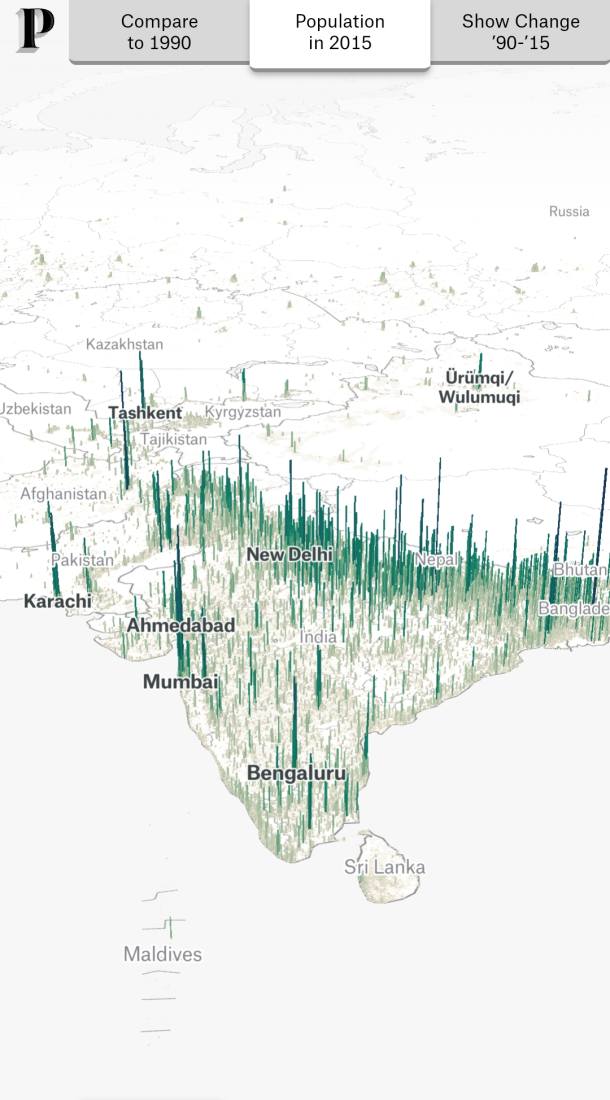
Many of our earlier ancestors believed that the world was flat. This is logical because most of the terrain around us looks flat. As we have evolved, however, many observations have shown things that could only have been accounted for with some kind of spherical shapes. All this thinking is two-dimensional (only surfaces). The Anthropocene is characterized by a third dimension, the density of humans. Figure 3 is an example of such a three-dimensional India.

Figure 3 – Population density in India (Source: Reddit)

Records about India also show that the country is running out of space for its new deaths. According to the latest census, India has just surpassed China as the most populated country, with 1.4 billion people. 80% of the population is Hindu and 14% is Muslim. However, even 14% of 1.4 billion is a large number (close to 200 million). The Hindu majority favors cremation but the article below shows that India, too, is running out of space in its cemeteries, especially given the extenuating circumstances of COVID-19:

NEW DELHI – The tombstones in the area designated for Covid-19 victims at Delhi’s biggest Muslim graveyard – the Jadid Qabristan Ahle Islam – tell a story of permanent exile. Many of the bodies here are of patients from states such as Bihar and Uttar Pradesh, individuals who came to Delhi for treatment but could not return to be buried closer to home.

The authorities in the city still do not permit bodies of Covid-19 victims to be taken back because of sanitation protocols, forcing families to bury them in Delhi’s graveyards.

This burden of interring the dead from smaller towns and rural parts of the country is one of the contributing factors to a problem for graveyards in big Indian cities – they cannot keep pace with the country’s growing Covid-19 death toll.

A similar scenario is taking place in China:

China is facing a space problem, not only for its living residents but also for its dead. While the U.S. currently has around 50,000 cemeteries, China only has about 3,000, Quartz points out, and they’re quickly filling up. Within six years, experts project that the country will run out of currently allocated space for burying people, according to Want China News.

As a result of dwindling supply for millions of aging citizens, plot prices are shooting up. One prime spot in Shanghai sold for $3.5 billion earlier this year, Quartz writes, while the average burial real estate goes for around $15,000. Prices are climbing each year, and one company that owns and manages graveyards has decided to go public, with a rumored IPO of $200 million to be announced immanently, Quartz reports. On the other hand, Want China Times reports that another company was caught selling $48 million’s worth of grave plots on the black-market.

The peaks in the density maps indicate that, at least presently, a lack of space doesn’t necessarily mean an absolute lack of space everywhere. It means a lack of more “convenient” space. Cemeteries near the places where family and friends live, which are increasingly urban places (peaks in the population density), become especially crowded. This also means that even countries with majorities that follow cremation practices, which in principle require less space, can be short of burial space that is convenient for many of its citizens.

To my knowledge, the desire to perpetuate individual stories in a cost-effective way that will go beyond the rich and powerful has yet to be fully explored. We will stay tuned (as long as we can).

Posted in Climate Change | Leave a comment

Dying in the Anthropocene

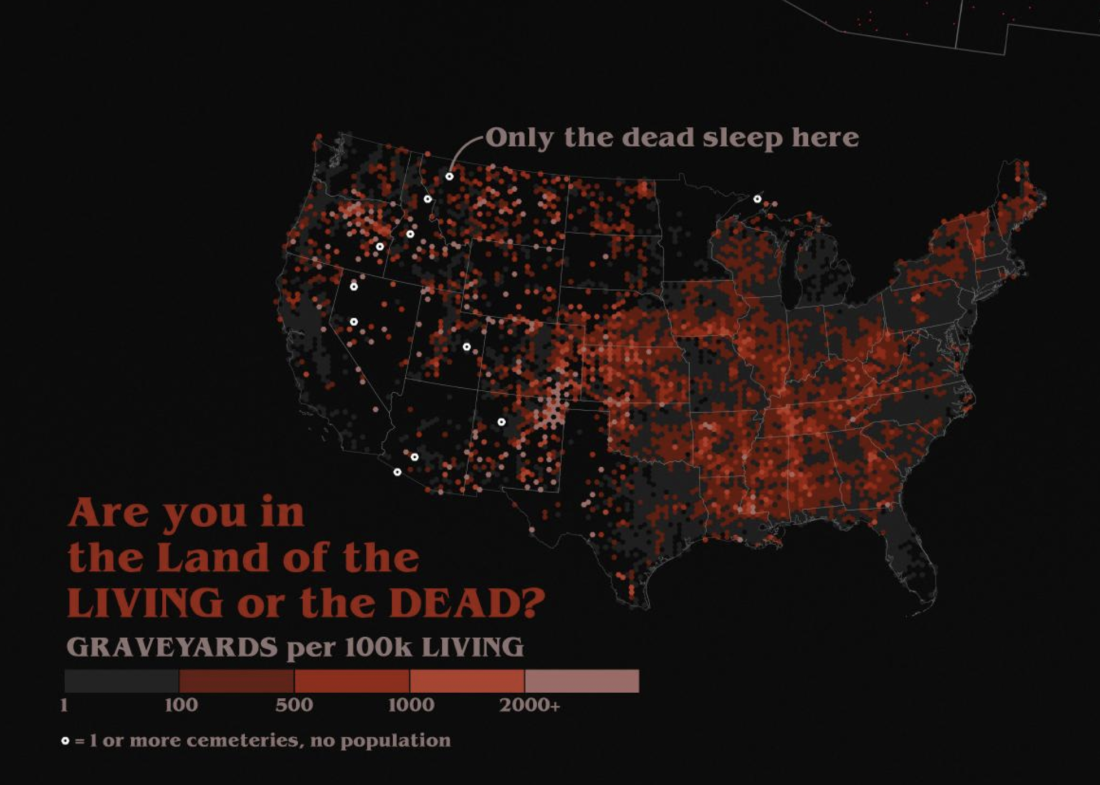
Map of number of graveyards in the contiguous USFigure 1 – Graveyards of the contiguous US (Source: Joshua Stephens via Insider)
I will die in the Anthropocene. The only uncertain part of this statement is whether the global epoch that is now under consideration will be officially named as such by that time. I will not be alone. At the end of last year, the global population passed 8 billion. All 8 billion will die within this epoch. More than that, I was born in 1939. A quick estimate of all the people who have lived on Earth since I was born (the estimated global population for 1939 is about 2 billion) can be helped by an estimate of the number of people that were born over this period (280 million). The total number of people born after the start of the Anthropocene will exceed 50 billion (we obviously have no idea how long the Anthropocene will last and in what form will it end. Most of the dead are buried one way or another (cremation vs. burying will be discussed in the next blog). As I’ve mentioned before, our planet is finite. The situation in the United States is shown in the opening picture of the blog with the suggestion that we are now living in the “land of the dead.” The global population is still increasing (though at a slower rate now). What can we do about it??

This blog will focus on two issues directly connected to our mortality: the finite availability of burial land and the unfulfilled wish of many of us for our stories to remain available after we are gone in a way that will not crowd the planet with stone memorials.

There is some background to these wishes:

In a previous blog (April 12, 2022), I described a recently-erected monument in Farsleben, Germany, which marks the liberation of my group of Bergen-Belsen inmates by the American army. The liberation took place on April 13th as the German army tried to move us from our camp to another camp farther away from the front line (Bergen-Belsen was liberated by the British army on April 15th).

I was involved in the construction of the monument. During the construction process, a friend (and relative), who works in the electronics industry suggested that we embed an electronic chip in the monument that could connect visitors with the story of our liberation. He donated a few chips that are about to be embedded.

A short internet search quickly convinced us that the appropriate technology exists; it has been dubbed the “Personal RosettaStone.” An article from 2010 describes it:

March 12, 2010 — After he dies, Christopher Hill plans to speak to his grandchildren, great grandchildren and even future generations from beyond the grave – not through a psychic medium or his last will and testament, but through a microchip.

“I think that when you walk by a gravestone and only see things like a few words, or a name and a date, it can be somewhat cold, impersonal, and almost incomplete,” the 41-year-old from Northern Virginia told ABCNews.com. “This gravestone is supposed to tell the story of a person, and provide you that connection or emotional remembrance.”

With new technology developed by a Phoenix, Ariz. company, he now thinks that could be a real possibility.

Launched by Objecs, LLC last month, Personal RosettaStones are iPod-sized stone tablets embedded with RFID (Radio Frequency Identification) tags that can store up to 1,000 words and a picture. When they’re near a mobile phone equipped with compatible technology, the information in the microchip is beamed right on to the cell phone screen. Objecs says the tags, which can be affixed to headstones, can last for up to 3,200 years.

A more recent link lets us see more, although the company’s websites don’t seem to be in service any longer.

As the example shows, the technology is based on RFID (Radio-frequency Identification) tags and is part of the more general category of the Internet of Things.

Such a solution can enhance the durability of our stories, but it will not contribute to more effective burial practices. It can, however, serve as an intermediate step in the burial transition.

I have played with the concept of perpetuating memories for some years now. The first time that I tried was shortly after the German reunification (around 1990). Closely after that event, the German government announced its intent to build a Holocaust Memorial in Berlin. I was inspired by the Vietnam Veterans Memorial in Washington, DC and tried to figure out what it would take to construct the memorial as a winding labyrinth with similar characteristics. The length of the Vietnam memorial is 200 feet, with more than 58,000 names engraved. My question was what area it would take to construct a similar memorial with 6 million names engraved using similar fonts and sizes to those at the Vietnam memorial.  I have since lost the details of these calculations, but I remember my conclusion – such a labyrinth was practical within Berlin’s city limits.

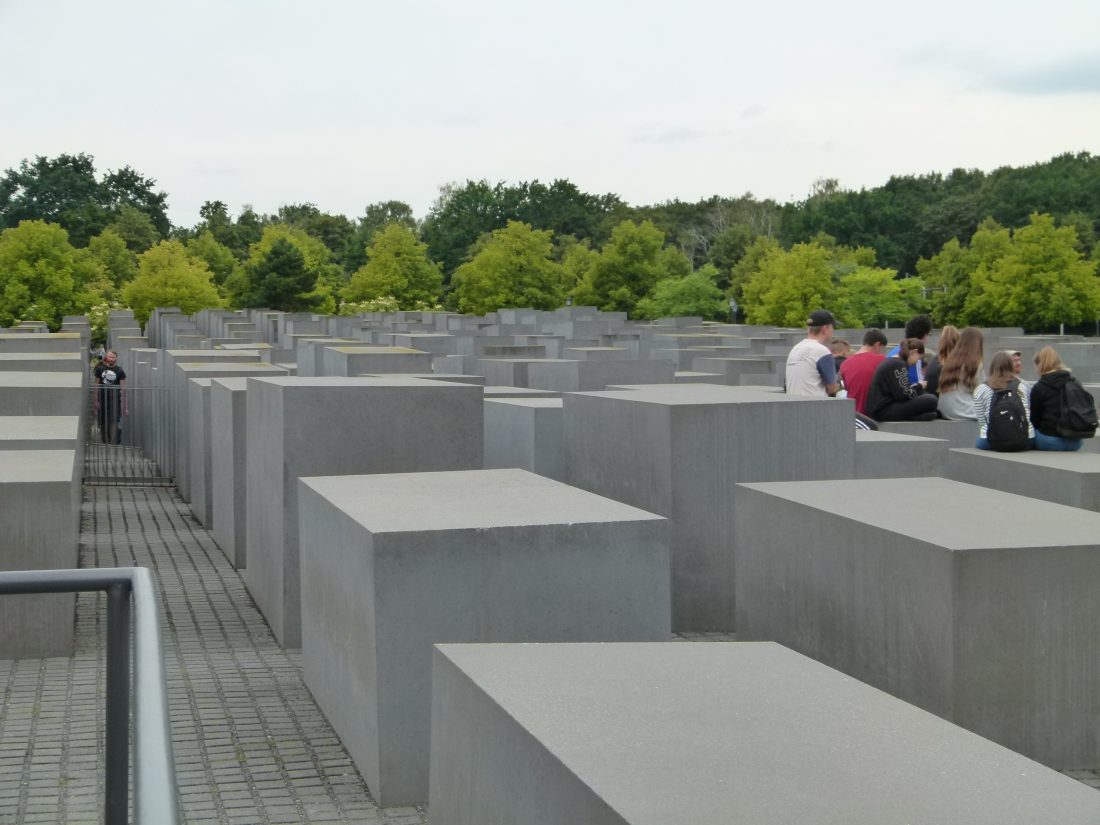
Figures 2 & 3– Berlin memorial for the Jews murdered in Europe (Berlin Holocaust Memorial)

The actual memorial was dedicated in 2005, and it contains 2711 slabs, shown in Figures 2 & 3 from two perspectives. Rather than being carved into the slabs themselves, an attached underground “Place of Information” holds the names of approximately 3 million Jewish Holocaust victims, obtained from the Israeli museum Yad Vashem.

What Christopher Hill (see the beginning of this blog) wanted to leave to his grandchildren is now being happening without any electronic chip (or headstone). People like Steven Spielberg are “immortalizing” individual experiences of recent genocides, with an emphasis on Holocaust survivors:

In 1994, after the filming of Schindler’s List, Steven Spielberg founded the Survivors of the Shoah Visual History Foundation with the aim of videotaping 50,000 first-person accounts by Holocaust survivors and witnesses.
The massive global documentation effort began with the first interview on April 18, 1994. The foundation trained 2,300 interviewer candidates in 24 countries, hired 1,000 videographers, and recruited more than 100 regional coordinators and staff in 34 countries to organize the interviewing process in their respective regions. Between 1994 and 2000, interviews with Holocaust survivors and witnesses took place in 56 countries and were conducted in 32 languages.

Within the context of commemorating the Holocaust victims and survivors, a large step forward was recently taken by both Yad-Vashem, the Holocaust memorial in Jerusalem, and the “World Memory Project” of the US Holocaust Memorial Museum at the World Memory Project. The Yad-Vashem “Book of Names” installation is on loan to the UN General Assembly for a month, starting with January 27, International Holocaust Memorial Day. (Holocaust ‘Book of Names’ to be inaugurated at the UN underscores the individual identities of the 6 million – Jewish Telegraphic Agency) After New York, it will return to Jerusalem at the end of February. I will visit the UN headquarters to see the installation in a week. Most of the “World Memory Project” is online. I tested it on my iPhone. Within a few minutes, I was able to find myself and most of my family after supplying only my last name. The site contains first names, date of birth, in many cases date of liberation, and the original source of information.

Traditional headstones include a person’s name, date of birth, and date of death, often with a sentence about the greatness of the deceased. We now have the technology to replace headstones and cemeteries with electronic memorials that take up much less space and include much more information.

I realize that this blog is loaded with the death culture of the rich, western world. In next week’s blog, I will try to expand the concept beyond the rich world with an emphasis on India and China, including a distinction between burials and cremation.

Posted in Anthropocene, Climate Change, Holocaust, Sustainability | Leave a comment