Sustainability – Through the Horizon

In the future we are all dead…the idea of the future being different from the present is so repugnant to our conventional modes of thoughts and behavior that we, most of us, offer a great resistance to acting on it in practice.

– John Maynard Keynes 

In the previous blog (January 28) I used my definition of sustainability in terms of three “simple” criteria:

1.       For the time span applicability I am using President Obama’s definition of a future – not the Keynesian definition:

“We must act, knowing that today’s victories will be only partial, and that it will be up to those who stand here in four years, and forty years, and four hundred years hence to advance the timeless spirit once conferred to us in a spare Philadelphia hall”.

The future is being treated as a horizon – the line that appears to separate the Earth from the sky; the line that we will never reach; the line that will always move with us and give us the option to adjust and re-evaluate. Yes – in the future we are all dead but our children and grand children and their families will always be with us (my definition of now in my book “Climate Change: The Fork at the End of Now”). It will be their decision to continue to keep their vision at the horizon and to act so their children will inherit a sustainable future. Our contribution to our children’s decision making will come through the education opportunities that we give our children and through the examples that we provide.

2.       Sustainable action requires equilibrium with the Earth’s physical environment (at least until such time as we can develop the technology to settle extra-terrestrially). This condition excludes unrestrained economic growth and requires that we strive to base our economy on complete recycling of the resources that we use. Since Physics tells us that energy cannot be fully recyclable, we will need instead to fully convert our energy sources to sustainable ones. The only practical way that we know of in which to do this is to base our energy needs on the solar energy that we currently sequester and use it in a way that doesn’t result in polluting our physical environment with non-recyclable residues. The possibility of mastering controlled fusion technology provides an interesting exception to this statement and will need to be reexamined once the technology that would make it feasible develops. (This possibility “short-circuits” the Sun by getting its own energy from fusion of hydrogen).

We have existing technology capable of converting solar energy into usable forms (in terms of electricity, heat and chemicals), but in its present state it requires a premium cost. The necessary equilibrium with the Earth’s physical environment also requires constant Life Cycle Assessments (LCA)  of our activities to discover and address all adverse impacts. We have already made great progress in this effort and in the corresponding effort to construct a database of Life Cycle Inventory (LCI) that will eliminate duplicate efforts and guide us in optimizing our activities.

3.       We must focus our economic growth (which is subject to the restrictions in criterion 2.) on maximizing individual opportunities for everybody on this planet. This requirement is less obvious than the previous two requirements and will require intense discussion. It requires a different form of growth – an internal growth to fill up the voids in the global opportunity distribution. Here again, I am following President Obama’s line of thought as was expressed in an address on Dec. 6, 2011 at Osawatomie High School in Kansas and quoted by Thomas B. Edsall on his blog:

This kind of gaping inequality gives lie to the promise that’s at the very heart of America: that this is a place where you can make it if you try. We tell people — we tell our kids — that in this country, even if you’re born with nothing, work hard and you can get into the middle class. We tell them that your children will have a chance to do even better than you do. That’s why immigrants from around the world historically have flocked to our shores.

President Obama’s emphasis is on the US, mine is global.

The argument for the growth of equal opportunities is not based solely on ethical considerations or our struggle for social justice, although these are indeed very important. This requirement is not based on assuming collective responsibility. It does not involve dividing the World into givers and takers in the controversial way brought up in the last US presidential campaign. The argument is instead based on the life experience that expanded individual opportunities are necessary for the expansion of collective opportunities and hence, collective growth. Equal opportunities for all will probably also give us the best opportunity to avoid destroying ourselves by killing each other.

We do have the means to accomplish all three requirements. In my opinion these are important long-term goals that are achievable within a timescale that will prevent the type of irreversible damage to which it would be impossible to adapt. These goals are achievable and transferable with perpetual improvements from generation to generation through example and education on all levels. There is no question that as always, attempts to accomplish long-term goals will conflict with immediate needs. Keeping our eyes focused on the horizon should not blind us to the immediate needs. The challenge will always be to keep the balance between the two and try to do everything that we can to ensure that our children will continue to do the same.
Going back to the Fermi Paradox (January 28), as of now we have no evidence of the existence of extraterrestrial life. In this vast Universe, as far as we know, we are unique. It would be a great shame, then, if we were to let ourselves be demolished as a result of either careless destruction of our habitat or intentionally killing each other, marking us as a curiosity in the history of the Universe that nobody would be able to study.
I have an undergraduate student, Ms. Aisha Dorta, who works with me in an attempt to quantify some of these concepts. She read the last blog (January 28) and in response she wrote to me the following comment:

It seems that at a time where this planet is at civil war (i.e. USA – Afghanistan), and there are so many chronic problems that have yet to show any chance of subsiding, the chances of Earth becoming a sustainable planet are dimmer. Of course this is all speculation and there is no tangible evidence of this being the case.

I find it to be an interesting response because it illustrates our individual and collective attitudes to the future of the planet and divides us into optimists and pessimists. This is another strong distinguishing factor that emerges from being part of the physical environment. When we investigate any system -be it a far away galaxy, a drug (provided that we are not the patient for whom the drug is directed) or any other “scientific” topic, we do not usually exhibit emotional attachments. We investigate the response of the system to perturbations that we provide and in the process, learn about the system. The science of Geology is defined by the Merriam-Webster dictionary as “a: a science that deals with the history of the earth and its life especially as recorded in rocks, b: a study of the solid matter of a celestial body (as the moon)”. It excludes humans and it excludes the future.
We can study such systems in a rational way with no emotional attachments. With a population of 7 billion people, which is bound to increase to 16 or 9 (depending on the scenario) toward the end of the century, the equation changes. We are investigating ourselves and we are emotional. However, since we lack a truly objective party to do this study, we must make do with ourselves, focusing on the horizon in sight with the hope that by bettering our world today we can brighten that which future generations look upon.
Posted in Climate Change | Tagged , , , , , , , , , , , , | 4 Comments

The Physics of Sustainability

Here is a key paragraph from  President Obama’s inauguration speech on Monday, January 21st. 2013:

For now decisions are upon us, and we cannot afford delay. We cannot mistake absolutism for principle, or substitute spectacle for politics, or treat name-calling as reasoned debate. We must act, knowing that our work will be imperfect. We must act, knowing that today’s victories will be only partial, and that it will be up to those who stand here in four years, and forty years, and four hundred years hence to advance the timeless spirit once conferred to us in a spare Philadelphia hall.

The President was making a pledge, and was calling on all of us to join him, to act now for the benefit of future generations. The President was urging all of us to act now, to make the world a better place so that in four years, forty years or four hundred years, future generations can improve on what we are doing. In his short speech, he made a specific reference to climate change as an “obvious” place to start. In this and future blogs I would like to try and quantify this concept, as well as describe what, in my opinion, is involved. In my background, we call this effort sustainability.

There is a standing effort (including by my school and my students) to define sustainability, especially since the word is so often used in conjunction with environmental issues.

An article by Johnston, Everard, Santillo and Robèrt with the title “Reclaiming the Definition of Sustainability” (Env Sci Pollut Res 14 (1) 60 – 66 (2007)) starts with the following paragraph:

The idea of ‘sustainable development’ was first widely articulated in 1987’s Brundtland Report (World Commission on Environment and Development) from the United Nations. The ‘Brundtland definition’ of sustainable development was framed as “…development that meets the needs of the present without compromising the ability of future generations to meet their own needs”. It posits that the only truly sustainable form of progress is that which simultaneously addresses the interlinked aspects of economy, environment and social well-being.

In the subsequent two years, around 140 alternative and variously-modified definitions of ‘sustainable development’ emerged. Currently, it has been estimated that some three hundred definitions of ‘sustainability’ and ‘sustainable development’ exist broadly within the domain of environmental management and the associated disciplines which link with it, either directly or indirectly.

Let me try here to add my own definition:

I will start with a story that over the years became a concept. The concept is called the Fermi Paradox. Enrico Fermi is considered to be one of the greatest physicists, ever. He was born in Italy and immigrated to the United States in 1938 (his wife was Jewish). In 1950, while working at the Los Alamos National Laboratory, Fermi had a casual lunch conversation with other physicists, among them Edward Teller. The topic was the recent spate of claimed UFO (Unidentified Flying Objects) sightings and the likelihood of the existence of extraterrestrial life capable of reaching us from outer space. According to some accounts, Fermi did some quick calculations that resulted in a conclusion in the form of a question – if they are there – where are they?

The question was later formalized in the following form:

The Fermi paradox (or Fermi’s paradox) is the apparent contradiction between high estimates of the probability of the existence of extraterrestrial civilization and humanity’s lack of contact with, or evidence for, such civilizations. The basic points of the argument, made by physicists Enrico Fermi and Michael H. Hart, are:

  • The Sun is a young star. There are billions of stars in the galaxy that are billions of years older;
  • Some of these stars likely have Earth-like planets which, if the Earth is typical, may develop intelligent life;
  • Presumably some of these civilizations will develop interstellar travel, as Earth seems likely to do;
  • At any practical pace of interstellar travel, the galaxy can be completely colonized in just a few tens of millions of years.

According to this line of thinking, the Earth should have already been colonized, or at least visited. But no convincing evidence of this exists. Furthermore, no confirmed signs of intelligence elsewhere have been spotted, either in our galaxy or the more than 80 billion other galaxies of the observable universe. Hence Fermi’s question “Where is everybody?”

There is much more in the Wikipedia article that describes the efforts to resolve this paradox. There are concerted efforts to search for extraterrestrial life: These efforts include The SETI Institute (Search for Extraterrestrial Intelligence), the Kepler space observatory to search for Earth-like planets and the search and life forms on Earth that develop in extreme environments. The only effort that directly relates to the Fermi Paradox is the SETI effort; they should be coming to look for us and not the other way around. We have yet to develop interstellar travel capabilities (the movie Avatar was not filmed on site 🙂 ). By the most optimistic estimates – if everything goes well (no self inflicted destruction of any kind) it will take us a few hundred years of technological development to accomplish this. Assuming that our civilization can last long enough to develop these capabilities, we must therefore necessarily be sustainable for at least that long.

We can reverse this scenario and imagine that a SETI institute, or something similar, exists somewhere in our galaxy (further away it gets really complicated) and is waiting for us to show up. I define sustainability as the condition that we have to develop here to flourish until we develop the technology for extraterrestrial travel that will allow us to move to another planet once we ruin our own.

In my opinion, the conditions to achieve this are very “straightforward”. They have to be able to answer two “simple” questions:

  • For how long? – Forever! To repeat President Obama’s language – We must act, knowing that today’s victories will be only partial, and that it will be up to those who stand here in four years, and forty years, and four hundred years hence to advance the timeless spirit once conferred to us in a spare Philadelphia hall
  • How to do it? – To achieve the sustainable objectives on this time scale, we will have to establish equilibrium with the physical environment and at the same time maximize individual opportunities for everybody on this planet.

“Forever” can be considered as an unrealistic requirement. Actually, Physics tells us that nothing in the Universe is sustainable forever. Under normal conditions, in about 5 billion years our Sun will exhaust its fuel and convert to a giant fireball that will reach us. On a somewhat shorter time scale, our brightest star, Sirius, (which is actually a binary star that rotates with a corps [White Dwarf] around their mutual center of gravity), could lose enough mass to the White Dwarf to cause a massive explosion in the form of a supernova that would evaporate our Solar system. Other cosmological collisions within this time scale are obviously also possible. On a more human time scale, however, we can consider a few hundred years as forever.

It reminds me of the days that I had a contract with an industry to help dispose of radioactive waste that was accumulating at the Hanford Nuclear facility in Washington State. The effort was guided by the requirement of the surrounding community to have a guarantee that whatever disposal method is being used, it would remain stable for at least 100,000 years. Everybody with even a minimal technical background regarded a guarantee over such a time scale to be completely unrealistic. But, through the interpretation of “forever” through President Obama’s statement, the “forever” becomes doable. We just have to try hard, not be perfect. Keep our eyes at the target and correct as we go along and hope that future generations will continue with the effort.

With the current global population at 7 billion, estimated to stabilize at 9 billion toward the end of the century, the requirement to establish and maintain equilibrium with the physical environment and at the same time maximize individual opportunities for everybody on this planet, rules out “back to the cave” scenarios.

In future blogs, I will try to argue that we need the economists to be our social engineers who will show us how to achieve a sustainable world here.  Hopefully, they will be able to shift the emphasis from trying to understand the economy to trying to lead us how to optimize the way we live in order to achieve these long-term objectives. The first step will probably be to move away from a perpetual growth desire to a flexible, productive, equilibrium.

Posted in Climate Change | Tagged , , , , , , , , , , , , , | 4 Comments

Where is our Tipping Point?

The spring semester is about to start. I am preparing to teach a new course on Physics & Society. I was chatting about the new course with a friend – a distinguished physicist. His comment was – don’t “forget” to touch on economics. I promised to do as advised.

A few days later, I read the New York Times review of a new book titled, “The Physics of Wall Street” by James Owen Weatherall. Curious, I ordered the book. It arrived in two days and took me a weekend to finish. I found it interesting, even though I was already familiar with many of the cases that Weatherall describes.

The book discusses a number of cases in which people with a background in Physics and Mathematics did well in the financial markets. Its conclusion is that we need more of these types of people in the market, not less. This, in spite of the widely spread belief that the schemes concocted by these “quants” were partially responsible for some of the market’s painful bubble bursts recently.

I think that this would be a great book for my students to read before the course starts, mostly to familiarize them with some of the language. My objective for this course is to discuss man’s role as a part of nature, as well as explore career opportunities beyond the usual boundaries of textbooks physics, to include human activities.

The starting point in the course will be the generalized definition of Physics. One good example is the one given in the Miriam Webster Dictionary:

Physics –  science that deals with the structure of matter and the interactions between the fundamental constituents of the observable universe. Long called natural philosophy (from the greek physikos), physics is concerned with all aspects of nature, covering the behavior of objects under the action of given forces and the nature and origin of gravitational, electromagnetic, and nuclear force fields. The goal of physics is to formulate comprehensive principles that bring together and explain all discernible phenomena.

I am not an economist and I need help here. Weatherall is not an economist either, although he has advanced degrees in Physics, Mathematics and Philosophy. Climate Change should be an important part of this course (see my December 31st blog discussing the American Physical Society’s attitude on this issue). Despite my ignorance, I have included some economic considerations in many of the posts throughout this blog, simply because I felt I had to. I will try to amplify this trend – starting with this post. Hopefully, comments from readers and students will enable me to rectify many of the misconceptions that usually come along with ignorance.

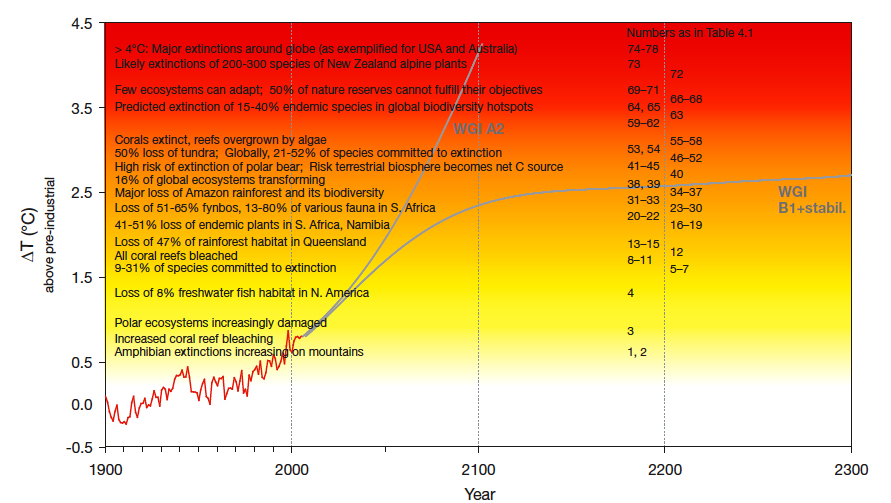
From the start (April 22, 2012), I have described the impact of climate change under a business as usual scenario, as a “self-inflicted genocide.” The reason was the IPCC finding that a reliable, computer generated, average global temperature rise of more than 40C (70F) will result in global climate change that will destroy around 40% of the eco systems. I have assumed that since humans are part of these ecosystems, and their destruction will result in major loss of human life, the situation fits the dictionary definition of genocide. For a short period of time, this characterization (together with Andrew Revkin’s comment on this in his blog in the New York Times) made this blog “viral” with floods of disagreements.

In the September 24 and the December 10 blogs, I showed two IPCC socio-economic scenarios that constitute the base to these predictions – the A2 and B1 scenarios. The A2 represents business as usual, while the B1 represents an example of an environmentally “friendly” scenario that stabilizes the impact to around 2.50C.

There were two main differences in these scenarios: Toward the end of the century, the A2 scenario assumes a global population of 15 billion while the B1 scenario assumes that population will more or less stabilize at present levels of 7 – 8 billion. In addition, the A2 scenario assumes that fossil fuels will continue to be our main energy source at approximately the present level of 85% while the B1 scenario assumes that we replace more than 50% of our energy sources with sustainable sources that will not result in atmospheric chemical changes that impact the climate. Most of the other blogs that I wrote focused on how to achieve such a global energy transition.

I have so far omitted one important element from these discussions. The scenarios also include economic activities.

The IPCC SRES scenarios are listed here (version 1.1 – July 2000). The A2 and B1 scenarios for the global population and economic activity are listed in the table below.

Year

Population, Billions

GDP/GNP(MEX) in Trillion 1990 US$. () – Per person in US$.

A2

B1

A2

B1

2010

7.2

6.9

31.9 (4431)

37.3 (5406)

2050

11.3

8.7

81.6 (7221)

135.6 (15,586)

2100

15.1

7.0

242.8 (16,079)

328.4 (46,914)

MEX is the abbreviation for Market Exchange Rate.

Analyzing these data, one arrives at the astounding conclusion that the A2 scenario anticipates a 1.2% average growth in inflation-adjusted GDP/Capita from 2010 to 2050, with that growth accelerating to 1.6% from the year 2050 to 2100. It gets better with the B1 scenario, which foresees an inflation-adjusted GDP/Capita growth of 2.6% from 2010 to 2050 that decelerates to 2.2% between 2050 and 2100. At the end of the century, in the B1 scenario, an average human will live like an average American today. These averages include large developing countries with a GDP/capita 50 times smaller than that of the US. A dream come true.

These scenarios equate (at least in the case of A2) to “self-inflicted genocides,” with the survivors living like kings. That is very different from my own experience as a Holocaust survivor. One cannot escape the impression that the economic aspects of these scenarios were derived by applying a simple exponential growth equation, not taking into account anything that happens in the projected impacts on the physical environment (December 10 blog).

The most important parameter for projecting the impacts of climate change is called climate sensitivity. It projects the average global temperature rise as a function of the increased concentration of greenhouse gases in the atmosphere. The uncertainty margin in this parameter is large (see the discussion and graph in the December 10 blog) mainly because it incorporates several significant non-linear elements, which are often referred to in common lexicon as tipping points. These include the melting of long-term ice, such as glaciers and icebergs. The melting of ice on such a scale causes changes in a parameter called “Albedo,” which describes the fraction of incoming solar radiation that is being reflected back to space by the white ice surface. Melting causes changes in the reflection properties of the surface of the earth, thus changing the amount of radiation absorbed that leads to the temperature change.

Another major tipping point is the melting of the permafrost in the arctic. The permafrost captures large amounts of carbon compounds that accumulated before the ground froze. Upon melting, the carbon is released, with a significant fraction ending up in the atmosphere, adding to the concentration of the greenhouse gases there.

One of the main trapped organic compounds is methane, the main constituent of natural gas. Every molecule of methane is 20 times more active as greenhouse gas than a corresponding molecule of carbon dioxide.

Additional, important tipping points are the state of the oceans and land biota as sequesters of carbon dioxide (see the June 25 blog). Right now, for every quantity of carbon dioxide that we emit, only about half ends up in the atmosphere. The oceans are net absorbers of half of the excess while the green biota is absorbing the other half. Both land and sea store large carbon reservoirs and their ability to absorb or emit carbon dioxide depends on the ambient temperature. The tipping points take place when the atmospheric conditions force the land and sea on the planet to convert from net absorbers to net emitters. We don’t fully understand these complex physical processes but we know from basic science that they take place and have major impact on the climate.

Yet – as far as we humans are concerned, by the SRES account, we can continue to live like kings (at least those of us that survive the flooding, droughts, sinking of islands and major coastal cities, collapse of our infrastructure, major increase in extreme events, etc…). It seems to me that the only reason that this is happening is because we still treat the physical environment (including our own bodies) as a completely separate discipline from our socio-economic-cultural environment. We insist on continuing this behavior even though Climate Change no longer allows us to do so.

Posted in Climate Change | Tagged , , , , , , , , , , , , , , , , , , , , | 3 Comments

Voices from the Farm and Beyond

Turkana Farms is a small-scale producer of heritage breed livestock and a wide array of vegetables and berries on just over 39 acres in Germantown, New York. It is run by two friends who have sent me the following message for the New Year:

Hello All and Happy New Year (Peter here):

I think we are all, either from direct experience or reading about it, aware that the year 2012 has gone down in U.S. weather history as being the hottest since records have been kept. And those of us who enjoy local fruit or have orchardist neighbors are also aware that a two week record breaking heat wave last April took the temperatures up to the 90’s, causing apple, pear, and cherry trees to bloom prematurely in Columbia County, only to be followed by a killing frost a few weeks later, effectively decimating about half of the expected fruit crop.

Our sympathies go out to our near neighbors, the Riders, who lost virtually their entire 2012 apple, pear, and cherry crop. And, of course, to our disappointed pigs who usually look forward with great anticipation to the cast off apples that annually come our way from the Riders.

Other problems and disruptions caused by Climate Change are not so obvious but are subtly changing life at Turkana. We are becoming more and more aware of how changes in light and temperature control the life cycles of our livestock. The cues for our peacock to begin and end his mating period, for instance, somehow changed this season. Ordinarily in late spring, when his tail feathers have completely grown back, the peacock begins his displays, which usually continue to the end of July/early August when he molts his tail feathers, and the daily dances end. I was surprised in early spring, three weeks earlier than usual to see him displaying (with partially grown out tail feathers), and then to see him end his gorgeous show three weeks earlier than usual, as his tail feathers began to drop out.

But an even more dramatic disruption of the cycles was evidenced by our sheep lambing in early December rather than in mid January or February. We usually keep our ram together with his ewes and have let him in the past set the mating schedule. He in turn is programmed by weather conditions, and ordinarily would take his cue from the first cool night of around 55 degrees in August or September, the births taking place about five months from this date.

But it is only January 4th and we have already had over twenty lambs—all of these before the time we normally begin lambing. This would mean that the ram began making his conjugal rounds in July. Could there have been, we wonder, a string of changes in the environmental cycle that precipitated his activity? That both the peafowl and the sheep’s normal cycles were disrupted suggests that this is so.

The farm was affected not only by the excessively hot summer of 2012 but also by the almost non-existent winter of 2011-12. Quite early in the spring I began to notice a rat and mouse population moving into our barn and other outbuildings. Inquiring around I learned that this was a common problem at other local farms. Normally this invasion is something to be expected in late fall as the weather turns extreme and food sources begin to dwindle.

At first I attributed this early migration to the extremely wet spring weather, which raised considerably the water table, assuming that the rodents were being driven out of their holes and tunnels by water. But I have since heard a more persuasive explanation: that it was the extremely mild winter that is actually the cause, a mild winter that allowed the rats to, as they say in the Bible, “be fruitful and multiply.” Again a change in the environmental cycle, no freezing period to trigger hibernation and, therefore, more sexual activity, accounts for the early plague of rats.

The rat situation was not helped by the resistance of Mark and our farm helper, whose scruples apparently did not allow them to plant poison rat blocks in the affected places. Since there was no hope of a Pied Piper of Hamlin magically appearing on the scene, it would be up to me, I realized, to be the Darth Vader of the rat population.

Soon rats were not only working their way through the clapboarding of the barn and coop walls but also, amazingly punching holes, through the concrete floors. But the biggest disaster was finding one day that over a third of our chicks had gone missing from the brooder box. Upon inspection I found that the rats had gnawed through the several inch thick boards of the brooder box and been carrying off the chicks at will. The only solution was to move the surviving chicks into wire cages and suspend the cages by ropes from the ceiling.

When the chicks had outgrown the cages it was impossible until they reached a certain size to release them in the coop for fear of what would happen to them in the night. It became obvious that we needed to discover where the rats were nesting. My guess was under the brooder box they had gnawed into. When we moved the brooder box we found a nest of a dozen or so, obviously poisoned rats dead or dying, directly beneath it. How many healthy live ones absconded from there as we moved the box I had no idea. Ultimately I set in motion a determined campaign of setting poison, sealing holes in the concrete floor and walls, and removing food sources. I am happy to report that after my blitzkrieg that at last the rat population seems virtually decimated.

Our experiences this past year make it clear to us that Climate Change is and will be working its strange magic at the farm in all kinds of unexpected ways. Obviously, halting climate change is infinitely more complicated than halting the proliferation of rats, but as we saw with the rat situation, dragging one’s feet only compounds and increases the problem. Are we now that we are starting a new administration in Washington, at last ready to at least talk about addressing Climate Change once again?

They know, as well as most of us, that the variety of impacts that they observed on the farm and attribute to Climate Change, are not necessarily anthropogenic (man induced) in origin. The impact is not specific to their farm and has many contributions from a variety of non-anthropogenic sources. All the impacts that they list can be attributed to attempts to adapt to climate change – some more successful than others. We also know (my June 25th blog post) that our present energy use leads to a disruption of the global energy balance, which leads to major climate changes by way of changes to the chemistry of the atmosphere. The atmospheric changes are fast approaching the levels that trigger non- linear imbalances (tipping points in some jargon) that will leave us helpless to adapt to these changes. So, the local, observable changes in the weather serve (or should serve) as an alarm call.

None of Turkana Farms’ impacts are attributed to the increase in the intensity and frequency of extreme weather events. To show this, we would need more data.

Here is a summary of a very recent report compiled by NOAA (National Oceanic and Atmospheric Administration) for the United States on 2012’s extreme weather and climate events:

Today, NOAA released preliminary information on extreme weather and climate events in the U.S. for 2012 that are known to have reached the $1 billion threshold in losses. As of December 20, NOAA estimates that the nation experienced 11 such events, to include seven severe weather/tornado events, two tropical storm/hurricane events, and the yearlong drought and associated wildfires.

These eleven events combined are believed to have caused 349 deaths, with the most significant losses of life occurring during Sandy (131) and the summer-long heat wave and associated drought, which caused over 123 direct deaths (though an estimate of the excess mortality due to heat stress is still unknown).

The eleven events include:

  • Southeast/Ohio Valley Tornadoes — March 2–3 2012
  • Texas Tornadoes — April 2–3 2012
  • Great Plains Tornadoes — April 13–14 2012
  • Midwest/Ohio Valley Severe Weather — April 28–May 1 2012
  • Southern Plains/Midwest/Northeast Severe Weather — May 25–30 2012
  • Rockies/Southwest Severe Weather — June 6–12 2012
  • Plains/East/Northeast Severe Weather (“Derecho”) — June 29–July 2 2012
  • Hurricane Isaac — August 26–31 2012
  • Western Wildfires — Summer–Fall, 2012
  • Hurricane Sandy — October 29–31 2012
  • U.S. Drought/Heatwave — throughout 2012

More from NOAA

“2012 was warmest and second most extreme year on record for the contiguous U.S.”

“The average temperature for 2012 was 55.3°F, 3.2°F above the 20th century average, and 1.0°F above 1998, the previous warmest year.”

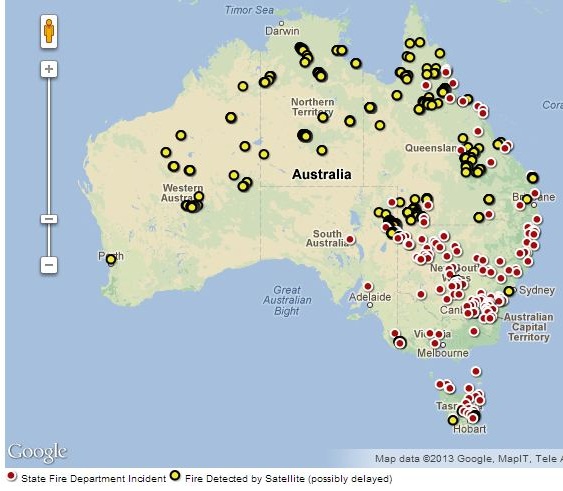
The impact is not localized to the United States: England was flooding, China is freezing and Australia is burning as described  in Sarah Lyall’s January 10, 2013 article in the New York Times,  “Heat, Flood or Icy Cold, Extreme Weather Rages Worldwide.”

A map of the very recent fire distribution in Australia where temperatures have exceeded 500C (1220F) is given below.


The official global average temperature and some of the distributional properties of this record are expected in a week. The anticipation is not for a global record breaking because of La-Nina, but a statistical adjustment for La-Nina can probably confirm the trend.

My friend from Turkana’s obvious question was – what can we do about this? As we will see in the coming blogs, we need some help to address it.


Posted in Climate Change | Tagged , , , , | 4 Comments

Vive La France Part 2 – The Power of Hot Bodies

In a New York Times Op-Ed (December 29, 2012), Diane Ackerman described an alternative way to get energy that will not pollute the environment – the power of a crowd. The first paragraph is cited below:

As I waited with a throng of Parisians in the Rambuteau Metro station on a blustery day, my frozen toes finally began to thaw.  Alone we may have shivered, but together we brewed so much body heat that people began unbuttoning their coats. We might have been penguins crowding for warmth in Antarctica’s icy torment of winds.  Idly mingling, a human body radiates about 100 watts of excess heat, which can add up fast in confined spaces.

The article reminded me of another non-polluting attractive energy alternative in the form of power-generating exercise bicycles that were used in Lyon-France to “power” outdoor display devices that I described in my December 17, 2012 blog,  “Vive La France.”

I don’t know whether Ms. Ackerman is French, but it seems to me that the French have the capacity to inspire thinking out of the box.

As it happens, the Op-Ed was published before New Year’s Eve, and my French cousin and her son were our guests in New York. Her son was my source of information for the Dec. 17 blog, so, this time, I had her read the Op-Ed and asked for her opinion.

Her first reaction was that her father (my uncle – a psychiatrist – now deceased) thought about a similar scheme while holding an overactive screaming baby. He mentioned that all this energy could be very useful if channeled to, say, light a house. Reading further, she quietly mentioned that a more acceptable solution would be to hold  a crowded sex party in an enclosed space close to some freezing spaces. It sort of seems logical that moving sex parties to spaces that need heat would be more practical than moving Metro stations.

Similar to the Lyon biking experiment, it seems to be a good opportunity to go to the numbers and to some important physics.  (The physics can sometimes sound like a foreign language and, to many people, it is.  Wikipedia is a great help with the physics concepts that I will talk about, so please feel free to consult it if you need to.)

So – why do we emit about 100 watts of excess heat? It turns out that every “visible” object in the universe emits radiation that depends only on the temperature of the object and the surface area of the object. This kind of radiation is called blackbody radiation. “Visible” objects are the regular objects that are all around us and are constituted of atoms and molecules. There are other kinds of objects that don’t emit any radiation – this is dark matter and we can locate it only through its gravitational force. We don’t see this matter around us, but, in the universe, we find five times more dark matter as compared with visible matter and we still have no idea about the structure of dark matter.

Human bodies are obviously a form of visible matter. The amount of radiation that we radiate as excess heat depends only on the temperature and the surface area of our skin. These two parameters are routinely measured because they are indicative of our health conditions. Our skin surface area obviously varies with the individual but they range between 1.5 – 2 square meters (16.1 – 21.5 square feet). Our skin temperature is more complicated – it protects our body temperature so that it’s kept approximately constant at 370C (98.60F), but it strongly depends on the ambient temperature and the length of our exposure to the ambient temperature. Furthermore, different parts of our skin can be at different temperatures depending on the cover that we provide. The amount of excess heat (the blackbody radiation) that we emit is very sensitive to the temperature. It varies as the 4th power of the temperature but the temperature is measured in scales that we are not used to. The scale is the “absolute” temperature (or more often called the Kelvin scale after William Thomson, the 1st Baron Kelvin). We just take the temperature in Celsius scale and add 273 to get the temperature in the Kelvin scale.

Since the skin temperature is not very well known, for argument’s sake, I will take the 100 watts that Ms. Ackerman took and the average skin surface area at 1.75 meters square (19 square feet) and get a skin temperature of 270C (810F). This number is perfectly reasonable. A small electrical heater that I often use when my heating system is not doing its job is rated at 1.5kw (1500 watts) with an adjustment to lower power. This would require 15 people (crammed into my room) to supply the same heat. This is perfectly doable but a somewhat crowded substitute.

I can also try to calculate the relative environmental impact:  assume that the 15 people are making me “comfortable” for a full day, eating normally, consuming on average 2500 food calories for the day. Their emission of carbon dioxide amounts to approximately 11kg (24 lb) (For details on how to do these kind of calculations from first principles, see my book Climate Change: The Fork at the End of Now – Momentum Press – 2011.) My electric heater, at the full power of 1.5 kw and working for the full 12 hours, uses 18 kwh of electrical energy. Electricity is a secondary energy source. It needs a primary source to generate the electrical power. Based on conversion practices, it is limited by physical laws not to exceed an efficiency of around 30% (depends on the conversion temperatures). My electrical company mostly uses natural gas to generate its electricity. Based on this input – the carbon footprint of my electrical heater can be calculated to be 8.1 kg (17.8 lb).

As with the Lyon example, this idea doesn’t look too attractive at the moment.

But here we have an important mitigating element.

The carbon footprint that’s created by burning the natural gas that generates the electricity that’s heating the room with the heater is new carbon dioxide that contributes to the chemical changes in the atmosphere and thus directly contributes to climate change.

However, the carbon dioxide that is being exhaled by our 15 volunteers is generated through the metabolism of the food that they eat. Directly or indirectly (eating meat), the food is produced by processing green products (vegetables, fruit or feedstock for the animals) that grow by sequestering the same amount of carbon dioxide through the photosynthetic process. So, if we calculate the carbon footprints throughout the full cycle, the only net addition of greenhouse gas to the atmosphere should come through externalities such as burning the fuel needed for the cultivation of the agricultural products.  And that number should be considerably smaller than that from the fuel that is needed to generate the needed electricity in the room.

So… if anyone wishes to try using hot bodies as an energy generating alternative, please let me know the results!

Posted in Climate Change | Tagged , , , , , , , , , , , , , , , , , , , , , , , , , | 6 Comments

Happy New Year: We are Now Part of Nature

My intention was for this to be a very positive blog, focusing on what I have learned during 2012 from my students and all the commentators that posted their comments on this blog, emailed me directly their comments or expressed them in any other form. There has been a lot for which to be thankful. I started this blog in April— I was reluctant to engage and totally inexperienced. The staff of LCG Communications  has encouraged me and held my hand along the way. Some of my students have added their comments here on issues that that were discussed in class, while another class, which was focused on adaptation to Climate Change in New York City, presents their findings on a web page.

A few days ago, my focus changed. I got an unsolicited email from an organization called Science and Environmental Policy Project (SEPP).

This organization was founded by Fred Singer in 1990 and is privately financed. It can be “safely” categorized as a denier site, even with all the reservations for the term that I wrote about in earlier blogs. The email was basically a solicitation for a contribution. I would have ignored it, however it started with a “quote of the week,” given below:

Quote of the Week:

Is this what science has become? I hope not. But it is what it will become, unless there is a concerted effort by leading scientists to aggressively separate science from policy. The late Philip Handler, former president of the National Academy of Sciences, said that “Scientists best serve public policy by living within the ethics of science, not those of politics. If the scientific community will not unfrock the charlatans, the public will not discern the difference-science and the nation will suffer.” Personally, I don’t worry about the nation. But I do worry about science.

Michael Crichton [H/t Gordon Fulks]

The quote, from Michael Crichton, refers to a quote from Gordon Fulks. Michael Crichton was a productive and great writer. He is a writer of bestsellers such as The Andromeda Strain (1969), Jurassic Park (1990), Rising Sun (1992), Timeline (1999) and Prey. I have read most of his books and greatly enjoyed them. He was a Medical Doctor that graduated from Harvard and did his postdoctoral training at the Salk Institute.  He died on November 2008. In 2004 he wrote The State of Fear, in which he accused scientists of being alarmists about Climate Change in order to increase their research grants. I have recommended that my Climate Change students read this book as an enjoyable entry to the deniers’ world. Crichton taught Anthropology and Writing, but he was not a practicing scientist.

Gordon Fulks was a physicist who served as an academic adviser to the Cascade Policy Institute. The following sentence, which caught my attention, is attributed to him: “Scientists best serve public policy by living within the ethics of science, not those of politics. If the scientific community will not unfrock the charlatans, the public will not discern the difference – science and the nation will suffer.” I don’t want to interpret the statement as a declaration that the ethics of scientists are “naturally” superior to those of politicians so I will interpret it as a call for the two to be separated. This presents a serious problem – if the call is to separate the two – why should the politicians fund the scientists?

One might argue that Michael Crichton  and/or Gordon Fulks have questionable qualifications to speak for science.

Well – I am member of a professional society whose members claim to be the ultimate culmination of science – the American Physical Society. A few weeks ago, I posted a blog (December 10) which described some of the reactions that I got from Physics faculty members during a seminar that I gave on Climate Change. A comment to this post suggested declaring that I would not consider a thoughtful response from anybody that hadn’t published at least two articles on Climate Change in peer reviewed publications. Such a “policy” would create a serious problem. I have argued before (May 7) that the last thing we need is to appoint climate scientists to be our epistemological lawyers. Physicists, regardless of their publication record, should have opinions on such issues and, like everybody else; they have a full right to be listened to.

I will climb higher: The American Physical Society (APS) is the professional home to about 50,000 physicists, me included. On November 18, 2007 they issued a statement about Climate Change, shown below.

Emissions of greenhouse gases from human activities are changing the atmosphere in ways that affect the Earth’s climate. Greenhouse gases include carbon dioxide as well as methane, nitrous oxide and other gases. They are emitted from fossil fuel combustion and a range of industrial and agricultural processes. The evidence is incontrovertible: Global warming is occurring.

If no mitigating actions are taken, significant disruptions in the Earth’s physical and ecological systems, social systems, security and human health are likely to occur. We must reduce emissions of greenhouse gases beginning now. Because the complexity of the climate makes accurate prediction difficult, the APS urges an enhanced effort to understand the effects of human activity on the Earth’s climate, and to provide the technological options for meeting the climate challenge in the near and longer terms. The APS also urges governments, universities, national laboratories and its membership to support policies and actions that will reduce the emission of greenhouse gases.

Similar statements came from other scientific professional societies to constitute the evidence that “most” scientists do agree with the spirit of the statement.

Most is not all. Some very prominent physicists did not agree. Among them are such towering (but retired) physicists as Freeman Dyson and the Nobel winner Ivar Giaever, who left the Society as a result of the statement. This led to a petition to either retract the statement or to seriously modify it. The petition was overwhelmingly rejected by the membership (One blogger gave it 0.45% acceptance by the membership). However, as a direct result of this interest, a new division of the Society was formed that is dedicated to Climate Change. The new division is the “Topical Group on the Physics of Climate” (GPC). The following paragraph is a centerpiece of the guidelines to this new group:

The objective of the GPC shall be to promote the advancement and diffusion of knowledge concerning the physics, measurement, and modeling of climate processes, within the domain of natural science and outside the domains of societal impact and policy, legislation and broader societal issues. The objective includes the integration of scientific knowledge and analysis methods across disciplines to address the dynamical complexities and uncertainties of climate physics. Broad areas of initial scientific inquiry are described in the Areas of Interest below. These are expected to evolve with scientific progress, while remaining entirely within the domain of natural science.

The first sentence in this paragraph is for me the key to the thinking:  “The objective of the GPC shall be to promote the advancement and diffusion of knowledge concerning the physics, measurement, and modeling of climate processes, within the domain of natural science and outside the domains of societal impact and policy, legislation and broader societal issues” – in other words, ignore the human impact – concentrate on the science. This emphasis is being enforced in the guideline for submission of talks in a conference – “Contributed talks should focus on climate physics, without reference to issues of policy, legislation, or society. The Focus Session may include one or more invited presentations (from email distributed to members).”

This still, in my vocabulary, puts them in the deniers category (September 3 blog).

The high point in this saga can probably be found in the December issue of the journal “Physics Today,” the membership journal of the American Institute of Physics. To summarize 2012, the editors have tried to answer the question, “Which items on Physics Today’s website were the most popular in 2012?”.

Here is the direct quote from the email that I received as a member before delivery of the journal:

“The most popular item on Physics Today’s website in 2012 was not our coverage of the discovery of the Higgs boson or the announcement of the year’s Nobel Prize in Physics. The top spot went instead to David Kramer’s short news story, “NASA announces a new Mars mission,” which appeared on 22 August in the Politics and Policy department. Apparently, the story owes its popularity to being picked up by Reddit, a social news site. Of course, the story is also a concise and informative summary of a future mission!

Science controversies past and present

Besides the capriciousness of what gets picked by social media or online aggregators, online popularity lists also reveal what people care most about. The second most-viewed item in 2012 was a feature article from October 2011. In “Science controversies past and present,” Steven Sherwood placed anthropogenic climate change in the same category as Nicolaus Copernicus’s Sun-centric solar system and Albert Einstein’s theory of general relativity—that is, as a once-controversial idea that would later become widely accepted. The possibility that anthropogenic climate change might be empirically vindicated riled some online readers enough to comment extensively on the article and to share it with their skeptical friends, acquaintances, and colleagues. The article continued to attract (mostly hostile) comments for months after it had originally appeared.

Richard Somerville and Susan Hassol’s feature article, “Communicating the science of climate change,” appeared in the same issue as Sherwood’s and was the third most viewed article of 2012. The most recent comment was posted last month! In fifth place came Steven Corneliussen’s Science and the Media column about a news story in the 27 April issue of Science magazine. The story’s topic was a claim, published in Physical Review Letters, that the classic formula for the Lorentz force is inconsistent with Einstein’s special theory of relativity. Corneliussen is not a physicist, but evidently his journalistic nose for provocative science proved acute.

More climate change

“You should resign, and if you don’t, I’ll work to see that you are fired” is one example of the threats that climate scientists have received for claiming, on the basis of their experiments, simulations, and theories, that humanity’s emission of greenhouse gases is warming Earth’s troposphere. Physics Today’s Toni Feder reported on those threats and the impact they’re having on climate scientists’ lives for February’s Issues and Events department.

Her story was the sixth most-viewed item in 2012. Like the magazine’s other coverage of climate change, it attracted vitriolic comments, including this one, which, while seeking to downplay the story, inadvertently exemplified the hostility that climate scientists face:

“Oh, puleeeeze…”

I think that being put into the same category as “Nicolaus Copernicus’ Sun-centric solar system and Albert Einstein’s theory of general relativity” is a great place to start 2013.

Posted in Climate Change | Tagged , , , , , , , , , , , , , , , , | 1 Comment

A Stuttering Energy Transition


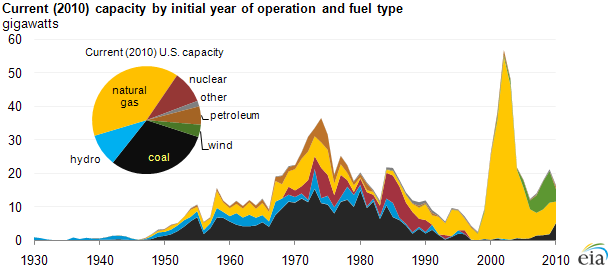
Figure 1

The EIA (Energy Information Administration) data (see October 15 blog) clearly shows that the US is in the midst of an energy transition. It may not be exactly the one needed to mitigate climate change – but we’re certainly on our way there through some fortunate, market driven, intermediaries. In this case, the transition has mostly been from heavy reliance on coal to a dominant use of natural gas. Parallel to this transition we see a more welcome, not yet market driven, transition away from fossil fuels. Considering that the estimated lifetime of a power plant is about 40 years, we still have many coal power plants to retire, but we at least have time to do so. Such is the nature of a transition. However I don’t expect such a transition to be particularly smooth, consisting of regular replacement of fossil energy sources with less polluting ones. I expect it to be a stuttering transition that requires our full collective ingenuity. Let me try to describe here some of this stuttering.

Recently, the British government did the “right thing.” They announced changes in energy regulations (New York Times – 11/24/2012) that are intended to encourage use of alternative energy sources and nuclear energy while at the same time ensuring that enough power will be supplied to satisfy future energy needs. As reported, the changes increase the levies on consumers and business to help support electricity generation, based on low carbon sources to a total of £9.8 billion by 2020 from the present £2.35 billion. This is, by any other name, a carbon tax that is being collected on top of the Cap and Trade policy that they already share with the rest of the European Union, but with a specification of how the money is intended to be used. This should add about 2% to an average electrical bill. The British government is concerned that the European Union (EU) will raise objections because the EU is against any government support of mature technology (in this case – nuclear).

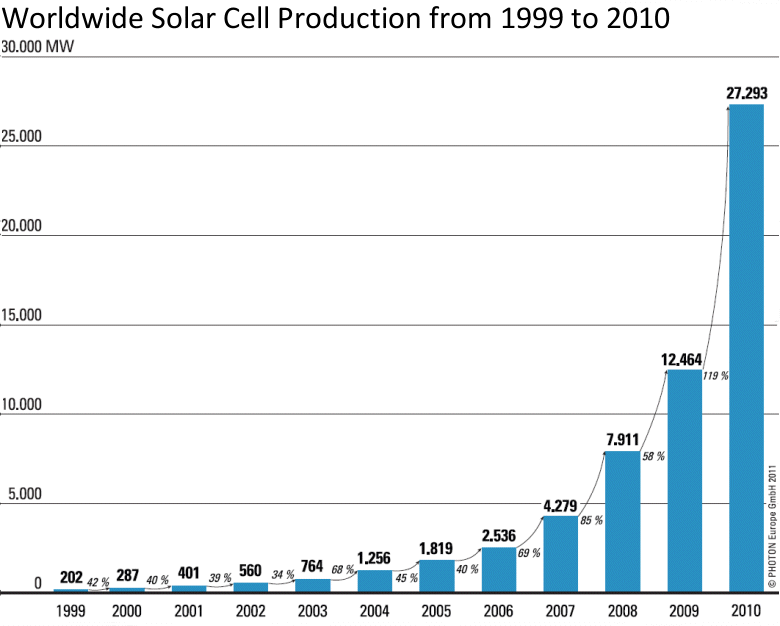
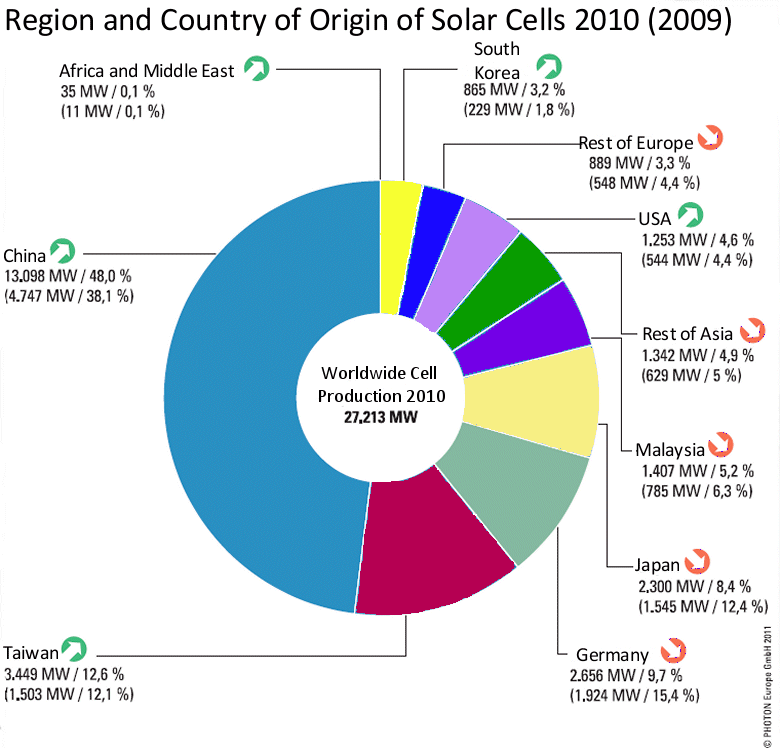
Direct solar energy, such as photovoltaic and photothermal, don’t show up in the American electricity production in Figure 1. Its share, while still too small to register, is growing fast. Figure 2 shows changes in cost per kWh (kilowatt hour) from 2005 with projections to 2031. The Figure also shows the projected intersection with projected average electricity cost around 2020. Figure 3 shows a major consequence of the price decrease: the global increase in solar cell production over the last 12 years. However, Figure 4, taken from the same source as Figure 3, shows the global distribution of the production effort in 2010. Close to half of the production has originated in the People’s Republic of China.

Figure 2

Figure 3

Figure 4

This distribution and price structure has major consequences.

Solyndra, a California-based solar panel manufacturer, declared bankruptcy in August 2011 after having received $528 million in federal loan guarantee (Story in NYT – 11/30/2012). The loan guarantee was part of the 2009 stimulus package, designed in part to help create jobs in new, non-carbon-based, energy industries. It became one of the loudest focal points of the 2012 presidential elections and subject to congressional investigations that focused on the hazards of the government picking winners and losers in the alternative energy industries. The main reason for the bankruptcy was the sharp drop in price – partially created by the lower cost of Chinese cells, which flooded the market with considerable help from the Chinese government. Solyndra and the American taxpayers were not the only casualties. Figure 5 shows the stock price of one of the better-known American solar cell companies – First Solar. Those who bought the stock at around $50 in February, for example, didn’t do so well – for the same reasons that Solyndra went bankrupt.

Figure 5  

Did the Chinese do better? As it turns out, China’s manufacturing capacity in photovoltaics and wind turbines soared even faster than the world’s demand did, creating a large over-supply and a consequent price drop. Great for a global energy transition, but not so great for the manufacturers, their employees and the State and the banks that helped to finance them (New York Times 10/5 20012).  In the current situation, many of the manufacturers end up loosing $1 for every $3 they sell. The lower costs are still considerably higher per-energy unit when compared to the energy generated by the plentiful coal in China – thus contributing to a global energy transition, but not necessarily to a transition in China.

The dynamics of replacing coal with wind power (another form of solar energy that does show up in Figure 1) went through similar setbacks to those I have explored for photovoltaics. Since the numbers here were greater (and the manufacturers were located in more competitive states for the presidential election), the US has decided to impose 30% duties on Chinese turbines – thus increasing their price and most likely slowing the transition.

Since, to quote Governor Romney, Climate Change is being referred to as Global Warming and not American Warming, price competition in energy sources designed to remedy the situation should be welcomed as important contributions to a solution and not developed primarily as a job creation activity. The same holds for the aspiration, expressed by both parties, for energy independence.

Posted in Climate Change | Tagged , , , , , , , , , , , , , , | 41 Comments

Vive La France

The Festival of Lights in Lyon, France, expresses gratitude to Mary, mother of Jesus, on December 8 every year.

My French 2nd cousin who lives in Paris emailed me that this year, one central display, shown below, was being powered by electrical power generated by visitors exercising on specially equipped exercise bicycles.

The two photographs below were taken from here.

Festival of Lights – 2012 – Lyon – France

What a great idea! I immediately thought about Times Square in NYC, where I live, and how to apply the same concept. My second though was – we need some numbers.

Times Square, NYC

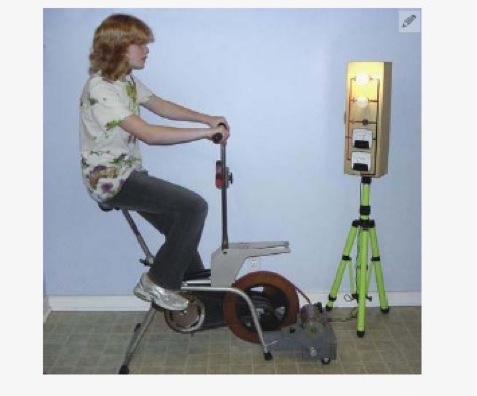
A photograph of a power generating exercise bicycle is shown below. I didn’t do market research, but a superficial inquiry informed me that there are few American manufacturers of such bikes, and presently their main use is as exercise bikes with the generated electricity delivered back to the electrical network to compensate for some of the equipment costs.

 Power generating exercise bike

A top shape athlete can generate up to 500 Watts on one of these bikes, while an “average” patron can generate 200 Watts.

I went to Times Square in NYC for an estimate of what it would take to illuminate some of the displays there. On a previous occasion, for a different use, I tried to find out the electrical consumption of the advertising displays in Times Square. I was not able to get the information. So, for the present objective I have tried to estimate the needs.

The power requirement of a P10 Outdoor SMD LED display is 1200 Watts/m2  (111.5Watts/ft2). A logical place to put the bicycles would be in the heart of Times Square between 45th and 47th streets, along 7th avenue. Since most of this area is traffic free, it could easily accommodate the bikes. The length of this stretch is about 500 ft. If we covered the area with a continuous stretch of 100m2 (1076ft2) displays of 4/3 aspect ratio (37.7ft length and 28.5 ft height) we will need 27 displays. This will amount to 29,050ft2 of display area that will require 3.2MW (Megawatts or million watts) power. This is the approximate power that can be generated by one large wind turbine or 16,000 active, “mediocre” exercise bikers. This is a large crowd for this stretch of New York City. The bikers would have the obvious incentive that exercise would enable them to see a popular great site illuminated, while at the same time keeping themselves in shape and reducing the carbon footprint on the environment.

If I need such a large crowd of sweating bikers for Times Square – how can Lyon pull it off?   My French cousin went to work to get additional information. He was able to contact a person in Lyon’s City Hall, who provided some enlightenment. For the animation, which is named “Magic Cube,” 30 bikes were wired to the cube. Over four days, 10,000 visitors used the bikes. The Cube, like any other display, was plugged into the electrical network, and draws its power from a “conventional” (in France more than 70% powered by nuclear power) grid – not the bikes. The bikes are used instead to change/modify the colors of the Cube.

I found this a bit disappointing, but if nothing else, it re-emphases the need to get more data on what is currently possible, and what could become possible for the future.

Posted in Climate Change | Tagged , , , , , , , , , , , | 3 Comments

Two Shades of Audience

Over the last two weeks, I was invited to give two different talks. One was to take place as part of another school’s Physics Department’s seminar program, and the other as part of an Economics Student Club at my own school. The economics meeting, which was organized by students, was a joint presentation with an Economics professor and was designed to show two perspectives in the need for an energy transition from “green to business” model.

I decided to think about the two talks as a single unit with some symmetry, and design them accordingly. My impression was that the audience at the Physics Department talk would consist of physics students and faculty, while the audience in the Economics Student Club would naturally be comprised mainly of students majoring in economics. I wanted the message to the physicists to be that career opportunities in physics extend well beyond textbook ideas of physics; that they can aspire broadly to be involved in any activity – it is their quantitative outlook that differentiates them from workers with a different background. To do that, I decided to bring my own career choices, present research activities, and life experiences to the forefront. I was also trying to demonstrate to the economics students that they should devote some of their time to the study of the language and fundamentals of the sciences. Given the consistently increasing interactive role humans have in the physical environment (Climate Change is a prime example here—see my June 25 blog), the physical environment will, in turn (in my opinion), take an increasing role in the economic decisions that society must make.

As often happens on such occasions, the reality turned out to be a bit different. The talk for the Physics Department started with the two figures below.

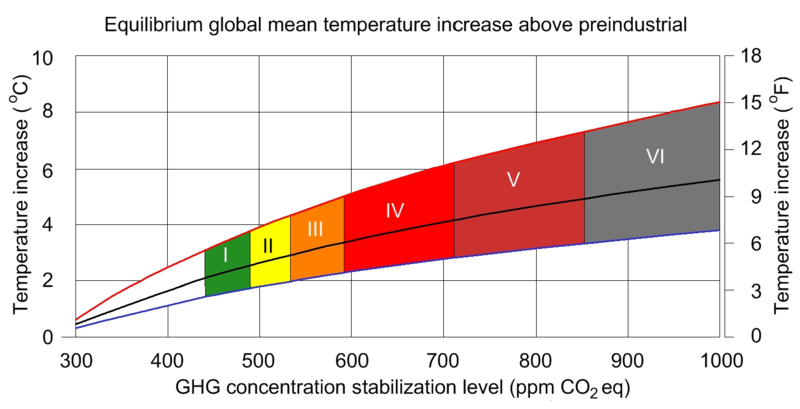
IPCC Equilibrium global mean temperature increase above preindustrialIPCC Ecosystem Risks ForkThese are often used figures that were taken from the last IPCC report (the second figure was already mentioned in my September 24 blog) (I showed much more recent figures, taken from the November 2012 World Bank sponsored report, later in the talk). I regularly use them as a quantitative introduction to my frequent discussion of our much-needed energy transition.
In this particular talk I didn’t go much further in talking about them. I was expecting familiarity with the figures and wanted to get quickly to what I considered the focus of the talk. (I was also working with the probably unconscious expectation that I was not dealing with an audience of deniers) I mentioned the data in the first figure as “simple spectroscopy” – a familiar branch in physics. I did emphasize the uncertainty that is visible in the band of the temperature response to atmospheric consequences of carbon dioxide. The purpose was to differentiate this figure from the second one, which is based on two specific scenarios and represents a projection of the future.

Well – I got a bucket thrown at me (figuratively speaking). The essence of the comments was that this is bad science: much worst science than what physicists are doing for example in figuring out properties of semiconductors— bad science because it cannot be described by a set of differential equations. I was told that in two hours, one of the physicists could come up with his/her own scenario – implying the arbitrary nature of analyzing a future based on projected scenarios. Surely, science with such uncertainty should not form the basis for action that could result in a reduction of our standard of living.

Since I included my Holocaust background (May 14 blog) later in my talk, it was strongly suggested to me to disconnect the two issues, because denying the climate change might lead to denying of the Holocaust.

I ended up in a completely defensive mode that I was not prepared for. In fact, I strongly suspect that what I achieved with the students that were present was the exact opposite of what I had intended.

The dynamics of the second talk were different — calmer. My colleague’s perspective was based on a more general perspective (shared by many economists) that the future, and our ability to predict it, needs to be taken with a large grain of salt. As evidence, he mentioned my data from papers by M. King Hubbert (that I discussed in my October 29 blog post), which showed not only the projected oil supply in the US but also a possible energy transition out of the projected shortage. My colleague did mention the recent advances in technology (Fracking) to drill for natural gas and oil, which are now causing a major shift in our energy usage. An issue that was of great interest to the students was the recent article by Justin Gillis (New York Times, December 5, 2012) titled “To Stop Climate Change, Students Aim at College Portfolios.” I was ambivalent about the tactic, mainly because of its dotted history, but I was admiring the students’ dedication to promote this issue, whose values I share. As far as encouraging studying science, it remains to be seen how effective I was.

Since my objective is to democratize the climate change issue as best I can, it is imperative, at least on my part, to continue to engage with diverse audiences and adapt my response accordingly. This means I will probably meet with varying responses and levels of success in the future, depending on my audience. In any case, it will be a learning experience, hopefully for both my audience and me.

Posted in Climate Change | Tagged , , , , , , , , | 9 Comments

Tackling Environmental Justice: Sovereign State against the Individual.

Last week, I started the discussion of how developing countries can contribute to alleviating anthropogenic (human caused) climate change.  The main goal is to mitigate climate change by achieving a global agreement to transition to more sustainable energy choices. I made mention of the important role efficiency could play for developing countries in using energy resources to enhance their GDP. (Interestingly, the same date that I posted last week also marks the beginning of the COP18 Doha Climate Change Conference to start the continuing efforts to reach global agreements on mitigation and adaptation policies.) Following Sandy’s impact on the most populated region in the States, and President Obama’s recent reelection, there is now some optimism that the United Stated might show heightened leadership in the struggle against climate change. I started the November 26 blog with Governor Romney’s response to a ScienceDebate question about his thoughts on Climate Change. I will repeat the quote here in order to emphasize a different issue:

The reality is that the problem is called Global Warming, not America Warming. China long ago passed America as the leading emitter of greenhouse gases. Developed world emissions have leveled off while developing world emissions continue to grow rapidly, and developing nations have no interest in accepting economic constraints to change that dynamic. In this context, the primary effect of unilateral action by the U.S. to impose costs on its own emissions will be to shift industrial activity overseas to nations whose industrial processes are more emissions-intensive and less environmentally friendly. That result may make environmentalists feel better, but it will not better the environment.

I would like to explore this claim that compares China to the United States in terms of overall responsibility to reduce its carbon footprint by shifting its energy sources. It is important because Governor Romney’s statement can be understood as advocating that as long as China does not reduce its carbon footprint, the US will follow suit, focusing only on R&D in order to not sacrifice economic advantages to China. The argument has a NIMBY (Not In My Backyard) flavor that I discussed in a previous blog (June 18) – we recognize the need to act, but as long as China and other developing countries refuse to get involved, we will deny our own duty.

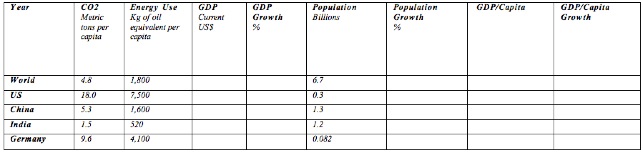
In the table below I ask undergraduates from my course (General Education – no prerequisites) to use primary sources to collect some relevant data about four countries and the World, and to answer a few questions by evaluating this data. I have filled in part of the table with the appropriate data for 2008 – the last year that data were available for the indicators in which I was interested.  

Fill up the following table:

Rank the four countries in terms of total energy use and CO2 emissions.

  1.   Compare (in %) the top user and emitter with World use and emission.
  2.   Rank the four countries in terms of energy use and CO2 emission per capita, and compare the numbers with global data.
  3.   If the GDP growth continues – how many years will it take China to catch up to the US?
  4.   If the GDP/Capita growth continues – how many years it will take China to catch up to the US?
  5.   What will the World’s GDP be at that time?
  6.   What will the World’s population be at that time?
  7.   If you assume that the last three terms of the IPAT equation will not change – what will the World’s CO2 emission be at that time?
  8.   Assume that only half of the emissions will stay in the atmosphere and that the Climate Sensitivity is 2.50C for doubling the concentration of CO2 compared to the pre-industrial levels – what will the climate consequences of 8 be?

Problems started with the first question – Half of the class has ranked both energy use and Carbon Dioxide emission in the following order – US, Germany, China and India.

Now – try it yourself and make a comment.

Large outcry was heard when answering the second question – “Professor – how it can be that the top energy user (US) is using 417% of the World’s total usage? Isn’t the US part of the World?”

Good question – yes it is. When Governor Romney uses carbon emissions from China and the US as criteria for needed efforts to curtail these emissions – what number should he be using – the number per person or the number per country? For me, it is a simple issue of Environmental Justice – every person is equal in his or her right for economic development, and comparisons should be based on people, not countries.

Posted in Climate Change | Tagged , , , , , , , , , , , | 7 Comments