
I have been busy analyzing global data about the ongoing energy transition to a more sustainable world. In addition to reflecting on my whirlwind (and worldwide) trip (September 4, 2019 blog), I wanted to look into global indicators with my two climate classes at Brooklyn College. I was also scheduled to give a talk on the role of game theory in the energy transition and decided to survey the current conditions.
Last week’s blog was the last in that series. Since then, a virtual avalanche of climate-related extreme weather events has taken place.
To start with, it’s fire season in California:
Utility companies have been taking steps to avoid the blame they experienced last year by preemptively cutting power. Below, Wikipedia summarizes:
The 2019 wildfire season is the current-running fire season in California. So far, over 6,402 fires have been recorded according to Cal Fire and the US Forest Service, totaling an estimated of 250,349 acres (101,313 ha) of burned land as of November 3.[1] Although the 2019 fire season had been relatively quiet in California through mid-September as compared to past years,[3] October through December is still expected to have the greatest fire potential as the Diablo winds and the Santa Ana winds pick up.[4]
In late October, the Kincade Fire became the largest fire of the year, burning 77,758 acres (31,468 ha) in Sonoma County by November 6.
Massive preemptive public safety power shutoff (PSPS) events have been controversial. PG&E and other power utilities have preemptively shut off power to over one million residents due to perceived risk of wildfires starting in high winds due to high-voltage power lines. While large areas have been without power for days, people in fire danger areas had trouble getting updates and critical life support equipment would not work without backup power.[5]
The Amazon rainforest in Brazil is also facing raging fires:
Three paragraphs from a Nature Conservancy article published on August 30, 2019 explain:
Farmers have been using fire, illegally in many cases, to convert rainforest into ranchland and crop farms for decades, a process known as deforestation. There have been more total fires than 2019’s fires five times since 2004. But deforestation and habitat fragmentation from these other years of fires have led to hotter and drier conditions that make it easier for fire here to spread. Coupled with a lack of oversight, these fires have reached an unprecedented and reckless scale.
Fire has shaped the diversity of life on the planet. Many landscapes depend on fires set by lightning strikes or humans (Indigenous peoples have managed forests sustainably for thousands of years) to keep them healthy and reduce the amount of fuel that can cause a catastrophic mega-fire. Australia’s grasslands and Oregon’s Ponderosa pine forests are examples of fire-adapted landscapes.
The Amazon Rainforest, however, is not a landscape where fire plays a natural role. The humidity and moisture of the rainforest do not lead lightning strikes to often cause fires here, and the plant and animal residents here are not adapted for it. These fires pose direct threats to the rainforest’s biodiversity and its Indigenous peoples, and also can harm the air quality of people throughout South America.
Australia too has fires:
Nature Conservancy also mentions fires in Australia: Australian authorities urge evacuations ahead of ‘catastrophic’ fire threat.
I have discussed many of these types of recurring extreme weather phenomena here before. For example, I looked at the Australian fire season in the February 12, 2019 blog.
Indonesia has both fires and floods:
Indonesia is not only dealing with similarly devastating fires, it is also sinking into the ground. Parts of Jakarta are expected to be completely underwater within thirty years.
NYT: JAKARTA, Indonesia — Nearly 2,000 wildfires are burning across Indonesia, turning the sky blood red over central Sumatra and creating dense clouds of smoke that have caused respiratory problems for nearly a million people.
The blazes, which tore through sensitive rain forests where dozens of endangered species live, have drawn comparisons to the wildfires in the Amazon basin that have destroyed more than 2 million acres. This year’s fires are the worst in Indonesia since 2015. Officials estimate that the fires have burned more than 800,000 acres.
TIME: The Indonesian capital of Jakarta is home to 10 million people but it is also one of the fastest-sinking cities in the world. If this goes unchecked, parts of the megacity could be entirely submerged by 2050, say researchers. Is it too late?
It sits on swampy land, the Java Sea lapping against it, and 13 rivers running through it. So it shouldn’t be a surprise that flooding is frequent in Jakarta and, according to experts, it is getting worse. But it’s not just about freak floods, this massive city is literally disappearing into the ground.
India is yo-yoing between floods and drought:
Throughout India, the number of days with very heavy rains has increased over the last century. At the same time, the dry spells between storms have gotten longer. Showers that reliably penetrate the soil are less common.
Venice is Sinking:
Likewise, the “City of Water” is more than living up to its moniker, facing the disaster of global sea level rise.
“Venice is like a canary in a coal mine,” said Sergio Fagherazzi, a coastal geomorphologist at Boston University, who also grew up in the northern Italian city. “It’s possible to apply the same concept in the U.S., and it’s very relevant now for any low-lying area.”
As climate change causes sea levels in Venice — and across the planet — to steadily inch higher, scientists say catastrophic floods could become more severe and more frequent, with some parts of the city being inundated on a daily basis.
This week’s flooding stemmed from unusually high tides exacerbated by the gravitational effects of the full moon and strong, 62-mph winds that whipped up a higher-than-expected storm surge. On Tuesday, water levels reached 6 feet 2 inches — the highest in 53 years and just 2 inches shy of matching the record of 6 feet 4 inches that was set in November 1966.
In a bit of tragic irony that reflects the denier mindset, Venice’s regional council rejected a plan to combat climate change on November 12th and the city subsequently flooded:
Sharing pictures of the room as water entered, Andrea Zanoni, the Democratic party’s deputy chairman of the council’s environment committee, wrote on Facebook: “Ironically, the chamber was flooded two minutes after the majority parties rejected our proposals to tackle climate change.”
Are there common climate factors in these extreme weather events?
Very much so, say the scientists.“The overall climate signal is that if you have it warmer, it is easier to burn; if you have higher seas, it is easier to flood,” said Prof Gabi Hegerl. “And if you have more moisture in the atmosphere, the same rainfall systems rain harder – that is something we see globally and that has a human greenhouse gas signal in it.”In extreme events, that’s where climate change bites us.”
The very scientific sounding Clausius-Clapeyron equation is one key element. Clausius and Clapeyron are the surnames of the German and French meteorologists who discovered that a warmer atmosphere holds more moisture. For every 1 degree C increase in temperature, the air can hold about 7% extra water vapor.
When you get the sorts of storms that generate rapid cooling, you get heavier rain falling rapidly out of the clouds, as happened in parts of England last week.
“As temperatures are warmer we get more intense rain, which by itself brings more floods, even if the number of storms hitting our shores don’t change,” said Prof Piers Forster from the University of Leeds.
“When coupled to warmer, wetter winters generally, as expected from climate change, the ground becomes more saturated so any rainfall will give a greater chance of flooding.”
“Stronger winds, again associated with more energy in the climate system, add to the fire risk and make them more intense and faster moving.”
There are multiple factors in all of these events. Humans play an important role—whether directly or indirectly—by way of their contributions to climate change. President Obama’s Science Advisor, John Holdren, testified before the US Senate regarding some of these direct connections (April 1, 2014 blog).
I had planned to delve into California’s recent strategy of disconnecting more than a million customers from the power grid as a precautionary step to prevent fire ignition next week but changed my mind when I read an article in the NYT. Instead, I will return to my continuous struggle to connect climate change with my Holocaust experience.
Meanwhile, to my American readers: have a happy Thanksgiving!


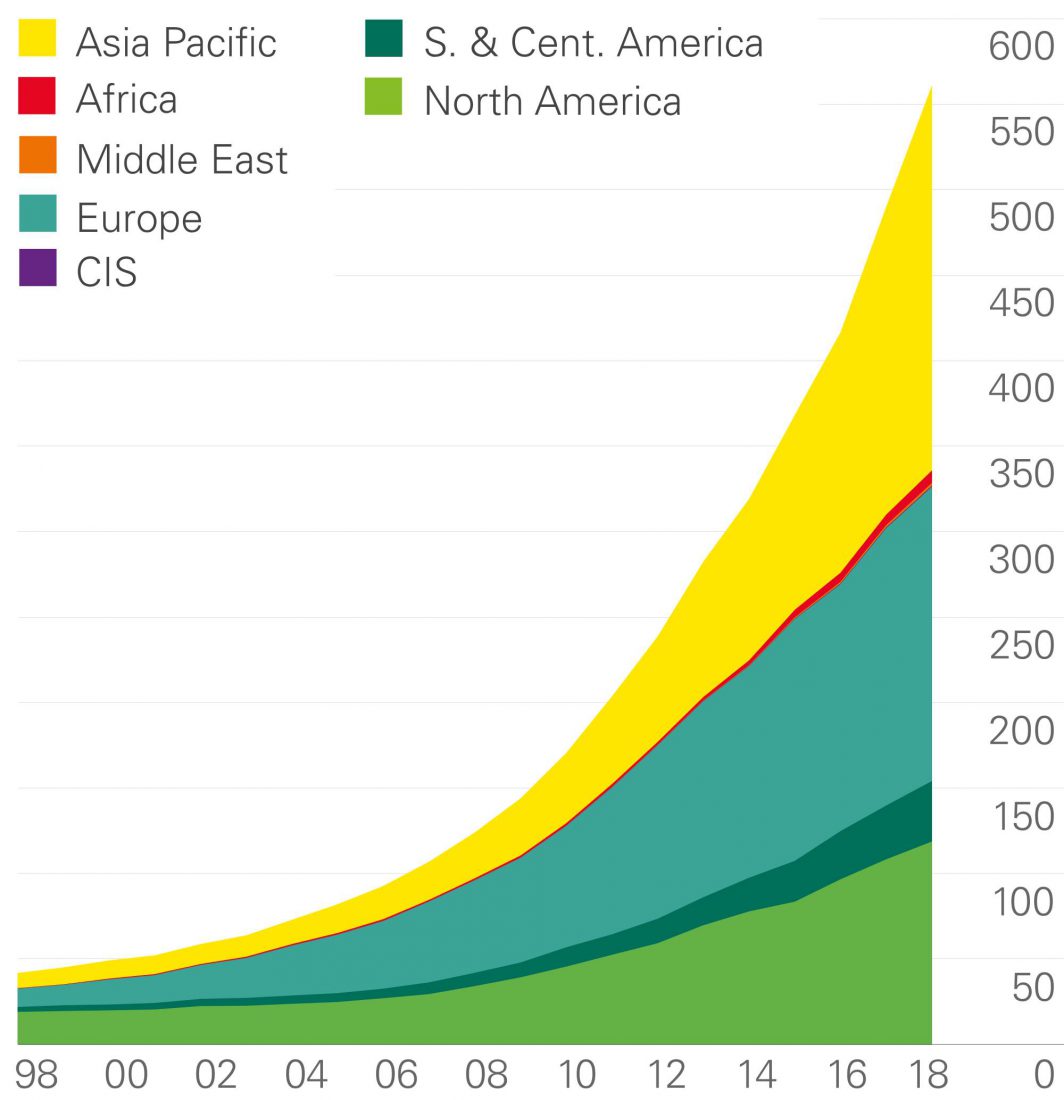
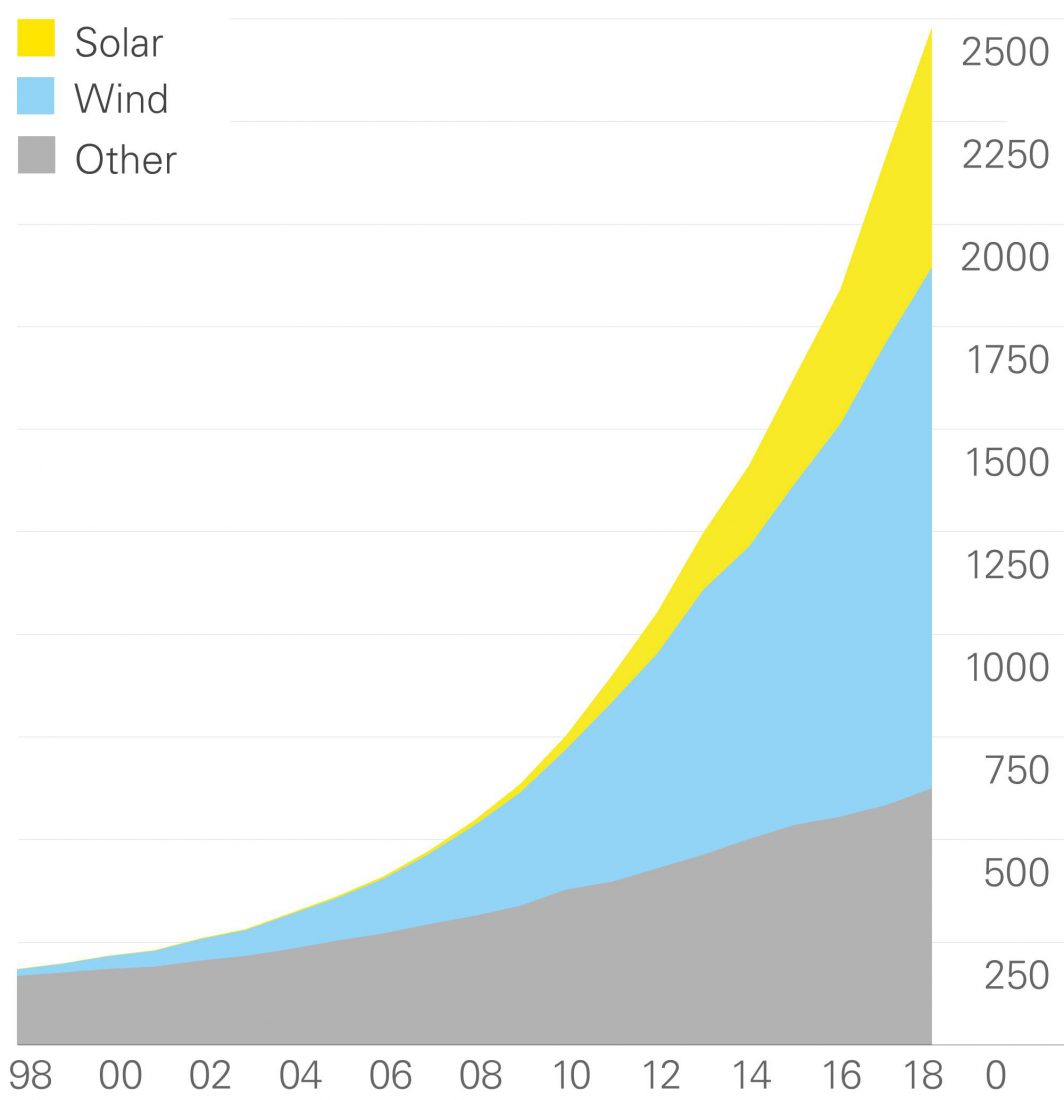 Figure 2 – Renewable energy consumption by source from 1998-2018 (in terawatt-hours)
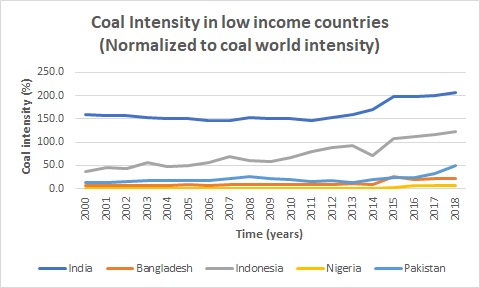
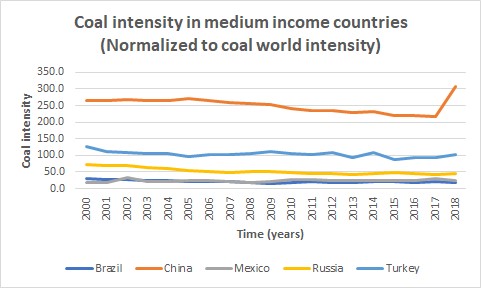
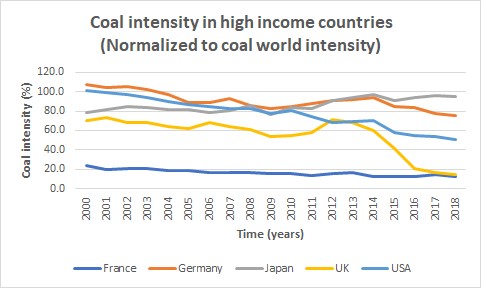
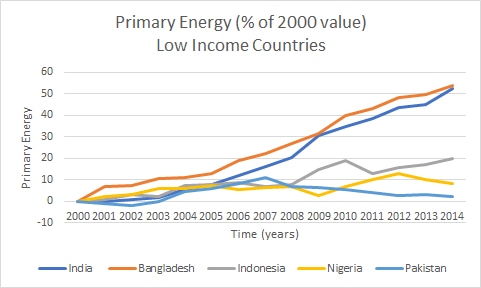 Figure 2 – Use of primary energy in low-income countries, as % of year 2000 value
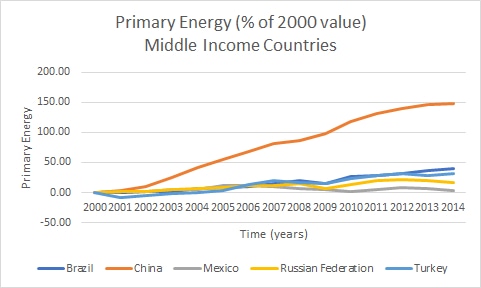 Figure 3 – Use of primary energy in middle-income countries, as % of year 2000 value
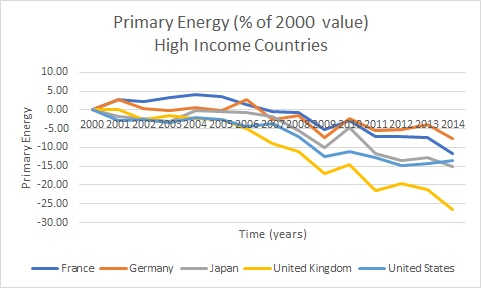 Figure 4 – Use of primary energy in high-income countries, as % of year 2000 value
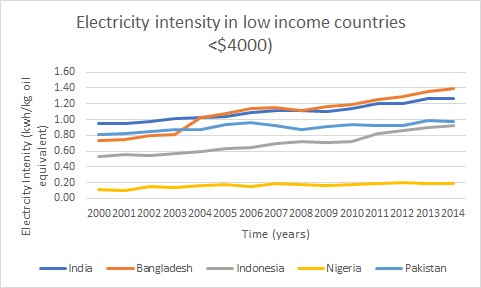 Figure 1 – Low-income countries
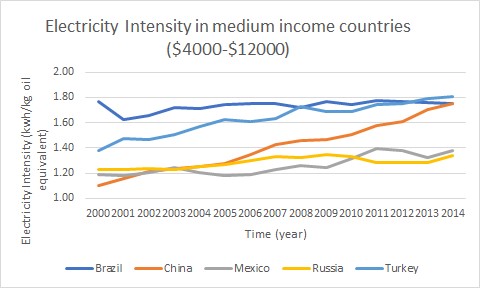 Figure 2 – Medium-income countries
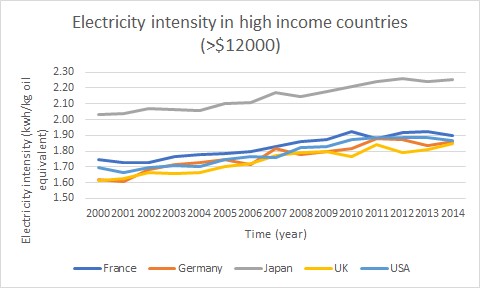 Figure 3 – High-income countries
Back to “Self-Inflicted Genocide”: Roger Hallam & the Holocaust
My original plan was to follow up on last week’s blog and look into the recurring complexities of the California fires. In light of the major power outages, some residents have gone so far as to claim that California has lost its capability to support human activity. As happens so often, however, I realigned my priorities based on more recent news. In this case, it was a New York Times article about climate change activist Roger Hallam diminishing the horrors of the Holocaust that brought me up short:
After I read the piece, I looked at my wife and told her to prepare for somebody using my activities on this blog as a reason to fire me from my job. Among other things, I teach students about climate change and specifically describe the future prospects of business as usual climate change as a “self-inflicted genocide.” She looked at me with a smile and assured me she would support me. Furthermore, she said, there was a big distinction between my teaching and Mr. Hallam’s statements, so it was unlikely my job was in jeopardy. For starters, I don’t belittle the Holocaust. Rather, I warn about the ever-worsening impacts of business as usual practices on climate change and their ultimate conclusion without coordinated global mitigation efforts. I thanked her for her encouragement but nevertheless found it necessary to compare myself to Mr. Hallam.
Self-Inflicted Genocide
In my first blog (April 22, 2012), I tried to establish the connections between my own experiences in the Holocaust and my work on climate change. I concluded with the following paragraph:
The last two sentences in that paragraph weren’t the start of my attempt to associate possible future consequences of unmitigated climate change with the Holocaust. It is a theme I have been discussing for over ten years. I have covered it in almost every talk that I have given on both topics and included it in the last chapter of the 2011 book that I wrote about climate change (Climate Change: The Fork at the End of Now – Momentum Press). I started this blog more than 7 years ago as another platform to broaden the reach of my warning. I strongly believe that my background provides me with the responsibility to spread this message.
The first blog provoked 82 responses, which I encourage you to revisit. The sizeable reaction forced me to follow up with more details. The two blogs that followed (May 7 and May 14, 2012) received 63 and 61 responses, respectively.
Today, a search on this blog for the term, “self-inflicted genocide” will yield 23 entries.
Three years ago, a group of students from the University of Pennsylvania who were trying to convince the university’s trustees to stop investing in fossil fuels read some of my material and invited me to take part in a panel about the topic. I joined them on December 1, 2016 to address the theme: Is Fossil Fuel Use A Moral Evil? Following the talk, Chris Doyle, one of the organizers of the event, summarized the arguments in a local paper. I am including some excerpts here:
Reactions
As you can see from the roughly 200 combined comments my first three blogs garnered, this line of comparisons has plenty of proponents and opponents. Nor were the comments and responses confined to the comments section or academic presentations.
I also received copies of three anti-Semitic caricatures in my mailbox at the University. I am including one here to illustrate the depth of Holocaust denial and hatred of Jews.
Figure 1 – An anti-Semitic cartoon denying the Holocaust
It is important to note that, as the Anti-Defamation League (ADL) explains:
My experiences with the consequences of comparing the Holocaust to climate change are different from those that Mr. Hallam is currently facing. I am not in as public or prominent of a position, so I didn’t get the attention of the foreign minister of a major country or cancellations of previous commitments to publish my work. Granted, I also didn’t try to make the comparison based on the actual number of victims. My use of the term self-inflicted genocide refers to the relatively distant future, while the Holocaust refers to a confirmed past event.
That said, any connection between the Holocaust and climate change invokes strong reactions. I am not alone in linking the two—the concluding chapter of Timothy Snyder’s 2015 book, Black Earth: The Holocaust as History and Warning also warns of climate change—but I was one of the first to do so. I also have significant “credentials” with regard to both the Holocaust and climate change.
Figure 2 – Timothy Snyder’s book
International Holocaust Remembrance Day
Two months from now, on January 27, 2020, we will mark International Holocaust Remembrance Day:
As we think about the tragedies of the past, let’s also start planning for ways to prevent those of the future.