
Energy Intensity

My recent blogs have focused on COP27 and its main decision of creating a mechanism for developed countries to transfer resources to developing countries to help them adapt to the damage that climate change inflicts. The best way for everybody to minimize such damage is, obviously, to minimize climate change itself by minimizing the increase in atmospheric greenhouse gas concentrations. The best way to accomplish that objective is to minimize the use of fossil fuels through a transition to non-carbon sources. This topic has come up repeatedly throughout the more than 10 years I’ve been writing this blog. Just put the title of this blog in the search box and see what you get.

Russian attempts to weaponize Europe’s dependence on its energy supply to try to minimize military aid to Ukraine (February 8, 2022 blog), have suddenly made energy resilience one of the most important considerations. Partly as a result of these pressures, the world found itself accelerating the transition to sustainable energy sources.

Last week’s blog showed that globally we are fast approaching the conditions in which our use of sustainable energy sources will surpass our use of fossil fuels. In the European Union, this landmark has already been reached.

Last week’s blog focused on this transition. One can say that the Russian invasion of Ukraine helped to put energy resilience in phase with climate change mitigation. It highlighted the need to replace fossil fuels as quickly as possible with sustainable energy sources.

The identity that can quantify the transition is the IPAT identity. Put IPAT into the search box and you will get many entries. A relevant entry for the present topic is the January 24, 2017 blog, “Searching for Limits – Stability for a Distant Future.” The general form of the identity is shown in Equation 1:


Impact = Population x Affluence x Technology                                             (1)


Population and affluence (expressed as GDP/Capita) are self-explanatory. The technology term for energy emission of carbon dioxide is shown in equation 2:


Technology = (Energy/GDP)x(Fossil/Energy)x(CO2/Fossil)                       (2)


With population and affluence growing, the way to reduce climate change impact is to reduce the technology term of the IPAT identity. The earlier blog summarized the challenge in the following way:

Almost all of the future scenarios for climate change make separate estimates of the indicators in this equation. The difference factor of 15 in GDP/Person (measure of affluence), between the average Chinese and average American makes it clear that the Chinese and the rest of the developing world will do everything they can to try to “even the score” with the developed world. The global challenge is how to do this while at the same time minimizing the environmental impact.

Last week’s blog emphasized the last two terms in equation (2), which deals with the nature of energy sources. It did not deal with the increase in energy efficiency which is expressed in the form of energy intensity: Energy/GDP. One reason for that is that the global energy intensity has been decreasing during the last 25 years, as is shown in Figure 1 and the summary paragraph in the Energy Information Administration (EIA) report shown below:

Worldwide energy intensity, measured as energy consumption per unit of gross domestic product (GDP), decreased by nearly one-third between 1990 and 2015. Energy intensity has decreased in nearly all regions of the world, with reductions in energy intensity occurring both in the more developed economies of the Organization for Economic Cooperation and Development (OECD) and in the emerging nations of the non-OECD.

Differences in energy intensity across countries and regions correspond to underlying factors such as economic structure, climate, and geography. Manufacturing-focused economies tend to use more energy per dollar of GDP than service-focused economies. Countries and regions with wider temperature variations tend to use more energy for heating and cooling. The distances between urban areas—and the infrastructure within them—can influence the amount of energy used to move goods and passengers.

Historically, energy intensity levels in non-OECD countries have been higher than levels in OECD countries. In many non-OECD countries, economies have been industrializing and rely on more energy-intensive forms of energy use. In contrast, many OECD countries have transitioned from relying on energy-intensive manufacturing to using more services-based economic activities that are less energy intensive. Based on 2015 estimates, OECD countries used on average 12% less energy per dollar of GDP than non-OECD countries.

Figure 1 – Global Energy intensity (Source: EIA)

The decrease in energy intensity over this time span applies to the global average as well as OECD (Organization for Economic Cooperation and Development) countries. OECD countries roughly correspond to developed countries. The graph shows that the rate of decline of the energy intensity in the developing countries is a bit faster than that of the rich countries.

Figure 2, taken from the same EIA source as Figure 1, shows the value of the energy intensity in one selected year (2015) and it shows that the differences are not necessarily anchored on the wealth of the countries (China in the more energy-intensive group and Japan in the less energy-intensive group).


Figure 2 – Energy Intensity by region and country (Source: EIA)

Figure 3, also taken from the same EIA source, shows the changes in energy productivity (more productive is equivalent to smaller energy intensity) between 1990 and 2015. It also shows no obvious trend between the rich and the poor countries.

All these data show that the decrease in energy intensity is now a long-term trend, common for rich and poor countries. It shows that short-term changes such as COVID and the Russian invasion of Ukraine cannot be easily separated from long-term trends.

It is still not clear to me what drives the long-term decline in energy intensity. Popular explanations such as Environmental Kuznets Curves (see the May 14, 2019) in which one assigns the cause as the transition from an energy-intensive heavy industry development phase to a service-based phase do not agree with the data. Whatever the cause, the trend supports trends toward decreasing the energy impact on climate change. It’s another reason for our children to be thankful.

Figure 3 – Recent changes in energy intensity in selected regions and countries (Source: EIA)

The sudden impact of Russia’s invasion of Ukraine and Europe’s desire to untie itself from the weaponized Russian natural gas dependence can be seen in Figure 4, which measures a month’s change in the use of natural gas in the OECD countries. Europe is trying to liberate itself.

Stay tuned.

Figure 4 – Changes in the use of natural gas in OECD countries (Source: IEA monthly gas statistics)

Posted in Climate Change | 1 Comment

Will Our Children and Grandchildren be Grateful and Think Well of Us??

The title of this blog doesn’t set any time frame. My grandchildren and my students are approximately the same age. However, it strongly indicates that something good is now happening. This good thing is happening as a result of the accumulation of trying times that most of us are experiencing now.

Russia’s invasion of Ukraine and Europe’s strong dependence on the Russian gas supply are a strong reminder that an energy shift away from fossil fuels is urgently needed now—not just to mitigate climate change but as a national security step so we don’t find ourselves short of energy because of geopolitical conflicts. Resilience in our energy supply is urgently needed, and the best solution is to shift to sources under our control. Fortunately, the need for resiliency and the shift to non-carbon energy sources have the same solution.

It is not easy to see that the world is adapting to such a solution but strong signals are now emerging that the response to Russia’s disruption in its energy supply may lead us to the promised land of acting to mitigate climate change.

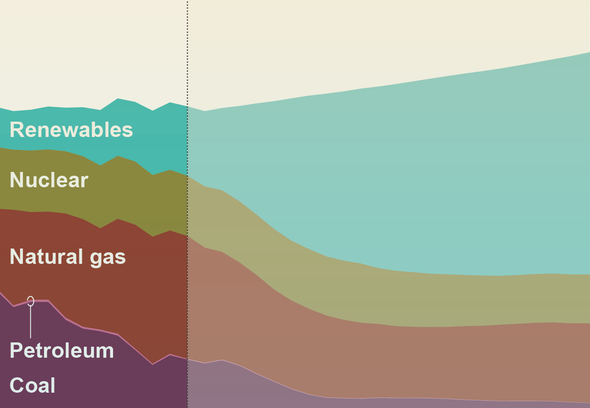
New data from the International Energy Administration (IEA) now show that globally, renewables are now replacing gas, not coal:

The International Energy Agency (IEA) has raised its global forecast for renewables growth in what it calls its “largest ever upward revision” for the sector. The latest revision means the agency now forecasts 76% more growth than it did just two years ago, Carbon Brief analysis shows. This means extra wind, solar and other renewable technologies equivalent to the entire electricity system of India being built by 2026, on top of last year’s projections. The agency says this year’s forecast accounts for a wave of new policies introduced largely in response to Russia’s invasion of Ukraine and soaring fossil fuel prices. The IEA’s latest annual report on the status of renewables notes that the global energy crisis is “pushing the accelerator on renewable energy expansion”, particularly in the EU, US, China and India. It says utility-scale solar and onshore wind power are now the cheapest options for new generation in “a significant majority of countries worldwide”. The influential Paris-based agency now expects renewables to surpass coal as the largest source of electricity generation by “early 2025”, reaching 38% of the power mix by 2027. The installed capacity of solar power alone is set to overtake that of coal in 2027. But, despite this increase in global ambition, the IEA says countries are still not on track to achieve a net-zero emissions energy system by 2050. It highlights how addressing regulatory and financial barriers could “significantly narrow the gap” to achieving this target.

Extra capacity In its 2020 renewables report, the IEA forecast an additional 1,092 gigawatts (GW) of global capacity would be built between 2022 and 2026. It raised this to 1,496GW last year. For the main scenario in its latest report, the agency estimates that an extra 424GW of renewables capacity will now be built over this five-year period, roughly equivalent to the entire power capacity of India. This is a 28% increase on the previous estimate and up 76% from two years ago.


Figure 1Cumulative power capacity, gigawatts (GW), by technology, 2010-2027 (Source: IEA Renewables 2022)

Figure 2 shows an alternative presentation of the same IEA data. Both figures make it clear that globally, renewable energy sources (solar and wind) are on their way to replacing fossil fuels.

Figure 2 – The same data from Figure 1 plotted as a percentage of the power capacity (Source: Renewables Now)

Figure 3 shows that the replacement in Europe is already underway.

Figure 3 – Regionally, the replacement trend (renewables to fossil fuels) is most pronounced in the EU (Source: Ember)

One result of the trend is the relative rise of the stocks of renewable companies following the Russian invasion of Ukraine at the end of February 2022, as seen in Figure 4.

Figure 4 – European stock prices of renewables (Source: Bloomberg)

Replacing carbon-emitting fossil fuels with sustainable energy is not the only way to reduce carbon footprints and thus mitigate climate change. Reducing energy intensity through increased energy efficiency, is another (see the May 31, 2022 blog on Electric Utilities through the Lens of the IPAT identity). I will return to this issue in future blogs, as we accumulate some more data.

Posted in Climate Change | 7 Comments

Adaptation and Affordability: Developed Countries

The last few blogs have been dedicated to COP27 and its central achievement of clinching a unanimous decision to create a fiscal mechanism for the rich countries to transfer resources to the developing countries for adaptation to climate change. It was necessary for the rich countries to agree because without such help the developing countries refuse to cooperate with mitigation efforts and the situation becomes worse for everybody. The mechanism for how this financial transfer will actually operate is under discussion, to be ready a year from now and finalized at COP28.

In the last few blogs, I also tried to raise two important questions: (1) Suppose the mechanism becomes operational and the developing countries can get the money for adaptation; what kind of projects are those countries interested in pursuing (see last week’s blog)? And (2) While we are focusing mostly on adaptation in developing countries, adaptations are specific to localities; given that many developed countries also suffer from a sharp disparity in financial resources, what is to be done with underdeveloped areas in developed countries? This blog tries to address the second question with a focus on the US.

My discussion starts with three vulnerability findings in a study reported by Matt Burdett, presented in the following three figures:

Map of US: Variation of the economic cost of climate change: predicted damage, 2080 – 2099

Figure 1 – Variation of the economic cost of climate change: predicted damage, 2080 – 2099

Map of US: percentage change in population 1970 – 2008

Figure 2 – Percentage change in population 1970 – 2008

Figure 3 – Rising temperature damage as a percentage of county income in the US

I discussed the irrationality of people’s mass movement to the most vulnerable locations in the US in an earlier blog (November 1, 2022), with Arizona as an example. Figure 1 shows the most vulnerable areas of the country and Figure 2 shows the migration trends. Figure 3 shows the effects of income disparity within the US.

Georgetown Climate Center’s State Adaptation Progress Trackerdiscusses which states are already implementing adaptation policies and which ones are “considering” such policies:

States and communities around the country have begun to prepare for the climate changes that are already underway.  This planning process typically results in a document called an adaptation plan.

Below is a map that highlights the status of state adaptation efforts. Click on a state to view a summary of its progress to date and to access its full profile page. State profile pages include a detailed breakdown of each state’s adaptation work and links to local adaptation plans and resources. Please move the map to view Alaska and Hawaii.

The conflict of whether to pay for damage or pay for adaptation is discussed in howmuch.net based on work discussed in Science magazine. A summary of the Science magazine findings is given below:

Estimates of climate change damage are central to the design of climate policies. Here, we develop a flexible architecture for computing damages that integrates climate science, econometric analyses, and process models. We use this approach to construct spatially explicit, probabilistic, and empirically derived estimates of economic damage in the United States from climate change. The combined value of market and nonmarket damage across analyzed sectors—agriculture, crime, coastal storms, energy, human mortality, and labor—increases quadratically in global mean temperature, costing roughly 1.2% of gross domestic product per +1°C on average. Importantly, risk is distributed unequally across locations, generating a large transfer of value northward and westward that increases economic inequality. By the late 21st century, the poorest third of counties are projected to experience damages between 2 and 20% of county income (90% chance) under business-as-usual emissions (Representative Concentration Pathway 8.5).

A special IPCC report, “Managing the Risks of Extreme Events and Disasters to Advance Climate Change Adaptation,” which enumerates the management of extreme events and disasters adaptation to climate change was published a few years ago.

An estimate of how much such efforts can cost the US can be found in this Scientific American piece.

Two recent examples of such payments can be found below:

U. S. to Pay Millions to Move Tribes Threatened by Climate Change

WASHINGTON — The Biden administration will give three Native tribes $75 million to move away from coastal areas or rivers, one of the nation’s largest efforts to date to relocate communities that are facing an urgent threat from climate change.

The three communities — two in Alaska, and one in Washington State — will each get $25 million to move their key buildings onto higher ground and away from rising waters, with the expectation that homes will follow. The federal government will give eight more tribes $5 million each to plan for relocation.

Climate-Proof Towns Are Popping Up Across the U.S. But Not Everyone Can Afford To Live There

In the aftermath of Hurricane Ian, which hit Florida’s southwest coast on Sept. 28 as a Category 4 storm, all eyes turned to one town. Just a few miles from places like Fort Myers, Port Charlotte, and Arcadia, where buildings were torn open or flooded, Babcock Ranch emerged virtually unscathed. Its 4,600 residents never lost power or internet access during the storm. And they were able to offer up their homes and school as shelter for less fortunate communities nearby.

The reason for Babcock Ranch’s unusual resilience? Planning. The town, which sold its first home in 2018, is part of a growing group of new master-planned communities in the U.S. designed with the increasingly severe impacts of the climate crisis in mind. Developers chose the location for Babcock Ranch, 20 miles inland and 30 feet above sea level, to escape storm surges. They buried power lines underground to shield them from wind. They designed drainage systems to complement the natural flow of rainwater over the landscape, with native vegetation soaking up water along roadways. And, they installed a large solar farm and battery infrastructure to keep the lights on even when the regional grid is struggling.

None of these enumerations include the expenses (social and monetary), of individual immigration (internal and external) of people seeking safety as environmental refugees (see April 3, 2018 blog).

Meanwhile, the World Bank provides estimates that include concrete numbers about the cost of extreme weather events globally, including values of damage in dollars:

Disasters, whether from natural hazards or man-made, cost lives and livelihoods. The immediate spending needed for response and reconstruction is compounded by a weakened economy, damaged infrastructure, destroyed businesses, reduced tax revenues and a rise in poverty levels.

  • According to the latest data from insurer Munich Re, losses from natural catastrophes in 2020 rose to $210 billion globally, from $166 billion in 2019.
  • Of all of deaths from weather, climate, and water hazards, 91% occurred in developing economies, according to the United Nations country classification from 1970 through 2019. The proportion remains similar for the World Bank country classification, according to which 82% of deaths occurred in low and lower-middle-income countries.
  • Since 1980, more than 2.4 million people and over $3.7 trillion have been lost to disasters caused by natural hazards globally, with total damages increasing by more than 800%, from $18 billion a year in the 1980s to $167 billion a year in the last decade.

I’ve mentioned before that implementation of the new mechanism agreed upon in COP27 to help developing countries adapt to the damage that is now growing because of the accelerating climate change, will have to wait for COP28 after a year-long discussion. Now is a trying time for such discussions.

As a recent NYT article emphasizes, many developing countries are already heavily in debt and in danger of catastrophic default, as summarized below:

WASHINGTON — Developing nations are facing a catastrophic debt crisis in the coming months as rapid inflation, slowing growth, rising interest rates and a strengthening dollar coalesce into a perfect storm that could set off a wave of messy defaults and inflict economic pain on the world’s most vulnerable people.

Poor countries owe, by some calculations, as much as $200 billion to wealthy nations, multilateral development banks and private creditors. Rising interest rates have increased the value of the dollar, making it harder for foreign borrowers with debt denominated in U.S. currency to repay their loans.

It will be difficult to agree to separate the new transfer of money proposals from the urgent need to restructure the present financial obligations.  Stay tuned.

Posted in IPCC, UN, US | 1 Comment

Adaptation and Affordability: Developing Countries

Last week’s blog ended with documentation of the COP27’s late unanimous agreement to generate a special fund to help developing countries to cope with adaptation to damage that climate change inflicts. Below is the exact language that the UNFCCC is using to describe the nature of the agreement:

UN Climate Change News, 20 November 2022 – The United Nations Climate Change Conference COP27 closed today with a breakthrough agreement to provide “loss and damage” funding for vulnerable countries hit hard by climate disasters.

“This outcome moves us forward,” said Simon Stiell, UN Climate Change Executive Secretary. “We have determined a way forward on a decades-long conversation on funding for loss and damage – deliberating over how we address the impacts on communities whose lives and livelihoods have been ruined by the very worst impacts of climate change.”

Creating a specific fund for loss and damage marked an important point of progress, with the issue added to the official agenda and adopted for the first time at COP27.

Governments took the ground-breaking decision to establish new funding arrangements, as well as a dedicated fund, to assist developing countries in responding to loss and damage. Governments also agreed to establish a ‘transitional committee’ to make recommendations on how to operationalize both the new funding arrangements and the fund at COP28 next year. The first meeting of the transitional committee is expected to take place before the end of March 2023.

Parties also agreed on the institutional arrangements to operationalize the Santiago Network for Loss and Damage, to catalyze technical assistance to developing countries that are particularly vulnerable to the adverse effects of climate change.

As is described here, the all-important implementation of this agreement has been deferred until COP28, with the meeting of an established “transitional committee” to happen no later than March 2023. We obviously will return to this issue.

As promised, this blog will address the question of what the developing countries propose to do in case the funds are made available to them. Next week I will focus on the same issue from the perspective of the developed countries involved.

This blog will focus on a few examples of actual actions of some developing countries and on the related question of whether money from developed countries should be the only source of financing available to confront these issues.

An earlier blog (May 14, 2019), written by my students, addresses the contributions of two important parameters of global carbon emissions: the environmental Kuznets curve, which determines a country’s stage in its economic development (strongly energy-dependent heavy industry or relatively energy-light services) and the income distribution measured through the Gini coefficient. I suggest that you go back to that blog for a refresher on what these two parameters mean. The Gini coefficient is an income distribution parameter that ranges between 0 and 1 (or in percent, between 0 and 100%). 0 indicates perfect income distribution while Gini = 1 indicates all the income is concentrated in the hands of a single person). Putting this in less extreme terms, a small Gini indicates a relatively broad income distribution while a relatively large coefficient indicates that fewer hands hold most of the income. Figure 1 shows a global map of the distribution of the Gini coefficients with the darker colors indicating a more unequal distribution. For more detailed, recent values of the Gini coefficient, one can go to the original World Bank publication. The most recent values from the World Bank are available under the Gini index section of the World Bank website..

Figure 1 – Map of global Gini coefficients reported by the World Bank (Source: ResearchGate)

One can see from Figure 1 that uneven income distribution is less of a problem in richer countries. Many of the rich countries such as most of Europe, Canada, Australia, and Japan enjoy relatively broad income distribution. A handful of very poor countries such as Afghanistan and Ethiopia also enjoy a “healthy” distribution, meaning that most people there are poor.

A high Gini coefficient is seen in the southern parts of Africa and South and Central America. One can deduce from such maps that more effective taxation of higher income brackets might be an effective way to increase these countries’ resources to fight ecological disasters. I will return to this issue in the following blog when I deal with the role of rich countries in fighting the climate change crisis.

I will now shift to a few cases of relatively poor countries that have already found the resources to make major progress in shifting their development to a more sustainable landscape. I have also asked one of my students to write a guest blog that will include other examples of what countries that currently lack the resources to fight climate change intend to do once such resources become available.

The efforts below represent major steps to enhance sustainability. First, we look at two small developing countries: Belize and Nepal. Meanwhile, so far, an agreement about the joint environmental impacts between three large developing countries (Brazil, Indonesia, and Congo) that host more than half of the global forests has no source of funding. Finally, there’s an agreement between a group of developed countries to help Indonesia in its transition away from coal:

Belize cut its debt by fighting global warming:

TURNEFFE ATOLL, Belize — Belize faced an economic meltdown. The pandemic had sent it into its worst ever recession, putting the government on the brink of bankruptcy.

A solution came from unexpected quarters. A local marine biologist offered Prime Minister Johnny Briceño a novel proposal: Her nonprofit would lend the country money to pay its creditors if his government agreed to spend part of the savings this deal would generate to preserve its marine resources.

For Belize, that meant its oceans, endangered mangroves and vulnerable coral reefs.

Nepal grew back its forests:

“You see that? They were barren mounds of red mud 15 years ago,” said the man, Khadga Bahadur Karki, 70, tears of pride fogging up his glasses. “These trees are more than my children.”

This transformation is visible across Nepal, thanks to a radical policy adopted by the government more than 40 years ago. Large swaths of national forest land were handed to local communities, and millions of volunteers like Mr. Karki were recruited to protect and renew their local forests, an effort that has earned praise from environmentalists around the world. But the success has been accompanied by new challenges — among them addressing the increase in potentially dangerous confrontations between people and wildlife.

Community-managed forests now account for more than a third of Nepal’s forest cover, which has grown by about 22 percent since 1988, according to government data. Independent studies also confirm that greenery in Nepal haas sprung back, with forests now covering 45 percent of the country’s land.

Brazil, Indonesia, and Congo signed a rainforest protection pact:

SHARM EL SHEIKH, Egypt — The three countries that are home to more than half of the world’s tropical rainforests — Brazil, Indonesia and the Democratic Republic of Congo — are pledging to work together to establish a “funding mechanism” that could help preserve the forests, which help regulate the Earth’s climate and sustain a variety of animals, plants, birds and insects.

The agreement, announced on Monday and signed by ministers from the three countries, said they would cooperate on sustainable management and conservation, restoration of critical ecosystems and creation of economies that would ensure the health of both the people and the forests.

The plan has no financial backing of its own and was more of a call to action than a strategy for how to achieve its goals.

US, Japan, and partners mobilized $20 billion to help Indonesia to transition away from coal

NUSA DUA, Indonesia/SHARM EL-SHEIKH, Egypt, Nov 15 (Reuters) – A coalition of countries will mobilise $20 billion of public and private finance to help Indonesia shut coal power plants and bring forward the sector’s peak emissions date by seven years to 2030, the United States, Japan and partners said on Tuesday.

The Indonesia Just Energy Transition Partnership (JETP), more than a year in the making, “is probably the single largest climate finance transaction or partnership ever”, a U.S. Treasury official told reporters.

The Indonesia JETP is based on last year’s $8.5 billion initiative to help South Africa more quickly decarbonise its power sector that was launched at the COP26 climate summit in Glasgow by the United States, Britain and European Union.

To access the programme’s $20 billion worth of grants and concessional loans over a three- to five-year period, Indonesia has committed to capping power sector emissions at 290 million tonnes by 2030, with a peak that year. The public and private sectors have pledged about half of the funds each.

As I’ve mentioned before, great inequalities are major impediments to addressing climate change on both global and local levels. The next blog will try to address the issues on the rich countries’ level.

Posted in Climate Change | 3 Comments

COP27 is Over: Draft of Final Decisions to Transfer Resources to Developing Countries

The COP27 meeting concluded on November 18th; I’ve been following its progress. As I described last week, this meeting’s main topic was the difficulty developing countries are having in financing the required mitigation and adaptation to climate change. They have demanded financial help from developed countries and I promised that this week I would address the question of what they propose to do in case the funds are made available to them. Next week, I will focus on the same issue from the perspective of developed countries.

Not surprisingly, given the requirement of a unanimous decision by all participating countries (about 200), there were difficulties concluding the meeting with affirmative decisions. By Sunday morning (NY time), November 20th, the news media reported the progress in the matter:

SHARM EL SHEIKH, Egypt — Diplomats from nearly 200 countries concluded two weeks of climate talks on Sunday by agreeing to establish a fund that would help poor, vulnerable countries cope with climate disasters made worse by the greenhouse gases from wealthy nations.

The decision on payments for loss and damage caused by global warming represented a breakthrough on one of the most contentious issues at United Nations climate negotiations. For more than three decades, developing nations have pressed rich, industrialized countries to provide compensation for the costs of destructive storms, heat waves and droughts linked to rising temperatures.

But the United States and other wealthy countries had long blocked the idea, for fear that they could face unlimited liability for the greenhouse gas emissions that are driving climate change.

The loss and damage agreement hammered out in this Red Sea resort town makes clear that payments are not to be seen as an admission of liability. The deal calls for a committee with representatives from 24 countries to work over the next year to figure out exactly what form the fund should take, which countries and financial institutions should contribute, and where the money should go. Many of the other details are still to be determined.

While the agreement above obviously didn’t find its way into the final resolution, it was good enough news that I decided to rededicate this blog to the relevant portions that did. I still plan to continue with the promised two blogs about the different perspectives on the role of inequality between developed and developing countries in adapting to and mitigating climate change. I will reexamine the final resolution at the end of this process and will let you know.

Here, I am posting the relevant sections of the preliminary resolution that deal with the transfer of resources between developed and developing countries. These resolutions take time and countless edits; they’re in the process of being updated but for now I’m bolding the sections that still need completion:

{Loss and damage}

  1. Welcomes the Parties’ agreement for the first time to include a sub-agenda item titled “Matters related to funding arrangements responding to loss and damage associated with the adverse effects of climate change including a focus on addressing loss and damage” under agenda item titled “matters related to finance” under COP and CMA, as a reflection of the wide global consensus around the grave situation in relation to loss and damage and the need for effective funding arrangements related to responding to loss and damage in particular addressing loss and damage.
  2. Notes with great concern, as documented by the IPCC 6th AR WG II and WG III reports, the growing gravity, scope and frequency of loss and damage in all regions, and that loss and damage associated with the adverse effects of climate change take the form of extreme weather events as well as slow onset events, and result in devastating economic and non-economic losses including through its impact on cultural heritage, human mobility and forced displacement and the lives and livelihoods of local communities, and underlines in this regard that an adequate and effective response to loss and damage is of great importance to the continue credibility and relevance of the UNFCCC process.
  3. Expresses deep concern towards the significant financial costs associated with loss and damage for developing countries, resulting in increasing the burden of indebtedness and impairing the realization of the 2030 Sustainable Development Goals.
  4. Welcomes the Parties’ agreement on all the institutional arrangements of the Santiago Network for averting, minimizing and addressing loss and damage associated with the adverse effects of climate change to enable its full operationalization, supports its mandated role in catalyzing technical assistance for the implementation of the relevant approaches at 6 the local, national and regional levels in developing countries that are particularly vulnerable to the adverse effects of climate change, and renews their determination to select the host of the Santiago Network Secretariat by 2023 through a selection process which is conducted in an open, transparent, fair and neutral manner in accordance with the process outlined in paragraphs 17-18 of CMA/**** COP/****;
  5. {Placeholder funding arrangement responding to loss and damage}.

{Implementation – Just Transition Pathways}

  1. Emphasizes the urgent need for immediate, deep, rapid and sustained reductions in global greenhouse gas emissions by Parties across all sectors, in order to limit global warming to 1.5 °C above pre-industrial levels; and highlights the importance of ensuring and enabling just transition for developing countries.
  2. Affirms that sustainable and just solutions to the climate crisis must be founded on meaningful and effective social dialogue and participation of all stakeholders, and notes that the global transition to low emissions provides opportunities and challenges for sustainable economic development and poverty eradication.
  3. Emphasizes that just and equitable transition encompasses pathways which include energy, socio-economic, workforce and other dimensions, all of which must be based on nationally defined development priorities and include social protection dimensions to mitigate potential impacts associated with the transition, and highlights the important role of the instruments and measures related to social solidarity and social protection floors in mitigating the impacts resulting from the applied measures.
  4. Decides to establish a work program on just transition to discuss pathways to deliver on article 2.1 of the Paris Agreement in the context of article 2.2 and requests the Subsidiary Body for Implementation and the Subsidiary Body for Scientific and Technological Advice to recommend a draft decision on this matter for consideration and adoption by the Conference of the Parties serving as the meeting of the Parties to the Paris Agreement at its fifth session, in a manner that builds on and compliments the relevant work streams under the Convention and the Paris Agreement, including the Mitigation work program.
  5. Decides to convene an annual high-level ministerial round table on just transition, as part of the just transition work program beginning at the fifth session of the Conference of the Parties serving as the meeting of the Parties to the Paris Agreement.

 {Finance}

  1. Reiterates articles 2, 4 and 9 of the Paris Agreement; and highlights that about $4 trillion a year needs to be invested in renewable energy until 2030 – including investments in technology and infrastructure – to allow us to reach net-zero emissions by 2050. Furthermore, a global transformation to a low-carbon economy is expected to require investments of at least USD 4-6 trillion a year. Delivering such funding will require a transformation of the financial system and its structures and processes, engaging governments, central banks, commercial banks, institutional investors and other financial actors.
  2. Notes with concern the growing gap between the needs of developing country Parties, in particular due to the increasing impacts of climate change and increased indebtedness, and the support provided and mobilized to complement their efforts to implement their nationally determined contributions, highlighting that current estimates of such needs are in the scale of 5.6 trillion USD up to 2030, while the global annual flows to developing countries.
  3. Expresses grave concern that the goal of developed country Parties to mobilize jointly USD 100 billion per year by 2020 has not yet been met and urges developed country Parties to meet the goal and address the shortfall to $100 billion since 2020.
  4. Emphasizes that accelerated financial support for developing countries from developed countries and other sources is a critical enabler to enhance mitigation action and 7 address inequities in access to finance, including its costs, terms and conditions, and economic vulnerability to climate change for developing countries. Scaled-up public grants for mitigation and adaptation funding for vulnerable regions, especially in Sub-Saharan Africa, would be cost-effective and have high social returns in terms of access to basic energy.
  5. Notes that global climate finance flows are small relative to the overall needs of developing countries. Global climate finance in 2019–2020 was estimated to be USD 803 billion. This amount is 31–32 per cent of the annual investment needed for the global temperature rise to follow a well below 2 °C or a 1.5 °C pathway. This level of climate finance is also below what one would expect in the light of the investment opportunities identified and the cost of failure to meet climate stabilization targets.
  6. Notes the important role of technology transfer in enhancing climate action and that capacity gaps and needs still exist in developing countries.
  7. Urges developed country Parties to provide enhanced support, including through financial resources, technology transfer and capacity-building, to assist developing country Parties with respect to both mitigation and adaptation, in continuation of their existing obligations under the Convention, and encourages other Parties to provide or continue to provide such support voluntarily.
  8. Calls on MDBs and IFIs to align and scale up funding, ensure simplified access, mobilize climate finance from various sources, and encourages the shareholders of MDBs to define a new vision and commensurate operational model, channels and instruments that fit for-purpose to adequately address the global climate emergency; including deploying full suit of instruments from grants to guarantees and non debt instruments, without exacerbating debt burdens, and address the conservative risk appetites and limited scale of capitalization towards increasing their deployment on climate finance three folds up to 2025.
  9. Calls on multilateral development banks to reform their practices and priorities, in order to reduce the cost of borrowing for climate projects in developing countries and to increase their investment into adaptation financing and urges MDBs to align their operations with the Paris Agreement on Climate Change, and climate change emergency.
  10. Urges the ad hoc work programme on the new collective quantified goal to produce more efficient and operational results by 2023
  11. Calls on multilateral development banks to significantly increase climate ambition using the breadth of their policy and financial instruments for greater results including on private capital mobilization.
  12. Calls on multilateral development banks to ensure higher financial efficiency and maximize use of existing concessional and risk capital vehicles to drive innovation and accelerate impact.

{NCQG}

  1. {Placeholder for relevant outcomes from the ongoing negotiations}

NCQG stands for New Collective Quantified Goal on Climate Finance.

As I mentioned at the beginning of the blog, the agreement was “to establish a fund that would help poor, vulnerable countries cope with climate disasters made worse by the greenhouse gases from wealthy nations.” The major thing that remains open is where to draw the line of who needs to pay vs. who can withdraw from the fund. To put this question differently, how do we establish where middle-income countries fall on the binary? For instance, China is now the largest carbon emitter by far according to country measures but it trails many rich countries in emissions per capita, income per capita, and cumulative emissions. This issue has shadowed climate change agreements since its inception (put “Kyoto Protocol” in the search box for some perspective). Not surprisingly, the present agreement only establishes a committee that will submit a report about implementation to next year’s COP28 meeting, rather than trying to take definitive action now.

I will continue to follow the progress.

Posted in Climate Change | 5 Comments

Adaptation and Affordability: Global

Figure 1 – Historic cumulative emissions of countries (size of the circles) as a function of their vulnerabilities to climate change (Source: The New York Times)

It is now the second week of COP27 and the last month of my current semester. I asked my students if they have any idea what COP entails and whether they follow its progress. Of the three climate change-related courses that I teach, I got a positive answer from only one student. Test yourself on the two questions and let me know. Put COP26 in the search box and you will get 13 entries. COP is an abbreviation of Conference of Parties; it’s been held yearly since 1995 and is the preferred global meeting for world leaders to discuss global issues related to climate change. You can follow the COP27 process through the UN link and get the list and locations for all previous (and some future) meetings on the Wikipedia site.

COP27 started on Sunday, November 6th, in the Egyptian resort of Sharm El Sheikh, and is scheduled to conclude this Friday, November 18th. I am writing this blog through the end of the first week of the meeting. As it seems now, COP27’s main topic is developing countries’ ability to find resources to fund both adaptation and mitigation of climate change. To put the issue a bit differently, the conference appears to focus on the role of equity in confronting climate change. I addressed this issue in a previous blog (August 4, 2020), “Inequity: The Intersection of Coronavirus, Poverty & Other Expected Trends,” where I posted a Venn diagram with equity in the center, surrounded by COVID-19, climate change, population, and jobs.

This blog will focus on the global issues of proposed mechanisms for moving resources from developed countries to developing ones. Next week, I will focus on what developing countries are supposed to do with the resources, should such mechanisms prove successful. Obviously, inequity is not only a global issue between rich and poor countries. It is also an issue that rich countries confront internally. Since adaptation to climate change needs to be addressed on local levels, I will try to address it toward the end of November.

The background for the effort to provide resources to developing countries confronting climate change can be seen in the top figure that plots the historic cumulative emissions of countries (size of the circles) as a function of their vulnerability, plotted on the horizontal axis.  If you plot the same data in terms of historic cumulative emissions per person vs. vulnerability, the figure will look quite different. I will return to this issue in future blogs.

A few catch-all terms are often used for the proposed mechanisms of moving resources from rich to poor. One is compensation:

SHARM EL-SHEIKH, Egypt, Nov 6 (Reuters) – Delegates from nearly 200 countries kicked off the U.N. climate summit in Egypt on Sunday with an agreement to discuss compensating poor nations for mounting damage linked to global warming, placing the controversial topic on the agenda for the first time since climate talks began decades ago.

The agreement set a constructive tone for the COP27 summit in the seaside resort town of Sharm el-Sheikh, where governments hope to keep alive a goal to avert the worst impacts of planetary warming even as a slew of crises – from a land war in Europe to rampant inflation – distract the international focus.

Such a mechanism is almost identical to reparations. It is based on the premise shown in Figure 1, which puts the rich countries (many of them shown with large circles) on the left side of the diagram. Historically these countries have accumulated their wealth through the use of fossil fuels; as a result, poorer countries are more vulnerable, with very few resources to adapt to the changes. Repayment in this approach is based on blame, although the largest emitter right now is China by a large margin.

An alternative approach, loss and damage, is based on needs:

The 27th annual U.N. climate talks, known as COP27, began yesterday. At the top of the agenda for developing countries is financing for loss and damage: Who will pay for the costs of a warming world?

For them, loss and damage is a matter of justice. They face irreversible destruction and want rich nations — which have emitted half of all heat-trapping gases since 1850 — to compensate them.

Wealthy nations blanch at accepting blame. The U.S. and the E.U. fear that such compensation could become an unlimited liability. Last year, wealthy nations vowed to provide $40 billion per year by 2025 to help poorer countries with adaptation, but a U.N. report estimates that this amount is less than one-fifth of what developing nations need.

In fact, one frequently cited study estimated that developing countries could suffer between $290 billion to $580 billion in annual climate damages by 2030, even after efforts to adapt. Those costs could rise to $1.7 trillion by 2050.

Some of the history of this dispute is summarized in the piece below:

SHARM EL SHEIKH, Egypt — For 30 years, developing nations have been calling for industrialized countries to provide compensation for the costs of devastating storms and droughts caused by climate change. For just as long, rich nations that have generated the pollution that is dangerously heating the planet have resisted those calls.

At the United Nations climate summit last year, only Scotland, the host country, committed $2.2 million for what’s known as “loss and damage.” But this week, the dam may have begun to break.

On Sunday, negotiators from developing countries succeeded in placing the matter on the formal agenda of this year’s climate summit, known as COP27, or the 27th session of the Conference of the Parties.

“The addition of loss and damage on the agenda is a significant achievement, and one that we have been fighting for many years,” Mia Mottley, the prime minister of Barbados, said on Tuesday. “We have a moral and just cause.”

A third alternative is now in development that more closely follows present practices of the rich world in financing perceived general social needs:

SHARM EL SHEIKH, Egypt — The World Bank and the International Monetary Fund were created 80 years ago to rebuild countries devastated by World War II and to stabilize the global economy. But an expanding group of world leaders now say the two powerful institutions need a 21st century overhaul to handle a new destructive force: global warming.

There is growing momentum behind a set of ideas that would fundamentally overhaul the two powerful financial institutions, which frequently loan or grant money from rich, industrialized nations to developing countries. The proposals are rapidly gaining traction among heads of state, finance ministers and even leaders of the bank and the fund, who are all meeting now at the United Nations climate summit known as COP27.

But as climate change continues to deliver a cascading series of hurricanes, floods, drought and fires, poor nations have found themselves victims of not only extreme weather but of the financial institutions designed for a different age. They are desperate for funds to recover from climate disasters while also starved for money to prepare for the next calamity. They are saddled with debt yet need to invest in a transition away from fossil fuels so they can lower the emissions that are heating the planet and causing so much damage in the first place.

The issue is now starting to expand beyond blame and resources to include health. On top of the lack of financial resources for proper adaptation to climate change-caused destruction or mitigation through changing energy sources, many poor countries are in desperate need of medical help. We know, for instance, that climate change brings a higher vulnerability to medical threats (see the guest blog from August 27, 2019).

Organizations such as Doctors Without Borders/Médecins Sans Frontières (MSF) are realigning their structures to accommodate these needs:

NEW YORK/GENEVA, NOVEMBER 4, 2022—Teams with the international medical humanitarian organization Doctors Without Borders/Médecins Sans Frontières (MSF), the International Committee of the Red Cross (ICRC), and the Red Cross and Red Crescent Movement see each day that climate change is not a distant threat; it is already dramatically affecting vulnerable people across the globe. In advance of the start of the annual UN COP27 climate conference on Sunday, the organizations call on world leaders to live up to their commitments under the Paris Agreement and Agenda 2030 to help ensure that vulnerable and conflict-affected people are adequately supported to adapt to a changing climate.

“We must collectively find solutions and ensure access to adequate climate finance in challenging environments,” said leaders of the organization in a joint statement today. “Leaving people behind is not an option.”

People who are affected most by the changing climate also often face armed conflict and health emergencies. In fact, of the 25 countries that are most vulnerable to climate change and least ready to adapt, the majority are also experiencing armed conflict. In many of these locations, people lack access to basic health care. People’s lives, health, and livelihoods are threatened when climate shocks occur in countries with limited food, water, and economic resources.

As I mentioned earlier, next week’s blog will investigate how developing countries plan to use newly available resources if some of these wealth transfer mechanisms are approved at COP27.

Posted in Climate Change, COP, UN | 2 Comments

Antisemitism and Collegiality

Two days before the Israeli elections (Tuesday, November 1st) and a week before the approaching elections in the US (Today, Tuesday, November 8th), I received an email from a Jewish colleague about an ongoing, anti-Israeli petition that was circulating in the school where both of us teach (City University of New York (CUNY)). The petition PDF that was originally attached to her email was dated 2021. I first thought that this was an old issue, but she corrected me by saying that the petition is ongoing, and names are being added even now. Below is the link and two key paragraphs from the petition:

“We, members of the City University of New York community, stand in solidarity with the people of Palestine resisting the violence and oppression of Israeli settler colonial and apartheid rule. We condemn the brutal bombing of Gaza, one of the world’s most densely populated areas, by Israeli forces. This represents the latest chapter of a nearly-fifteen-year illegal blockade that has transformed the territory into a prison for its two million inhabitants, most of whom descend from refugees expelled and driven from their homes during the Nakba that resulted from the establishment of the settler colonial state of Israel. We condemn the forced removal of Palestinians from their homes in Sheikh Jarrah—part of the broader colonial project of dispossession and expulsion, including unequal residency rights and discriminatory planning policies designed to advance the ethnic cleansing of Jerusalem. We oppose the raiding of the al-Aqsa mosque, and the de facto annexation of East Jerusalem, which is illegally occupied territory.

We mourn all loss of life. But we do not subscribe to a “both sides” rhetoric that erases the military, economic, media, and global power that Israel has over Palestine. This narrative ignores and conceals the meaningful differences between Israel—one of the most heavily militarized states in the world that receives $3.8 billion of military aid annually from the U.S.—and a Palestinian population resisting colonial occupation and oppression. We pledge to do all in our power to change the conversation.

My initial reaction was to suggest that my friend should organize a counter petition (that I promised to sign). Her response was that she knows too little about the issues in the petition.

I don’t feel so restrained, and this blog is my response.

I wrote an earlier blog on Antisemitism (February 11, 2020) as a result of a direct challenge through comments during my talk on International Holocaust Day in 2020. I usually confine myself to issues connected directly to climate change, but my Holocaust background, explained in the earlier blog, makes me occasionally refocus.

A few days ago, an Israeli friend emailed me to inform me that in a few months he is coming to the US for a conference, and he would like to meet. We hadn’t seen each other for a few years and started with a short electronic chat about what we are doing. I told him about the petition and about my proposed response. Below, I quote what he had to say:

Antisemitism is not a new phenomenon, but it wears different clothes in each generation. The difference is that 80 years ago, there was almost no way for Jews to respond proactively to these false accusations. Perhaps now the situation is opposite, and we have to be very careful in our reactions in order to convince the majority of the people, who are neutral (and in most cases very pro) that we are not overreacting to these false accusations. Best wishes.

Well, my Israeli friend is a famous scientist, but he is not a politician and is not part of the Israeli government. A bit more qualified Israeli is Yair Lapid: he is now the temporary Prime Minister of Israel and in 2021 he was the Israeli Foreign Minister. When similar issues arose, he expressed his opinion about what Antisemitism entails. On July 14, 2021, he tried to expand the context to extreme hatred:

On July 14th, Yair Lapid spoke at the conference against antisemitism in Jerusalem. The text from his speech was posted on his Facebook page…

“It’s time that we tell the right story about antisemites. It’s time that we tell the world what we face. Antisemites weren’t only in the ghetto in Budapest. The antisemites were the slave traders who threw chained slaves into the ocean. The antisemites were the Hutu tribe members in Rwanda that slaughtered the Tutsis.  The antisemites are those Muslims who have killed more than 20 million fellow Muslims in the past decade. The antisemites are ISIS and Boko Haram. Antisemites are those who beat young LGBT people to death. The antisemites are all those who persecute people not for what they did, but for who they are, for what they were born as.”

The CUNY petition certainly was qualified on these terms because it showed extreme hatred to Israel. Lapid got a lot of negative feedback for his expansion of the concept. The objections basically said that once you expand something too much it loses its meaning. A few days after that speech, on July 26, 2021, Lapid wrote an op-ed in the Israeli newspaper Haaretz. Below are three short paragraphs from the article:

The first question we must ask ourselves is what antisemitism is. Astonishingly, that question has never had a simple answer. Antisemitism is too ancient and too broad in scope to allow a uniform definition. How exactly would we link the hatred of Jews that led to pogroms in Alexandria in 38 C.E. and the hatred of Jews that led to a demonstration by young supporters of the boycott, divestment and sanctions movement on the streets of Madrid?

In the absence of another definition, I accept the slightly cumbersome definition of the International Holocaust Remembrance Alliance that antisemitism is a certain perception of Jews, which may be expressed as hatred toward Jews. Rhetorical and physical manifestations of antisemitism are directed toward Jewish or non- Jewish individuals and/or their property, toward Jewish community institutions and religious facilities.

I also support the IHRA’ s explanation that disproportionate attention to Israel or efforts to apply a standard to Israel that is not applied to other countries constitutes antisemitism.

IHRA stands for International Holocaust Remembrance Alliance.

The petition is not an isolated event.

On June 10, 2021, our faculty union came out with an almost identical anti-Israeli pronouncement in the form of a resolution by the Union Delegate Assembly under the heading of racial justice that resolved that the State of Israel is responsible for the massacre of Palestinians and supported the BDS (Boycott Divestment and Sanctions) with direct comparison to the South African apartheid policies.

The effective anti-apartheid campaign against South Africa is a popular reference point for anti-Israeli campaigns in reference to the Israeli-Palestinian conflict. However, there is a big difference between the two situations in terms of directing the anti-apartheid campaign against a minority, undemocratic, government directly responsible for the apartheid policy. I will return later to this issue.

I, and most Jewish faculty members in my school, are members of the union. 50 Jewish faculty members were so upset with the anti-Israeli resolution that they left the union. I was considering doing the same but then decided that I, with my background, might be more effective at trying to moderate the attitude from within. I wanted to internalize the debate and I wrote a counter-piece in the union’s monthly publication The Clarion. However, the piece was not printed; nor did I receive a rejection letter.

There are no words written either in the ongoing petition or in the 2021 union resolution about all the other injustices taking place, as listed in Yair Lapid’s expanded definition of antisemitism (seen above). To his list, I will add the Rohingya in Myanmar, governmental actions against minorities in Syria, Yemen, Ethiopia, Iran, and Turkey (the Kurds), and the Russian slaughter in Ukraine.

According to Lapid, this singling-out is antisemitism (his referral to the IHRA definition). However, we do not need Lapid’s expanded definition of antisemitism to label the ongoing petition as antisemitic. It is sufficient to use the one-sentence definition from the Meriam-Webster dictionary:

 “Hostility toward or discrimination against Jews as a religious, ethnic, or racial group.”

To make the case, I have two questions for the organizers of the ongoing petition:

  1. Against whom is the petition written?
  2. For whom is the petition intended?

These two questions are closely related. As I mentioned earlier, the petition and the repetitive anti-Israeli campaign, got their inspiration from the global campaign targeted against South Africa’s apartheid policy. In that case, the campaign was targeted at a minority: the South African government. This particular petition, however, cannot be targeted against the Israeli government because over the last four years there were five fully democratic elections in Israel, meaning that the government has changed multiple times during the lifetime of the petition.

Obviously, there is nothing wrong with criticizing Israeli policies toward the Palestinians. Half of Israel agrees with most of the criticism. So, maybe the petition is directed at that part of the Israeli population. The results of the recent election just came in, though, and the other half—the right wing parties who completely disagree—will take power now.

Here are the latest results of Israel’s last election:

Likud – 32

Yesh Atid (Yair Lapid’s party) – 24

Religious Zionism – 14

Arab-dominated parties United Arab List and Hadash-Taal – 5 members each.

Parties that didn’t pass the threshold of parliamentary entry (3.25% of the total vote):

Meretz – a few thousand votes short of the threshold

Balad (the third Arab party) – short by 0.5% of the vote

The Netanyahu right-wing coalition has 64 mandates; the Anti-Netanyahu coalition has 51 members. Overall, 280,000 votes of the anti-Netanyahu coalition ended up wasted for not passing the threshold. There have been 5 elections in 4 years with the most recent one with the widest participation.

The petition would be rightly directed at the leadership of the Religious Zionism party, which consists of Bezalel Smotrich and Kahanist Itamar Ben-Gvir. Their motto is and openly was, that the anti-Palestinian policies were not extreme enough. They are now going to be part of the Israeli government. The other half of Israel is as desperate about the results it as the writers of the petition.

So, for whom the petition is intended? Going through the list of injustices, both Lapid’s list, and my additions, and trying to find CUNY personnel that cares deeply about Israel, provides some explanation. As far as I know, we don’t have many Kurds as students or as faculty. We do, however, have many Muslim students and a few Muslim faculty and we have many Jewish faculty and many—but a declining number—of Jewish students. The global Muslim population is around 1.6 billion and they have many countries under their control. Some of them are on the list of abusers of minority rights; most of them are not.

Israel is the only country in the world with a mostly Jewish government. So, it’s not surprising that many Jewish people feel a special relationship with it (as I’ve mentioned in earlier blogs).

I grew up in Israel and I have dual American-Israeli citizenship, even though I wasn’t born in either of the two countries. The Jewish population of the City of New York is more than a million, about 2.5 times the total population of Tel Aviv. Jews are not currently a recognized minority in the US, so I have no idea how many Jews are working and studying in CUNY. I have some numbers for Brooklyn College, which claims they make up 4,000 or 29% of the school. I cannot vouch for these numbers because, even on a personal level, I have no idea who is a Jew. I know for a fact that the issue of antisemitism constantly occupies CUNY on all levels.

I know well a few of the people that signed the petition. They are my colleagues. They know that I am Jewish. Some of them know that I am a Holocaust survivor and some of them know that I grew up in Israel. I have been working for CUNY for 43 years. At no time have I felt any hatred or discrimination from anybody. I have no idea about the degree of knowledge that anybody signing this petition has about Israel or about the Israeli-Palestinian conflict. However, my analysis leads me to think that the consistent anti-Israeli efforts are targeted at the Jewish population of CUNY. As such, based on the narrowest definition of antisemitism by the Merriam-Webster dictionary, this counts.

Instead of propagating hateful documents among significant sections of the school, it would have been much more productive to call for help for the Palestinians, the Kurds, the Rohingya, the Syrians, the Ethiopians, and every other minority that currently suffers from mistreatment. I will happily sign such a document and try to help in any way I can. I am sure that others will join.

Posted in Holocaust | Tagged , , , , , , , | Leave a comment

Human Reactions to the Climate Shift

The last three blogs examined the state of science in assigning attributions for extreme weather events to climate change. We have found that while this science is young when it comes to local events, it’s definite in terms of global impacts. Today’s blog is focused on public, non-scientific responses to the issue—this is a topic that I have covered extensively throughout the more than 10 years that I have been writing this blog. Just paste public attitude to human attribution to climate change into the search box and you will get a handful. A Pew Research survey from 2019 gives some details:

Majorities of Americans say the federal government is doing too little for key aspects of the environment, from protecting water or air quality to reducing the effects of climate change. And most believe the United States should focus on developing alternative sources of energy over expansion of fossil fuel sources, according to a new Pew Research Center survey.

A report from last year that focuses on the American public’s positions regarding climate change comes to the same conclusion. The project maps these attitudes across the US, tracing beliefs, risk perceptions, policy opinions, and everyday behaviors.

The US is not the only country to share this attitude; it seems to be the same globally: 75% of people in 19 countries view global climate change as a major threat (though, it’s not clear from the survey if these people also agree about the anthropogenic origin of climate change).

Meanwhile, extreme weather events translate to high costs:

In a new study, Stanford researchers report that intensifying precipitation contributed one-third of the financial costs of flooding in the United States over the past three decades, totaling almost $75 billion of the estimated $199 billion in flood damages from 1988 to 2017.

“The fact that extreme precipitation has been increasing and will likely increase in the future is well known, but what effect that has had on financial damages has been uncertain,” said lead author Frances Davenport, a PhD student in Earth system science at Stanford’s School of Earth, Energy & Environmental Sciences (Stanford Earth). “Our analysis allows us to isolate how much of those changes in precipitation translate to changes in the cost of flooding, both now and in the future.”

oscillations that alter local astronomical tidal cycles and contribute to coastal impacts, will also increase in many regions. Here, we present an analysis of the CMIP5 climate model projections of future sea level to show that there is a tendency for a near-global increase in sea level variability with continued warming that is robust across models, regardless of whether ocean temperature variability increases. Specifically, for an upper-ocean warming by 2 °C, which is likely to be reached by the end of this century, sea level variability increases by 4 to 10% globally on seasonal-to-interannual timescales because of the nonlinear thermal expansion of seawater. As the oceans continue to warm, future ocean temperature oscillations will cause increasingly larger buoyancy-related sea level fluctuations that may alter coastal risks.

Who will pay for those damages? As I mentioned earlier (October 11, 2022), Florida is happy to get as much money as it can from the US federal government. Unfortunately, that is not an option for poor countries that don’t have such resources:

Twenty countries most vulnerable to climate change are considering halting their repayment of $685 billion in collective debt, loans that they say are an “injustice,” Mohamad Nasheed, the former president of the Maldives, said on Friday.

When the World Bank and the International Monetary Fund conclude their annual meetings in Washington on Sunday, Mr. Nasheed said he would tell officials that the nations were weighing whether to stop payments on their debts. The finance ministers are calling instead for a debt-for-nature swap, in which part of a nation’s debt is forgiven and invested in conservation.

“We are living not just on borrowed money but on borrowed time,” said Mr. Nasheed, who brought global attention to his sinking archipelago nation in the Indian Ocean by holding an underwater cabinet meeting in 2009. “We are under threat, and we should collectively find a way out of it.”

This fact sheet provides information on climate change polling in the United States and internationally from Spring 2015 to Spring 2016.

Poorer countries are trying to make the rich countries pay, arguing that rich countries have emitted the majority of the emissions responsible for climate change.

One rational attitude might be to leave the most vulnerable areas and look for safer places to live. In poor countries, this idea has resulted in a major increase in environmental refugees (put “environmental refugees” into the search box and see what you get).

In rich countries, such as the United States, however, the process seems to be going in reverse–in many cases, people are counterintuitively flocking to the most vulnerable places. Most of the fastest-growing states in the United States are in the West and South. In terms of the climate change impacts, the South is known for its floods and the West for its fires and droughts:

Nearly half of the continental United States is gripped by drought, government forecasters said Thursday, and conditions are expected to worsen this winter across much of the Southwest and South.

Mike Halpert, deputy director of the Climate Prediction Center, a part of the National Oceanic and Atmospheric Administration, said a lack of late-summer rain in the Southwest had expanded “extreme and exceptional” dry conditions from West Texas into Colorado and Utah, “with significant drought also prevailing westward through Nevada, Northern California and the Pacific Northwest.”

Much of the Western half of the country is now experiencing drought conditions and parts of the Ohio Valley and the Northeast are as well, Mr. Halpert said during a teleconference announcing NOAA’s weather outlook for this winter.

One big city will serve as an example:

The largest city in Arizona is its capital, Phoenix, which has been the fastest-growing city in the US for the last three years. It’s now (2022) the fifth most populated city in the US (after New York, Los Angeles, Chicago, and Houston).

The four figures below show some of the changes in Phoenix over the last 30 years. These include population (Figure 1), climate—seen in terms of temperature (Figure 2) and precipitation (Figure 3), and the price of real estate (Figure 4) compared to New York City and the US average.

Figure 1 – Population increases in Arizona over the last 30 years (Source: City of Phoenix)

Figure 2 –Phoenix’s timeline of increased monthly average temperatures (Source: ABC 15 Arizona)

Figure 3 – Phoenix’s timeline of the decrease in precipitation (ex. January: -0.04” from 1991-2020)

Figure 4 – Case-Shiller home price index comparisons for the US, NYC, and Phoenix (Source: Arizona Real Estate Notebook)

Phoenix housing prices to be growing significantly faster than the national average. From the given data, Phoenix is about to resemble Dubai (See September 10, 2019 blog). The reasons for Arizona’s population growth are complex but proximity to California is playing an important role. Other, big, high-growth, states such as Florida and Texas are also suffering from major climate change impacts. The American public is not suicidal, but it seems to be discounting the problems visible within even a relatively short-term future in favor of present-day conveniences.

Posted in Climate Change, Extreme Weather | 5 Comments

Attributions of Fires and Floods

Table 5.1 of the 2016 National Academy’s Attribution of Extreme Weather Events in the Context of Climate Change (described in my October 11th blog), grades our knowledge of attributions of extreme climate events.

The table summarizes the assessment of the state of event distributions for different event types in terms of three criteria: capabilities of climate models, quality and length of observational records, and understanding of the physical mechanisms that connect the event with climate change.

The capabilities of climate modeling and understanding of the physical mechanisms of wildfires are low; the quality and length of their observational records are medium. Floods don’t show up on the table but events that contribute to them do. These include extreme rainfall, snow and ice melting, and tropical and extratropical storms. Measuring capabilities in these events vary between low and medium, using the same criteria.

Fires and floods attract the most media attention and students that want to practice assigning climate change attributions usually try their hand at these two.

Two paragraphs on fires in the National Academy report summarize some aspects of this assessment:

Although wildfires are not meteorological events, their likelihood and extent can be influenced by climatic factors. Wildfires are often large and rapidly spreading fires affecting forests, shrub areas, and/or grasslands. Wildfires occur in many areas of the world, especially those with extensive forests and grasslands (Romero-Lankao et al., 2014). While most wildfires are started by lightning, a substantial number are started by humans, especially near populated areas. The most common metric of wildfires is the area burned, either by a single wildfire or by all wildfires during a fire season in a particular region.

Climate warming has resulted in longer fire seasons, consistent with the recent observed increase in severe fire years in the western United States and Alaska, as well as Brazil, eastern Africa, and parts of Eurasia (Jolly et al., 2015). What is less clear is how climate warming is driving changes in the atmospheric circulation and its teleconnections, resulting in persistent areas of high pressure that lead to large fire years on regional scales. Similarly, it is unclear how climate warming is regulating the shorter-term weather patterns that control extreme fire periods during which fires expand rapidly. Counterfactual model experiments are needed to address the role of climate warming in severe fire years regionally and in shorter episodes of rapid-fire expansion.

From this, I understand that the emphasis here remains on how wildfires start: whether the fire can be attributed to either humans or lightning. Figure 1, constructed by Visual Capitalist, provides a graphic of data on the starts of extreme fires in the US over the last 20 years:

Figure 1 – Wildfire attributions in the US over the last 20 years, with lightning on the left and humans on the right (Source: Visual Capitalist)

The association between how the fires start and attributions contradicts the argument that I made in last week’s blog that initial conditions and attributions are separate actions.

The capability of modeling wildfires, as a test for attribution, according to the National Academy, was low. However, that National Academy report was published in 2016. Below is a Wikipedia entry, last edited in 2022, on the same topic:

Wildfire modeling attempts to reproduce fire behavior, such as how quickly the fire spreads, in which direction, how much heat it generates. A key input to behavior modeling is the Fuel Model, or type of fuel, through which the fire is burning. Behavior modeling can also include whether the fire transitions from the surface (a “surface fire”) to the tree crowns (a “crown fire”), as well as extreme fire behavior including rapid rates of spread, fire whirls, and tall well-developed convection columns. Fire modeling also attempts to estimate fire effects, such as the ecological and hydrological effects of the fire, fuel consumption, tree mortality, and amount and rate of smoke produced.

Wildland fire behavior is affected by weather, fuel characteristics, and topography.

Weather influences fire through wind and moisture. Wind increases the fire spread in the wind direction, higher temperature makes the fire burn faster, while higher relative humidity, and precipitation (rain or snow) may slow it down or extinguish it altogether. Weather involving fast wind changes can be particularly dangerous, since they can suddenly change the fire direction and behavior. Such weather includes cold frontsfoehn winds, thunderstorm downdraftssea and land breeze, and diurnal slope winds.

Wildfire fuel includes grass, wood, and anything else that can burn. Small dry twigs burn faster while large logs burn slower; dry fuel ignites more easily and burns faster than wet fuel.

It has long been recognized that “fires create their own weather.” That is, the heat and moisture created by the fire feed back into the atmosphere, creating intense winds that drive the fire behavior. The heat produced by the wildfire changes the temperature of the atmosphere and creates strong updrafts, which can change the direction of surface winds. The water vapor released by the fire changes the moisture balance of the atmosphere. The water vapor can be carried away, where the latent heat stored in the vapor is released through condensation.

A schematic representation of the complexity of wildfires and their connections to climate change is shown in Figure 2:

Figure 2 – Infographic of mechanisms of climate change attributions to wildfires (Source: Union of Concerned Scientists)

One of the important aspects of assessment tools for attribution of an extreme event the National Academy report mentions is the length and quality of observations of the event. Again, we turn to Visual Capitalist for a visual representation of the data over the last 30 years, shown here in Figure 3.

Figure 3 – Number and area of wildfires in America over the last 30 years (Source: Visual Capitalist)

A visual increase toward the later years is observed but certainly not of the same magnitude as the observed rise in temperature that I’ve described in previous blogs as resembling a hockey stick.

As I mentioned before, floods are a bit more complex than wildfires, but as we will see below (Table 1), they are also more devastating. There are now strong attempts to model individual floods and their attributions to rising temperatures. For example:

To determine how rising temperatures have altered flood risk, atmospheric scientist Pardeep Pall of the University of Oxford in the United Kingdom and his colleagues ran thousands of climate simulations. In roughly half of them, they reduced atmospheric concentrations of carbon dioxide to levels measured in the year 1900, and they adjusted ocean temperatures and the amount of Arctic sea ice—which affects high-latitude weather patterns—accordingly. In the other simulations, they modeled modern conditions. Then they compared the rainfall amounts generated in both types of simulations. Finally, they fed the rainfall values into a model that assesses the potential for flooding.

In 90% of the simulations, results suggested that the flood risk in England and Wales in autumn 2000 was at least 20% higher than it would have been in 1900. In two-thirds of the cases, the flood risk was at least 90% higher—nearly double the risk at the beginning of the 20th century.

Figure 4 shows a map of the global flood risks that the world is facing, with the progressively darker red patches representing higher levels of a population exposed to such events.

Figure 4 – Map of global flood risks (Source: World Bank)

I will end this blog with a compilation Visual Capitalist made of the number of global deaths since 2010 from global natural disasters. Obviously, floods and wildfires are major contributors to these numbers.

Table 1 – Number of deaths from global natural disasters between 2010-2019 (Source: Visual Capitalist)

Extreme weather events are a deadly force. The question we are working on addressing is the extent to which we are making them more frequent or larger through anthropogenic climate change.

Posted in Anthropogenic, Climate Change | 4 Comments

Attribution Vs. Chaos

My previous blog cited a long 2016 report by the National Academy that outlines two classes of mechanisms used for climate events to assess the likelihood of attributions to climate change:

Event attribution approaches can be generally divided into two classes: (1) those that rely on the observational record to determine the change in probability or magnitude of events, and (2) those that use model simulations to compare the manifestation of an event in a world with human-caused climate change to that in a world without. Most studies use both observations and models to some extent—for example, modeling studies will use observations to evaluate whether models reproduce the event of interest and whether the mechanisms involved correspond to observed mechanisms, and observational studies may rely on models for attribution of the observed changes.

Below that paragraph, I showed a table from the same report that illustrated the state of understanding of various extreme consequences of climate change. These were grouped into three relevant categories:

  1. Ability to model the climate event.
  2. Quality and length of observational record of the event
  3. Understanding the mechanisms that lead to the event.

In all three categories, the only events for which the paper claimed to have a high degree of understanding were extremely high and low temperatures. Amid the fires, droughts, extreme storms, etc., the report’s table doesn’t even mention floods as a distinctive category.

Plenty of work remains for us to quantify the understanding of climate change’s impact on these extreme weather phenomena. In future blogs, I will try to describe in more detail some of the difficulties involved in quantifying such attribution.

This blog is focused on two relevant aspects: Attribution to anthropogenic (human-caused) to global extreme climate events and a distinction between chaotic systems, on which physics teaches us that initial conditions for such events cannot be determined, and anthropogenic attributions to such events.

I have repeatedly discussed anthropogenic attributions to global extreme climate events in previous blogs. The two that are most relevant are the following:

“Doomsday: Attributions,” from October 3, 2017, deals with the modeling of human influence on the global temperature from the beginning of the 20th century and the decline of the radioactive isotope carbon-14 in the atmosphere over that time—an indicator that burning fossil fuels is culpable of that change.

“The Little Ice Age,” from April 16, 2019, shows the reconstructed global temperature change from the beginning of the common era to the present day. This reconstruction shows a “hockey stick” shape: behavior with sharp temperature rises from the mid-20th century.

These data are such important evidence that they have convinced more than 90% of the world’s scientists about the post-Industrial Revolution climate change’s major human attribution. They also satisfy the two classes of observation outlined by the National Academy in last week’s blog. Figure 1 is repeated from the October 3, 2017, blog, showing the NASA simulation of the global temperature from the beginning of the 20th century.

Figure 1 – Attribution of global warming – simulation of 20th century global mean temperatures (with and without human influences) compared to observations
(Source: NASA via Wikipedia)

Chaos

The Oxford Language Dictionary defines chaos in the following way:

PHYSICS

  • behavior so unpredictable as to appear random, owing to great sensitivity to small changes in conditions.
  • the formless matter supposed to have existed before the creation of the universe.

I will focus here on the first definition (I covered the second definition in my July 26, 2022 blog, “Creation”).

When you Google climate change attributions and chaos, you will get many links to climate change deniers who claim that since—per definition—chaotic systems are very sensitive to initial conditions, we cannot attribute the majority of climate change to humans and that climate change cannot be predicted and thus cannot be attributed. Skeptical Science is a famous blog that addresses and rebuts such issues; I have mentioned it several times, including in one of my earliest blogs (July 13, 2013). I am quoting the relevant Skeptical Science post on this issue below.

The argument: Climate is chaotic and cannot be predicted

‘Lorenz (1963), in the landmark paper that founded chaos theory, said that because the climate is a mathematically-chaotic object (a point which the UN’s climate panel admits), accurate long-term prediction of the future evolution of the climate is not possible “by any method”. At present, climate forecasts even as little as six weeks ahead can be diametrically the opposite of what actually occurs, even if the forecasts are limited to a small region of the planet.’ (Christopher Monckton)

Response (with repeating Monckton’s argument):    “One of the defining traits of a chaotic system is ‘sensitive dependence to initial conditions’. This means that even very small changes in the state of the system can quickly and radically change the way that the system develops over time. Edward Lorenz’s landmark 1963 paper demonstrated this behavior in a simulation of fluid turbulence, and ended hopes for long-term weather forecasting.”

However, climate is not weather, and modeling is not forecasting.

Although it is generally not possible to predict a specific future state of a chaotic system (there is no telling what temperature it will be in Oregon on December 21 2012), it is still possible to make statistical claims about the behavior of the system as a whole (it is very likely that Oregon’s December 2012 temperatures will be colder than its July 2012 temperatures). There are chaotic components to the climate system, such as El Nino and fluid turbulence, but they all have much less long-term influence than the greenhouse effect.  It’s a little like an airplane flying through stormy weather: It may be buffeted around from moment to moment, but it can still move from one airport to another.

Nor do climate models generally produce weather forecasts. Models often run a simulation multiple times with different starting conditions, and the ensemble of results are examined for common properties (one example: Easterling & Wehner 2009). This is, incidentally, a technique used by mathematicians to study the Lorenz functions.

The chaotic nature of turbulence is no real obstacle to climate modeling, and it does not negate the existence or attribution of climate change.

Wikipedia’s entry summarizes the essentials of chaos theory:

Chaos theory is an interdisciplinary scientific theory and branch of mathematics focused on underlying patterns and deterministic laws, of dynamical systems, that are highly sensitive to initial conditions, that were once thought to have completely random states of disorder and irregularities.[1] Chaos theory states that within the apparent randomness of chaotic complex systems, there are underlying patterns, interconnection, constant feedback loops, repetition, self-similarityfractals, and self-organization.[2] The butterfly effect, an underlying principle of chaos, describes how a small change in one state of a deterministic nonlinear system can result in large differences in a later state (meaning that there is sensitive dependence on initial conditions).[3] A metaphor for this behavior is that a butterfly flapping its wings in Brazil can cause a tornado in Texas.

The simplest way to get a feeling for or understanding of chaos theory is to play with the logistic map:

The logistic map is a polynomial mapping (equivalently, recurrence relation) of degree 2, often cited as an archetypal example of how complex, chaotic behavior can arise from very simple non-linear dynamical equations. The map was popularized in a 1976 paper by the biologist Robert May,[1] in part as a discrete-time demographic model analogous to the logistic equation written down by Pierre François Verhulst.[2] Mathematically, the logistic map is written

where xn is a number between zero and one, that represents the ratio of existing population to the maximum possible population. This nonlinear difference equation is intended to capture two effects:

  • reproduction where the population will increase at a rate proportional to the current population when the population size is small.
  • starvation (density-dependent mortality) where the growth rate will decrease at a rate proportional to the value obtained by taking the theoretical “carrying capacity” of the environment less the current population.

The usual values of interest for the parameter are those in the interval [0, 4], so that xn remains bounded on [0, 1]. The r = 4 case of the logistic map is a nonlinear transformation of both the bit-shift map and the μ = 2 case of the tent map. If r > 4 this leads to negative population sizes. (This problem does not appear in the older Ricker model, which also exhibits chaotic dynamics.) One can also consider values of r in the interval [−2, 0], so that xn remains bounded on [−0.5, 1.5].[3]

By varying the parameter r, the following behavior is observed:

Evolution of different initial conditions as a function of r

  • With r between 0 and 1, the population will eventually die, independent of the initial population.

  • With r between 1 and 2, the population will quickly approach the value r − 1/r, independent of the initial population.

  • With r between 2 and 3, the population will also eventually approach the same value r − 1/r, but first will fluctuate around that value for some time. The rate of convergence is linear, except for r = 3, when it is dramatically slow, less than linear (see Bifurcation memory).

  • With r between 3 and 1 + √6≈ 3.44949 the population will approach permanent oscillations between two values. These two values are dependent on r and given by[3]

  • With r between 3.44949 and 3.54409 (approximately), from almost all initial conditions the population will approach permanent oscillations among four values. The latter number is a root of a 12th degree polynomial (sequence A086181 in the OEIS).

  • With r increasing beyond 3.54409, from almost all initial conditions the population will approach oscillations among 8 values, then 16, 32, etc. The lengths of the parameter intervals that yield oscillations of a given length decrease rapidly; the ratio between the lengths of two successive bifurcation intervals approaches the Feigenbaum constant δ ≈ 4.66920. This behavior is an example of a period-doubling cascade.

  • At r ≈ 3.56995 (sequence A098587 in the OEIS) is the onset of chaos, at the end of the period-doubling cascade. From almost all initial conditions, we no longer see oscillations of finite period. Slight variations in the initial population yield dramatically different results over time, a prime characteristic of chaos.

The result of all of this is shown in Figure 2:

Figure 2 – Logistic map of Equation 1, regarding global population (Source: Hyperchaos)

The easiest way to construct Figure 2 from Equation 1 is to put the values of the three parameters of Equation 1 into Excel and to take about 30 recurring values of x.

Figure 2 starts with a deterministic pattern and continues, independent of the initial conditions until the rate (r in Equation 1 or a in Figure 2) reaches the value of 3. As the value of the rate surpasses 3, it starts to bifurcate—first between two very different values, then between other values—into patterns that look completely random. In practice, this means that major population changes can follow the smallest changes in the initial conditions. If we are in that chaotic regime, we cannot trace our way back to where we started the process.

The organization Project Nile published a great piece about chaos theory.

When we have an extreme weather event such as a fire or flood, we often look for a source that we can blame. This might satisfy our instincts but it will not be useful. On the other hand, if we can compare the statistics in terms of frequency and intensity to a missing driving force (like human action), as we are trying to do with attribution research, we can begin mitigation efforts and work to lessen the rate of such events.

This conclusion agrees with the Skeptical Science conclusion: “attribution is not a determination of initial conditions.”

Posted in Anthropocene, Anthropogenic, Climate Change, Extreme Weather, Sustainability | 5 Comments