“Me” and “They” in the Climate and COVID Disasters

vaccination, anti-vax, covid, science, Kevin Siers, death

Figure 1

Figure 1 reflects the deadly strength of anti-vaccination sentiment. Its resistance to science, policy, and any desire to ensure continued public safety seems to be equally relevant for denial of climate change.

My November 17, 2020 blog, “Teaching Moment 2: How Do We Vote?” discussed the US attitude toward climate change: about 60% of respondents agreed with the statement “global warming will harm people in the US,” while 30% agreed that “global warming will harm me personally.” In other words, almost uniformly across the US, about 30% of the population separated the “me” from the “us” (personal vs. collective) in terms of consequences. If you search this blog for “climate change deniers,” you’ll find multiple entries posted over its nine-year run, starting on September 3, 2012, with the blog, “Three Shades of Deniers.” It feels like I’ve written enough about climate deniers for the moment, so this blog will focus instead on vaccine deniers (or, as they are often labeled, “anti-vaxxers”).

Anti-vaxxers are more complex than climate change deniers. Their variety of reasoning is summarized well in a Harvard blog:

Different people, different reasons for not getting vaccinated

A monthly poll tracking vaccine attitudes and experiences in the US reported in June 2021 that the top reasons people gave for deferring vaccination are:

  • the vaccines are too new or were rushed to market too fast
  • concerns about side effects or safety
  • distrust in the government or medicine, especially from people of color and others who have experienced betrayal of their trust
  • questioning the benefit of vaccination based on breakthrough infections — which typically do not cause serious illness or death, by the way — or because people would rather rely on their own immune system to fight off the virus.

The poll notes other reasons, too. More than one in 10 of people surveyed said the main reason they had not been vaccinated was one of the following:

While it may be a personal decision not to get vaccinated, the large numbers of anti-vaxxers make it a social phenomenon. Climate denial in large numbers makes mitigation and adaptation much more difficult. Often, climate change denial is anchored to political or economic consideration—not being willing to sacrifice present advantages for the benefit of future considerations. We discussed this in the context of the oil companies and the political divide.

Science Magazine described a symposium that discussed the dichotomy between anti-vaxxers and climate change deniers:

The presenters included a philosopher, a medical historian, a plant scientist, and a technology historian. Their talks underscored that the people who worry about vaccinating their children are not necessarily doubters of climate change or even against GMOs. “There are a variety of different concerns behind the resistance in each of these three areas,” said Roberta Millstein, a philosopher at the University of California, Davis. “There’s no overall organized attack going on here.” She said the two sides in each debate might even agree on the facts and the potential risks, but they have difficulty seeing eye to eye on the significance of the risks”

The anti-vax sentiment is not specific to the US and almost all the arguments that the Harvard blog mentioned have also manifested in other countries. A good example comes from a small village in Italy:

The province of Bolzano has the country’s highest level of coronavirus infection and lowest vaccination rate, as many people there prefer to rely on the pure air and herbal remedies.

With about 70 percent of the province fully vaccinated, Bolzano has the highest number of coronavirus cases per 100,000 people in Italy, and the highest share of intensive care unit beds occupied by coronavirus patients. All of the patients in intensive care were unvaccinated, Dr. Franzoni said.

Perhaps the complexity of the dichotomy of comparing the climate change denier with the vaccine denier can best be demonstrated within a single individual, Robert F. Kennedy Jr.:

While many nonprofits and businesses have struggled during the pandemic, Robert F. Kennedy Jr.’s anti-vaccine group has thrived.

An investigation by The Associated Press finds that Children’s Health Defense has raked in funding and followers as Kennedy used his star power as a member of one of America’s most famous families to open doors, raise money and lend his group credibility. Filings with charity regulators show revenue more than doubled in 2020, to $6.8 million.

Since the pandemic started, Children’s Health Defense has expanded the reach of its newsletter, launched an internet TV channel and started a movie studio. In addition to opening new US branches, it now boasts outposts in Canada, Europe and Australia and is translating articles into French, German, Italian and Spanish.

Kennedy’s environmental stewardship and its apparent contradiction with his anti-vax attitude are best described in his profile description on Wikipedia:

Since 2005, he has promoted the scientifically discredited idea that vaccines cause autism,[4] and is founder and chairman of Children’s Health Defense, an anti-vaccine advocacy group.

In 1998, Kennedy, Chris Bartle and John Hoving created a bottled-water company, Keeper Springs, which donated all of its profits to Waterkeeper Alliance.[62] In 2013, Kennedy and his partner sold the brand to Nestlé in exchange for a donation to local Waterkeepers.[63]

Kennedy was a venture partner and senior advisor at VantagePoint Capital Partners, one of the world’s largest cleantech venture capital firms. Among other activities, VantagePoint was the original and largest pre-IPO institutional investor in Tesla. VantagePoint also backed BrightSource Energy and Solazyme, amongst others. Kennedy is a board member and counselor to several of Vantage Point’s portfolio companies in the water and energy space, including Ostara, a Vancouver-based company that markets the technology to remove phosphorus and other excessive nutrients from wastewater, transforming otherwise pollution directly into high-grade fertilizer.[64] He is also a senior advisor to Starwood Energy Group and has played a key role in a number of the firm’s investments.[65]

He is on the board of Vionx, a Massachusetts-based utility scale vanadium flow battery systems manufacturer. On October 5, 2017, Vionx, National Grid and the US Department of Energy completed the installation of advanced flow batteries at Holy Name High School in the city of Worcester, Massachusetts. The collaboration also includes Siemens and the United Technologies Research Center and constitutes one of the largest energy storage facilities in Massachusetts.[66]

Kennedy is a Partner in ColorZen, which offers a turnkey cotton fiber pre-treatment solution that reduces water usage and toxic discharges in the cotton dyeing process.[67]

Kennedy was a co-owner and Director of the smart grid company Utility Integration Solutions (UISol),[68] which was acquired by Alstom. He is presently a co-owner and Director of GridBright, the market-leading grid management specialist.[69]

In October 2011, Kennedy co-founded EcoWatch, an environmental news site. He resigned from the board of directors in January 2018.

It is striking to see the juxtaposition between Kennedy’s active support for scientific endeavors that aim to mitigate climate change and his insistence on supporting the debunked anti-science, anti-vax movement. Next week, I will go smaller and try to describe the conflicts between “me” and “they” in an academic setting, with an emphasis on my own campus.

Posted in Climate Change, Energy, Water | Tagged , , , , , , , , , , , , , , , , , , , , , , , , , , | 1 Comment

Integrate “Them” with “Me” and “We”: Omicron, Climate Change and Global Threats

Fall classes are over for the semester at my school (final exams are still coming, though, so it’s not over for the students). Christmas and New Year are around the corner and now’s the time to think and make wishes. COVID-19 is not yet over so, at least for me, travel is highly restricted. We are still in the middle of a unique double global transition that requires all of us to act in ways that we are not used to.

I’ve been thinking a lot about the issue of “Them” vs. “Me” vs. “We”; it’s a theme that I have covered through this blog’s nine-year run. For example:

Inequity: The Intersection of Coronavirus, Poverty & other Expected Trends

Collective Irrationality and Individual Biases: Climate Change II

Me vs. Them vs. We – Time

Me vs. Them vs. We – Nationalism/Populism vs. Globalism

Teaching Moment 2: How Do we Vote?

It’s a sort of cumbersome concept and I asked my wife, a professor of psychology, to suggest a more compact expression. She suggested, “all of us.” I thought about it and responded that it is compact enough but it misses the dynamics of the interactions between the three components. So, she added, “all of us, uniquely.” I am still trying to figure out how I feel about that, so in the meantime, I will stick with what I had and proceed with the specifics on all the scales that I have in mind. After that, I’ll wait for your input. In this and the coming blogs, I will refer to Me, We, and Them as the “three components.”

This blog will focus on the interactions between the three components in both the energy transition and the COVID-19 pandemic. Future blogs will focus on the same two disasters, only in consecutively smaller scales of interactions within: my country, my school, and me.

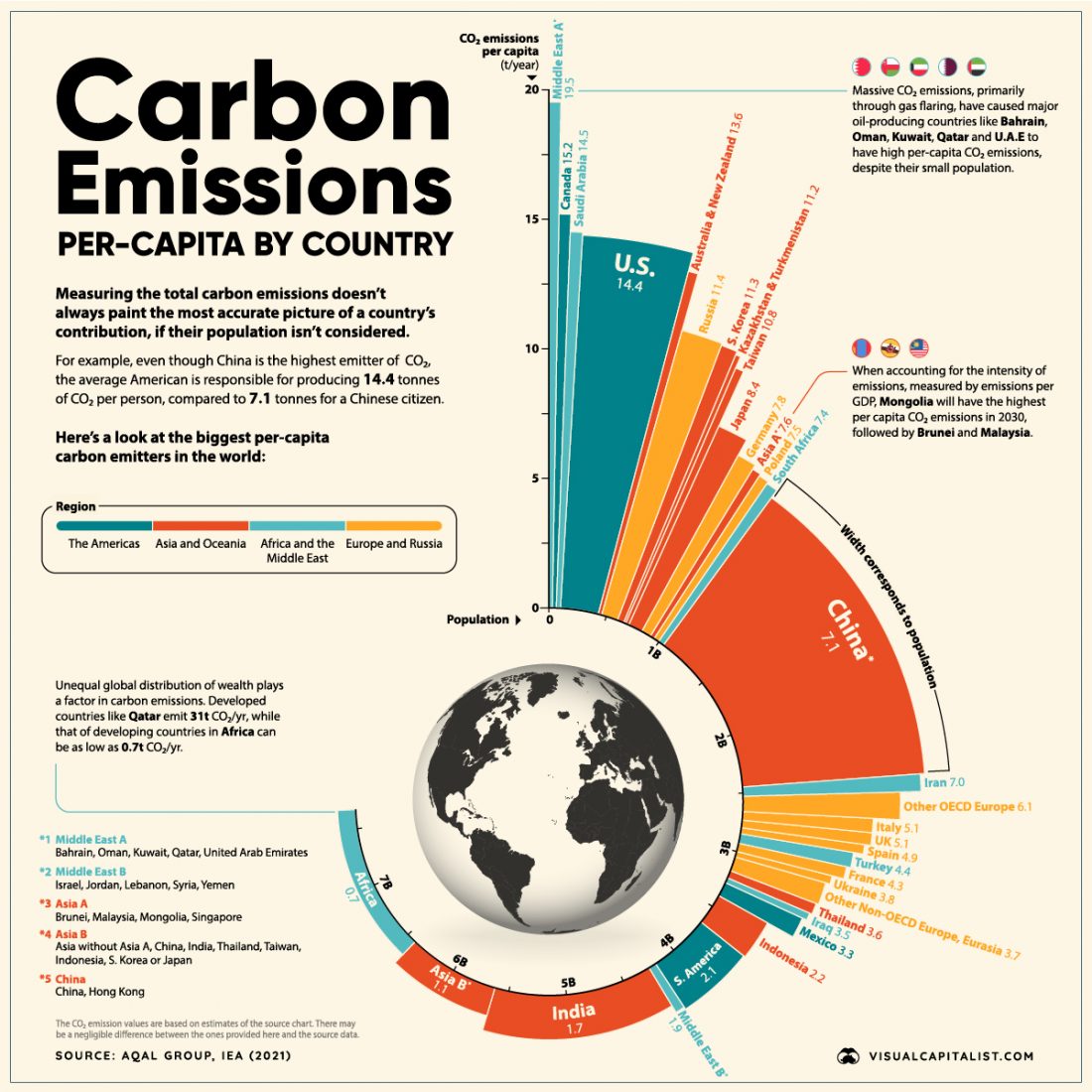
Figure 1 demonstrates recent data on the global distribution of the vaccination, while Figure 2 does the same with the global distribution of carbon emissions.

Figure 1 – COVID-19 Vaccinations

The omicron variant of COVID-19 was discovered in Botswana and South Africa. Figure 1 shows that the partially vaccinated rate in each of these countries is about 30%. The NYT wrote about the correlation between low vaccination rate and the evolution of new viruses that can easily spread globally:

Most wealthy countries have vaccinated significant shares of their populations and have rapidly moved into the booster-dose phase. But one year into the global vaccine rollout, the gap between vaccination rates in high- and low-income countries is wider than ever.

Poorly vaccinated countries face several challenges. Early in the rollout process, some countries were not able to secure enough doses to inoculate their residents, and many still face shortages. In others, supply is only part of the story. A New York Times analysis of available data highlights the countries where infrastructure issues and the public’s level of willingness to get vaccinated may pose larger obstacles than supply.

Some countries that have below-average vaccination rates are using most of the vaccine doses they have on hand, and some are not. Most countries with high vaccination rates have used most of the doses delivered to them; they are clustered to the right side of the chart above.

As new viruses, such as omicron, start evolving and spreading globally, the rich countries feel compelled to recommend booster shots, which only enhances the shortages in the poor countries:

As the emergence of the omicron variant of the coronavirus has spurred governments of wealthy nations to step up booster-shot campaigns, the World Health Organization again expressed concern Thursday that the push could further undermine global vaccine equity.

“Broad-based administration of booster doses risks exacerbating inequities in vaccine access,” Alejandro Cravioto, chair of the WHO’s Strategic Advisory Group of Experts on Immunization, told reporters.

The administration of boosters is now outpacing first shots around the world.

On issues such as the pandemic and as we will see, climate change, slogans such as MAGA (Make America Great Again) are unhelpful—we’re all in this together, meaning that in such matters we don’t actually have an Us or Them—almost any disaster tends to spread globally.

Climate change doesn’t spread through viruses, but the impact is global, and while the rich countries have the resources to help poor countries to adapt (to a point), they mostly don’t seem to be doing so. The problem is that when people cannot make a living, they will try to move to places where they have a higher probability of adaptation and acceptance. The result is a major global instability with security threats to everybody. I have covered this issue in past blogs as well (See January 28, 2020).

Figure 2 comes from my favorite infographics site, VisualCapitalist, and illustrates global carbon dioxide emissions per capita.

Figure 2Visualizing Global Per Capita CO2 Emissions

The Guardian reminds us below that rich countries have contributed more than 50% of the carbon emissions, even though them make up less than 10% of the population.

“The richest 10% produce about half of greenhouse gas emissions. They should pay to fix the climate”

There is a fundamental problem in contemporary discussion of climate policy: it rarely acknowledges inequality. Poorer households, which are low CO2 emitters, rightly anticipate that climate policies will limit their purchasing power. In return, policymakers fear a political backlash should they demand faster climate action. The problem with this vicious circle is that it has lost us a lot of time. The good news is that we can end it.

Let’s first look at the facts: 10% of the world’s population are responsible for about half of all greenhouse gas emissions, while the bottom half of the world contributes just 12% of all emissions. This is not simply a rich versus poor countries divide: there are huge emitters in poor countries, and low emitters in rich countries.

For the full record, see Our World in Data.

This fact had a strong impact on the recent COP26 meeting in the unanimous final resolution in the COP26 meeting (see the November 23rd blog). The relevant entries are below:

  1. Finance, technology transfer and capacity-building for mitigation and adaptation
  2. Urges developed country Parties to provide enhanced support, including through financial resources, technology transfer and capacity-building, to assist developing country Parties with respect to both mitigation and adaptation, in continuation of their existing obligations under the Convention, and encourages other Parties to provide or continue to provide such support voluntarily;
  3. Urges developed country Parties to fully deliver on the USD 100 billion goal urgently and through to 2025, and emphasizes the importance of transparency in the implementation of their pledges; 28. Urges the operating entities of the Financial Mechanism, multilateral development banks and other financial institutions to further scale up investments in climate action, and calls for a continued increase in the scale and effectiveness of climate finance from all sources globally, including grants and other highly concessional forms of finance;
  4. Loss and damage
  5. Resolves to strengthen partnerships between developing and developed countries, funds, technical agencies, civil society, and communities to enhance understanding of how approaches to averting, minimizing and addressing loss and damage can be improved.

One of my earlier posts that I mentioned in the beginning of this blog uses a Venn diagram with circles that represent climate change, COVID-19, population, and jobs, with a central circuit that overlaps with the previous four that represents equity. The meaning of equity is broad. It can mean purposeful redistribution of resources so that everyone experiences equal gain and/or equal suffering but it can also be less purposeful: the winners may become more vulnerable as they are eventually affected by losers’ losses (e.g. refugees from poor countries fleeing to rich ones). Both aspects are important. Thus, equity is a central managing tool for society to flourish and try to make everybody better. Everyone should be involved. As I mentioned before, this is the end of the semester in my school. In the next few weeks, I am supposed to have more time. Knowing that, my French family recommended that I read Thomas Piketty’s new book, Time for Socialism. I bought it and when I scanned it, it became obvious to me that Piketty doesn’t use “socialism” the way either my extreme left French cousin or Senator Sanders and his followers do. It seems much more in the same vein as European Social Democrats or American Democratic party. I’ll let you know how it is.

Posted in Climate Change | Tagged , , , , , , , , , , , , , , , , , , , , , , , , | 1 Comment

The Math of the American Commitment

A short entry appeared in the Scientific American journal in the middle of the COP26 meeting: “Doing the Math on Biden’s Climate Pledge.” The author was trying to explain how the Biden administration—only three months after assuming control from an administration that basically refused to recognize climate change as a threat—had already made a hefty new emissions commitment, promising to reduce US CO2 emissions by 50%, compared to 2005 levels. To a large degree, the commitment was based on computer simulations by the Rhodium Group:

The Rhodium Group released a report last month that attempted to show how the U.S. could reach Biden’s 2030 target (Climatewire, Oct. 19). It assumed Congress passed a climate spending bill that lacked both the CEPP—which is out of the bill—and a fee on methane emissions from energy production—which, for the moment, is still in the bill.

“We haven’t modeled the announced package on its own, but from what we know so far, yes, it’s roughly in line with what we modeled for congressional action in our ’Pathways to Paris’ report,” said Maggie Young, a spokeswoman for Rhodium. “So, if this were to pass, along with the subsequent executive branch and subnational actions that we modeled in the report, this combination of actions would likely put the 2030 target within reach.”

But to get there, Rhodium assumed EPA and other agencies would create a host of rules for sectors that have yet to be regulated for greenhouse gases, from chemical factories to liquefied natural gas terminals to petroleum refineries.

It also envisioned muscular rules for sectors that have been regulated for carbon—like power plants—that would leave Obama-era regulations in the dust and test the boundaries of legal defensibility.

For example, the Obama-era rule for new power plants—which is still on the books—mandates that coal-fired power plants capture 40 percent of their emissions via carbon capture and storage. That requirement would be replaced with a 90 percent CCS mandate for new coal- and gas-fired power plants in a rule that would take effect next year, under the Rhodium analysis.

For existing power plants, Rhodium sees an 80 percent CCS mandate phased in for coal- and gas-fired units by 2030.

The Rhodium Group analysis was obviously not the only source of data analyzed for the commitment. Within days of the commitment’s announcement, the NYT and WSJ (among others) provided additional sources.

One important thing to consider is that the commitment ties into this administration’s goal to reclaim America’s leadership in confronting climate change among developed countries.

However, less than two weeks before the start of the COP26 meeting, the Rhodium Group issued a detailed, 35-page report on how the US can fulfill this ambitious commitment. Since the previous two blogs focused on where the commitment stands now, I thought that it would be worthwhile to use pieces of the report to summarize some of the Rhodium Group’s insights.

According to the report:

Rhodium Group is an independent research provider combining economic data and policy insight to analyze global trends. Rhodium’s Energy & Climate team analyzes the market impact of energy and climate policy and the economic risks of global climate change. This interdisciplinary group of policy experts, economic analysts, energy modelers, data engineers, and climate scientists supports decision-makers in the public, financial services, corporate, philanthropic, and nonprofit sectors. More information is available at www.rhg.com.

The Executive Summary seems rather long in comparison to the rest but it is important enough that I am duplicating most of it below with the hope that it will convince some of you to read the full report:

Figure 1, from the Executive Summary of the Rhodium Group report

Without new action, the US will not meet its 2030 target

Under current policy as of May 2021, with no new action, the US is on track to reduce GHG emissions 17- 25% below 2005 levels in 2030. The range reflects uncertainty around energy markets, clean technology costs and the ability of natural systems to remove carbon from the atmosphere. This leaves a gap of 1.7-2.3 billion metric tons of emission reductions required to achieve the US target in 2030 (Figure ES1). The gap is roughly equal to all 2020 emissions from the transportation sector on the low end and all emissions from electric power and agriculture combined on the high end. While the challenge of closing the gap is daunting, achieving the target is in line with what’s required to avoid the worst impacts of climate change. Not following through on this commitment risks undermining the credibility of the US and reduces the chances of an ambitious multilateral response to climate change.

Joint action by Congress, the executive branch, and subnational leaders can put the 2030 target within reach, but all must act

Our analysis demonstrates that meeting the US’s 2030 target is achievable, if Congress, the executive branch, and subnational leaders all take a series of practical and feasible policy actions—what we refer to as our “joint action” scenario (Figure ES2). This scenario represents passage this year of the infrastructure bill and budget reconciliation package in Congress, coupled with a steady stream of standards and regulations by federal agencies and accelerated action by leading states and companies. Combined, these actions can cut US net GHG emissions to 45-51% below 2005 levels in 2030.

At each level of government, we identify practical policy actions under clearly established authorities (where applicable) that, if pursued on reasonable timelines, can help achieve the target. No one level of government alone can deliver on the target. None of the policies we identify are novel or new, and all federal regulatory action can be implemented with existing legal authority. To close the emissions gap, agencies and states will need to pursue new actions at a pace, scope, and level of ambition that has not been seen to date, but which are also practical and within reach.

Action across all sectors of the economy is required to achieve the 2030 target

We find that the biggest opportunities for emission reductions in this decade reside in the electric power sector—covering 39-41% of total reductions achieved in the joint action scenario. If actions to cut electric power sector emissions are not successful, then achieving the 2030 target may not be possible. Even so, achieving the target will require successful emission reduction actions across all sectors of the US economy, not just the power sector, as well as increased natural and technological removal of carbon from the atmosphere.

Achieving the 2030 target can also cut harmful air pollutants and consumer bills

Getting US emissions on track to reach the 2030 target can be done with little cost to consumers. Long-term tax credits, investments in energy efficiency and other factors cushion consumers from price increases associated with new standards and regulations. On a national average basis, households save roughly $500 a year in energy costs in 2030 in our joint action scenario. Many policy actions that cut emissions also reduce harmful air pollutants. For example, SO2 emissions in the electric power sector decline to near zero by 2030.

If Congress fails to act, the 2030 target may be in jeopardy

Congressional action is critical to achieving the 2030 target for two reasons. First, measures in the infrastructure and budget packages can enable and accelerate clean technology deployment and on their own cut emissions significantly. Second, those same programs reduce consumer and compliance costs of federal and state actions that, combined with congressional actions, put the target within reach. Without the cost reduction assistance of congressional actions, federal and state leaders will face higher technical and political hurdles as they pursue the ambitious policies required to get to the 50-52% target. Congressional investments in emerging clean technologies will also drive innovation to enable the next wave of decarbonization after the 2030 target is reached.

Achieving the target will be a historic feat but is only halfway to the net-zero finish line

If all actors successfully pursue all aspects of the joint action scenario and achieve the 2030 target, it will represent one of the most monumental national achievements in recent decades. Even then, achieving the ambitious goal puts the nation just halfway to the longer-term goal of net-zero emissions by mid-century, which is the level required for the US to play its role in a robust global response to the threat of climate change. Getting to net-zero will require new policies and the commercial scale-up of a suite of emerging technologies like clean hydrogen, direct air capture, and advanced zero-emission electric generation, as well as continued electrification of transportation and buildings. Without near-term progress on these fronts in the years ahead, closing the gap to net-zero emissions by 2050 will be even more challenging than getting to the 2030 target.

As I mentioned in last week’s blog, we are in the middle of the story. The $1.2 trillion (new and old money) Infrastructure Investment and Jobs Act was approved by Congress and signed by the president. Meanwhile, the $1.85 trillion Social Policy and Climate Change Package is still under discussion. Stay tuned.

Posted in Climate Change, Energy, law, politics, Sustainability, US | Tagged , , , , , , , , , , , , , , , , , , , , , , , , , , , , , | Leave a comment

The American Commitment

COP26 ended with a unanimous decision on how to accelerate the global effort to mitigate climate change. This included plans to assist developing countries in their adaptation efforts and to monitor progress in these areas on an annual basis.

It’s now time to start to monitor the progress. In one of my classes, each student selected a country and has been charged to do just that. I focused on the US and how local efforts translate to global ones. This blog starts my coverage of mitigation efforts, while next week’s blog will be focused on the US and the current administration’s April 20th re-commitment to the original Paris agreement:

NATIONALLY DETERMINED CONTRIBUTION

The nationally determined contribution of the United States of America is: To achieve an economy-wide target of reducing its net greenhouse gas emissions by 50-52 percent below 2005 levels in 2030.

It took several months for the practical steps that the US was taking to fulfill this commitment to come to light. These efforts were incorporated into two resolutions drafted in collaboration with Congress and represent a summary of the present administration’s efforts to redefine the role of government in the American economy.

One resolution, the Infrastructure Investment and Jobs Act was signed into law on Monday, November 15, 2021. Figure 1, from corporate services company EY, outlines the spending in that resolution. While it includes a full list of categories and their allotted budgets, it does not explicitly label climate change anywhere. However, the legislation itself features a relatively minor category addressing energy & climate, which identifies mitigation-related “key words” such as clean energy and grid—two essential concepts relating to changing our energy sources. A more in-depth examination reveals that if the executive branch of the government strongly believes in the necessity of taking a leadership position in fulfilling our COP26 commitment, most of the other categories can serve as legitimate vehicles to achieve it.

Figure 1 Budgets for each category in the Infrastructure and Investment Jobs Act

EY—the company that created Figure 1 using data from the White House record—wrote a description of the resolution:

Infrastructure in the Unites States is deteriorating. The Infrastructure Investment and Jobs Act (IIJA or the Infrastructure Bill) would provide for $1.2 trillion in spending, $550 billion of which would be new federal spending to be allocated over the next five years. The historic investments included in the IIJA, from clean energy to broadband, would significantly reframe the future of infrastructure in the US.

In other words, the $550B marks the new money that has not yet been allocated through the normal budget allocation process.

Meanwhile, looking at other categories, one does not need a vivid imagination to connect improvements in public transportation with a decrease in use of private cars. As long as the majority of private cars continue to run on fossil fuels, any decrease in their use will reduce carbon emissions. This is also true for electric vehicles, unless the electricity used to charge their batteries is sourced from something other than fossil fuels.

I have explored the connections between water infrastructure and climate change multiple times (for the latest entry, see the October 26, 2021 post that deals with the Water-Energy nexus). Additionally, albeit indirectly, the category of infrastructure resilience deals with climate change: specifically, the enhanced intensity and probability of major, climate-related disasters.

As this discussion has hopefully made clear, direct calculation of how much of the infrastructure budget is allocated to addressing climate change will depend strongly on the administration that oversees that spending. By any account, even this resolution will not be enough to fulfill Mr. Biden’s pledge to halve US emissions from 2005 levels by 2030.

The largest part of President Biden’s effort to fight climate change is included in his $1.85 trillion social policy and climate change package. Below are some highlights of this package:

Climate has emerged as the single largest category in President Biden’s new framework for a huge spending bill, placing global warming at the center of his party’s domestic agenda in a way that was hard to imagine just a few years ago.

As the bill was pared down from $3.5 trillion to $1.85 trillion, paid family leave, free community college, lower prescription drugs for seniors and other Democratic priorities were dropped — casualties of negotiations between progressives and moderates in the party. But $555 billion in climate programs remained.

It was unclear on Thursday if all Democrats will support the package, which will be necessary if it is to pass without Republican support in a closely divided Congress. Progressive Democrats in the House and two pivotal moderates in the Senate, Joe Manchin III of West Virginia and Kyrsten Sinema of Arizona, did not explicitly endorse the president’s framework. But Mr. Biden expressed confidence that a deal was in sight.

The centerpiece of the climate spending is $300 billion in tax incentives for producers and purchasers of wind, solar and nuclear power, inducements intended to speed up a transition away from oil, gas and coal. Buyers of electric vehicles would also benefit, receiving up to $12,500 in tax credits — depending on what portion of the vehicle parts were made in America.

The rest would be distributed among a mix of programs, including money to construct charging stations for electric vehicles and update the electric grid to make it more conducive to transmitting wind and solar power, and money to promote climate-friendly farming and forestry programs.

This package recently passed the House but its fortune in the US Senate is still unknown. The big question remains, who is going to pay for it. Below is the latest background on this issue:

WASHINGTON — President Biden’s pledge to fully pay for his $1.85 trillion social policy and climate spending package depends in large part on having a beefed-up Internal Revenue Service crack down on tax evaders, which the White House says will raise hundreds of billions of dollars in revenue.

But the director of the nonpartisan Congressional Budget Office said on Monday that the I.R.S. proposal would yield far less than what the White House was counting on to help pay for its bill — about $120 billion over a decade versus the $400 billion that the administration is counting on.

It is obvious that the Congressional Budget Office, which evaluated the bill, didn’t factor in the physical or fiscal damages that will result from a failure to mitigate and adapt to uncontrolled climate change (see blogs dated November 21, 2017, September 15, 2020, January 21, 2020).

Stay tuned. Next week, I will explore the calculations that the US administration made public that led to the April 20, 2021 commitments.

Posted in Climate Change, Electric Cars, Energy, Extreme Weather, Sustainability, UN, US | Tagged , , , , , , , , , , , , , , , , , , , , , , , , , , , , , , , , , | Leave a comment

Conclusions From COP26

This semester, I am teaching two courses directly related to climate change. I start both with an exploration of the basic science involved. It’s a multidisciplinary topic that requires using first principles to address the overlap of the physical, natural, and social sciences. For the second half of the semester, I turn to helping my students understand—from both observer and participant perspectives— how global current events relate to climate change. This semester provided us with a rich selection of such events, culminating in COP26 in Glasgow, Scotland.

The observation part of both courses was to compile an individual e-journal of the global developments, ending with a summary of the global climate picture, as they saw it developing. In terms of participation, for the first course, each student had to select a country whose developments in the global climate challenge they would track and summarize. They were asked to give short class presentations following any important developments. Students chose countries based on personal connections, including birth, affiliation of relatives, and special affinity. I personally covered both the United States and the global trends.

The participation part of the second course was targeted at our “campus as a lab” effort to decarbonize campus (type Brooklyn College into the search box to follow my efforts on this line) through students’ bottom-up efforts. This is part of a multi-year project, which includes several similar courses. We have summarized the results of this effort on a webpage that is being sent to decision-makers; we hope that some of the proposals will be implemented.

COP26 was concluded on Saturday, November 13th. As is the usual practice of such meetings, it ended with a successful unanimous decision by the 197 official participation countries.

To their credit, Wikipedia contributors were able to post an objective summary of the most important accomplishments of the meeting only a few days after the conclusion of the meeting:

The number of countries pledged to reach net-zero emissions passed 140. This target includes 90% of current global greenhouse gas emissions.[6]

More than 100 countries, including Brazil, pledged to reverse deforestation by 2030.

More than 40 countries pledged to move away from coal.

India promised to draw half of its energy requirement from renewable sources by 2030.[7]

The governments of 24 developed countries and a group of major car manufacturers including GM, Ford, Volvo, BYD Auto, Jaguar Land Rover and Mercedes-Benz committed to “work towards all sales of new cars and vans being zero emission globally by 2040, and by no later than 2035 in leading markets”.[8][9] Major car manufacturing nations like the US, Germany, China, Japan and South Korea, as well as Volkswagen, Toyota, Peugeot, Honda, Nissan and Hyundai, did not pledge.[10]

Most of the sources I saw (including press, TV, and social media) criticized the results, saying either that the decision didn’t go far enough or that it went too far.

To keep some balance, I’m including what I find to be the most significant entries in each category of the latest draft of the final resolution that was available to me. The final resolution (COP26 cover decision) is not long (around 7 pages) and I strongly recommended that you read it in its entirety so you can form your own opinion:

Glasgow Climate Pact

Acknowledging the devastating impacts of the coronavirus disease 2019 pandemic and the importance of ensuring a sustainable, resilient and inclusive global recovery, showing solidarity particularly with developing country Parties,

  1. Science and urgency
  2. Expresses alarm and utmost concern that human activities have caused around 1.1 °C of global warming to date and that impacts are already being felt in every region;
  3. Adaptation
  4. Emphasizes the urgency of scaling up action and support, including finance, capacitybuilding and technology transfer, to enhance adaptive capacity, strengthen resilience and reduce vulnerability to climate change in line with the best available science, taking into account the priorities and needs of developing country Parties;

III. Adaptation finance

  1. Urges developed country Parties to urgently and significantly scale up their provision of climate finance, technology transfer and capacity-building for adaptation so as to respond to the needs of developing country Parties as part of a global effort, including for the formulation and implementation of national adaptation plans;
  2. Mitigation
  3. Calls upon Parties to accelerate the development, deployment and dissemination of technologies, and the adoption of policies, to transition towards low-emission energy systems, including by rapidly scaling up the deployment of clean power generation and energy efficiency measures, including accelerating efforts towards the phasedown of unabated coal power and phase-out of inefficient fossil fuel subsidies, while providing targeted support to the poorest and most vulnerable in line with national circumstances and recognizing the need for support towards a just transition;
  4. Finance, technology transfer and capacity-building for mitigation and adaptation
  5. Urges developed country Parties to provide enhanced support, including through financial resources, technology transfer and capacity-building, to assist developing country Parties with respect to both mitigation and adaptation, in continuation of their existing obligations under the Convention, and encourages other Parties to provide or continue to provide such support voluntarily;
  6. Urges developed country Parties to fully deliver on the USD 100 billion goal urgently and through to 2025, and emphasizes the importance of transparency in the implementation of their pledges; 28. Urges the operating entities of the Financial Mechanism, multilateral development banks and other financial institutions to further scale up investments in climate action, and calls for a continued increase in the scale and effectiveness of climate finance from all sources globally, including grants and other highly concessional forms of finance;
  7. Loss and damage
  8. Resolves to strengthen partnerships between developing and developed countries, funds, technical agencies, civil society and communities to enhance understanding of how approaches to averting, minimizing and addressing loss and damage can be improved;

VII. Implementation

  1. Strongly urges all Parties that have not yet done so to meet any outstanding pledges under the Convention as soon as possible;

VIII. Collaboration

53. Recognizes the importance of international collaboration on innovative climate action, including technological advancement, across all actors of society, sectors and regions, in contributing to progress towards the objective of the Convention and the goals of the Paris Agreement

As you can tell from the Wikipedia summary, the final resolution is not the only outcome of the conference. Figure 1 shows a snapshot of the 31 separate outcomes that passed without unanimous decisions.

Figure 1 – Screenshot of the main page of COP26 outcomes

I chose to highlight two of these outcomes. One—the ARA—the first in Figure 1, includes not only several member states but also signatories from of cities, companies, and other large entities. This coalition strengthens the belief that strong bottom-up commitments to fight climate change are the best way forward. The second one, not visible in Figure 1, calls for instituting an annual global checkpoint process by 2022:

These statements and declarations are the high-level outcomes from the World Leaders Summit and presidency theme days of the two-week programme of COP26.

We the undersigned, representing over 100 organisations across 35 economies, have gathered here at the 2021 United Nations Climate Change conference (COP26), in Glasgow, United Kingdom, to launch the Adaptation Research Alliance (ARA).

A bold new coalition of global adaptation actors, the ARA will catalyse and scale investment in action-oriented research and innovation for adaptation that strengthens resilience in communities most vulnerable to climate change.

Breakthrough agenda – launching an annual global checkpoint process in 2022

The breakthrough agenda launched at the world leaders summit commits countries to work together to make clean technologies and sustainable solutions the most affordable, accessible and attractive option in each emitting sector globally before 2030.

Wikipedia rightly lists this annual checkpoint process as the biggest accomplishment of the meeting. I fully agree. Hopefully, it will guarantee that the large groups interested in global climate change mitigation will shift from future commitments to ongoing accomplishments in the wake of the COP26 meeting.

I will end this blog by stating my belief that the outcome of COP26 probably would have felt much more discouraging if not for the unexpected announcement of an agreement between the US and China to work together to slow the impact of global warming and to ensure a successful conclusion of COP26.

Posted in Climate Change, Economics, Energy, Sustainability, UN | Tagged , , , , , , , , , , , , , , , , , , , , , , , , , , , , , , , , , , , , , , | 1 Comment

Managing the Energy Transition: Specifics

Rex Tillerson, the former CEO of ExxonMobil, may have asked, “what good is it to save the planet if humanity suffers?” (September 21, 2021) but this week, in the context of COP26, the current CEO of Exxon expressed a different opinion:

Darren W. Woods, the chief executive of Exxon Mobil, made the case for his company to play a role in helping the global economy transition to clean energy at the DealBook Online Summit on Wednesday.

“There are a lot of sectors of the economy which are critical to supporting modern life that aren’t easy to decarbonize, where we don’t have a good solution,” Mr. Woods said in an interview with DealBook’s Andrew Ross Sorkin. “Frankly, that’s where I think a company like Exxon Mobil can bring value,” he said, by finding ways to “bridge that gap between what’s needed today and what we want for tomorrow.”

Not surprisingly, oil companies had a large representation at COP26; the final conclusions of the meeting might reflect it.

By the time that this blog is posted, the COP26 meeting will be over (officially, the meeting closed on Friday; however, attempts to reach a unanimous decision often overflow into the day after the official closing). Given that I write my blogs ahead of time, I will wait until next week to give my take on the meeting’s closing.

This blog is a continuation of last week’s post, with an emphasis on some specifics in the efforts to transition the global energy supply away from carbon sources. I will start with an industry-friendly description about managing the balance between the need to decarbonize our energy source and our ability to generate a sufficient amount of energy from alternative sources:

The world wants to “transition” away from fossil fuels toward green energy, but the difficult reality is this: Dirty fuels are not going away — or even declining — anytime soon.

The total amount of renewable energy that’s available is growing. That’s good news for a world threatened by potentially devastating climate change.

But the increase in renewable energy is still lower than the increase in global energy demand overall. A “transition” from fossil fuels may come someday, but for now, renewable energy isn’t even keeping pace with rising energy demand — so fossil fuel demand is still growing.

“The global power market is experiencing rapid power demand growth as markets recover from the pandemic. Despite all the capacity additions in renewables generation, the amount of power currently generated by renewables is still not enough to meet this increased demand,” Matthew Boyle, manager of global coal and Asia power analytics at S&P Global Platts, told CNBC.

The global supply of renewables will grow by 35 gigawatts from 2021 to 2022, but global power demand growth will go up by 100 gigawatts over the same period, according to Boyle. Countries will have to tap traditional fuel sources to meet the rest of the demand. A gigawatt is 1 billion watts.

Now that we are (hopefully) at the tail-end of the COVID-19 pandemic, the global economy is starting to rebuild. Of course, this means an accelerated demand for energy that must be synchronized with available supply (see last week’s post on how natural gas ties in here).

Coal was a major topic at the COP26—specifically, how to secure commitments to stop using it as an energy source. That’s easier said than done, though:

Coal was supposed to be headed to the dust bin of history as the world increasingly embraces renewable energy.

After all, many countries were shutting down these sooty, air-choking power plants. Mines closed, coal companies went bankrupt, and utilities started to replace coal-fired electricity generation with natural gas or wind and solar energy.

But it turns out that weaning the world off fossil fuels, particularly the dirtiest fuel of them all, isn’t going to be easy or quick, as coal’s price and demand have been revived this year. Transitions take time.

“From our point of view, the energy transition was always a multi-decade story,” said Biff Ourso, senior managing director, Nuveen Real Assets. “And there’s invariably going to be periods of spikes in demand, or supply/demand imbalances that was going to cause a resurgence in carbon-based generation sources.”

Coal is likely to stick around as countries rely on it to ensure the lights stay on and the economy hums along. Coal’s resurgence also shines a light on the need for improved battery storage for renewables if the world is going to decarbonize.

One of the apparent low-lying fruits, which some hope will emerge out of this meeting, is for all participating governments to agree to stop subsidizing fossil fuels:

The head of the United Nations Development Programme told CNBC that $423 billion of taxpayers’ money is being spent on subsidizing fossil fuel use each year, and is preventing a transition toward cleaner energy.

Speaking around the launch of its new campaign, “Don’t Choose Extinction,” UNDP Administrator Achim Steiner said he was “very worried” that we are in a “historical moment in time” with all the means to tackle climate change, but not taking the decisions necessary to make it happen.

The new UNDP campaign against fossil fuel subsidies sees a dinosaur, voiced by global stars in various languages including Jack Black, Eiza Gonzalez, Nikolaj Coster-Waldau and Aïssa Maïga, addressing the United Nations in New York, urging the world not to make choices that could lead them to follow dinosaurs into extinction.

The global approach could be helpful if all of the countries signed on, however, this is so far not the case. Among the rich countries, Australia, at least under its present government, wants to find its own way forward. It is one of the largest exporters of coal and it would like to continue to enjoy the advantages that this lucrative business brings:

“Australia’s energy and natural resources sectors have evolved and reduced emissions much faster than we expected a decade ago,” Mr Taylor said when asked what the energy landscape would look like in 2030.

He said he believed hydrogen – made from either renewable energy or from natural gas combined with a process to trap and bury the carbon dioxide released – would be more competitive by then and help cut emissions in parts of the economy that could not be easily electrified.

“The extraordinary uptake of renewables, particularly household solar, towards the end of the 2010s, has been matched by huge growth in the 2020s of a range of new low-emissions energy technologies,” Mr Taylor said.

While many experts agree government policy is needed to help phase out planet-heating fossil fuels, the Morrison government has adopted an approach of “technology not taxes” to drive commercial uptake of lower-carbon energy. It has resisted setting industry emission targets, a carbon price or moves to reduce fossil fuels’ role in the grid in coming years.

The difficulties of the transition are not confined to finding enough supply of decarbonized energy sources. The global objective of the transition is to emit less carbon dioxide overall but some industries need carbon dioxide for their industrial production—it is an essential part of their supply chain. Below is an example from England:

Britain’s pig farmers are the latest casualty of the worsening energy crisis which threatens to trigger a shortage of carbon dioxide used across the food and drinks industry. Nick Allen, chief executive of the British Meat Processors Association, said: “We urgently need the secretary of state for business to convene the big CO2 manufacturers to demand that they coordinate to minimise disruption, and provide information to Britain’s businesses so contingency plans can be made.”

Rocketing gas prices have caused a Europe-wide slowdown for some chemical factories that produce fertiliser, a byproduct of which is carbon dioxide, used in fizzy drinks and beer as well as in the meat industry to stun animals before slaughter.

Meat industry representatives have warned that farmers may imminently be required to begin “humane” pig culls because of a looming shortage of carbon dioxide to slaughter the backlog of animals destined for abattoirs that are already understaffed amid labour shortages.

Probably the most difficult and important issue that the COP26 meeting tackled was how to mitigate the impacts of the immense, destructive powers of climate change while also seeing to the financial and energy needs of developing countries. In next week’s blog, I will try to share my views on the strengths, weaknesses, and overall outcome of COP26.

Posted in Anthropogenic, Climate Change, Electricity, Energy, Sustainability | Tagged , , , , , , , , , , , , , , , , , , , , , , , , , , , , , , , , , , , | Leave a comment

Managing the Energy Transition on a Global Scale

Figure 1

Figure 2

I have been (starting on September 21st) focusing on energy companies’ transitions away from fossil fuels; many are finally realizing that such global shifts are necessary if we cannot implement an acceptable way to capture the immense amounts of carbon we emit. While the energy companies are the sector with the most potential for change, the related climate catastrophes affect us all.

In September of this year, Rex Tillerson, the former CEO of ExxonMobil, questioned, “what good is it to save the planet if humanity suffers?” (September 21, 2021). In a certain sense, he is right—that is, if humanity suffers in the transition to save the planet, chances are that people will not be willing to go along with the necessary changes. A “return to the cave”—or less technological—scenario is not an option. Of course, in order to avoid inflicting mass misery, such a global transition will necessarily be both complex and time-consuming. It must replace fossil fuels with sustainable energy—or at least, energy alternatives that don’t end up changing the chemistry of the atmosphere in a detrimental way. (This will likely include nuclear energy and carbon capture). At the same time, the transition must ensure a constant supply of sufficient energy to drive the global economy while also supporting a growing human population. Since a polluted atmosphere is global, the energy transition must be global as well to include both mitigation and adaptation to the new climate. Arguments such as “Make America Great Again” (MAGA), which focus on a specific country or region, must be replaced by new slogans such as “Keep Our Planet Livable.” Otherwise, rising social unrest will stop the transition cold, putting our collective existence in question.

Figures 1 and 2 show the two faces of such transitions. Figure 1, taken from a CleanTechnica piece about the Global Association for Transition Engineering (GATE) shows schematics for how an engineer sees such a transition, while Figure 2, taken from the NYT article I cited above, shows how we present the transition in layman’s terms: as a one-parameter event that extrapolates the future climate based on how much carbon we emit.

Almost immediately after the opening of COP26, President Biden was caught in what seemed to be a duplicitous statement:

President Biden told a global climate summit on Monday that “we only have a brief window before us” to reduce the emissions from burning oil, gas and coal that pose an “existential threat” to humanity. But only days earlier, he was urging the world’s largest oil producers to pump more of the fossil fuels that are warming the planet.

The incongruity was on center stage both at the global climate summit currently taking place in Scotland, and in Rome this past weekend during a gathering of leaders from the 20 largest economies. The president’s comments highlighted the political and economic realities facing politicians as they grapple with climate change. And they underscored the complexity of moving away from the fossil fuels that have underpinned global economic activity since the Industrial Age.

“On the surface, it seems like an irony,” Mr. Biden said at a news conference Sunday. “But the truth of the matter is — you’ve all known; everyone knows — that the idea we’re going to be able to move to renewable energy overnight,” he said, was “just not rational.”

This does not mean that President Biden is a duplicitous man; he understands the nature of the energy transition that we are trying to enact. However, he also realizes that we are also trying to recover from the economic damage that COVID-19 has inflicted on the world—and the current global energy shortage has major impacts on that recovery:

Much of the world is suddenly worried about running short of natural gas, and the impact is being felt in surging utility bills, shuttered factories and a rising desperation as winter approaches.

Across Asia, Europe and Latin America, consumers still reeling from the pandemic are finding energy costs soaring, driven higher by natural gas prices that have increased fourfold in some regions in recent months, hitting record highs this week. Makers of chemicals, steel, ceramics and other goods that require large amounts of energy are seeing their bottom lines squeezed and, in some cases, suspending operations.

In South Korea, electric rates just increased for the first time since 2013, and small businesses that struggled under months of strict pandemic rules are now fearing future price jumps. “It’s already hard for small businesses to survive,” said the Korea Federation of Micro Enterprise.

In Brazil, the worst drought in 90 years has depleted hydroelectric output, forcing power generators to import expensive natural gas. The government raised electricity prices by nearly 7 percent in September, after a nearly 8 percent increase in July.

Europeans are also feeling the pinch. In Spain, the government recently said it would take profits away from energy companies to help rate payers. In Italy, residents were recently hit with a 14 percent increase in their gas bills, accompanied by a nearly 30 percent jump in electricity rates.

“We’ll have to do the dishes or laundry at nighttime to save money,” said Carla Forni, a teacher and mother of two in Bologna.

In China, already the world largest importer of natural gas, demand is up 13 percent as Xi Jinping, the country’s leader, presses forward with plans to clean up the environment by turning away from coal.

As a major gas exporter, the United States has been benefiting from the strong global demand. Of late, prices that have risen to their highest levels in years have prompted calls to rein in the shipments abroad. American prices, though, are just a fraction of those seen recently in Europe and Asia.

All these shortages coincide with the opening of the COP26 meeting, one of whose main agendas is to establish a timeline to stop the use of coal:

Coal was supposed to be headed to the dust bin of history as the world increasingly embraces renewable energy.

After all, many countries were shutting down these sooty, air-choking power plants. Mines closed, coal companies went bankrupt, and utilities started to replace coal-fired electricity generation with natural gas or wind and solar energy.

But it turns out that weaning the world off fossil fuels, particularly the dirtiest fuel of them all, isn’t going to be easy or quick, as coal’s price and demand have been revived this year. Transitions take time.

“From our point of view, the energy transition was always a multi-decade story,” said Biff Ourso, senior managing director, Nuveen Real Assets. “And there’s invariably going to be periods of spikes in demand, or supply/demand imbalances that was going to cause a resurgence in carbon-based generation sources.”

Coal is likely to stick around as countries rely on it to ensure the lights stay on and the economy hums along. Coal’s resurgence also shines a light on the need for improved battery storage for renewables if the world is going to decarbonize.

In spite of these energy shortages, 40 countries—among them several major coal users—signed an agreement that laid out a timeline for ending their use of coal:

In a surprise announcement from the COP26 climate summit in Scotland, an international agreement has been reached to accelerate the end of coal, the fossil fuel that is the single biggest source of the emissions that cause climate change.

According to a release from the U.K. Government’s Department for Business, Energy and Industrial Strategy (BEIS), 18 additional countries will commit to ending their use of coal in the 2030s and the 2040s. These include the highly coal-dependent nations of Poland, Vietnam, Egypt, Chile and Morocco.

Importantly, the agreement does not include the coal-heavy powers China or Russia, the first and fifth most polluting nations respectively, whose leaders are not attending the summit in Glasgow. However, in the run up to the COP, China reaffirmed its commitment to achieve net-zero carbon emissions by 2060 and to reach peak emissions by 2030.

China,  as well as Japan and Korea, announced within the last year that they would no longer fund new coal-power projects overseas.

The announcement also does not cover India, though on Monday the nation’s Prime Minister Narendra Modi announced a series of new carbon-cutting goals, with pledges to reach net-zero carbon emissions by 2070, and to slash emissions by 1 billion tons by 2030.

Of course, as the article mentions, not all of the major coal producers or users are among the signatories. Next week, we’ll be nearing the end of COP26 meeting, and should have a clearer picture of the various commitments.

Posted in Climate Change, Energy, Sustainability, US | Tagged , , , , , , , , , , , , , , , , , , , , , , , , , , , , , , , , , , , , , , , | 1 Comment

Universal Hydrogen Economy: Part 2


This week, we’re back to our discussion about the hydrogen economy. The Economist published a great summary of the related challenges we’re facing right now:

Today’s hydrogen business is, in global terms, reasonably small, very dirty and completely vital. Some 90m tonnes of the stuff are produced each year, providing revenues of over $150bn—approaching those of ExxonMobil, an oil and gas company. This is done almost entirely by burning fossil fuels with air and steam—a process which uses up 6% of the world’s natural gas and 2% of its coal and emits more than 800m tonnes of carbon dioxide, putting the industry’s emissions on the same level as those of Germany.

Tomorrow’s hydrogen business, according to green-policy planners around the world, will be vital in a different way: as a means of decarbonising the parts of the economy that other industrial transformations cannot reach, and thus allowing countries to achieve their stated goal of stabilising the climate. But for that vital goal to be met everything else about the industry has to change. It can no longer stay small. Morgan Stanley, an investment bank, reckons that, if governments take their green commitments seriously, today’s market could increase more than five-fold to over 500m tonnes by 2050 as these new applications grow (see chart 1). And it has to become clean, cutting its carbon-dioxide emissions to zero.

As the European Union’s hydrogen strategy puts it, “From 2030 onwards and towards 2050, renewable hydrogen technologies should reach maturity and be deployed at large scale to reach all hard-to-decarbonise sectors.” Forcing the industry to the level of maturity which will allow that deployment is set to soak up $100bn-150bn in public money around the world in the decade to 2030. Some $11bn of that will be spent this year, according to Bloombergnef, a data company.

Reuters adds some details about the funds necessary to reach that goal:

Governments need to step up investment in hydrogen production and storage chains to help cut net emissions to zero, the International Energy Agency (IEA) said on Monday.

States and private investors had so far only come up with about a quarter of the $1,200 billion needed by 2030 to develop and deploy hydrogen and make it part of global net zero strategies, the Paris-based organization said.

Efforts should be directed on getting hydrogen into more sectors and developing technologies to make it cheaper to produce with renewables, its report added.

Meanwhile, the CEO of Siemens Energy has a rather more pessimistic (some will say more realistic) view:

The CEO of Siemens Energy has spoken of the challenges facing the green hydrogen sector, telling CNBC that there was “no commercial case” for it at this moment in time.

In comments made during a discussion at CNBC’s Sustainable Future Forum on Tuesday, Christian Bruch outlined several areas that would need attention in order for green hydrogen to gain momentum.

“We need to define boundary conditions which make this technology and these cases commercially viable,” Bruch, who was speaking to CNBC’s Steve Sedgwick, said.

“And we need an environment, obviously, of cheap electricity and in this regard, abundant renewable energy available to do this.” This was not there yet, he argued.

Hydrogen can be produced in a number of ways. One method includes using electrolysis, with an electric current splitting water into oxygen and hydrogen.

If the electricity used in this process comes from a renewable source such as wind or solar then some call it green or renewable hydrogen.

It’s cyclical: you cannot have commercially viable green hydrogen without having commercially viable green electricity to break apart our most abundant hydrogen resource, water. Meanwhile, we will continue to harvest the most efficient renewable energy via the fusion of hydrogen from the center of our solar system.

In addition to direct, straightforward solar energy, we can also get the hydrogen from the sun both indirectly and with byproducts that might help to pay for the technology:

We will make zero-CO2 hydrogen from natural gas so cheaply we could give it away for free’

US start-up H Quest says its emissions-free microwave plasma pyrolysis technology will turn methane into H2 and high-value solid carbon or petrochemicals — with these “co-products” alone making projects profitable, writes Leigh Collins

This is because the technology will also produce high-value carbon-based products and chemicals at the same time as the hydrogen — and the income from selling those would be enough to render any project profitable.

The microwave plasma pyrolysis technology developed by Pittsburgh-based H Quest uses electricity to generate microwaves that moves methane (CH4) into a plasma state, stripping off hydrogen atoms and initiating a chain reaction that creates solid carbon or petrochemical compounds such as acetylene (C2H2) and ethylene (C2H4).

Facilities to produce hydrogen are now popping up everywhere but the origin for this hydrogen is not always clear. By convention, they separate electricity into coal-, natural gas-, or “green”- (from sustainable energy sources) powered but rarely disclose specific sources for the latter. Here are descriptions of the efforts to produce hydrogen in India and Japan.

My next blog will discuss the timing of these transitions.

Posted in Climate Change, Economics, Electricity, Energy, Sustainability | Tagged , , , , , , , , , , , , , , , , , , , , , , , , , | Leave a comment

Universal Hydrogen Economy

My last 5 blogs have looked at global energy companies’ apparent green shift, questioning their objectives: where are they shifting? Last week, I promised that I’d address both this and the timing needed for the transition. To address the first part, I must tackle the larger issue: globally, where do we ultimately need to go to shift our energy use so that we have enough energy at a price that all of us can afford? We need to power a flourishing global economy without destroying the planet in the process.

Obviously, I am not the only one that is trying to address the issue. The COP26 UN meeting in Glasgow, Scotland is quickly approaching (scheduled to last two weeks from its start on October 31st); I am focusing here on two of the biggest subjects leading up to it: energy generation from the fusion of hydrogen nuclei and the hydrogen economy. I’ve addressed both topics extensively throughout Climate Change Fork’s more than 500 posts. You can search for either in the search box to find examples. Both concepts, as their names imply, are based on hydrogen and its isotopes. The two are tightly connected.

Earlier this month, I looked at the transition in the automotive industry (October 12, 2021). I included the example of what is happening at Daimler, the world’s largest maker of heavy trucks. The batteries that have been successful in powering vehicles for shorter distances are not practical for long-haul trucks. Daimler and its competitors are instead looking into internal combustion engines with green hydrogen fuel (produced from water with non-carbon energy sources).

Obviously, not everybody is giving up on the electrical grid. Not surprisingly, the solution that is attracting more and more attention (and money) is nuclear fusion (emphasis is mine):

ABINGDON, England — Harnessing fusion energy into something commercially viable — and maybe, ultimately, a clean source of power that replaces fossil fuels for centuries to come — has long been considered by some as the ultimate moonshot.

But investor interest in fusion energy continues to slowly rise, and the number of start-ups in the field is multiplying, with an estimated 1,100 people in several countries making their living at these firms. An industry is taking shape, with a growing network of companies that supply highly specialized equipment, like the components of the powerful magnets that fusion devices require.

The British government even recently saw the need to issue regulations for fusion energy — a kind of milestone for a burgeoning industry.

No one knows when fusion energy will become commercially viable, but driving the private investments is a rising alarm about global warming.

“Nobody has a better plan to deal with the climate crisis,” said David Kingham, one of the three co-founders of Tokamak Energy, a company that has raised about $200 million, mostly from private sources.

This is not the only publication to describe this trend.

If all our energy were to come from fusing hydrogen, as present trends indicate might be possible, our electricity use would technically make Earth a star, making us a binary star with the sun. Stars are defined in terms of their hydrogen fusion energy-producing cores. To fuse hydrogen in its core, gravity needs to produce a core with a temperature of millions of degrees C. We need a large mass to accomplish it. The lowest surface temperature of stars is 3000oK (2730oC) (oK, or Kelvin, is equal to the Celsius scale with the addition of 273). Understandably, that means there is no life possible (that we know of) on the surface of any star.

Earlier this year, I discussed the prospect of producing electricity using hydrogen fusion (June 8, 2021). We have plenty of hydrogen on this planet in the form of water; its molecular structure consists of two hydrogen atoms connected to an oxygen atom. However, water is the stable, low-energy product of the combustion of hydrogen. We would need to use energy to separate its hydrogen atoms before we could use those for energy production.

The nature of the water cycle on Earth is such that, even though it is constantly changing form, it’s a closed system and the total value of the planet’s water is constant (see the September 3, 2013, blog). Energy use, on the other hand, is not cyclical. The second law of thermodynamics means that the output is always less than the input. We get high-quality energy (high temperature), mostly from the sun, use it for whatever the planet needs, and emit it back into space in the form of lower temperature heat.

However, what makes this planet habitable is the large availability of accessible liquid water. Every form of life that we know needs liquid water to survive. Humans can only directly use fresh water, which consists of around 0.5% of all naturally available water.

Figure 1 shows the schematics of the “water-energy nexus,” the connection between our energy use and our water availability. If you Google the term, you’ll run into a slew of diverse activities emerging around this connection.

Figure 1Water-Energy nexus

A recent World Meteorological Society (WMS) report (2021 State of Climate Services (WMO-No. 1278) | E-Library) summarizes the connection. From the abstract:

Water is a top adaptation priority. In 2018, 2.3 billion people were living in countries under water stress1,2 and 3.6 billion people faced inadequate access to water at least one month per year. By 2050, the latter is expected to be more than five billion.3 Assuming a constant population, an additional 8% of the world’s population in the 2000s will be exposed to new or aggravated water scarcity4 associated with a 2°C of global warming.5 Concurrent population growth would further increase this number. Human- and naturally-induced stressors are increasingly adding pressure on water resources, a key prerequisite for human development. In the past 20 years, terrestrial water storage – the summation of all water on the land surface and in the subsurface, including soil moisture, snow and ice – has been lost at a rate of 1cm per year. The situation is worsening by the fact that only 0.5% of water on Earth is useable and available freshwater. Integrated Water Resources Management (IWRM) is vital to achieving long-term social, economic and environmental well-being. But, although most countries have advanced their level of IWRM implementation, 107 countries remain off track to hit the goal of sustainably managing their water resources by 2030,6 as set out in the UN Sustainable Development Goal No. 6 (SDG 6). In 2020, 3.6 billion people lacked safely managed sanitation services, and 2.3 billion lacked basic hygiene services. The current rates of progress need to quadruple in order to reach the global target of universal access by 2030.7,8 Meanwhile, water-related hazards have increased in frequency for the past 20 years. Since 2000, flood-related disasters have increased by 134%, compared with the two previous decades.9 Most of the flood-related deaths and economic losses were recorded in Asia, where end-to-end warning systems for riverine floods require strengthening in many countries. The number and duration of droughts also increased by 29%. Most drought-related deaths occurred in Africa, indicating a need to continue strengthening end-to-end warning systems for drought.

The WMS report mostly focuses on climate change’s destructive power: worsening water-related hazards and diminishing fresh water availability. Meanwhile, when we look at water’s impact on energy production, we often focus on hydroelectric power generation, which now makes up 65% of global renewable energy production. However, it is important to remember that water is also directly involved in the cooling of almost all power plants, regardless of their energy sources.

This blog is old enough to be able to track updates in the hydrogen economy. My last blog that dealt with the issue (April 2, 2019) focused on Japan. Today, almost every country or region is experimenting with the concept. I will try to expand the term of hydrogen economy to include energy production from hydrogen fusion in next week’s blog. In this universal hydrogen economy, not all energy production needs to be human-made on Earth; a significant fraction of our energy comes from the sun (including solar and wind)—after all, we are part of the solar system.

Posted in Climate Change, Electric Cars, Electricity, Energy, Water | Tagged , , , , , , , , , , , , , , , , , , , , , , , , , , , , | 1 Comment

Learning from COVID-19 to mitigate the energy transition

Two years ago, I wrote a blog, “Cherry-Picking Data in an Energy Transition: Renewables & Polar Bears” (September 17, 2019) that took stock of where we stood in the ongoing energy transition. I am repeating the photos from that blog here, with two questions: What is the mama-bear trying to teach her cubs now? and what does the ice-water phase transition represent today?

For me and those of you with enough imagination, Figure 3—with its loaded ships full of imported containers stuck in the LA port, ties in with Figure 2. One is a literal freeze and the other a supply-chain freeze. It is difficult to teach your cubs in these kinds of transitions how to move forward.

I posted the 2019 blog only a few months before the COVID-19 pandemic struck the world. Climate change impacts were in a slightly earlier stage. With God’s help, and a great deal of work by vaccine innovators, many of us have been able to get vaccinated; surges and variations aside, predictions say that the COVID-19 pandemic is winding down. Meanwhile, the impacts of climate change are clearly getting worse. As I have often discussed, we are living through two immense phase transitions. One is existential and mostly irreversible, marked on a generational time scale. The other has claimed more than 5 million lives within a matter of months but is hopefully more temporary. Can we learn from one how to mitigate the other?

Phase transitions (like water to ice in Figure 2) are among the most complex physical systems that science encounters; the components of the two phases coexist and interact with each other in unique ways. We have made great progress in understanding these systems on a laboratory scale. We have a long way to go in understanding them on a global, human scale.

polar bears, renewables, Arctic, sea ice, climate change Figure 1 – Mama-bear trying to teach her cubs what to do

Arctic, sea ice, climate change, melt

Figure 2 – A freezing lake

freeze, supply chain, economy, port, energy

Figure 3The supply-chain freeze in import arrivals at the Los Angeles port

The last few blogs focused on large fossil fuel companies that are finding themselves in the middle of a stuttering energy transition. Forced by external factors, many are starting to announce that they will go green by 2050, whether or not they want to.

Many of them have grudgingly promised to lower their own emissions while carefully avoiding any further commitments that might undercut profits:

Earlier this year, Chevron faced a reckoning when 61 percent of the company’s shareholders backed a nonbinding resolution asking it to cut its emissions. The oil and gas giant had previously announced goals to make its operations less carbon-intensive, but at its annual general meeting in May, shareholders effectively crossed their arms and shook their heads, demanding that the company cut emissions from the use of its products, too.

But even after the majority shareholder vote, Chevron is barely budging.

On Monday, Chevron announced a new “aspiration” to reduce emissions from its upstream operations to net-zero by 2050, along with a separate target of reducing the carbon intensity of its products by 5 percent by 2028. That mouthful of words means the company plans to keep producing just as much oil as it always has, if not more, but emit less carbon per barrel.

Activist shareholders were not impressed with the update.

Nor is Chevron the only company with this attitude: “US oil majors have largely favored plans that target the emissions produced by their own operations, covering just a tiny proportion of their wider impact on the climate.”

Even when cornered, these companies are trying to deny responsibility. Right now, we’re in a climate change-triggered phase transition: either we can keep using conventional fossil fuels, allowing energy companies to continue business as usual, or we can replace the fossil fuels with sustainable energy sources and other fuels such as nuclear energy that don’t leave the same level of destructive residues in the physical environment. However, in order to sustain the global economy, we still need access to current energy levels. Fortunately, we are making progress; renewable energy is poised to overtake fossil fuels in some places:

Australia’s clean energy transition is tipped to accelerate to the point that most homes will have solar panels paired with batteries by 2030 and the nation could have the highest penetration of renewable energy per-capita of anywhere in the world.

As pressure mounts ahead of the Glasgow climate summit for Australia and other developed nations to quit coal-fired electricity by 2030, a new report compiling the views of 30 energy industry and government leaders, including Federal Energy Minister Angus Taylor, details the commonly held expectation that the shift to clean power rolling through the sector is only going to get faster.

While that’s great news, we immediately see negative effects on a global scale if the requirement to replace conventional fossil fuel with non-carbon-emitting energy sources is not synchronized with energy production needs. Below are two examples from China and Europe:

China is dealing with rising energy demands as the pandemic begins to slow; the country’s response is not eco-friendly:

BEIJING — A bread company can’t get all the power it needs for its bakeries. A chemicals supplier for some of the world’s biggest paint producers announced production cuts. A port city changed electricity rationing rules for manufacturers four times in a single day.

China’s electricity shortage is rippling across factories and industries, testing the nation’s status as the world’s capital for reliable manufacturing. The shortage prompted the authorities to announce on Wednesday a national rush to mine and burn more coal, despite their previous pledges to curb emissions that cause climate change.

Mines that were closed without authorization have been ordered to reopen. Coal mines and coal-fired power plants that were shut for repairs are also to be reopened. Tax incentives are being drafted for coal-fired power plants. Regulators have ordered Chinese banks to provide plenty of loans to the coal sector. Local governments have been warned to be more cautious about limits on energy use that had been imposed partly in response to climate change concerns.

“We will make every effort to increase coal production and supply,” said Zhao Chenxin, the secretary general of the National Development and Reform Commission, China’s top economic planning agency, at a news briefing on Wednesday in Beijing.

Europe:

Soaring natural gas prices have roiled Britain and the rest of Europe, leading to price spikes in the cost of electricity that are raising utility bills for consumers, putting pressure on energy suppliers and disrupting industries.

The consequences of the turmoil are unfolding every day, as factories shut down, ministers huddle with business leaders to find solutions and idled coal-burning plants are pressed into service to provide more power.

On Wednesday, the crisis became geopolitical as the U.S. energy secretary, Jennifer M. Granholm, appeared to take aim at Russia, the largest supplier of gas to Europe. The United States and its allies, she said, “have to be prepared to continue to stand up when there are players who may be manipulating supply in order to benefit themselves.”

There are suspicions that Moscow is using the gas markets to pressure Europe to sign off on a giant new pipeline to Germany called Nord Stream 2. For years, Nord Stream 2 has been a lightning rod in U.S.-Russian relations …

Globally, the transition is much worse in developing countries that don’t have the resources required for a successful energy transition. Since the impact of this transition is global, selective mitigation is not doing much good. In the same way that they need to ensure worldwide vaccine availability in order to effectively end the pandemic, rich countries must contribute to facilitating the energy transition in the developing world. Larry Fink, the chairman and CEO of the investment company Blackrock, described this situation forcefully:

As the leaders of the World Bank and the International Monetary Fund meet this week, they have a chance to reimagine how the world can use finance to reduce the risks from climate change.

For the economies working toward the goal of achieving by 2050 a net-zero world — one where we have removed as much of our carbon emissions as we produce — a huge obstacle will be mobilizing enough private investment to help developing countries do their part. In the coming decades, emissions from fast-growing emerging markets such as Brazil, India, Indonesia, and South Africa are expected to increase at faster rates than those from rich countries like the United States, the members of the European Union and Japan. If this comes to pass, the entire world will be overwhelmed by the effects of climate change.

Achieving the net-zero transition will require unprecedented levels of investment in technology and infrastructure. Investments in low-carbon projects in poor countries will need to total more than $1 trillion a year — more than six times the current rate of investment of $150 billion.

The next two blogs will try to address two key issues in this complicated transition: where should we aim our changes? and how long do we really have to transition before the planet becomes irreversibly unlivable? November is coming up soon; when the COP26 international meeting takes place in Glasgow, Scotland, the world will announce its collective commitments to the transition. I’ll be watching.

Posted in Climate Change, Energy | Tagged , , , , , , , , , , , , , , , , , , | Leave a comment