Children and Climate Change

Greta Thunberg, future, children, Swedish

Greta Thunberg

Children are our future, and this is especially true with regards to climate change. They are the ones that will bear the brunt of its effects. Fortunately, some of them are well aware of this and taking action: our grandchildren will show the way, with Greta Thunberg in the lead. I took her picture from a piece in The Hill that describes some of her main activities:

Greta Thunberg, the Swedish teen who inspired a massive youth movement to combat climate change, announced that she would be donating the proceeds from her newest book to charity.

“Some of my [speeches] have been released as a book by Penguin Random House. It’s out now,” Thunberg, 16, tweeted Monday.

“All of my earnings will go to charity. Just like the other books by me + my family.”

Thunberg, the founder of Youth Strike for Climate, began advocating for climate change policy last year by walking out of school to protest weekly outside the Swedish Parliament.

Her school strike inspired thousands of students worldwide to walk out of their classrooms and demand action on climate change from their political leaders.

“No One Is Too Small to Make a Difference,” published by Penguin Random House, is a selection of 11 of Thunberg’s speeches, according to The Guardian.

Thunberg, who has also addressed world leaders at a United Nations climate conference, was nominated for the Nobel Peace Prize earlier this year.

“Greta Thunberg has launched a mass movement which I see as a major contribution to peace,” said Freddy André Øvstegård, a Socialist member of the Norwegian Parliament.

In February, an estimated 10,000 students skipped school for a climate protest in the United Kingdom. And in January, about 12,000 students in Belgium skipped school on multiple occasions to take part in a climate protest.

I really hope that she wins the Nobel Prize!

What else can children do? They can lead the change in perception, starting at home:

“Children can foster climate change concern among their parents”

Danielle F. Lawson, Kathryn T. Stevenson, M. Nils Peterson, Sarah J. Carrier, Renee L. Strnad & Erin Seekam

The collective action that is required to mitigate and adapt to climate change is extremely difficult to achieve, largely due to socio-ideological biases that perpetuate polarization over climate change1,2. Because climate change perceptions in children seem less susceptible to the influence of worldview or political context3, it may be possible for them to inspire adults towards higher levels of climate concern, and in turn, collective action4. Child-to-parent intergenerational learning—that is, the transfer of knowledge, attitudes or behaviours from children to parents5—may be a promising pathway to overcoming socio-ideological barriers to climate concern5. Here we present an experimental evaluation of an educational intervention designed to build climate change concern among parents indirectly through their middle school-aged children in North Carolina, USA. Parents of children in the treatment group expressed higher levels of climate change concern than parents in the control group. The effects were strongest among male parents and conservative parents, who, consistent with previous research1, displayed the lowest levels of climate concern before the intervention. Daughters appeared to be especially effective in influencing parents. Our results suggest that intergenerational learning may overcome barriers to building climate concern.

What about legal resources? Can children sue the government and their parents’ generations for destroying their future? They’ve certainly tried:

Three federal judges heard arguments Tuesday about whether young people have a constitutional right to be protected from climate change. In the lively, hourlong hearing, the judges, from the Court of Appeals for the Ninth Circuit, pushed skeptically on the arguments of both sides.

Education is key. Type “teaching climate change” into the search box at the top of the page and you will find 47 entries from the over 7 years that I have been blogging here. One of these is a guest blog from Randee Zerner (April 1, 2013) about how her 4th grade kid started pushing her family to take its own steps to mitigate climate change:

My son, who is in the 4th grade, is required to participate in a science fair project. Last year, we did a composting project, were he received honorable mention. This year, his goal was to surpass that and win the chance to go to Brookhaven Labs. So naturally, we asked our friend Professor Tomkiewicz what environmental project he would suggest. The recommendation was an energy audit of our home, with ideas for ways to reduce our carbon footprint. We then asked another of my mother’s coworkers, and she suggested a study about snails. My son, being who he is, chose the more complex project.

For the next 6 weeks, the energy audit became the central activity of our home. We first had to list all of the light sources in all the rooms in the house and record the wattages for each bulb. In order to get a seven day average of our electricity usage, my son put a piece of paper on every light switch in the house. For seven days, every member of the family had to write down the time the light was turned on and off in every room. At first we had fun calling out to each other, “Did you write down the time?” As the days passed, at times, we either kept the lights on (A rare occurrence, since we are very conscious of turning off the lights when leaving a room), or did not turn them on at all. Which led to our going to the bathroom in the dark more often than not (for boys, not an easy task).  Over time, we learned that the natural light during the day was usually sufficient for most activities.

My son used a Kill-A-Watt meter provided by Professor Tomkiewicz. We connected this device to our refrigerator, garage refrigerator, deep chest freezer, microwave, toaster, computer, TV/cable box, apple device charger, and telephone. We were unable to do this with the dishwasher, oven, washer and dryer, so we took the information from those appliances and asked our energy guru to help figure the kWh of these appliances.

Then the real fun began, and we did all of the math problems and converted the watts into kW and then into kWh (After figuring out the average time the lights were on). After many emails back and forth with Professor Tomkiewicz to make sure our formulas were right, we then figured out the sum of the kWh for both lights and appliances. At this point, we were calling our guru to check our work (Wondering if maybe, at this point, he regretted helping out?). We then compared our final sum of kWh usage to our electrical bill. The emails were going back and forth at a rapid pace – we were trying to show all of our work and to double-check everything. We were so proud of everything… and then our guru dropped the bomb: “Where is the carbon footprint?” At which point, my son and I looked at each other and said, “How do we figure that out?” As usual, we were then given yet another formula (I’m so happy my son loves math). My son then typed up some suggestions for us to do as a family to decrease our energy use.

The board was finally put together and handed in; we celebrated by leaving on some lights for a little while, (Shh, don’t tell anyone). Tuesday night, we went to school to see the board presented along with 100 others.  Of course, we thought ours was the best, but we had to admit there were some other great projects. The teacher told my husband and me that she recommended our son’s project for honorable mention; been there, done that – hoping for more! We will find out tomorrow.

Meanwhile, of course, for those children who don’t yet know about the problem, the more traditional flow of information remains. Parents and teachers can (and should) explain climate change to youngsters. In doing so, they might even be able to process their own beliefs and concerns.

Psychologists say the way parents and teachers talk about climate change with children has an effect on their young psyches.

“A lot of people, when they talk to kids, are processing their own anxiety and fears,” said John Fraser, a psychologist and chief executive of New Knowledge, a social science think tank that studies health and the environment. “Do you think kids won’t be scared, too? As a culture, we haven’t developed good tools to talk about these things.”

Janet K. Swim, a professor of psychology at Penn State University, said she emphasized several steps for parents (and teachers, for that matter) to take when talking about climate change with youngsters.

“You should start off with something positive, like, ‘We like the planet,’” she said. This should be followed with taking children outside to appreciate nature. For city dwellers, this is as simple as going to a park. Families in more rural areas can hike.

“The goal is for them to appreciate the beauty of nature,” Dr. Swim said. “They should be thinking about what is good in the environment.”

This serves a purpose: connecting children to a world larger than their own.

“There is this thinking that young kids will understand what we are talking about,” Dr. Fraser said. “But summer and fall are new. They are only beginning to understand the seasons. Nature, to them, is a tree.”

This interplay between generations is even taking place before conception: some people are refusing to have kids at all because of climate change. Personal experience from teaching has shown that the students who have expressed this sentiment have been exclusively female. Why? I will return to this issue in a future blog, where I will revisit my discussion of major global changes in fertility rates all over the planet.

Posted in Anthropocene, Anthropogenic, Climate Change, Education, Electricity, Energy, Sustainability | Tagged , , , , , , , , , , , , , , , , , , , , , , , , , , , , , , , , , , , , , , , , , , , , , , | 7 Comments

Vacation Notice

This week I am taking a break from the blog, so there will be no post. Please do come back next Tuesday, when I promise to continue our discussions.

Posted in Climate Change | Tagged | Leave a comment

Extreme Heat: Big Cities, 2050

We are entering new levels of extreme heat. June 2019 was the warmest June ever recorded. The Weather Channel summarized it:

At a Glance

  • Four separate analyses, including from NOAA and NASA, found Earth’s warmest June on record was in 2019.
  • Earth is on track for one of its warmest years dating to 1880 based on trends from the first six months of 2019.
  • Among areas most above average in June were Europe, Siberia, Arctic Canada and Alaska.
  • This was despite a relatively mild June in parts of the U.S.

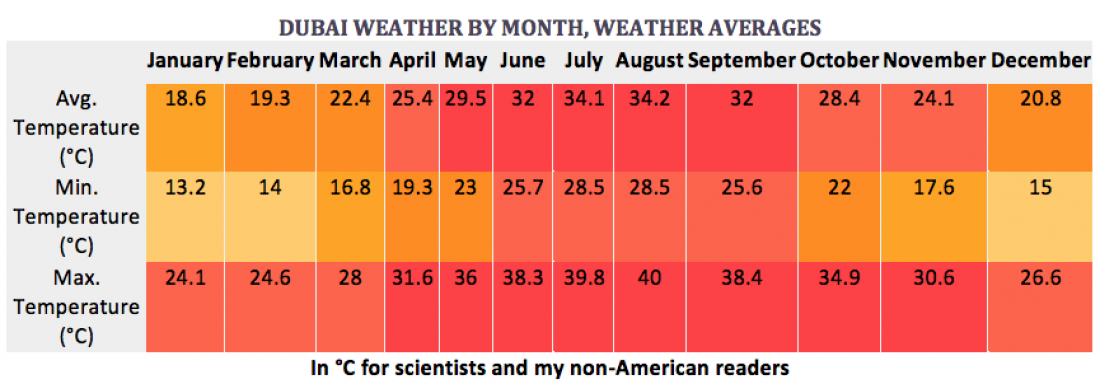
I am writing this blog in the middle of a blistering heat wave in New York City—the humidity index here has exceeded 100oF for three consecutive days (see July 3, 2018 blog) —and 50,000 people lost their power. Not surprisingly, we are bombarded with publications about air conditioners (1.5 billion units are currently in use globally, a number expected to increase to 5.6 billion by mid-century) and severe water shortages that serve as canaries in a coal mine for the deadly impacts of climate change. Dubai has a permanent heat wave. Its hotels, cars, and shopping malls have air conditioning but 90% of the population there are workers with no such access. Even Europe is facing deadly heat waves and only about 10% of the people there are equipped with air conditioners. The Red Cross issued a 94-page report advising cities on how to protect their citizens.

A few days ago, the BBC published a list of eleven cities worldwide and their expected temperatures for the warmest months in 2050. That’s only one generation away. I compiled the BBC data and the cities’ most recent populations. I’m sure we’ll see a change in the latter number.

Table 1 – Expected temperature changes in 2050 vs. most recent populations in 11 major cities worldwide

City Expected Temperature Change in 2050 (oC) Population (Millions)
Ljubljana, Slovenia 8 0.7
Madrid 6.4 3.3
Seattle 6.1 0.7
London 5.9 7.6
Moscow 5.5 10.4
Mexico City 4.2 12.3
New York City 4 8.2
Delhi 3.5 10.9
Istanbul 3.4 *14.8 (largest)
Beijing 1.9 11.7
Tokyo 1.9 8.3

At the moment, Ljubljana, Slovenia, which ties with Seattle for the smallest population on the list, is projected to have the most drastic change—a whopping 8oC (14.4oF!), while Istanbul, with the largest population, will “only” rise by 3.4oC (6.12oF).

Figures 1 and 2 are from the C40 initiative (See July 9, 2019 and June 4, 2019 blogs); they provide a striking illustration of the projected change.

Urban populations, risk, extreme heat 2000s, heat wave, future

Figure 1 – Urban populations at risk, 2000s

Urban populations, risk, extreme heat 2050s, heat wave, future

Figure 2 – Urban populations at risk, 2050s

  • The number of cities exposed to extreme temperatures will nearly triple over the next decades. By 2050 more than 970 cities will experience average summertime temperature highs of 35˚C (95°F). Today, only 354 cities are that hot.
  • The urban population exposed to these high temperatures will increase by 800 percent to reach 1.6 billion by mid-century.
  • Cities in countries that are less used to dealing with extreme heat are especially vulnerable. The 2003 heatwave in Europe led to 70,000 deaths.
  • Extreme heat puts pressure on essential services such as energy, transport, and health. During the 2016 heatwave India’s hospitals received twice as many patients as usual.
  • Heatwaves are an economic drain. They can cut goods and service outputs by more than 20 percent in sectors such as manufacturing and construction. Global economic costs of reduced productivity due could reach 2 trillion dollars by 2030.

Figure 3, from the same source, summarizes some of the consequences.

C40, extreme heat, heat wave, heatwave, summer, Figure 3

You don’t have to wait until 2050; you can envision the expected consequences now. The link here reports on mapping the trajectories of many cities within the US as their climates change over this time period.

If you figure out a city’s current temperature and precipitation, you can assume a business as usual scenario and calculate the city’s expected change by 2050. The cities that Vox examined in the article linked above will more closely resemble other ones that are farther south (sometimes hundreds of miles away). For example: staying put in St. Louis will be equivalent to moving to Tulsa; Minneapolis, to Des Moines; Albuquerque, to Elephant Butte, etc. In other words, to escape this plight, there will likely be a mass internal migration to the north, similar to what fish do each year. Think about the impact on real estate prices: what will the dynamics be during this transitional time and after? These changes will only continue.

Posted in Anthropocene, Anthropogenic, Climate Change, Extreme Weather, Sustainability | Tagged , , , , , , , , , , , , , , , , , , , , , , , , , , , , , , , , , , , , , , , , , , , , , , , , , , , , , , , , , , , , , , , , , , , , , , , | 1 Comment

Electricity Use: Lighting – Incandescent vs. LED

In this blog, I would like to go through some details about judicious selection of the lighting devices that we use (e.g. incandescent, compact fluorescent, halogen or LED) and when or how much we choose to use our electricity. It is a continuation of my exploration of best practices within the necessary energy transition.

My last few blogs focused on locally mandated zero carbon energy transitions, including those affecting where I work and live. Accordingly, I should be in a position to observe and report on these changes going forward, as well as potentially have some impact on aspects of the transition processes. Presumably, these local transitions will also have some ramifications on the global transition that is taking place—if only as examples of possible ways forward.

Key to all these transitions is the use of electricity. This is the most convenient and flexible—though not the most efficient and certainly not the most economical–energy form that we use. I highlighted these issues in my series of blogs in March and the beginning of April, about the electric power sector’s role in the transition, especially with regards to the popularization of electric cars.

Figure 1 illustrates US energy consumption by sector. Electricity comprises close to 40% of the total usage (2015).

US energy consumption by sector, industrial, transportation, electricity, commercial, residential

By Delphi234 – Own work, Wikimedia. Data is from US EIA MER Section 2.1., CC0

Figure 1Energy consumption by sector

As my series about electric cars demonstrates—because of its relative simplicity and flexibility—the effort to transition energy use through electricity is probably the most important current energy shift. Considering the fact that close to 20% of humanity is still deprived of electric power, this transition is in the process of being amplified. The movement to computer-driven technologies in all sectors of the economy is a major element in this shift.

This handover of much of the global GDP to electric power is the reason why, when my students, Kyle O’Carroll, Daniel Kruglyak, and Vikash Tewari, published a guest blog on April 30th about electricity use in the US, I was surprised with their findings. They showed that for the years 1997–2017, the ratio of electricity use to GDP decreased, instead of increasing as I had expected. This trend is so important that I am repeating it here in Figure 2 below. It means that, in spite of the major transition to electricity in major areas of the economy, electricity efficiency is rapidly increasing.

Ratio of Electricity Generation to GDP in the US, 1998-2017, efficiency, efficient, electricity, energy, GDP

Figure 2 – Ratio of electricity generation to GDP in the United States from 1998 to 2017 (April 30, 2019 guest blog)

Figure 3 breaks down how electricity is used in the US. The largest applications are in appliances and electronics, and air conditioning. These usages are likely to increase due to climate change and the rise of even more computerized aspects of modern life. Agencies such as the EPA’s Energy Star are usually the ones to monitor the energy conversion efficiency of various devices. If we follow their recommendations, chances are high that we will help increase efficiency of energy use—and in the process, reduce carbon emissions (assuming that the electricity is produced by burning fossil fuels) and save money on our electric bills.

electricity, use, US, home, air conditioning, A/C, water, heat, appliances, electronics, lighting

Figure 3

Lighting

Figure 4 itemizes the changes in the number of various light bulbs installed in the US from 2010-2016. Many branches of government are now providing encouragement for lighting efficiency in the form of free or highly subsidized LED light bulbs. This is a visible and painless way for us to show that we are good citizens, while taking steps to conserve electricity. If we get the LEDs for free, we don’t sacrifice anything by switching away from incandescents. Of course, this should only be a marker of good citizenship in countries where the government supplies such subsidized bulbs.

light bulb, incandescent, compact fluorescent, cfl, halogen, LED,

Figure 4

New York State is advertising the transition:

Upgrading lighting is a low-cost way to save energy and money in your home whether you own or rent. In comparison to conventional lighting options (such as incandescents, fluorescents, and halogens), energy-efficient light bulbs use less energy, cost less to operate, and can last up to 25 years longer.

There are many government rebate programs to replace incandescents with LED bulbs. However, once you sign up for such a program you are denying yourself the “fun” of balancing the economic and environmental considerations that should guide our behavior.

What if the bulbs were not subsidized and our consideration was purely economic? Should we replace the incandescent bulbs with LEDs? Below, I am including this quandary in the form of a problem and its solution (I usually give these to my general education students).

light bulb, cfl, LED, halogen, incandescent, fluorescent, watts, wattage, energy, wasted energy, lumens, voltage,

Graphic by George Retseck and Jen Christiansen, Scientific American
Sources: U.S. Department of Energy and Efficacy calculations based on currently available bulbs (traditional, halogen and compact fluorescent); SWITCH LIGHTING (led)

Figure 5Characteristics of the four light bulbs from Figure 4

Problem:

As shown in Figure 5, the average 100W incandescent bulb costs around $0.37 and lasts about 750 hours. Many countries (including the European Union, Brazil, and the US) are replacing it with more efficient bulbs. The rate of replacement in the US is shown in Figure 4. Given that the price of electricity is $0.11/kWh, under what conditions would it pay off to replace the incandescent light bulb with an LED one at a cost of $45 per bulb (data are from 2012—they are now significantly cheaper, ranging from $1.50-$5—but the exercise is still worth examining) and a lifetime of 20,000 hours?

Solution:

Assume that the light bulbs are on for X hours. The total cost of using the light bulb for that amount of time is equal to its original price + the hourly cost of electricity times X. The cost of electricity in kWh is equal to the power of the light bulb (in kW) times the hours the bulb is in use. This will produce an equation that looks like this:

Price of bulb + ($0.11/kWh)*(Wattage in kW)*(X hours) = Total cost

For the relatively short lifetime of the incandescent light bulb (750hrs) the total cost of the incandescent bulb will be:

0.37 + 0.11*0.1*750 = $8.62

0.37 + 8.25 = $8.62

That is considerably smaller than the cost of the LED ($45), so the replacement is not cost effective. For a longer time, equal to the lifetime of the LED (20,000hrs), the price of using the incandescent bulb will look like this:

0.37*(20,000/750) + 0.11*0.1*20,000 = $229.87

0.37*26.67 + 220 = $229.87

9.87 + 220 = $229.87

Meaning that we would be using approximately 27 incandescent light bulbs. As we can see, the price of the light bulbs will be negligible (less than $10); the real cost will come from the usage.

For the same period of time, the price of the LED will be:

45 +0.11*0.02*20,000 = $89

45 + 44 = $89

About half of the cost in this case comes from the price of the bulb and half from its use. How long is 20,000 hours? It is 2.3 years! Of course, your decision whether to switch over directly depends on the bulb’s intended use and considerations such as the ease in replacing it.

Timing Our Electricity Use

Meanwhile, I found the following communication from our local NYC power provider, Con Ed (indirectly), in Habitat magazine. It provides another opportunity to for us to balance our commitment to behavioral change with economy of energy:

The backdrop. Con Ed has a demand challenge. From May through September, when New York has its hottest and most humid days, the demand for electricity skyrockets. One way to meet this need is to do less with more.

Instead of digging up streets to install new electrical infrastructure, Con Ed digs into its corporate pockets and pays customers to use less electricity.

Simply speaking, you get paid when Con Ed asks you to reduce your electrical usage. This happens during the May through September season, and in years past has occurred about four times each period. There is also a mandatory test event. To make participation attractive at the get-go, Con Ed will pay you to sign up. Called a reservation fee, it depends on how much load you can commit, but a 50 kilowatt commitment could put $10,000 in your coffers.

Go deeper. There are two separate programs under the umbrella of Demand Response – one is peak shaving and the other is reliability (which is neighborhood by neighborhood). The peak shaving program is more appropriate for residential buildings who rely on building staff to manually adjust controls to reduce electric load. There are about 1,500 customers participating in both programs, says Shira Horowitz, manager of Demand Response.

This adjustment is known as load balancing and it’s not a bad idea given the massive numbers of people who use enormous amounts of electricity during the summer (witnessed by the chaos caused by the dramatic blackout here a few days ago). In a sense, it’s like a mini cap and trade system—in that it’s essentially a system of people selling their unused hours/potential for usage—but it does not include any actual limits on other individuals’ usages. The original link comes with some examples and numbers for our consideration.

As we saw in Figure 2, strategies like this one are bearing fruit.

Posted in Climate Change, Electricity, Energy, Sustainability, US | Tagged , , , , , , , , , , , , , , , , , , , , , , , , , , , , , , , , , , , , , , , , , , , , | 4 Comments

Buildings: Emissions

In urban environments, buildings are major contributors to climate change. In fact, according to the NYC Greenhouse Gas Inventory of 2016, they are responsible for two-thirds of New York City’s annual emissions. I have been looking at mitigation efforts of both my campus and my apartment. When I have discussed mitigation of university campuses, I have made the distinction between new and old buildings. Changes in construction and renovation stem from three forces: compulsory, top-down change, as mandated by legislation; collective self-motivation, and aspiration.

I live and work in New York City. In the compulsory column, we can now add the city council’s decision (see my June 4th blog), mandating landlords are required to retrofit all buildings larger than 25,000ft2 (2322 m2) with new windows, heating systems, and insulation by 2024. These changes should cut emissions (in comparison to calculations from 2005) by 40% in 2030, and double those cuts by 2050, for a total estimated reduction of about 80%. Landlords face heavy fines if they fail to meet these targets. This basically means that by 2050, the city’s buildings will be almost zero carbon, which is in line with the C40 initiative (June 4th blog) that ex-NYC mayor Bloomberg has coordinated (and partially financed). This is an example where the compulsory mandate and the aspirational mandate coincide (most likely not by accident— NYC is part of the C40).

In case this initiative takes hold, it is not difficult to predict that self-motivation will also play a role: somebody will probably form a well-publicized list that will rank buildings in a similar way to how the Sierra Club ranks campuses, prompting building owners to take action to climb these lists. Not only will doing so reflect good values and the desire to avoid fines, they may well impact the underlying real estate values.

The new NYC law, now known as Local Law 97 for 2019 or “NYC Building Emissions Law” is detailed and complex. You can read the summary at the bottom of the blog or by going here.

As indicated at the bottom of the second page of the summary, the emission limits begin in 2024 and the first compliance report is due in the middle of 2025. This is not a long time for such a transformation. The law is local, so different city governments can make changes before enacting their own versions. Businesses are already raising their voices—some support it and some complain about the costs and the exclusions. The law also extends to educational institutions and residential buildings.

My wife is the president of our co-op building and a strong environmentalist. Her immediate reaction to the law was, “OK, what do we do now?” This is almost the same question that I have raised in the context of the campuses: OK, we know what to do with new buildings—we simply tell the contractors to follow certain rules. But how do we tackle the problem of old buildings?

Let us start by analyzing the carbon emissions from a building—any building, old or new. Many publications, such as Energy Star’s Portfolio Manager, include instructions on how to do so. “Energy-related emissions” describes both direct and indirect forms. Both depend on the type of energy source that we are using. Direct emissions come from fossil fuels such as natural gas, gasoline, and oil. Indirect emissions include the fuels that our power companies are using to produce the electricity that we use. Any non-local power distribution (such as steam) should count as an indirect emission.

It is important for non-scientists to recognize that one can’t directly measure emissions. For direct emissions, one must use the “emission coefficients” that are published by organizations such as EIA (Energy Information Administration), which correlate the amounts of specific fuels that one uses with the standard emissions that result from burning these fuels. I use these coefficients to teach my students how to calculate emissions by using basic principles such as the chemistry of the fuels. Just type EIA into the search box at the top of the blog (click on the little magnifying glass) to see some examples. For indirect emissions, we need to find the fuel composition that our power company is using. My recent set of blogs about electric cars contains some of my best examples of this process (March 12, 19, 26, 2019). Next week’s blog will focus on electricity use.

The best way to save on energy-related emissions is obviously to use less energy. For this, we have to do an energy audit of a building, identify where the energy losses are, and try to minimize them. We can do this through better insulation, changing windows, using more efficient lightning, painting our roofs white or covering them with vegetation, and upgrading to better thermostats as well as energy certified refrigerators and air conditioners.

As usual, if you have the money and you don’t want to bother yourself with any of this, you can farm out the process. Most electric utilities now have the capacity to provide you with carbon-free electricity generated from renewable sources. You can now convert most of your energy use to electricity—this is not the most efficient or cost-effective method but you pay for convenience. It will cost you but as long as the electricity is being produced from renewable energy you will have no problem complying with the emissions mandate.

Below, I end this blog with the City’s two-page summary of the law, including a timeline with the new emissions requirements in NYC.

The Law: Summary of local law 97 NYC, buildings, emissions, law, carbon, urban green, energy, efficiency, efficient, green, timeline, legislation, government, governance

NYC, buildings, emissions, law, carbon, urban green, energy, efficiency, efficient, green, timeline, legislation, government, governance

Meanwhile, here are a few useful links:

Free NYC advisory on how to achieve these targets

NYC’s existing program for multifamily buildings

Handbook for carbon reduction for multifamily buildings

Energy consumption by age of buildings

Posted in Climate Change | Tagged , , , , , , , , , , , , , , , , , , , , , , , , , , , , , , , , , , , , | Leave a comment

Sustainable CUNY Solar + Storage Summit 2019

solar, conference, CUNY, NYC, zero carbon, economy, energy transition, sustainable, sustainability

Over the last few years, the City University of New York has organized several Solar + Storage summits focused on local needs and opportunities to accelerate the local energy transition to a carbon neutral economy. This year, the conference was on June 13th at John Jay College. The recent emphasis, both in the City and State of New York (which I described in previous blogs) to accelerate the transition with specific targets for zero net carbon economies, made such a conference especially timely. I decided to attend to try to identify new opportunities—both for learning and for teaching. I was happy that I did.

The agenda included:

  • Ask the expert booths with representatives from relevant industries
  • Introduction by Tria Case, CUNY Director of Sustainability
  • Keynote by NY Lieutenant Governor Kathy Hochul
  • Panel discussion about policy issues and institutional commitment by senior executives from Con Edison, New York Power Authority, the US Department of Energy, and the NYC Mayor’s Office of Sustainability
  • Panel discussion on financial risks and values by senior executives from National Grid, NY Green Bank and NYCEEC (a nonprofit finance company that provides loans and alternative financing solutions for clean energy projects)
  • Separate schedules for energy storage and solar energy tracks

The rather blurry opening photograph shows the first panel discussion.

Everything that I learned was relevant on the local level, echoing themes that I have emphasized in the previous blogs—namely, that energy transitions can be effective when employed on multiple levels.

The summit included discussions of smart grids; resiliency and grid distribution; power sharing; and CUNY’s own sustainability efforts. As often happens at such conferences, some of the concepts regarding local initiatives, such as microgrids, were ones that I have previously blogged about (April 29, 2014; May 6, 2014; May 27, 2014; and February 24, 2015)—although most of the time I’ve discussed microgrids it’s been in the context of developing countries. Here is how the conference defined them (In these contexts, PV stands for solar photovoltaics):

Electrical systems that can connect and communicate with the utility grid that are also capable of operating independently using their own power generation are considered microgrids. Single buildings or an entire community can be designed to operate as a microgrid. Microgrid infrastructures often provide emergency power to hospitals, shelters or other critical facilities that need to function during an electrical outage. Microgrids can include conventional distributed generators (i.e., diesel or natural gas gensets), combined heat and power (CHP), renewable energy such as PV, energy storage, or a hybrid combination of technologies. If inverters are used, such as for a resilient PV system, they must be able to switch between grid-interactive mode and microgrid (intentional island) mode in order to operate as a microgrid. For large microgrid systems that include distributed energy resources (DER), a supervisory control system (a system that controls many individual controllers) is typically required to communicate with and coordinate both loads and DER.

Other key issues, such as the “DG Hub,” were new to me; I needed some background:

The NY-Solar Smart Distributed Generation (DG) Hub is a comprehensive effort to develop a strategic pathway to a more resilient distributed energy system in New York that is supported by the U.S. Department of Energy and the State of New York. This DG Hub fact sheet provides information to installers, utilities, policy makers, and consumers on software communication requirements and capabilities for solar and storage (i.e. resilient PV) and microgrid systems that are capable of islanding for emergency power and providing on-grid services. For information on other aspects of the distributed generation market, please see the companion DG Hub fact sheets on resilient solar economics, policy, hardware, and a glossary of terms at: www.cuny.edu/DGHub.

I was particularly interested in a joint-published work by NREL (National Renewable Energy Laboratory) and CUNY, which offered a detailed analysis of the effectiveness of solar panel installations in three specific locations in New York. The paper included a quantitative analysis of the installations’ contributions to the resilience of power delivery in these locations. Below is a list of the different models that they have tried to match to the  locations. The emphasis here is on the methodology and what they are trying to do, not on the sites themselves. REopt is a modeling platform to which they try to fit the data:

This report will help managers of city buildings, private building owners and managers, the resilient PV industry, and policymakers to better understand the economic and resiliency benefits of resilient PV. As NYC fortifies its building stock against future storms of increasing severity, resilient PV can play an important role in disaster response and recovery while also supporting city greenhouse gas emission reduction targets and relieving stress to the electric grid from growing power demands.

This analysis used the REopt modeling platform to optimally select and size resilient power options for the sites in the study. Four scenarios were modeled to reflect different priorities and constraints; each scenario was modeled with and without a resiliency revenue stream. The value of resiliency to a site in this analysis is equal to the estimated costs incurred due to grid interruptions. In each case, the resilient PV system was able to capture revenue streams associated with displacing energy purchases from the grid, reducing peak demand charges, and shifting grid-purchased energy from high to low time-of-use cost periods. In all cases, the model found the combination of energy assets that minimized the life cycle cost of energy for the site.

1. Scenario 1: Resilient PV sized for economic savings; no resiliency requirement imposed The model chose from solar and storage resources to size a system that is cost-effective* for the host site.

2. Scenario 2: Resilient PV sized to meet resiliency needs The model chose from solar and storage resources to size a system that supports critical electric loads for short and long outages.

3. Scenario 3: Resilient PV and a generator (hybrid system) sized to meet resiliency needs The model chose from solar, storage, and diesel generator resources to size a hybrid system that supports critical electric loads for short and long outages.

4. Scenario 4: Generator sized to meet resiliency needs The model sized a diesel generator to support critical electric loads for short and long outages.

This is a particularly useful experiment that has the potential to accelerate the transition. I will try to find some examples when I visit Germany this summer (see the June 11th blog for more info about where I am going and why). The conference gave me an opportunity to see some initiatives in action in an urban environment and try to participate in the effort.

Next week, I will end this series of blogs on the energy transition in New York/CUNY by focusing on residential buildings and uses of electricity.

Posted in Climate Change, Conference, Education, Sustainability | Tagged , , , , , , , , , , , , , , , , , , , , , , , , , , , , , , , , , , , , , , , , , , , , , , , , , , , | 1 Comment

Multilevel Confrontations with Climate Change: State Legislation

Wherever you live or work there is a very good chance that you are subject to multiple jurisdictions , with laws that you have to abide by. In my case, those include New York City and State, and the US federal government. In addition, I live in an apartment building that has its own rules and regulations, as does the university where I teach. It is not surprising that—by now—all these jurisdictions have policies, rules, and laws that were drafted to address climate change. Starting with the May 28th blog, with one exception (The June 11th blog that focused on D-Day), I have tried to cover my campus’ efforts to place itself in a leadership position in this area. I have described the commitments that Brooklyn College made in 2009, as well as New York City’s recent detailed legislation.

New York State’s work on the issue was invisible until now. On June 20th (last Thursday), this situation changed. Reuters and other publications announced that both chambers of the New York legislation came out with major legislation that put NY at the forefront of global efforts to mitigate climate change through major changes in energy use.

The figure below, taken from the Energy Information Administration (EIA), shows that in the United States, NY State is second only to Washington, D.C. in emitting the least carbon dioxide per person. The main reason is that close to 50% of the state’s residents live in NYC—the largest urban area in the United States—with widely used public transportation, multi-tenant housing, and an economy dominated by non-polluting service economies such as finance.

energy, carbon dioxide, emissions, state, policy, legislation

Nevertheless, in view of the passive position that the US federal government is now taking on the issue, NY State, together with other local governments, decided to take the lead. Below are selected paragraphs from the Reuters publication that describes the new legislation:

“New York lawmakers pass aggressive law to fight climate change”

By: Barbara Goldberg

NEW YORK (Reuters) – New York state lawmakers passed early Thursday one of the nation’s most ambitious plans to slow climate change by reducing greenhouse gas emissions to zero by 2050. If signed into law, it would make New York the second U.S. state to aim for a carbon-neutral economy, following an executive order signed by then California Governor Jerry Brown last year to make that state carbon neutral by 2045.

The marathon session stretched past 2 a.m. Thursday before the votes were tallied with 104 in favor to 35 against. The New York Assembly’s vote in the state capital Albany followed a Senate vote that passed the measure on Tuesday.

It mandates reducing emissions by 85% from 1990 levels by 2050, and offsetting the remaining 15%, making the state carbon neutral.

New York’s “Climate and Community Protection Act” calls for reducing emissions by 40% by 2030 and using only carbon-free sources such as solar and wind to generate electricity by 2040.

“Jobs created in renewable energy and energy efficiency can’t be outsourced, it’s always local,” said Daniela Lapidous, organizer for NY Renews, a coalition of over 100 environmental groups.

“New York is mostly purchasing fossil fuel products out of state,” she said. “So when we transition to a renewable economy we will be spending New York dollars in New York, creating good local jobs that pay well and are meant to be accessible to women, communities of color, low-income communities.”

I looked into the original legislation and managed to find a detailed summary. It is very complex. One of the reasons for that complexity is that many legislators now insist upon inclusion of socioeconomic provisions within the objectives of new legislature. I will quote one paragraph that directly relates to the main objective, as Reuters reported it:

75-0107. Statewide greenhouse gas emissions limits.

   36   1. No later than six months after the effective date of this article,

37 the department shall determine what the statewide greenhouse gas emis-

38 sions level was in 1990, and, pursuant to rules and regulations promul-

39 gated after at least one public hearing, establish a statewide green-

40 house gas emissions limit as a percentage of 1990 emissions, for the

41 following years as follows:

42   a. 2020: 100% of 1990 emissions.

43   b. 2025: 75% of 1990 emissions.

44   c. 2030: 50% of 1990 emissions.

45   d. 2035: 40% of 1990 emissions.

46   e. 2040: 30% of 1990 emissions.

47   f. 2045: 20% of 1990 emissions.

48   g. 2050: 0% of 1990 emissions.

49   2. In order to ensure the most accurate determination feasible, the

50 department shall utilize the best available scientific, technological,

51 and economic information on greenhouse gas emissions and consult with

52 the council, stakeholders, and the public in order to ensure that all

53 emissions are accurately reflected in its determination of 1990 emis-

54 sions levels.

It’s an ambitious plan. The same day, The New York Times printed a few more details:

The plan would phase out gasoline-powered cars

The measure does not envision a day when individual car owners will be required to turn in their old vehicles, proponents say. Rather, new regulations would force automakers to accelerate the trend toward producing more and cheaper electric vehicles.

Now, electric car ownership is almost exclusively for single-family homeowners who can plug in cars at home. Charging stations would be needed, for instance, all over New York City, which plans to experiment with putting plugs on existing streetlamps. Customers would plug in cords with built-in meters to charge them for the power.

It would mean no oil- and gas-burning heaters and boilers

“The furnace in an average New Yorker’s home will no longer be fossil fuel fired,” said Peter Iwanowicz, the executive director of Environmental Advocates, a lobbying group. “It will probably be electric.”

The transformation would most likely start with regulations on new construction, backed by incentives for homeowners and landlords to retrofit existing heating systems, experts said.

The easiest way to abide by the new guidelines would be to convert as many energy activities as possible to be electrically powered (such as heating, hot water, electric cars, etc.). However, as I mentioned earlier this year in the context of electric cars (March 12April 2, 2019), energy-wise that is not the most efficient way to go through the transition. It also requires that the entire power industry reach carbon neutrality at the same time.

Almost as soon as it was announced, people objected to this new piece of state legislation. The main objection is also the most obvious one — who will pay for all of this? The politically easy answer is that businesses will pay. However, many businesses have warned that they will simply move to another state to avoid stricter policies. These kinds of threats are becoming increasingly prevalent as the federal government tries to shift the responsibility back onto states, counties, and cities. It opens new migration mechanisms that could potentially sharpen the divide between blue states that are trying to actively deal with climate change and red states that are passively watching it happen. I will expand on this in future blogs.

Posted in Climate Change | Tagged , , , , , , , , , , , , , , , , , , , , , , , , , , , , , , , , , , , , , , , , | 2 Comments

Campus Transition into Sustainability Teaching Laboratory

My May 28th blog discussed the Sierra Club’s ranking of university campuses’ sustainability conversions. I also included the organization’s methodology. Later, in my June 4th blog, I suggested that campuses could convert this transitional process into a teaching moment — perhaps even a teaching laboratory. I didn’t, however, list the Sierra Club’s scoring keys anywhere. If a campus decides to put serious efforts into climbing the ranks, it must first know the details of what is involved — including the metrics. The list of these is incredibly long, but I decided that it was essential to have the full set here for reference. Several of the blogs that follow will also depend on this list. Below, I have extracted the 10 highest-scoring activities, along with some suggestions for how campuses should proceed in order to improve their scores in these categories. I then include the full list:

Explanation:

The GHG Protocol Corporate Standard classifies a company’s GHG emissions into three ‘scopes’. Scope 1 emissions are direct emissions from owned or controlled sources. Scope 2 emissions are indirect emissions from the generation of purchased energy. Scope 3 emissions are all indirect emissions (not included in scope 2) that occur in the value chain of the reporting company, including both upstream and downstream emissions.

Colleges should provide a detailed accounting of their scope 1–3 emissions (it’s not necessary to include external evaluations). This makes it easier for the Sierra Club to identify and credit any changes.

This is self-explanatory.

This can be done building by building, starting with the oldest buildings.

There was a June 13th conference on the use of solar energy on CUNY campuses. I will expand on this issue next week with some details about the conference.

An institution must initially get a detailed accounting of its waste and then identify (and follow through with) actions to reduce it.

Same process as above.

Since most projects are done by outside contractors, the contracts should include this requirement.

For educational institutions this is one of the most important topics that will define campuses as working sustainability laboratories.

This is self-explanatory but is at least relatively easy in NYC where we can contact the power company to request that they deliver at least a certain portion of our electricity from renewable sources.

This is by far the highest number of available points and it calls for major action — not just pledges or promises!!

Here’s the full set:

Scoring Key 2016

Posted in Climate Change, Sustainability | Tagged , , , , , , , , , , , , , , , , , , , , , , , , , , , , , , , , , , , , , , , , , , , , , , , , , , , , , , , , , , , , , , , , , , , , , , , , , , , , | 4 Comments

D-Day Anniversary: 75 Years Later and What I Mean by Self-Inflicted Genocide

A photo from a meeting of WWII liberators and survivors
(I am in the middle of the back row)

The 75th anniversary of D-Day was on Thursday. The celebration was not about me. It was about the soldiers that took part, with many of them giving their lives to save the world from the Nazi horrors. However, I am part of the picture.

In the commemoration of the 75-year anniversary of this momentous event, President Trump quoted President Roosevelt’s prayer at the start of the invasion. Here is how The New York Times describes it:

Mr. Trump appeared most presidential in his appearance at Portsmouth, on the coast of southern England, one of the key embarkation points for the D-Day invasion of Normandy, France.

The president spoke for less than two minutes, reading an excerpt from a prayer that Roosevelt delivered in a radio address on the evening of the invasion.

“Almighty God,” he read, “our sons, pride of our nation, this day have set upon a mighty endeavor, a struggle to preserve our republic, our religion, and our civilization, and to set free a suffering humanity. They will need thy blessings. For the enemy is strong.”

And: “Some will never return. Embrace these, Father, and receive them, thy heroic servants, into thy kingdom.”

I emphasized a few words because I represent a fraction of the group they describe.

Here’s my history, from my very first blog post (April 22, 2012):

I was born in Warsaw, Poland in May, 1939. The first three years of my life were spent in the Warsaw Ghetto, as the Nazis developed their plans for systematic Jewish genocide. Before the destruction of the Ghetto in 1943, I was hidden for a time on the Aryan side by a family friend, but a Nazi “deal” to provide foreign papers to escape Poland resulted in my mother bringing me back to the Ghetto. Then a Nazi double-cross sent the remnants of my family not to safety in Palestine, but to the Bergen-Belsen concentration camp as possible pawns in exchange for German prisoners of war. As the war was nearing an end, in April 1945, we were put on a train headed to Theresienstadt, a concentration camp further from the front lines. American tank commanders with the 743rd tank battalion of the American 30th Division intercepted our train near Magdeburg in Germany, liberating nearly 2500 prisoners. Within the year, my mother and I began building new lives in Palestine.

Twelve years ago, I located the units of the American army that participated in my liberation. Since then, I have tried to attend as many liberator/survivor events as I could. The press has covered many of these; you can find the stories on the internet. The opening photograph is from one of the more recent meetings. I included the relevant link below it.

It will not be a great surprise to anybody that all of us in the photograph look old. I was 6 years old when I was liberated and the soldiers were all in their twenties. We — both survivors and liberators — are the last generation alive that lived through these events. Both groups have been speaking of their experiences to schools and interested listeners, trying to do everything in our power to prevent more genocides such as the ones that took place in WWII. Genocides come in various shades and forms so it requires full awareness to forestall recurrences of what happened there.

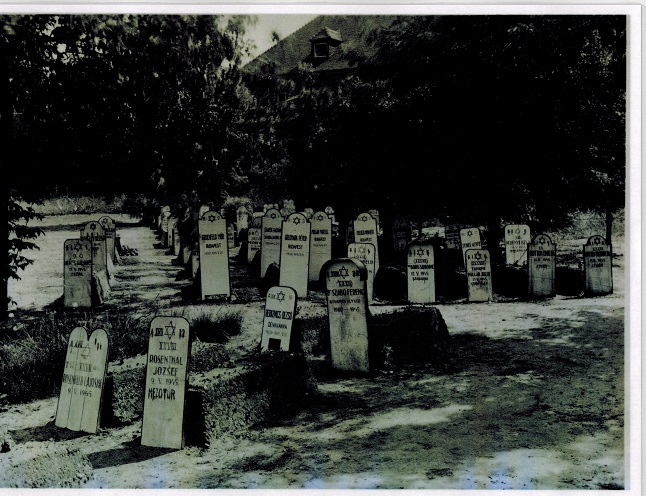
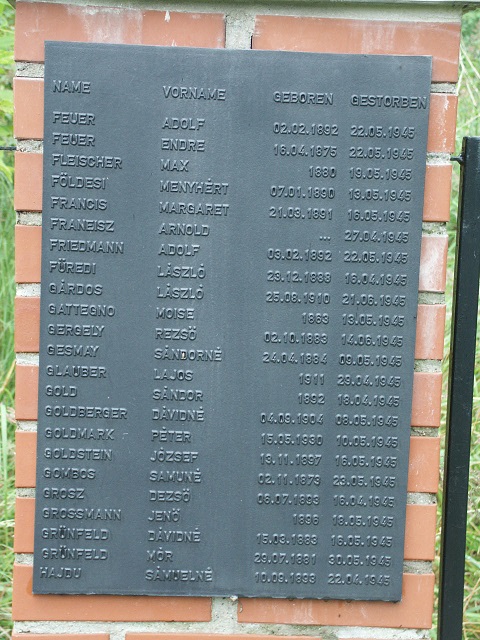
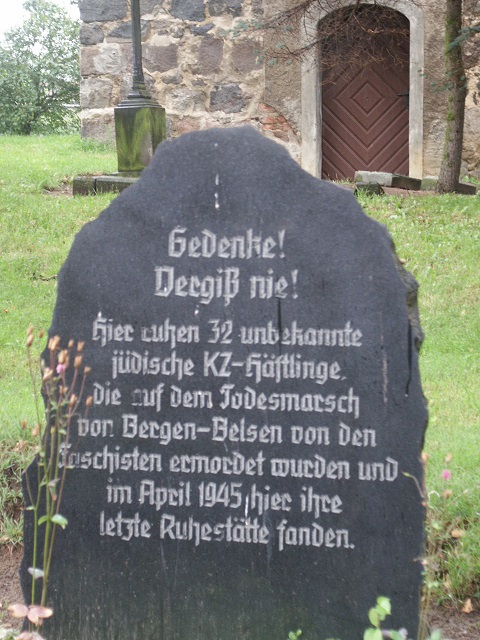
When Frank Towers (standing third from the right), an officer during the liberation event, passed away (at age 99), a Dutch friend who used to attend some of these events suggested we build a monument to the survivors and liberators in the German town where the train was intercepted (Farsleben). I have joined forces with the people of Farsleben, along with a few second-generation survivors and liberators who now live in the US and Israel, to try to help him bring the idea to fruition.

Over the summer, my wife and I will travel to Farsleben. We will interact with students, teachers, and adults as we try to facilitate getting the monument ready for a formal dedication on April 2020: the 75th anniversary of the Liberation.

I teach students about Physics and climate change at Brooklyn College as my day-to-day job. I also do research on climate change. At every possible opportunity, I try to connect climate change to the Holocaust, describing anthropogenic climate change as a self-inflicted genocide. You can see my detailed reasoning in the first three posts on this blog, from 2012.

This summer I will also be working on a talk that I am scheduled to give in November about possible ways for the world to reach an agreement to mitigate and adapt to climate change. Many approaches in this area are mathematically based on game theory. One of the strongest groups doing work in this area is from the Potsdam Institute for Climate Impact Research (PIK). The game theory approach to solve climate change can be very complex. One of the reasons for that complexity is that players need to agree to play collectively and not isolate themselves as free riders. Free riders benefit from global mitigation caused by limits on carbon emissions but also get to continue using the relatively low-cost fossil fuels that are causing those emissions. Free riding also tends to be contagious (the US is now a free rider). Humans can be difficult to predict and harder to shift. It seems to me that game theory or any other mathematical approach does not work very well in a system that involves more intricate human motivations. What we really need are political solutions that will include all of us. That means that such solutions will be compromises similar to that achieved in Paris at the end of 2015, from which United States is presently in the process of withdrawing.

Potsdam is about 90 minutes’ drive from Farsleben. D-Day reminds us that the WWII victory also needed a political solution. The aftermath of WWII almost assured that any repeat would involve nuclear weapons with the capacity for a global genocide. The Potsdam Conference between July 12 and August 2, 1945 attempted to reach a peaceful settlement.

Back to the D-Day memorial. The President of the United States received a great reception from the British Royal Family. At an official banquet at Buckingham Palace, Queen Elizabeth II toasted him with the following remark:

As we face the new challenges of the 21st century, the anniversary of D-Day reminds us of all that our countries have achieved together. After the shared sacrifices of the Second World War, Britain and the United States worked with other allies to build an assembly of international institutions to ensure that the horrors of conflict would never be repeated. While the world has changed, we are forever mindful of the original purpose of these structures: nations working together to safeguard a hard-won peace.

Later, Prince Charles spoke at length with President Trump about climate change. Such institutional, international cooperation to prevent future global disaster caused by climate change is badly needed now. Unfortunately, the 90-minute effort on the part of the heir to the British crown to deliver this point to our president didn’t go far in influencing him to change his stance on climate change or other threats to humanity.

Posted in administration, Climate Change, Holocaust, Sustainability, Trump, US | Tagged , , , , , , , , , , , , , , , , , , , , , , , , , , , , , , , , , , , , , , , , , , , , , , , , , , , , , , , , , , , , , | 2 Comments

Campus Sustainability – NYC and CUNY

Sustainability in NYC

In mid-April, the New York City Council passed an incredibly important piece of legislation regarding our city’s sustainability, calling for landlords to upgrade the built environment:

New York City Passes Historic Climate Legislation

The Climate Mobilization Act lays the groundwork for New York City’s own Green New Deal.

By Alexander C. Kaufman

The legislation sets emissions caps for various types of buildings over 25,000 square feet; buildings produce nearly 70% of the city’s emissions. It sets steep fines if landlords miss the targets. Starting in 2024, the bill requires landlords to retrofit buildings with new windows, heating systems and insulation that would cut emissions by 40% in 2030, and double the cuts by 2050.

“This legislation will radically change the energy footprint of the built environment and will pay off in the long run with energy costs expected to rise and new business opportunities that will be generated by this forward thinking and radical policy,” said Timur Dogan, an architect and building scientist at Cornell University.

The Climate Mobilization Act’s other components include a bill that orders the city to complete a study over the next two years on the feasibility of closing all 24 oil- and gas-burning power plants in city limits and replacing them with renewables and batteries. Another that establishes a renewable energy loan program. Two more that require certain buildings to cover roofs with plants, solar panels, small wind turbines or a mix of the three. And a final bill that tweaks the city’s building code to make it easier to build wind turbines.

The cost to landlords is high. The mayor’s office estimated to The New York Times that the total cost of upgrades needed to meet the new requirements would hit $4 billion.

It reads a lot like a NYC-specific Green New Deal (GND) (see the February 19, 2019 blog). This is appropriate, given that New York’s own Rep. Alexandria Ocasio-Cortez is the congresswoman people most identify with the GND (cosponsored by Sen. Ed Markey, D-Mass). The legislation sounds great but we have lived through these kinds of initiatives before; some regulations are more effective than others. I used to teach a course at my school that focused on New York City’s efforts to mitigate and adapt to climate change. For example, this is from a class file from Spring 2010:

PlaNYC Energy Initiatives

On Earth Day, 2007, Mayor Bloomberg released plaNYC, a sustainability plan for the City’s future. The plan is designed to lower our collective carbon footprint while also compensating for population growth and improving the city as a whole. Here we address its fourteen-point plan for energy and analyze its progress thus far. 

Sustainability at CUNY

I work within the City University of New York (CUNY) — the largest urban university in the US. Following Mayor Bloomberg’s announcement, CUNY formed a sustainability task force:

The CUNY Sustainability Project was given institutional clarity and impetus through the acceptance by Chancellor Goldstein on June 6, 2007 of Mayor Bloomberg’s ’30 in10′ challenge. This challenge will motivate New York City’s public and private universities to reduce their greenhouse gas emissions 30% by 2017. CUNY is committed to investing the resources necessary to construct, retrofit and maintain more sustainable and green facilities.

You can follow the university’s progress in this area here.

While a number of UC schools feature in the Sierra Club’s list of the country’s 200 most sustainable schools (see last week’s blog), CUNY campuses are nowhere to be found. In fact, the top NYC school on the list is St. John’s University at #50, with Columbia University coming in at #90.

We (New York and CUNY) can and should do much better. To my knowledge, nobody has ever tried to use schools as laboratories where they could correlate economics with energy transition. In theory, in addition to converting the campus itself into an environmentally friendly institution, a school could train its graduates to perform such conversion jobs —thus enhancing their qualifications for satisfying employment once they leave school.

I teach physics in my school; it’s an experimental science:

experimental science

  1. Diligent inquiry or examination in seeking facts or principles; laborious or continued search after truth; as, researches of human wisdom; to research a topic in the library; medical research.
  2. Systematic observation of phenomena for the purpose of learning new facts or testing the application of theories to known facts; — also called scientific research. This is the research part of the phrase “research and development” (R&D).

    Note: The distinctive characteristic of scientific research is the maintenance of records and careful control or observation of conditions under which the phenomena are studied so that others will be able to reproduce the observations. When the person conducting the research varies the conditions beforehand in order to test directly the effects of changing conditions on the results of the observation, such investigation is called experimental research or experimentation or experimental science; it is often conducted in a laboratory. If the investigation is conducted with a view to obtaining information directly useful in producing objects with commercial or practical utility, the research is called applied research. Investigation conducted for the primary purpose of discovering new facts about natural phenomena, or to elaborate or test theories about natural phenomena, is called basic research or fundamental research. Research in fields such as astronomy, in which the phenomena to be observed cannot be controlled by the experimenter, is called observational research. Epidemiological research is a type of observational research in which the researcher applies statistical methods to analyse patterns of occurrence of disease and its association with other phenomena within a population, with a view to understanding the origins or mode of transmission of the disease.

One of the biggest disciplines of experimental science is natural science, i.e. using the scientific method (try typing that into the blog’s search box) to study nature. Examples include physics, chemistry, earth science, biology, etc. The terminology was largely introduced to distinguish them from social sciences, which use the scientific method to study human behavior. As a rule, one cannot properly teach natural sciences without laboratory components where we test almost everything that we learn.

So where do we place anthropogenic climate change in our studies? The term describes man-made changes to the physical environment and reflects on how, in turn, those changes impact humanity. Many university campuses are now affiliated with laboratory schools or demonstration schools where they train future teachers and conduct educational experimentation and research. Can we devise laboratory experiences/experiments regarding climate change on a matching scale?

Michael Bloomberg, after his three terms as mayor of NYC, started a new environmental enterprise focused on climate change. The C40 initiative currently boasts the participation of 94 cities (NYC included), which together make up 25% of the global GDP. The initiative’s latest commitment is that new buildings will conform to Net Zero Carbon by 2030 and old buildings will show net zero carbon by 2050. These are clear objectives on which one can measure progress.

The changeover to a zero-carbon environment is often expensive. Many schools, including mine, only find the necessary resources when they construct new buildings. For old buildings the conversion is even pricier (hence the delay in the target date under the C40 aspirations). Almost all the buildings in most campuses are old. Sustainable buildings and teaching laboratories each need resources for both initial costs and maintenance. We have very little experience with conversion of old buildings into more sustainable ones but we have a much richer history of working with teaching laboratories.

The initial funding for the laboratories usually comes with the original budget for the building — that is one of the main reasons that science buildings are so expensive. Once we start using it, a lab needs periodic maintenance — mainly for updating, replacing, and repairing equipment. A lot of the capital for these projects — at least at my school — comes from the students’ technology fee.

At CUNY, tuition for full-time in-state students is $3,135/semester; technology fees are $125/semester.

In 2003, the CUNY Board of Trustees adopted legislation requiring students to pay an annual technology fee. The revenues generated by the fee are to be used by the colleges to enhance opportunities for students to use current technology in their academic studies and to acquire the knowledge and skills that the modern, information-centered world requires.

Each year, a committee composed of administrators, faculty and students, chaired by the Provost, solicits suggestions from the college community and prepares a plan for the use of the technology fee funds. The plan is submitted to the Chancellor for approval. Brooklyn College’s advanced use of technology enables the committee to both pursue more advanced goals and concentrate on projects that build on mature foundations.

Approved projects are expected to further the college’s goals of: expanding student access to computing resources, improving computer-based instruction, improving support for students using college computers, improving student services, and using technology to enrich student life on campus. These goals should now [sic] only make college life more enjoyable, but also provide Brooklyn College students with an edge as they enter the job market or move on to postgraduate studies.

The committee’s plan is typically cast as a formatted spreadsheet indicating categories and examples of projects. The projects listed in the spreadsheet represent the college’s priorities, but until it is known exactly how much money will be available, the college cannot determine whether or not all of them will be funded. You can view the budget plans by clicking the links below.

My Proposal

Given NYC’s new legislation, I think it is time for CUNY to update its approach to the sustainability of its infrastructure.

CUNY, sustainable, sustainability, old, new, carbon neutral, zero carbon, renovation, conversion, building

Figure 1 – Age of CUNY buildings

Figure 1 shows the age distribution of CUNY’s buildings. According to the department of energy, the average lifetime of a building made of concrete, steel, and wood is about 70 years. So, by these data, the majority of the buildings will shortly exceed their lifetimes and need to be replaced.

I propose the addition of a sustainability fee to match the technology fee, so we can start to accumulate the resources for these replacements. Majors such as Urban Sustainability and Economic Management will identify and target facilities for replacement and will collaborate with the administration in providing the technical know-how that will be required. In addition to the new fee, these projects will be funded using a mix of private donations and state budgetary allotments.

Students will issue periodic, quantitative reports about progress made in the process of converting the old buildings to zero-carbon buildings. The 20-year target difference between conversion of new and old buildings should be more than enough time for the process to be feasible.

In the next blog I will continue to add some more details about my proposed sustainability conversion.

Posted in Anthropocene, Anthropogenic, Climate Change, Sustainability | Tagged , , , , , , , , , , , , , , , , , , , , , , , , , , , , , , , , , , , , , , , , , , , , , , , , , , , , , , , , , , , , , , , , , , , , , , , | 6 Comments