
Single-Use Plastic and Decarbonization

Source: Advanced Waste Solutions

As I mentioned in last week’s blog, I will temporarily leave the topic of the devastating Russian aggression against Ukraine and shift back to the impending global environmental threats connected to climate change. The Russian-Ukrainian conflict is not ending anytime soon. The destruction of cities and random killings have had the devastating consequence of making more than 10% of the population refugees: 4 million—mainly women, children, and the elderly— have had to leave their country for refuge in neighboring states. However, as I have mentioned in earlier blogs, the state of any possible settlement or end of the conflict and the state of the fighting are still in a fog. The important impacts of this conflict on the global energy transition are still too recent to monitor with numbers that will help us measure the long-term impacts. I will return to these issues as soon as that changes.

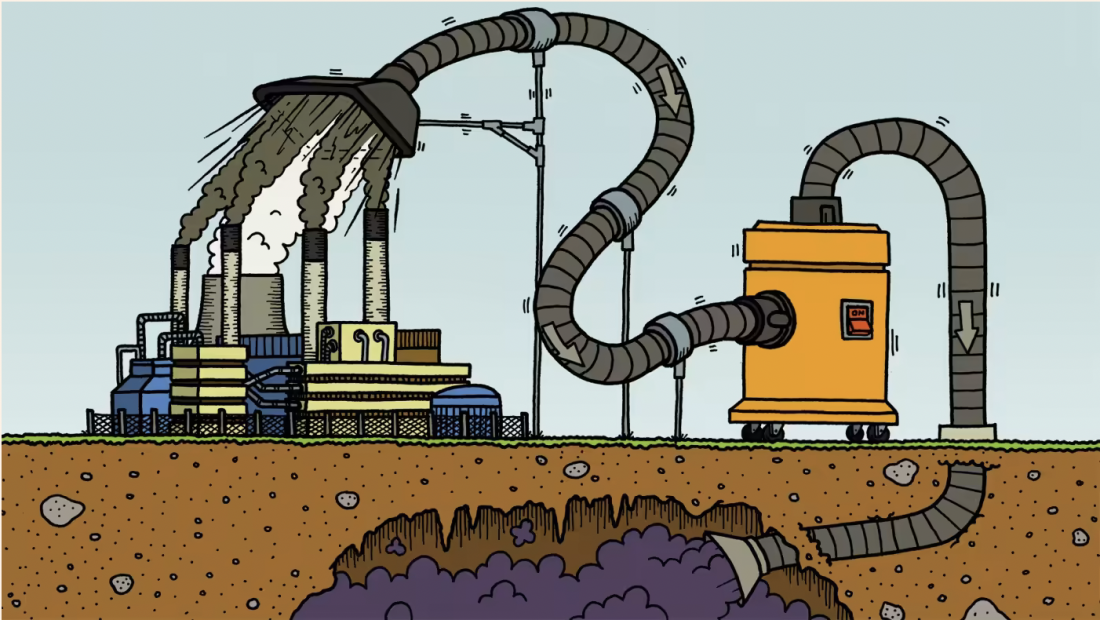
The title of this blog, with the supporting opening figure, was designed to attract the attention of my students and the administrators of my university—to help address long-term environmental threats that are already mandated by political authorities that govern us and which implementations of their decisions are left to us. The emphasis in this blog will be on mitigating our use of single-use plastics (SUP) and decarbonizing our energy use.

Efforts to minimize the use of SUP are now starting to advance from the general to the global scale:

Against the backdrop of geopolitical turmoil, the UN Environment Assembly (UNEA-5) shows multilateral cooperation at its best,” said President of the Assembly, and Norway’s Minister for Climate and the Environment, Espen Barth Eide. “Plastic pollution has grown into an epidemic. With today’s resolution we are officially on track for a cure.”

The resolution, based on three initial draft resolutions from various nations, establishes an Intergovernmental Negotiating Committee (INC) which will begin its work this year, aiming to complete a draft legally binding agreement by the end of 2024.

That in turn, is expected to present a legally binding instrument, which would reflect diverse alternatives to address the full lifecycle of plastics, the design of reusable and recyclable products and materials, and the need for enhanced international collaboration to facilitate access to technology, to allow the revolutionary plan to be realized.

The list of sovereign countries and states that have already instituted, in various forms, a ban on the use of SUP includes Canada, Kenya, Zimbabwe, the UK, the US (NY, California, and Hawaii individually but no federal ban), the EU, China (to be announced this year), and India.

Down to my own state, the specific legislation that recently was signed by the NY state governor to encourage the two largest public universities—SUNY and CUNY—is given below:

AN ACT to amend the education law, in relation to encouraging the elimination of the use of certain single use plastic items at state university of New York and city university of New York campuses The People of the State of New York, represented in Senate and Assembly, do enact as follows:

  1. Section 1. Section 355 of the education law is amended by adding a new
  2. subdivision 21 to read as follows:
  3. The state university trustees shall adopt a policy requiring that
  4. each institution of the state university of New York collaborate with
  5. students, faculty and staff to encourage campuses to eliminate the use
  6. of certain plastic items generally recognized by the public as being
  7. designed for single use. Such plastic items may include, but shall not
  8. be limited to, tableware, straws, stirrers, cups and food service
  9. In establishing such a policy, the trustees shall consider
  10. the following:
  11. the availability of affordable alternatives;
  12. the accessibility of alternatives to all students, faculty, and
  13. staff;
  14. an evaluation of the effectiveness of reusable alternatives; and
  15. benchmarks for assessing progress.
  16. 2. Section 6206 of the education law is amended by adding a new
  17. subdivision 21 to read as follows:
  18. The board of trustees shall adopt a policy requiring that each
  19. institution of the city university of New York collaborate with
  20. students, faculty and staff to encourage campuses to eliminate the use
  21. of certain plastic items generally recognized by the public as being
  22. designed for single use. Such plastic items may include, but shall not
  23. be limited to, tableware, straws, stirrers, cups and food service containers.
  24. In establishing such a policy, the trustees shall consider
  25. the following:
  26. the availability of affordable alternatives;
  27. the accessibility of alternatives to all students, faculty, and
  28. staff;
  29. an evaluation of the effectiveness of reusable alternatives; and
  30. benchmarks for assessing progress.
  31. 3. This act shall take effect on the ninetieth day after it shall
  32. have become a law.

Other colleges and universities in the US are following a similar path.

The CUNY Board of Trustees requires that campus councils draft a plan to eliminate single-use plastics on campus by April 15th of this year. I am involved in the efforts to follow this mandate.

The multi-level global effort to mitigate the excessive use of SUP has some similarities to the longer effort to mitigate the excessive use of fossil fuels to power our economies.

On a campus level, similar to global carbonization of the atmosphere, SUP can be sorted into four groups that I described in an earlier blog (June 18, 2019):

Scope 1 – direct use on campus.

Scope 2 – indirect use through suppliers or services such as the cafeteria.

Scope 3 – all other indirect use (use by campus personnel away from the campus).

Scope 4 – incorporate minimizing local use in the college curriculum through using college efforts as a lab (see the same June 18, 2019 blog for similar use for decarbonization).

For both decarbonizing energy use and minimizing the use of SUP that results from Scope 2 activities, one needs dedicated administrators that will go through all our delivery contacts to find out if there are alternatives that are committed to delivering their services with zero SEP and using zero-carbon energy.

To address Scopes 1 and 3, we need strong cooperation from students—something that organizations such as NYPIRG can help with. To address Scope 4, we need faculty cooperation to change the curriculum.

Both CUNY and SUNY are multi-campus organizations in which some of the functions are led by the central authority of the university and some are administered by the local campus. The complexities that arise from such a setting will be discussed in a separate blog.

Posted in Climate Change | Tagged , , , , , , , , , , , , , , | Leave a comment

Fogs and Clear Skies

Ukrainian President Volodymyr Zelenskyy (Source: BBC)

Previous blogs emphasized the fog of the Ukrainian-Russian war (March 8th) and the fog of the peace attempts (March 22nd) but even the combination doesn’t cover the reality of the Russian aggression. Many more aspects of this conflict are covered with fog, even as some important aspects remain clear. One of the clearest aspects of this conflict is the extent to which this aggression is viewed as a global event. A quarter of the Ukrainian population (of 44 million) have been forced to leave their homes, out of which 3.6 million have been forced to leave the country.

The number of dead and injured, whether civilian or military, is still under fog. The economic impacts—both to Russia and the rest of the world—have become more transparent. The complete destruction of the Ukrainian economy doesn’t need numbers to be transparent.

There is no question (at least in my mind) that the transparent parts of the conflict owe a great deal to Volodymyr Zelenskyy, the Ukrainian President. His constant communication with the Ukrainian people, combined with major appearances before parliaments of important states and regions, has united most of the world in support of Ukraine. He has directly addressed the governing bodies or parliaments of the US, England, Germany, Israel, France, and the European Union. He has also addressed the Russian people in their own language (and his), drawing a lot of support from that country’s citizens. In terms of communication, he will be known as one of the most effective wartime leaders in recent history. His background in entertainment is helping him in his role as the leader of the underdog country in a wartime conflict.

However, the supporting world is not willing to help Ukraine with direct military involvement to confront Russia. As I mentioned in the last blog, Russia is home to the world’s largest nuclear arsenal. Fear of escalating this war to WWIII, which might involve the use of chemical, biological, or nuclear weapons, is on everybody’s mind.

Instead, most of the countries that openly support Ukraine have stuck to using major economic sanctions on Russia in an attempt to shift the balance of power.

There is no question in my mind that the endgame of this conflict will leave major impacts on the global balance of powers but the nature of these impacts is still largely in a thick fog.

Meanwhile, we can clearly see major economic impacts on both Russia and the countries that are trying to punish its aggression. Below are a few of the echoes of these impacts:

Impacts on Russia:

Live Updates as Business, Lawmakers and Stocks Respond to Ukraine-Russia War

After shutting down for almost a month, the Russian stock market reopened for limited trading on Thursday. Just 33 companies, all listed in the benchmark MOEX index, were allowed to trade on the Moscow Exchange for four hours and ten minutes.

The MOEX index rose 4.4 percent, but it was probably buoyed by significant government policies intended to avoid a sell-off, including a measure to bar foreigners from selling stocks.

The Russian central bank said on Wednesday there would be a ban on short selling the stocks, a type of trade involving a bet that a company’s share price will fall. Previously, the government had said it would instruct its sovereign wealth fund to channel up to $10 billion into local stocks to stop their prices from plummeting. And in late February, the central bank barred brokers from executing sell orders by foreigners.

Putin to Charge in Rubles for Russian Oil Purchases by ‘Unfriendly Countries’

Economic sanctions imposed by the United States, Europe and their allies have shaken the Russian economy and caused the value of the ruble to plunge.

On Wednesday, President Vladimir V. Putin of Russia came up with a way to get his opponents to help prop up his currency, by demanding that “unfriendly countries” use rubles to buy the Russian oil and gas still flowing.

“I have made a decision to implement in the shortest possible time a set of measures to switch payments for … our natural gas supplied to the so-called unfriendly countries to Russian rubles,” Mr. Putin said.

Sanctions aimed at the Russian central bank effectively froze hundreds of billions of dollars of assets. The actions immediately drove down the value of the ruble as people frantically rushed to turn their rubles into a more stable currency, like the dollar or the euro.

“If you’re invoiced in rubles, you’ve got to go out and buy rubles,” he said. “I don’t know if there is a workaround.”

The German response to this demand was a direct refusal to do so: Germany Won’t Pay Russia in Rubles for Natural Gas, Defying Putin Request.

Total Energies Will Stop Buying Oil From Russia

Total Energies, the French oil and gas company, said on Tuesday that it would stop buying Russian oil by the end of the year and halt further investment in projects in the country.

At the same time, the company warned of the risks and potential negative consequences — for itself and Europe — of a headlong flight from Russia in the wake of Moscow’s invasion of Ukraine.

The Paris-based company said it had “initiated the gradual suspension of its activities in Russia, while assuring its teams’ safety.” Total Energies had said on March 1 that it would halt new Russian investment.

Tuesday’s announcement expanded on that initial statement, describing how the company would no longer enter into or renew contracts to purchase Russian oil and petroleum products, and saying that would it would halt all such purchases by the end of this year. Total Energies also said it would stop providing capital for new projects in Russia, including a large planned liquefied natural gas installation called Arctic LNG 2.

To what extent other companies will follow is still unknown.

Impacts on the parties that imposed the sanctions:

German Chancellor Says Boycott of Russian Energy Would Cost Jobs

BERLIN — A boycott of Russian oil and gas would have severe economic and social consequences in Germany and the rest of Europe, Chancellor Olaf Scholz told lawmakers on Wednesday.

Conceding that Germany has grown dependent on Russia for its energy, Mr. Scholz vowed to end its reliance as quickly as possible, but said: “To do so from one day to the next would mean plunging our country and all of Europe into recession.”

“Hundreds of thousands of jobs would be at risk,” he added, speaking on the floor of the Bundestag, the German legislature.

The United States and some eastern European Union countries, such as Poland and the Baltic States, have been pressuring the bloc to boycott Russian energy exports.

Will War Make Europe’s Switch to Clean Energy Even Harder?

Smoothly managing Europe’s energy switch was always going to be difficult. Now, as economies stagger back from the second year of the pandemic, Russia’s attack on Ukraine grinds on and energy prices soar, the painful trade-offs have crystallized like never before.

Moving investments away from oil, gas and coal to sustainable sources like wind and solar, limiting and taxing carbon emissions, and building a new energy infrastructure to transmit electricity are crucial to weaning Europe off fossil fuels. But they are all likely to raise costs during the transition, an extremely difficult pill for the public and politicians to swallow.

Communication channels are now saturated with the impacts of the Ukrainian conflict, to the exclusion of longer-term threats such as climate change. I will start to return my focus to climate change and related global environmental issues soon. As we saw in the last few blogs, there is no way to completely separate the two but there is a way to shift the emphasis, with the hope that some semblance of peace will return to this corner of the world.

Posted in Climate Change, Russia/Ukraine | Tagged , , , | Leave a comment

The Fog of Peace and the Online Revolution

Right now, peace in Ukraine is the top priority for all of us. Both sides are talking compromise, however, the reports are anything but clear. The fog of peace adds to the fog of war, amplifying confusion.

While there seems to be progress in the peace talks, Russia is simultaneously continuing its attack on Ukrainian urban centers, specifically in locations that target civilian populations. The expansion of online communication that has resulted from the global COVID pandemic facilitates talking and shooting at the same time. The fear of escalation hasn’t subsided, either. Below is a section of Thomas Friedman’s piece in the NYT on the topic:

If you’re hoping that the instability that Vladimir Putin’s war on Ukraine has wreaked on global markets and geopolitics has peaked, your hope is in vain. We haven’t seen anything yet. Wait until Putin fully grasps that his only choices left in Ukraine are how to lose — early and small and a little humiliated or late and big and deeply humiliated.

I can’t even wrap my mind around what kind of financial and political shocks will radiate from Russia — this country that is the world’s third-largest oil producer and possesses some 6,000 nuclear warheads — when it loses a war of choice that was spearheaded by one man, who can never afford to admit defeat.

Why not? Because Putin surely knows that “the Russian national tradition is unforgiving of military setbacks,” observed Leon Aron, a Russia expert at the American Enterprise Institute, who is writing a book about Putin’s road to Ukraine.

“Virtually every major defeat has resulted in radical change,” added Aron, writing in The Washington Post. “The Crimean War (1853-1856) precipitated Emperor Alexander II’s liberal revolution from above. The Russo-Japanese War (1904-1905) brought about the First Russian Revolution. The catastrophe of World War I resulted in Emperor Nicholas II’s abdication and the Bolshevik Revolution. And the war in Afghanistan became a key factor in Soviet leader Mikhail Gorbachev’s reforms.” Also, retreating from Cuba contributed significantly to Nikita Khrushchev’s removal two years later.

Bloomberg presents another endgame scenario:

President Vladimir Putin’s war in Ukraine is barely two weeks old, but this time it’s starting to look like an act of retribution that has no obviously achievable endgame. As Russia’s generals shift to ever-more-brutal tactics, it isn’t clear how Putin can marry Ukraine’s devastation with the goals he’s set out: namely, to create a neighbor that’s no longer “anti-Russian” and, in the process, to change Europe’s post-Cold War security order in Moscow’s favor.

nuclear weapons inventory around the world

Figure 1Who owns the world’s nuclear weapons

Nor has the risk of escalation to a suicidal nuclear war disappeared:

  • Russian Foreign Minister Sergei Lavrov he doesn’t think there will be nuclear war over Ukraine.

  • The remark on Thursday came amid high tensions over the West giving Ukraine military support.

  • Putin has made allusions to nuclear attacks and put his country’s nuclear forces on high alert.

Russia’s Foreign Minister, Sergei Lavrov, said that he does not think nuclear war is a likelihood in connection with the country’s invasion of Ukraine.

In comments made to press on Thursday in Antalya, Turkey, he said: “I do not want to believe in it and do not believe it,” as Russian state news agency RIA Novosti reported.

Lavrov had just concluded a meeting with the Ukraine’s foreign ministry, Dmytro Kuleba, in which the sides failed to make any progress towards ending their conflict.

Most likely, a decision to go nuclear wouldn’t  be a rational choice but a move of desperation. Below are two “rational” scenarios for such a development:

  1. Ukrainian pilots, sick of absorbing the killings in their country’s urban centers, decide with whatever equipment they still have, to expand the war across the Ukrainian borders.

Figure 2Russian urban centers beyond the Ukrainian border

Volgograd and Rostov-on-the-Don are likely targets for such attacks. For those of us who are weak on the history of WWII, Volgograd is the renamed city of Stalingrad. The battle of Stalingrad during the second half of 1942, was the turning point in WWII. Now, the city has more than 1 million inhabitants. While Rostov-on-the-Don has a similarly sized population, it is Volgograd that holds a special, justifiably proud corner in every Russian’s heart. Nobody wishes to contemplate the official reaction to any attacks to the city that plays such a large part in Russian identity.

I have no idea (fog of war) of the present status of the Ukrainian air force beyond the fact that it was decimated by the Russians in the opening acts of the invasion but I am sure that enough was left to create havoc on Russia. Ukraine is pushing Poland, which is willing under certain conditions, to provide it with some of the MiG fighter jets left over from the time that Poland was at the center of the Warsaw Pact (more than 30 years ago). One of these conditions was that Washington replenish Poland’s air force with modern fighter jets, however Washington is afraid that doing so would be an act of escalation and has declined the deal.

  1. NATO’s supply chain of non-air force armaments to the Ukraine will provoke a direct Russian attack that NATO will consider as an act of war.

There is a lot of activity now trying to label the situation as the start of WWIII. Indeed, there are some parallels to World Wars I and II. However, the global nuclear arsenal shown in Figure 1 should convince everybody that if such a conflict were to escalate to a nuclear WWIII, it would be the last global conflict between humans and would guarantee the extinction of our (and most other) species.

Posted in Russia/Ukraine | Tagged , , , , , , , , , , , , | Leave a comment

“Peak” Oil:  Self-Limiting or Open-Ended?

The Age of Oil started around 1800, when drilling techniques started to become available to extract oil from the ground. Figure 1 shows the oil price changes normalized to a constant US$ (2014) from the American Civil War until 2015. Global events that had direct impact on the price are superimposed on the graph. Figure 2 shows the changes in the price of oil over the last year and the impacts of two such global events: COVID-19, and Russia’s attack on  Ukraine. Figure 1 also shows oscillatory behavior of peaks and valleys and stable periods when prices stay relatively low. The fluctuations in oil prices are a constant topic on this blog. (Just put “peak oil” in the search box to examine the issue). The title of this blog asks the question – is today’s behavior any different?

Figure 1 – Oil prices in constant US$ (2014), from the civil war to 2015 (Source: World Economic Forum)

As Figure 2 shows, the recent rise in oil prices started well before Russia’s invasion of Ukraine and even before the threat of invasion started around November of last year. It was driven first by the COVID-19-related difficulties of adjusting global supply and demand, then strongly accelerated after the invasion.

Figure 2 – Oil prices over the last year (Source: Bloomberg)

Below is a piece written on the issue before the invasion that basically raises the same question that I am asking in this bog: are the increases self-limiting or open-ended?

“The only way to balance this market over the medium term remains high oil prices to slow demand growth,” analysts at Energy Aspects wrote in a note to clients this week cited by Bloomberg.

Bringing more supply, on the other hand, is now more challenging than before the pandemic. ESG issues and the energy transition for the international majors, as well as the new-found and still-largely-holding capital discipline of U.S. shale producers, combine with supply chain bottlenecks, labor shortages, and cost inflation. $100 oil could unleash a lot more U.S. oil production, in theory, but supply chain constraints and record-high frac sand prices are likely to temper growth, analysts at Rystad Energy say.

However, a few days after the invasion, it became clear that the present increase is not only driven by COVID-19 difficulties in the supply chain. Rather, they relate to a strong attempt by most of the world’s countries to slow the Russian attack on Ukraine. As I mentioned in a blog last month (February 8, 2022), Russia is a petrostate with an economy strongly dependent on energy exports. Meanwhile, Europe’s economy relies heavily on energy supply from Russia. Boycotting Russian energy exports is bound to have a strong and complex impact on the global economy.

There are a few options for mitigating the major changes that are now taking place in the global energy supply:

  1. Major increase in drilling and distilling outside of Russia.
  2. Decrease in the energy intensity (energy/GDP) and increase in energy efficiency in various uses of energy.
  3. Increase the use of non-fossil energy sources.

Options 2 and 3 are consistent with ongoing attempts to mitigate climate change, but option 1 is not.

Price increases are the natural economic way to shift the energy use in all three directions without policy interventions. It looks like all three mechanisms are now playing a role, with price increases probably dominant among them.

Hopefully, in future blogs, we will be better able to answer the title question of this blog and I will examine in some detail the present disruption’s impacts on our energy use. In this blog, I will mostly refer to early comments of some published opinions on these issues.

Accelerated Shift to Renewables

Europe:

MILAN, Feb 28 (Reuters) – Shares in European renewables companies rallied in turbulent markets on Monday on bets that the region would accelerate transition towards alternative sources of energy as governments seek ways to reduce reliance on Russian gas imports.

Shares in Nordex (NDXG.DE), Vestas Wind (VWS.CO), Siemens Gamesa (SGREN.MC), Orsted (ORSTED.CO) and EDP Renovaveis (EDPR.LS) rose by between 5% and 12% as investors sought bigger exposure to the sector ahead of top-level discussions in Europe on energy security.

German Chancellor Olaf Scholz on Sunday called for faster expansion of renewable energy after his country halted the $11 billion Nord Stream 2 gas pipeline project following Russia’s invasion of Ukraine. read more

“Policy changes in Germany and the spike in natural gas prices following recent events could now lead to a step change in how Europe, especially Germany, accelerates renewable energy plans that are currently behind schedule in many countries,” Citi analysts wrote in a note on Monday.

Effect of Renewables on Grid Stability:

Contemporary proliferation of renewable power generation is causing an overhaul in the topology, composition, and dynamics of electrical grids. These low-output, intermittent generators are widely distributed throughout the grid, including at the household level. It is critical for the function of modern power infrastructure to understand how this increasingly distributed layout affects network stability and resilience. This paper uses dynamical models, household power consumption, and photovoltaic generation data to show how these characteristics vary with the level of distribution. It is shown that resilience exhibits daily oscillations as the grid’s effective structure and the power demand fluctuate. This can lead to a substantial decrease in grid resilience, explained by periods of highly clustered generator output. Moreover, the addition of batteries, while enabling consumer self-sufficiency, fails to ameliorate these problems. The methodology identifies a grid’s susceptibility to disruption resulting from its network structure and modes of operation.

However, not everyone agrees that the shifts accelerate the energy transition away from fossil fuels:

The surge in crude oil prices past $100 a barrel has raised a big question: Will this latest spike in the notoriously volatile oil market help to speed the global transition from fossil fuels to cleaner energy sources to fight climate change?

The answer is probably not.

On the one hand, energy analysts say, soaring prices for gasoline, diesel and other products made from crude oil will drive cost-conscious consumers more quickly into electric vehicles and boost investment in competing clean technologies like hydrogen.

But at the same time, these high prices will also drive more drilling of oil and gas around the globe, as fossil fuel companies rush to cash in, sowing the seeds for the boom to turn to bust. That will make oil abundant and affordable again.

That is a pattern that the world has seen repeatedly in the oil age, and one that has punished clean energy investors harshly in the past.

More Drilling Outside Russia:

US to Push More Drilling at Home:

“As crisis looms in Ukraine, U.S. energy leadership is more important than ever,” the American Petroleum Institute, the powerful industry lobby group, wrote on Twitter with a photo that read: “Let’s unleash American energy. Protect our energy security.”

The crux of the industry’s argument is that any effort to restrain drilling in America makes a world already reeling from high oil prices more dependent on oil and gas from Russia, a rival and belligerent fossil fuel superpower.

The industry’s demands have focused on reversing steps the Biden administration has taken to start reining in the production of fossil fuels, the main driver of climate change.

Arguments in the Organization of the Petroleum Exporting Countries (OPEC):

With the price of a barrel of oil soaring, the group of oil producers known as OPEC Plus declined to take steps to cool the market at its monthly meeting on Wednesday.

In a statement that had surreal qualities given the surging prices in recent weeks, the group, which includes Russia, said current fundamentals and the outlook for the future pointed “to a well-balanced market.”

It blamed “volatility” on “geopolitical developments” — in other words, Russia’s onslaught in Ukraine.

Some analysts were not impressed. “Such an argument will increasingly strain credulity,” Helima Croft, an analyst at RBC Capital Markets, an investment bank, wrote in a note to clients.

Adjustments in the European Unionw

EU to Phase Out Russian Gas, Oil, Coal Imports – Leaders’ Draft

BRUSSELS (AP) — The European Union is seeking to fully phase out its dependency on Russian energy “well before 2030” to ensure the 27-nation bloc no longer faces difficult decisions about hurting their own economies in geopolitical crises like the invasion of Ukraine.

The EU leaders meet in Versailles outside Paris for a two-day summit starting Thursday and will be working on ways to reduce their dependency on Moscow for fossil fuels.

“We agreed to phase out our dependency on Russian gas, oil and coal imports,” said a draft of the summit declaration seen by The Associated Press.

At the same time, the European Commission already has proposals to make it happen. The EU’s executive arm said its measures “can reduce EU demand for Russian gas by two-thirds before the end of the year” as a first

To summarize:

I will go back to the title, where I ask whether “peak oil” is self-limiting or open-ended. Answering this involves trying to predict the future and the future now is complicated. We can predict some of the components: climate change is not self-limiting but it can be limited by our collective mitigation efforts to de-carbonize the atmosphere. The timing depends on our mitigation efforts, as measured in generations. COVID-19 is on its way out. The big unknown is the endgame of the Russian-Ukrainian conflict, which is now having major impacts on energy availability. My next blog will try to come up with some answers.

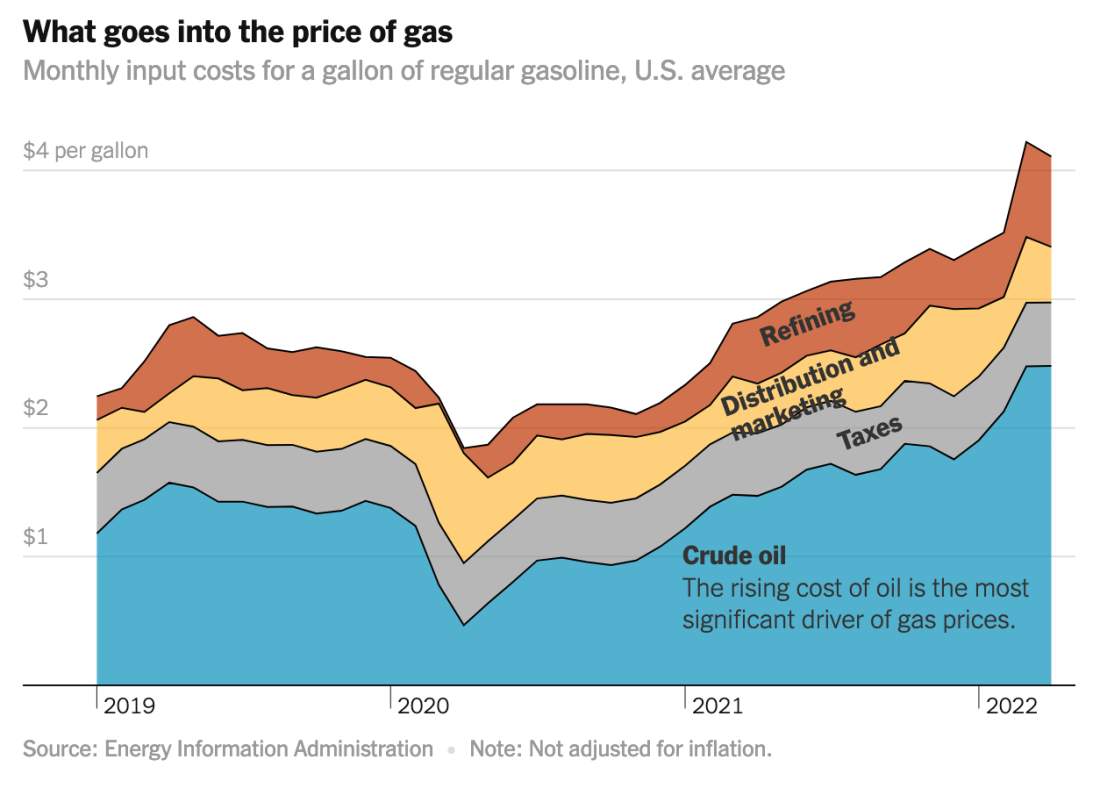
However, with a nation of 45 million being destroyed by its more powerful neighbor that has, so far, resulted in more than 2.5 million (and growing) mostly women and children, forced to escape the country and flooding into the rest of Europe, we shouldn’t worry too much about the price increase of gasoline.

Posted in Russia/Ukraine, Sustainability | Tagged , , , , , , , , , , , , , , , , , , , , , , , , , , , , | 1 Comment

Fog of War: A Dark Sky

 (Source: EverEdge)

Unsurprisingly, this blog will be a continuation of last week’s post, focusing on the Russian invasion of Ukraine. As with almost all wars (I took part in a few) the “fog of war” has already taken over and it is not easy to discern the truth. The rattle of nuclear escalation continues and Russian Foreign Minister Lavrov’s remarks that the country has a nuclear doctrine and is not run by insane people was not very convincing to many outside Russia. The belief in the Russian command and control system is shaky and it includes doubts about how much Lavrov actually knows President Putin’s thinking.

One example of the fog has to do with the state of Ukraine’s power reactors. We see some coverage that focuses on those that have stopped working and indicates a correlation with the Russian invasion:

Six of Ukraine’s 15 working nuclear reactors have stopped sending power into the nation’s electrical grid — a high rate of disconnection compared with routine operations before the Russian invasion. The reduction in output might result from the war’s interference with operation of the plants, which require a wealth of industrial supplies and care. The cutbacks, Western experts say, may spiral into rolling blackouts that could further cripple the beleaguered country.

However, we see the same issue presented in a way that stresses the safe, stable condition of the reactors that are functioning:

The State Nuclear Regulatory Inspectorate of Ukraine, in its update at 08:00 local time (06:00 GMT) on Monday 28 February said, there have been “no violations” of nuclear power plants’ “safe operation limits and conditions”.

The brief update from the regulator also said: “Radioactive situation meets established norms. Systems of NPP physical protection work in normal mode. NPP security divisions and physical protection services are on high alert.”

It said nine of the country’s 15 nuclear units were connected to the grid on Monday.

One day later we saw some “light” (fire) through the fog! Again, various news outlets presented different perspectives.

Reuters:

LVIV, Ukraine/KYIV, March 4 (Reuters) – Russian invasion forces seized Europe’s biggest nuclear power plant on Friday in what Washington called a reckless assault that risked catastrophe, although a blaze in a training building was extinguished and officials said the facility was now safe.

The New York Times:

LVIV, Ukraine — In darkness, Russia captured Europe’s largest nuclear power plant on Friday in Ukraine, prompting questions about the reasons it invaded the sprawling reactor site as well as the health risks to Ukrainians fighting desperately for their lives and freedom.

And it’s not the only power plant in Ukraine that could face attack by Russian forces. Some troops already appear to be marching toward another facility west of the Zaporizhzhia power plant, a Ukrainian energy official said.

For the moment, the Zaporizhzhia nuclear complex appears safe, with the plant’s array of sensitive detectors finding no releases of radioactivity above the usual background levels.

As I mentioned in last week’s blog, Russia is experiencing heavy global penalties for its un-provoked invasion. I am not referring to direct fighting back with guns and bullets; that has so far only involved Ukrainians and a few brave volunteers. However, the fog that is associated with the impact of the global sanctions on Russia is even thicker than the one that hangs over Ukraine. I addressed some of the impacts, such as the catastrophic fall in the stock market, the value of the ruble, and the country’s creditworthiness in last week’s blog. Since then, its stock market was closed for a week, and communication from Russia has been heavily censored. However, what is happening to Russian properties outside Russia has been much more transparent.

Stocks

Market Watch:

The dollar-denominated secondary listings of Russian companies continued to plunge on the London Stock Exchange on Wednesday, as the local Russian stock market remained shut for a third day. Lukoil LKOD, shares dropped 93%, Novatek NVTK, dropped 77% and Rosneft Oil ROSN, collapsed by 58%. X5 Retail FIVE, , [sic] however, surged 58%. Sberbank SBER, , Russia’s number-one lender, traded as low as a penny.

The Guardian:

The London Stock Exchange has suspended trading in 27 companies with strong links to Russia, including the energy and banking firms Gazprom and Sberbank.

The LSE said it was moving to block trading in the companies that include Severstal, Russia’s largest steel and mining company run by Alexei Mordashov, the country’s richest man.

Also barred are the aluminium company EN+, whose owners include the oligarch Oleg Deripaska, state-controlled Gazprom, the world’s largest gas producer, Rosneft and VK, the parent company of social networking sites including VKontakte, which is bigger than Facebook in Russia.

The list also includes the fertiliser company PhosAgro, which is chaired by former LSE chief Xavier Rolet and has shareholders including the billionaire Andrei Guriev, who owns Witanhurst in London’s Highgate, the largest private house in the capital and second in size only to Buckingham Palace.

Also barred are the energy firm Lukoil, Russia’s largest gold producer Polyus, which is controlled by the family of Suleiman Kerimov, as well as Sberbank, the country’s biggest lender, and Novolipetsk Steel, one of the four largest steel companies in Russia.

Oil Trade

Reuters:

LONDON, March 1 (Reuters) – Russian oil trade was in disarray on Tuesday as producers postponed sales, importers rejected Russian ships and buyers worldwide searched elsewhere for needed crude after a raft of sanctions imposed on Moscow over the war in Ukraine.

Numerous nations imposed sweeping sanctions against Russian companies, banks and individuals following Russia’s invasion of Ukraine last week and global majors announced plans to leave multi-million-dollar positions in Russia.

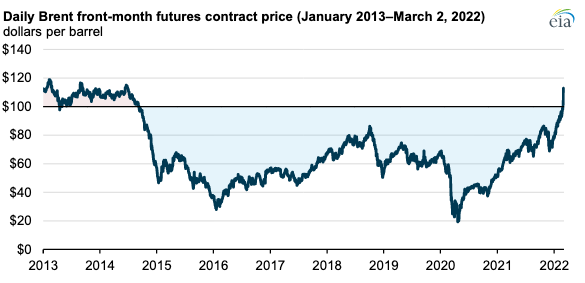
In addition, the price of oil has risen above $110/barrel—a 10 year high (As Oil Soars, OPEC and Its Allies Are Not Likely to Offer Relief). We still don’t know what the full impact of the soaring prices will be. Next week’s blog will try to explore whether such a peak in oil price is self-limiting or open-ended.

To add to our collective miseries, the second of the IPCC AR6 reports on the state of climate change became available at the end of last month: “Climate Change 2022 – Impact, Adaptation and Vulnerability.” The report contains 3675 pages, so I seriously doubt that anybody will read it cover to cover. Newspapers around the world have started to cherry-pick pieces relevant to the readers that they serve. I will do the same and ask my students to go over a few sections that I deem important, then elaborate on some of the cherry-picking in future blogs.

Posted in Russia/Ukraine | Tagged , , , , , , , , , , , , | Leave a comment

Russia: The Large Gas Station With Nuclear Weapons

The current situation between Russia and Ukraine started in November 2021, when the Russian army began encircling Ukraine. It was about two months before the Winter Olympics were scheduled to start, and President Putin had promised President Xi that he would attend. All of this was a huge hint to the world that—while an invasion was being planned, it would take place after the closing. Indeed, only a few days after the Sunday, February 20th closing, the Russian army started a massive Ukrainian invasion from all possible directions.

A few days before the invasion, a Harvard economist gave a succinct description of the aggressor:

Russia’s economy is “incredibly unimportant in the global economy except for oil and gas,” Jason Furman, a Harvard economist and former advisor to President Barack Obama, told The New York Times.

“It’s basically a big gas station,” he said.

I was on the same wavelength but less precise with my February 8, 2022 blog, where I described Russia as one of the petrostates: a country whose oil & gas constitute more than 50% of all its exports. It secures about 40% of its total fiscal revenue from fossil fuels.

However, President Putin was not satisfied with surrounding Ukraine with 200,000 soldiers. He also wanted to remind the world that Russia is a major nuclear power—with probably the largest nuclear arsenal on the planet. He did so by demonstrating showy nuclear exercises:

MOSCOW, Feb 19 (Reuters) – Russian leader Vladimir Putin oversaw strategic nuclear exercises involving the launch of hypersonic ballistic missiles and other weapons on Saturday, the latest show of strength at a time of acute tension with the West over Ukraine.

Putin watched the drills from a “situation centre” in the Kremlin, sitting alongside his close ally, Belarusian leader Alexander Lukashenko.

The drills involved launches from warships, submarines and warplanes as well as from land that struck targets on land and at sea, the Kremlin said.

On Sunday we were informed that Russia has put its nuclear forces on high alert.

So now we have a big gas station that is being less than subtle about threatening the world with its nuclear power.

My reaction was to go and re-read The Cold and the Dark, the 1984 book by Paul Ehrlich, Carl Sagan, Donald Kennedy, and Walter Orr Roberts about the world after a nuclear war. The book is not fiction; it is essentially a summary of a conference where scientists presented peer-reviewed pieces about the consequences of nuclear war. The main message that radiates from the book is that there is no “limited nuclear war.” The only reason our single nuclear war was so short and one-sided is that the bombs dropped on Hiroshima and Nagasaki on August 6 and 9, 1945 were the only nuclear weapons available at the time, meaning they marked a definitive end to WWII.

Those of us who studied or experienced WWII find many parallels between the dynamics of then and now—starting with the Treaty of Versailles and ending with the German invasion of Poland in September 1939. After all, the end of the Cold War and resulting breakup of the Soviet Union echoes the humiliation of Germany at the end of WWI. I was born in Warsaw three months prior to the Nazi invasion. The nuclear weapon was not available to anybody until July 1945.

It is obvious to me that with the present availability of nuclear power, no sane leader would start such a war but I can see how a miscalculation and/or miscommunication that confused a first strike with a second could lead to mutually assured destruction.

The press has been full of attempts to analyze President Putin’s psychology: what does he actually want? He came to power about eight years after the 1991 disintegration of the Soviet Union that left the US as the only functioning superpower and it is clear that he wants to reverse the clock. This is problematic because the West has used its power to admit most of the Eastern European countries into NATO. Many of these countries used to be part of the Warsaw Pact, a counterpart to NATO dominated by the Soviet Union during the Cold War. Now that the Warsaw Pact is no longer in play, most of the European countries that border Russia are members of NATO, with the exceptions of Ukraine, Belarus, and Finland. NATO’s Article 5 states flatly that it considers an attack on one of its members as an attack on all of them and will respond accordingly. Russia’s attack on Ukraine is clearly designed to prevent Ukraine from entering NATO.

This crisis comes on top of the three existing global crises the world is already facing (see the February 1, 2022 blog): the COVID-19 pandemic, the worldwide population decline, and the global energy transition driven by climate change. The fertility rates of both Russia and Ukraine are well below the replacement rate of 2.1 and both countries are still COVID hot spots. The only one of these transitions in which Russia has any power is in the last one, because of the statistics that I mentioned earlier. Its position in the energy transition and control over other countries’ energy supplies will have a strong impact on how the transition proceeds.

Europe is especially vulnerable to any energy disruption from Russia. The EU depends on Russia for 40% of its gas and 20% of its oil supply. However, this dependence varies sharply among the EU members. The Netherlands and France are the least reliant on it, while the “illiberal” countries of Hungary and Poland depend on Russian export for almost all their supply.

Figures 1 through 4 show some of the complex dynamics of the global energy supply within the last few years. The global rise in the price of oil and natural gas started way before the Russian preparation to attack Ukraine became visible. There is a correlation between the consumption and production of oil (and everything else) and as we are slowly emerging out of the COVID-19 restrictions, we are also dealing with a ton of supply chain difficulties. The Russian attack is of course not helping. More than that, since the West has decided not to put any of its soldiers on the ground in Ukraine, it has instead adopted a policy that aims to inflict economic pain on Russia. On this score, there might be a sign of success. Figure 5 shows what happened to the Moscow stock market on Thursday. It lost 50% of its value at one moment and got back half of it later on. I stopped following after that but things are changing very quickly.

Figure 1Daily oil price (WTI) over the past two years

Figure 2Recent prices of natural gas

Figure 3Recent changes in production and consumption of liquid fuels.

Figure 4US regular gasoline price

Figure 5 – Recent Moscow stock market prices

Meanwhile, in other positive news (for the US): “Russia’s credit rating cut to junk by S&P as other agencies mull or take downgrade action.” The exchange rate of the ruble (Russia’s currency) against the US dollar faced a similar demotion. All of us will stay tuned.

Posted in Energy | Tagged , , , , , , , , , , , , , , , , , , , , , , , , , | 1 Comment

Power and Politics in Education

The theme of the blog may look familiar to longtime readers of this blog, even if the exact title is new. If you put the title in the search box without quotation marks, you will get many related entries. The term “power and politics in academia” (again, without quotation marks) yields one entry: a blog from July 18, 2017, that discusses the driving forces of the Anthropocene. I also discussed the role of internal politics in academic institutions recently (December 28, 2021):

This observation is routinely attributed to Henry Kissinger who in a 1997 speech at the Ashbrook Center for Public Affairs at Ashland University, said: “I formulated the rule that the intensity of academic politics and the bitterness of it is in inverse proportion to the importance of the subject they’re discussing. And I promise you at Harvard, they are passionately intense and the subjects are extremely unimportant.”

My focus today is on the role that politics play in teaching and learning, as it directly impacts students. As I have mentioned in earlier blogs (see January 19, 2022, where I discuss cherry-picking and bias), there is a large power differential between teachers and students; bias on the part of teachers has a strong impact on student learning and needs to be discussed.

This issue of bias in student-teacher interaction has been covered extensively but mostly in terms of preferential treatment or neglect of certain students over others, based on characteristics such as gender, race, voluntary class participation, past performance, etc. Here, I want to cover biases that can be associated with an outlook on reality, including political biases.

This image is from https://whatiseducationhq.com which has some really interesting things to say on this same topic.

The first driving force that made me return to this issue is the mix of sex and power—something we hear about almost daily. The issue is institutional but not confined to academic institutions. However, when we speak of it in terms of academic institutions, we usually limit it to higher education because students in high schools and elementary schools are generally too young for consent, and our laws governing such behavior are anchored on the student’s age. In colleges and universities, most students are old enough for consent, so the laws and rules of behavior anchor instead on power differentials. Presently, every institution has its own set of regulations about the sexual behavior of its employees. My own institution (City University of New York) has a 23-page document. Here’s a key paragraph:

Amorous, dating or sexual activity or relationships (“intimate relationships”), even when apparently consensual, are inappropriate when they occur between a faculty member or employee and any student for whom he or she has a professional responsibility. Those relationships are inappropriate because of the unequal power dynamic between students and faculty members and between students and employees who advise or evaluate them, such as athletic coaches or workplace supervisors. Such relationships necessarily involve issues of student vulnerability and have the potential for coercion. In addition, conflicts of interest or perceived conflicts of interest may arise when a faculty member or employee is required to evaluate the work or make personnel or academic decisions with respect to a student with whom he or she is having an intimate relationship. Finally, if the relationship ends in a way that is not amicable, the relationship may lead to charges of and possible liability for sexual harassment.

As I said, the restrictions are strictly based on power differentials rather than age.

Since I mostly teach courses that focus on environmental issues, my thinking is as follows: Society puts so much attention on the role of power in personal relationships but gives relatively less attention to the role of power in teaching. At least in the US, however, the latter role has become highly politicized, especially recently. Here are a few examples:

When it came out, The New York Times’ “1619 Project”  became quite controversial, and remains so:

long-form journalism endeavor developed by Nikole Hannah-Jones, writers from The New York Times, and The New York Times Magazine which “aims to reframe the country’s history by placing the consequences of slavery and the contributions of Black Americans at the very center of the United States’ national narrative.”

Additionally, some states have made a popular activity of banning certain books in schools. This includes Maus, the graphic novel about the Holocaust.

Many of us learned, with some horror—whether through the “Inherit the Wind” movie or otherwise—about the Scopes Monkey Trial of 1935, in which segments of society tried to censor teachers from teaching about evolution.

We are now moving through three major global transitions that impact us all: COVID-19, climate change, and the massive reduction in population growth that in many countries is manifesting as population decline (February 1, 2022). The adaptive steps that society is taking to live with these changes are a precious learning opportunity. They can be a laboratory for our students, where they can learn how to use their knowledge in practical settings that will benefit them long after they finish school. Two out of the three transitions will affect my students for much longer than they will me (just in terms of age). However, all three have become highly political.

My climate change classes best demonstrate the related societal impacts and responsibilities of various scenarios. When I ask students about the possible personal impact, I get the response (almost always from female students) that they have decided not to bring kids into this kind of world. These are big decisions, which are politically loaded. We often describe the opinions of climate deniers, but since these are science courses, the arguments must be data-based. Aside from uncertainties in predictions of the future, there is not much science to support climate deniers (according to my data-based bias).

Talks with my colleagues in different departments expose a variety of attitudes regarding how to address similar problems. A Jewish friend was teaching a course on the recent history of the Palestinian-Israeli conflict, with a number of Muslim students taking the course. Both of us (the teacher and I) know that the version of this conflict many Muslim students know often differs from the version known to their Jewish peers. I asked him how he handles the bias disparity.  His answer was that he bases his teaching on original documents. I kept quiet. We both know that he is the one who selects which original documents his class discusses. His cherry-picking of documents might not be such a big issue because his class is an advanced elective, and it is easy for the students to research his background.

When I discussed these issues with another colleague who teaches political science and told him that I am trying to leave my politics out of the classroom, he responded that, in his opinion, everything is driven by politics.

In all these cases, none of us addressed the inherent power asymmetry between teachers and students.

Often, we are not fully aware of our biases. Even if our biases are pointed out to us, if we try to correct for them, we may end up with biases in the opposite direction. In my opinion, we cannot eliminate biases, but we can make them more transparent, such that students can normalize their analysis as part of their learning experience. One good way to accomplish this is by basing more of the course material on class conversation and group teaching: Team-Based Learning (TBL).

Occasionally, students complain about biased teachers. These complaints can go through various routes, including family, press, courts, etc. but most complaints end up with the administration of the institution. Some faculty (in the US now about 20%) has tenure for life—a measure designed to protect their academic freedom but which is conditional on following certain codes of conduct (see for various aspects of these issues:

https://www.aaup.org/article/academic-freedom-online-education


https://www.indeed.com/career-advice/career-development/the-role-of-tenure?aceid=&gclid=CjwKCAiAx8KQBhAGEiwAD3EiP4r2jbuhLqZM-D_aV_Yl6jWX5Ns_mspUR8qT6YXt4IoREbl_sLlgjxoCvMQQAvD_BwE )

Lifetime job tenure is not restricted to academia but without its protection, bias complaints can result in job termination.

The COVID-19 pandemic that triggered such advancement in remote learning offers one way to address these issues. Like many others, during the last two years, I have been teaching online. In one of the climate change courses that I taught, I used the TBL system. I divided the class into groups, which, during class time, I put into separate “rooms” where they could discuss the issues. Outside of class, I opened a Discussion Board on BlackBoard (A commonly used application) where they could communicate, letting them know I would visit periodically to monitor their discussions and add comments or answer questions as needed. A few students commented that opening a separate WhatsApp group might help. I agreed but I told them that group would be totally their own. The results were interesting.

Posted in Climate Change | Leave a comment

Robotics

Earlier this month (February 1, 2022), I mentioned the steps that Germany and the US have taken recently to remediate the decline in their workforces. Both countries basically declared that they are going to initiate brain drains from abroad (mainly from poorer countries). Germany said that it intends to initiate the yearly immigration of 400,000 skilled workers, while the US announced a new policy to facilitate the attraction of students in the sciences, presumably with the thinking that many of them will stay once they finish their studies.

The decrease of the “native” (excluding immigration) workforce follows a global decrease in fertility rates and an increase in life expectancy. Type “population decrease” into the search box and you will find multiple earlier entries that relate to the topic. However, only one significant entry pops up if you search for “robotics” (February 11, 2014) and it’s from 8 years ago. It addresses the global shipment of robots, using data through the year 2011. It’s time to revisit the issue.

robot, manufacturing, jobsFigure 1

Figure 1, taken from The Robot Report, summarizes the issue as it stands presently. The site adds the following information:

There are more than three million industrial robots operating in factories around the world, according to the International Federation of Robotics (IFR). In 2020, there was $13.2 billion of new robot installations.

Robot density, a metric used by the IFR, measures the number of robots per 10,000 workers in an industry. From 2015 to 2020, robot density nearly doubled worldwide, jumping from 66 units in 2015 to 126 units in 2020. In 2020 alone, robot density globally jumped from 113 units in 2019 to 126 units.

Regionally, Asia has the highest robot density in 2020, sitting above the global average at 134 units. Europe is slightly below the global average, with 123 units, followed by the Americas with 111 units.

The total number of people employed worldwide is estimated at 3.3 billion. In contrast, about 3 million industrial robots operate around the world, meaning they account for only 0.1% of the global workforce. However, in South Korea (the Republic of Korea) robots already account for 10% of the workforce and globally, the growth rate of robotics is 10%. These are significant numbers. Presently, the shift to robotics is confined to rich countries (including S Korea).

Figures 2 – 6 show the recent population changes that are taking place in the five countries with the largest robot densities, as shown in Figure 1. Each of these countries has its own dynamic.

population, decline, Japan, South Korea, Korea

Figure 2Population changes in Japan and South Korea (Source: World Economic Forum)

Singapore, population

Figure 3Population changes in Singapore (Source: Countryaah.com)

Germany, population

Figure 4Population changes in Germany (Source: Visual Capitalist)

What deserves special attention is the relative changes in the age group composition in Germany, as shown in Figure 5.

Germany, population, change

Figure 5 Changes in the age distribution of the German population (Source: Visual Capitalist)

Sweden, population, growth

Figure 6 Changes in the population growth of Sweden (Source: Statista)

The increases in robotics and brain drain haven’t yet caused social and governmental disruptions on the level of increased immigration but we are still at the beginning of the trend. This gives us some time to address the social consequences that are sure to come.

Posted in Economics | Tagged , , , , , , , , , , , , , , | 1 Comment

Petrostates

Right now, in the energy transition, there is an emerging weaponization of energy. Russia’s confrontation with the West over Ukraine is the present focal point. The following two publications provide some details:

“What Happens if Russia Cuts Off Europe’s Natural Gas?” – The New York Times

While Russia masses troops and military equipment near its border with Ukraine, parallel tensions have been building in world energy markets.

It is not hard to see why. Natural gas flowing through a web of pipelines from Russia heats homes and power factories across much of Europe. Russia is also one of the continent’s key sources of oil.

Now Western officials are considering what happens if Moscow issues a doomsday response to the tensions — a cutoff of those gas and oil supplies, in the depths of Europe’s winter.

The standoff over Ukraine comes at an inopportune time. World energy prices are already elevated as supplies of oil and natural gas have lagged the recovery of demand from the pandemic.

Russia Isn’t a Dead Petrostate, and Putin Isn’t Going Anywhere – The New York Times Opinion

Some may see Russia’s actions as the last gasp of a fading petrostate before the energy transition robs the country of geopolitical power. But that would be wishful thinking. The transition to a clean energy economy may actually empower Vladimir Putin, Russia’s president, and other petrostate leaders before it diminishes them.

In a world that is “net zero” on its carbon emissions, major fossil fuel producers — especially Russia — will be greatly diminished in their power, assuming they do not find a way to remake their economies in the interim. But in the next 10 to 20 years, the energy transition will make opportunities for petrostates to wield significant geopolitical and economic power. There are at least three reasons this is the case.

Petrostates obviously have the ability to use energy supply as a weapon, one reason that they are also the most desperate to slow the transition away from fossil fuels. I am sensitive to these dynamics. I have mentioned often on this blog that I grew up in Israel. At the time, Israel was surrounded by petrostates that were in a state of war with my country, trying to weaponize their energy. As a student, I chose to specialize in alternative energy use—not because of climate change but in an attempt to help develop alternatives to the state’s energy supply.

Below is how Wikipedia defines petrostates:

petrostate is a nation whose economy is heavily dependent on the extraction and export of oil or natural gas. The presence alone of large oil and gas industries does not define a petrostate, as countries like Norway, Canada, and the United States are major oil producers, but also have diversified economies.[1] Petrostates also have highly concentrated political and economic power, resting in the hands of an elite, as well as unaccountable political institutions which are susceptible to corruption.[2]

While the largest oil-producing states are often petrostates, this is not always true. In 2014, for example, the United States and Canada were among the top-five oil producing countries, but are not defined as petrostates due to their diverse economies.[1] Various countries have been identified as current or former petrostates:[2][1]

Although Norway, the US, and Canada are among the largest exporters of fossil fuels, their economies are diversified, meaning that they can handle fluctuations of the energy markets much better than the countries Wikipedia defines as petrostates. Before the pandemic and the emergence of the Russia-Ukraine crisis, The Economist ran an article with some updated data about the need for energy producers to diversify:

Figure 1The dependency of major energy producers on income from energy exports

Revenues from oil and natural gas have plunged in recent years, as prices have fallen. A new report from the International Energy Agency (IEA) puts the challenge in stark relief. In six large petrostates the IEA examined—Iraq, Nigeria, Russia, Saudi Arabia, the United Arab Emirates and Venezuela—net income from oil and natural gas in 2016 was less than one-third of its level in 2012. Such a huge drop-off is painful. In Russia, oil and gas receipts account for about 40% of the government’s revenue. In Iraq they account for 90%.

The response to sinking prices has varied. Many countries ran deficits rather than slash their generous domestic spending programmes. Bahrain requires a crude price of $113 a barrel to support its budget, according to MUFG, a bank. But most countries have started talking more earnestly about diversification. Fatih Birol, director of the IEA, predicts that countries’ efforts will gain more urgency for two reasons.

Russia stands out in this analysis both in terms of its dependence on this income and the income’s changes over time.

I have repeatedly emphasized the need to pay attention to both the winners and losers of the various transitions that we are going through— (see for example, “Winners and Losers: COVID and Coal” from February 9, 2021; “Yellow Vests, Al Gore, President Trump, Conflicts Between Present and Future” from December 18, 2018; and “Wisdom from Germany: How to Transition Away from Coal” from October 8, 2019).

As the current crisis with Russia shows, the price of not paying attention to the losers can be deadly.

Posted in Energy, Sustainability | Tagged , , , , , , , , , , , , , , , | Leave a comment

Back to the Energy and Population Transitions: Electrification and Brain Drain

In this blog, I will look at the ongoing global energy transition and the declining populations of rich countries around the world. I am specifically interested in attempts to redefine sustainable energy sources, as well as the ways in which brain drains from developing countries are affecting the populations of rich countries.

As a background, Figure 1 shows an infographic, constructed by Visual Capitalist, of the global use of nuclear energy to power electricity production:

Figure 1Global use of nuclear power for electricity production

Attempts to Define Sustainable Energy Sources

Figure 2 shows that, at least in the US, coal is on its way out. In other developed countries, the trend is similar. The issue is how to replace it as the primary energy source for electricity generation.

Figure 2Changes in US coal use for electricity generation (source: CleanTechnica)

Europe is finding itself with severe energy shortages and price increases. In an attempt to remedy the shortage, the EU declared natural gas and nuclear energy to be “sustainable energy sources.” This declaration didn’t come without serious opposition, however

Advisers to slam EU plan to label gas, nuclear investments as green-draft:

BRUSSELS, Jan 21 (Reuters) – Experts advising the European Union on its green investment rules will warn Brussels not to go ahead with draft plans to label gas and nuclear energy as sustainable, according to a document seen by Reuters.

The Commission’s proposals would grant gas plants a green label until 2030 if they meet criteria including an emissions limit of 270g of CO2 equivalent per kWh, or if their annual emissions average 550kg CO2e per kW or less over 20 years.

Germany cries foul over nuclear energy in EU’s green investment rule book:

BERLIN, Jan 22 (Reuters) – German Chancellor Olaf Scholz’s three-party coalition government has voiced its objections to a European Union draft plan to label nuclear power plants as a sustainable energy source in a formal letter to Brussels, ministers said on Saturday.

The EU taxonomy aims to set a gold standard for green investments, helping climate-friendly projects to pull in private capital and stamping out “greenwashing”, where investors and companies overstate their eco-credentials.

“As the federal government, we have once again clearly expressed our rejection of the inclusion of nuclear energy. It is risky and expensive,” Vice Chancellor and Economy Minister Robert Habeck said in a joint statement with Environment Minister Steffi Lemke, both senior members of the Greens party.

The US is not far behind. As Figure 1 shows, the US is the largest user of nuclear energy for the production of electricity. However, in the US, nuclear energy is not currently facing serious objections.

Many US states view natural gas as a somewhat sustainable energy source because of its considerably lower carbon output per unit of electricity production, compared to coal (See May 25, 2021 blog). However, its use has not escaped the current political divide within the US. Figure 3 shows that various states have taken legal steps to either prohibit or advance the use of natural gas in the construction of new power stations.

Figure 3US States advancing and prohibiting the use of natural gas to power electrification (source: CleanTechnica)

These policy shifts are starting to have consequences.

Brain Drain From Developing Countries

In another facet of the future, there is a tremendous brain drain currently taking place among front-line personnel. Doctors and nurses from around the world have turned out to help confront the COVID-19 pandemic, especially in rich countries but this will inevitably have an effect on the countries that they leave behind. Indeed, Germany already announced plans detailed plans continue to draw such people:

Germany wants to attract 400,000 skilled workers from abroad each year:

BERLIN, Jan 21 (Reuters) – Germany’s new coalition government wants to attract 400,000 qualified workers from abroad each year to tackle both a demographic imbalance and labour shortages in key sectors that risk undermining the recovery from the coronavirus pandemic.

“The shortage of skilled workers has become so serious by now that it is dramatically slowing down our economy,” Christian Duerr, parliamentary leader of the co-governing Free Democrats (FDP), told business magazine WirtschaftsWoche.

The US announced its intention to attract foreign students in the sciences, with the hope that many of them will stay after finishing their studies:

The Biden administration on January 21 announced policy changes to attract international students specializing in science, technology, engineering and math — part of the broader effort to make the US economy more competitive.

The State Department will let eligible visiting students in those fields, known as STEM, complete up to 36 months of academic training, according to a notice in the Federal Register. There will also be an initiative to connect these students with US businesses.

Homeland Security will add 22 new fields of study — including cloud computing, data visualization and data science — to a program that allows international graduates from US universities to spend up to three additional years training with domestic employers. The program generated about 58,000 applications in fiscal 2020.

The programs are designed to ensure that the US is a magnet for talent from around the world, attracting scientists and researchers whose breakthroughs will enable the economy to grow. Government data shows that international students are increasingly the lifeblood of academic research.

Such brain drains, as a response to population decline, are bound to have deadly global consequences for both rich and developing countries.

Next week’s blog will start to focus on individual countries that lead attempts to confront various global transitions. I will start with the petrostates.

Posted in Climate Change, Electricity, Energy, Sustainability | Tagged , , , , , , , , , , , , , , | 1 Comment