Audience Assessment: End of Year Test

2016 is about to end. It was a very challenging year around the world. Certain factions gained ground internationally, winning significant majorities in publicly elected government. In some senses, globalization has become a curse – when it gives rise to the nationalistic, xenophobic movements we are seeing right now. There’s been almost no way to distinguish between real news and fake news. Meanwhile, instead of treating climate change as an early sign of a transition to a human-dominated (Anthropocene) era – with the accompanying responsibility and accountability, people in charge have deemed it a “Chinese conspiracy” or a “new false religion.”

I started this blog on Earth Day 2012 – my small contribution to countering these trends. It’s high time to see how I’m doing. I will dedicate the two next blogs to such assessments, given the momentous and alarming trends that we have all experienced in 2016. My hope is that by doing so, I will help myself (and you!) be able to start 2017 with an optimistic smiling face and some helpful resolutions in mind.

I am an academic and teacher. Any school assessment necessarily involves questions such as “how well is the institution satisfying its goals?” and “how are the students benefiting from the training that the institution provides?” My quarterly assessment blogs, which I started in July of 2014, have all focused on self-evaluations – mainly in terms of exposure and feedback. This time I want to turn my attention to you, the readers.

The end of the year also coincides with the end of the semester in most schools. One of the most important measures of students’ learning is their performance on their final exams.

I teach a General Education course on “Energy Use and Climate Change.” The only prerequisite (November 29th blog) for this course is Junior Standing; as far as I am concerned, even that condition is superfluous. As I tried to explain here in a series of blogs starting May 24, 2016 (“Educating for the Anthropocene”), my wish is for all 7.3 billion citizens on Earth (babies get an exemption) to have access to similar material. With that in mind, I am attaching the final exam that I gave my students at the end of the course. That way you can all try your hands at finding out how you (and I) are doing.

The three sections of the exam A, B and C were designed to cover three categories – A: thinking, B: skills to calculate quantitative implications, and C: following current events.

Students got two hours to complete the exam. In addition to the exam my students got an additional page that includes all necessary unit conversions and the chemical reactions that are involved in using the three main fossil fuels: coal, petroleum, and natural gas.

In attempting to solve the exam, you can take as much time as you need and freely use the information available on the internet. Please don’t put the questions to Google or Wikipedia and type the answers verbatim; this would be too transparent and embarrassing.

Here is the exam: Good luck!

Answer all three parts of the exam (A, B and C): Section A is worth 60 points, section B is worth 40 points, and section C is extra credits worth 10 points.    

A. Answer one question from section a and one question from section b.

a. If you look at the World Bank database’s website, there is a section under Data called Indicators with a section on climate change. Two of the 41 climate change indicators are given below:

  • Ease of doing business
  • Ratio of girls to boys in primary and secondary education

Select one of the two indicators and try to justify its inclusion in the climate change category.

b. If you look at the summary of the recent Work Energy Outlook 2016 that was issued by the International Energy Agency you will find summary of trends that resulted from the recent UN Climate Change Conference that was held in Paris on December 2015. Two of these trends include:

i. Energy and water: one doesn’t flow without the other with an emphasis that managing energy-water linkages is pivotal to the prospects for successful realization of a range of development and climate goals.

ii. Efficiency is the motor of change

Select one of these two trends and explain the reason why the IEA selected to focus on this trend to achieve the objectives of the Paris meeting.

B. Answer one question from section a and one question from section b: Unit conversion page is included on the bottom of the test.

a. Answer one of the two choices in the following question:
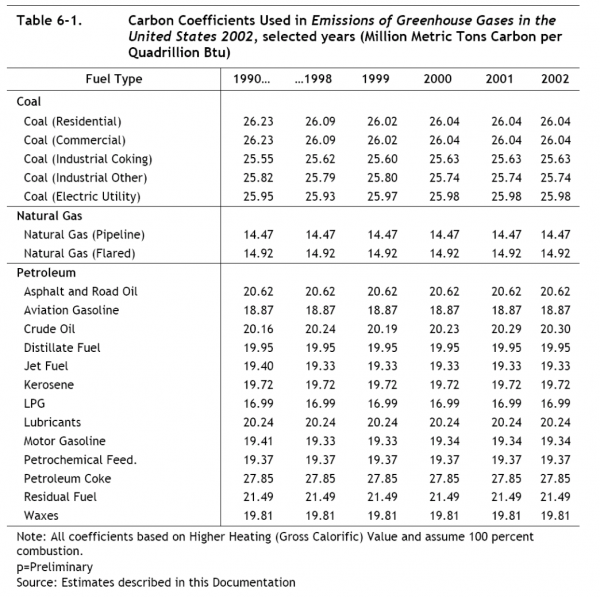
The table below shows the carbon coefficients of various fuels as calculated by the Energy Information Administration (EIA).

Select one of the two Natural Gas entries and compare these values with first principle calculations. One value as an example will do.
CO2

Metric tons per capita

Energy Use

Kg of oil equivalent per capita

Population

Billions

Population Growth

%

China 2.7 947 1.28 0.27
India 1.2 509 1.05 1.6
US 20.1 7936 0.29 1.1
World 3.9 1693 6.2 1.2

Use the data above to answer the following two questions:

  • Compare (in %) the top energy user and the top CO2 emitter with the World energy use and CO2
  • In class you have estimated that if present growth patterns will continue China’s GDP/Capita will approximately equal US GDP/Capita in about 50 years. Assuming again that present growth patterns will continue – what will be the approximate World population at that time?

b. Answer one of the two questions below.

  • An electric power generator of 1.5kW can supply electricity to an average American home. A modern wind turbine can generate up to 4 MW power. How many homes can it serve? (chapter 11).
  • How much coal will have the same heating value as 10 gallons of gasoline? (chapter 10)?

C.  President elect Donald Trump declared over his recent presidential campaign that climate change is a Chinese hoax designed to slow the American economy. He promised to take the US out of the recent Paris global agreement that was discussed in section A. What are his options once he takes office and what are the expected consequences from his actions?

Have a Happy Break!!
Posted in assessment, Climate Change | Tagged , , , , , , , , , , , , , , , , , , , , , , , , , , , , , , , , , , , , , , , , , , , , , , , , , , , , , , , , , , , , , | Leave a comment

The Urban/Rural Voting Split: a Global Perspective

Last week’s blog looked at the separation between the rural and urban vote in the just-concluded US presidential elections. This week I will examine whether this split is a unique American phenomenon or part of the global transition as we shift towards a human-controlled environment (Anthropocene – see previous blogs).

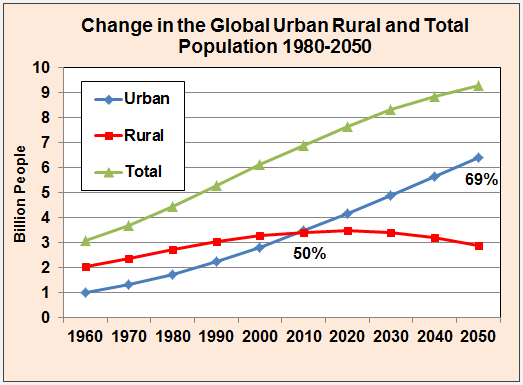
Figure 1 clearly shows that humanity is migrating in a massive way toward cities. The ratio between global urban populations and total population is increasing sharply.

Figure 1

A recent project was able to map the history of city settlements to the purported origin of their formation nearly 6,000 years ago.

(Esri, HERE, DeLorme, MapmyIndia, ©OpenStreetMap contributors, and the GIS user community/Meredith Reba et al, Scientific Data , Nature Publishing Group)

Figure 2first recorded populations for all urban settlements between 3700 B.C. and 2000 A.D.

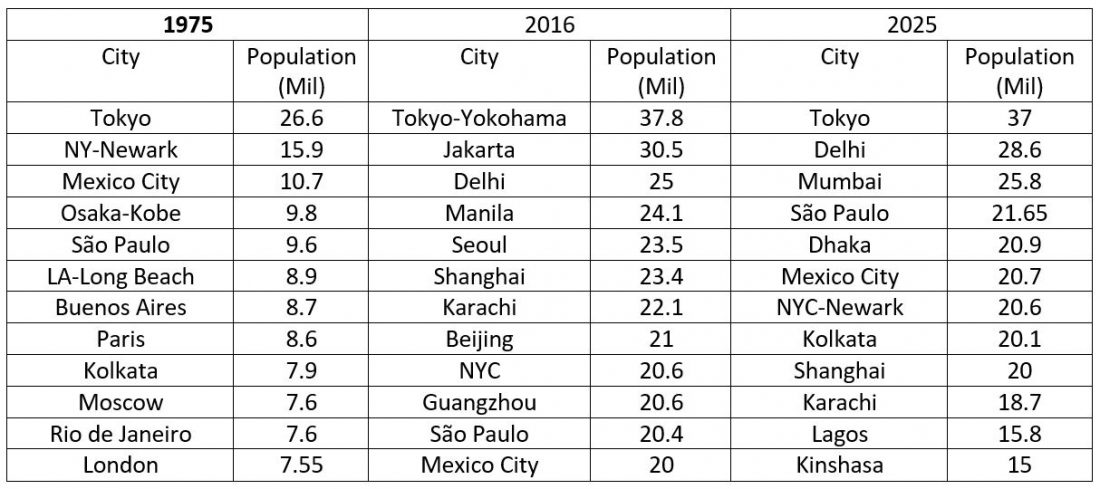
Table 1 shows the 12 most populated cities in 1975, now (2016), and as projected for 2025.

Table 1 – Population of the 12 most populated urban environments

The data for the 1975 and 2025 were taken from a special Science issue dedicated to to marking humanity’s passing the 7 billion people threshhold (Science 333, 543 (2011)); the data for 2016 were taken from WorldAtlas.

I will return to this table in upcoming blogs to discuss the future impact of climate change on sea level rise. For instance, in business as usual scenarios, most of the people who live in these cities will have to move as the majority of said cities will eventually be flooded.

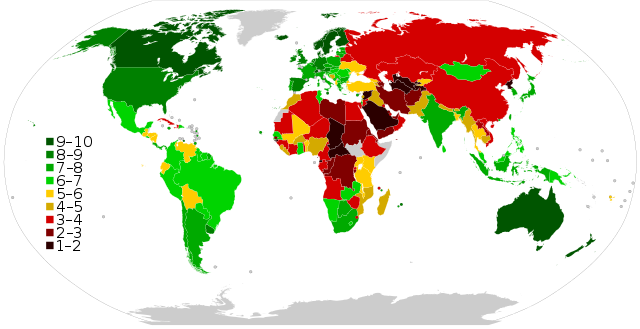
For most countries, the political consequences of this population redistribution will not be immediate – due in part to their lack of a one man-one vote democratic election system. Figure 3 shows a global map of the democratic index (March 8, 2016 blog).

By Ternoc – Own work, CC BY-SA 4.0, https://commons.wikimedia.org/w/index.php?curid=48202088

Figure 3 – Global map of the democratic index

Many commentators tried to compare the American election’s urban/rural split to that of Great Britain’s Brexit vote (August 16, 2016 blog). Recent results show that a total of 53.4% of people in England voted to leave the EU. However, this was not reflected in its major cities, most of which voted to remain.

Of its major cities, only Birmingham voted to leave, with a tight result of 50.4% (Leave) to 49.6% (Remain). As predicted, London voted in favor of remaining, but Bristol, Liverpool, and Manchester also voted overwhelmingly in favor of remaining. The results from other cities show a clear preference for the “remain” vote as well:

Birmingham: LEAVE: 50.4% REMAIN: 49.6%

Bristol: LEAVE 38.3% REMAIN: 61.7%

Leeds: LEAVE: 49.7% REMAIN: 50.3%

Liverpool: LEAVE: 41.8% REMAIN: 58.2%

London: LEAVE: 40.1% REMAIN: 59.9%

Manchester: LEAVE: 39.6% REMAIN: 60.4%

Aberdeen city LEAVE: 38.9% REMAIN: 61.1%

Edinburgh city: LEAVE: 25.6% REMAIN: 74.4%

Glasgow city: LEAVE: 33.4% REMAIN: 66.6%

Cardiff: LEAVE: 40% REMAIN: 60%

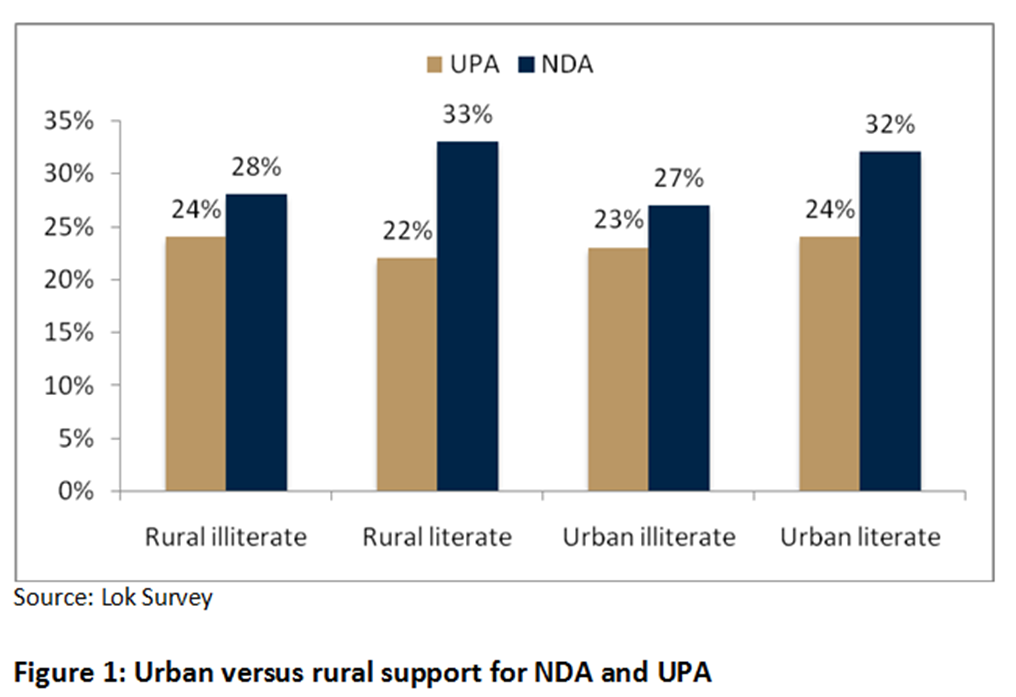
A much more interesting case might be to examine the urban/rural split of the most recent (2014) vote in the largest democracy on the face of the earth – India. Figure 4 shows the performance of the two main national blocks: The National Democratic Alliance (NDA) led by the Bharatiya Janata Party and the United Progressive Alliance (UPA), led by India’s National Congress. In terms of parliamentary seats, it was a landslide win for the NDA (336 seats for the NDA and 58 seats for the UPA). However the rural/urban split among both the literate and illiterate electorate was considerably more balanced.

Figure 4

814 million Indians were eligible to vote and the country had a participation rate of 66.5%. India’s issues were obviously different than those of England and the US, but the common denominator was the desire for change shared by both urban and rural constituencies. One important, noticeable issue in India’s elections was the limited representation of the Muslim population. Only 22 of the 543 elected parliamentary seats went to Muslims, even though Islam is the second largest religion in India, its practitioners making up 14.2% of the population. 172 million people in India are self-declared Muslims (2011 census) yet they only got 4% of the seats. For comparison, African Americans constitute 12.2% of the US population (approximately 38 million people); within the current congressional term (the 114th US Congress), they hold 2% of the Senate (2 out of 100 seats) and 10.5% of the House of Representatives (46 out of 435 seats).

Posted in Election | Tagged , , , , , , , , , , , , , , , , , , , , , , , , , , , , , , , , , , , , , , , , , , , , , , , , , , , , , , , , , , , , , , , , , , , , , , , , , , , , , , , , | 1 Comment

Election and Urbanization

Last month (November 22), I promised I would focus on some of the non-racial factors that significantly impacted the presidential elections. Last week’s blog explored educational aspects and today’s post will look at the urban/rural divide. The four figures below summarize the data.

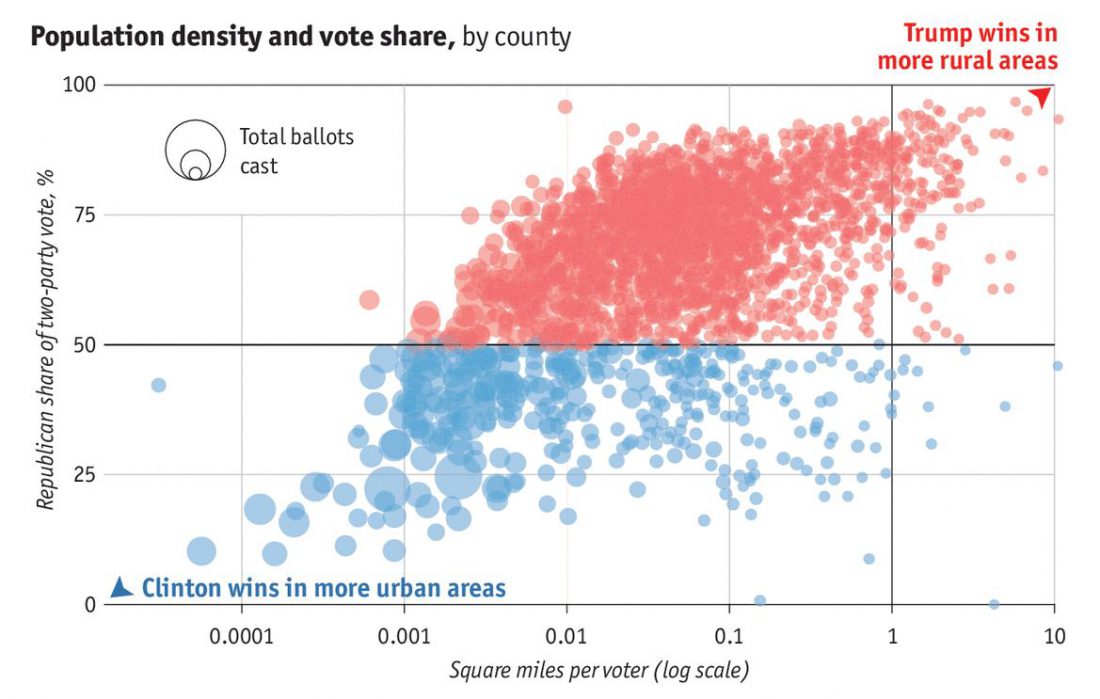
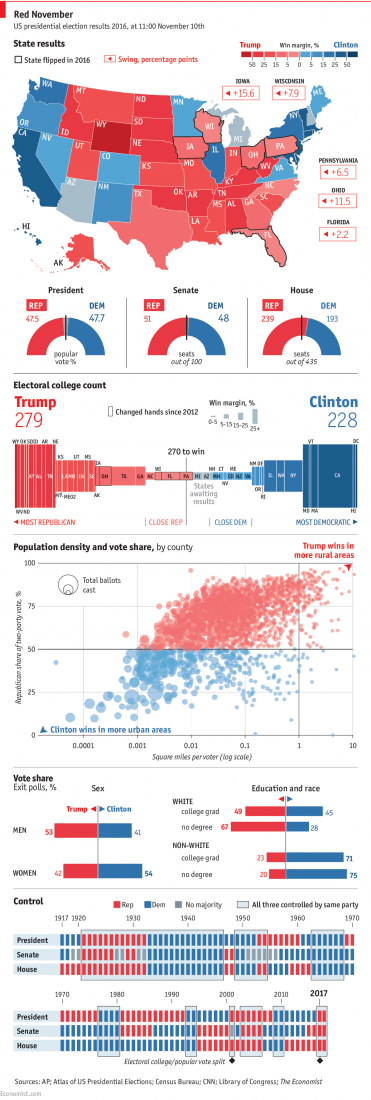
The first figure, taken from the Economist (the original sources were not specifically accredited within the article), provides the most complete description because it presents voting preferences as a function of a proper, measurable, non-confrontational variable: voter density (the reciprocal is square mile per voter). The scale is logarithmic (August 6, 2012 blog) to represent the extreme differences between high density urban populations and low density rural populations.

It is unfortunate that the data in the figure focus on density of voter population rather than that of the general population but in this case it is safe to assume that both are highly correlated.

population-density-and-vote-share-by-county-2016Figure 1

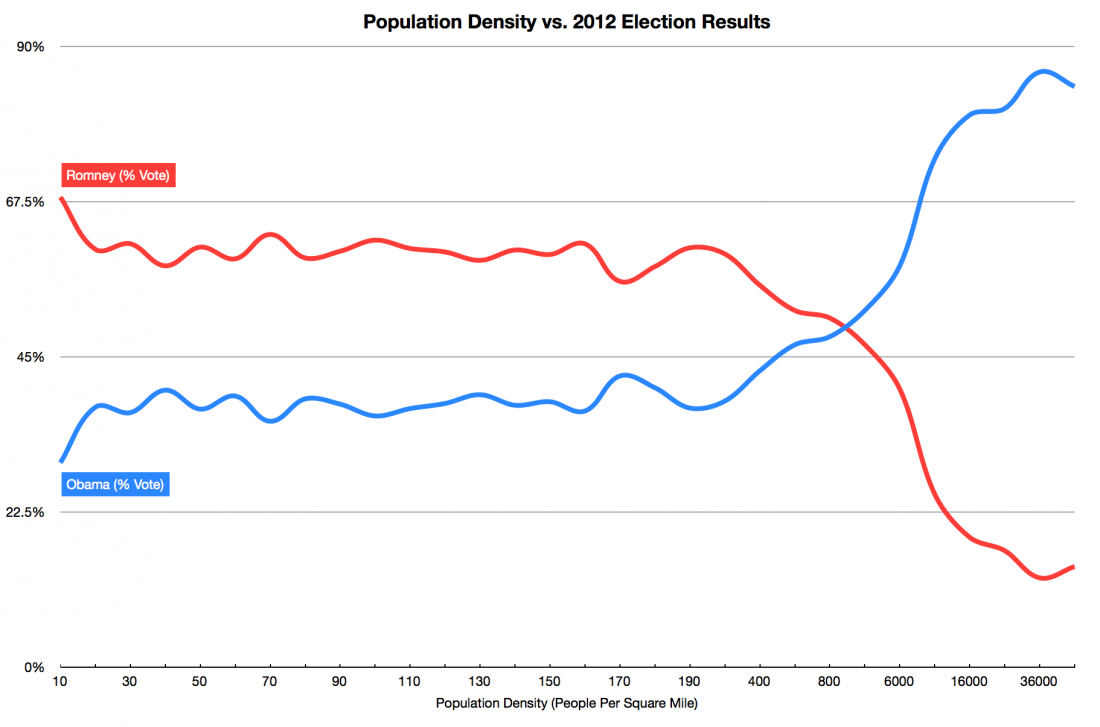
Is this sharp divide a Trump effect? Figure 2, which provides similar data from the 2012 elections clearly shows via total population density that this is not the case. The scale that they chose to use for Figure 2 is especially interesting (and somewhat suspicious) once you look closer. The horizontal scale is linear (a constant of 20 people per square mile) almost until the red and blue lines intersect, at which time it converts sharply into a non-linear logarithmic scale. Even after employing this kind of ruse, Figure 1 shows data for 6 orders of magnitude change in population density while Figure 2 shows data for variations that span less than 5 orders of magnitude. Proper scaling would require a repeat of the logarithmic scaling shown in Figure 1, which would (more accurately) show a much smoother transition between rural and urban voters.

population-density-vs-2012-election-resultsFigure 2

Meanwhile, the definitions of what constitute urban or rural areas can be controversial and somewhat arbitrary. Urban areas are usually associated with city populations, however, city boundaries often originate from political decisions. I ran across this difficulty when my students tried to calculate contributing factors to climate change through the IPAT identity (November 26, 2012) [Yevgeniy Ostrovskiy and Michael Cheng and Micha Tomkiewicz; “Intensive and Extensive Parametrization of Energy Use and Income in US States and in Global Urban Environments,” The International Journal of Climate Change: Impacts and Responses, Volume 4, Issue 4, pp.95-107.(2013)]. In that instance, we couldn’t find data that listed the indicators in a continuous way throughout density variations. We will try to revisit this project with different students to see if we can find more conclusive information.

Here is how the Census Bureau defines rural and urban:

Source: US Census Bureau

Released: Oct. 1995

URBAN AND RURAL

The Census Bureau defines “urban” for the 1990 census as comprising all territory, population, and housing units in urbanized areas and in places of 2,500 or more persons outside urbanized areas.  More specifically, “urban” consists of territory, persons, and housing units in:

  1. Places of 2,500 or more persons incorporated as cities, villages, boroughs (except in Alaska and New York), and towns (except in the six New England States, New York, and Wisconsin), but excluding the rural portions of “extended cities.”
  1. Census designated places of 2,500 or more persons.
  1. Other territory, incorporated or unincorporated, included in urbanized areas.

Territory, population, and housing units not classified as urban constitute “rural.”  In the 100-percent data products, “rural” is divided into “places of less than 2,500” and “not in

places.”  The “not in places” category comprises “rural” outside incorporated and census designated places and the rural portions of extended cities.  In many data products, the term “other rural” is used; “other rural” is a residual category specific to the  classification of the rural in each data product.

In the sample data products, rural population and housing units are subdivided into “rural farm” and “rural nonfarm.”  “Rural farm” comprises all rural households and housing units on farms (places from which $1,000 or more of agricultural products were sold in 1989); “rural nonfarm” comprises the remaining rural.

The urban and rural classification cuts across the other hierarchies; for example, there is generally both urban and rural territory within both metropolitan and nonmetropolitan areas.

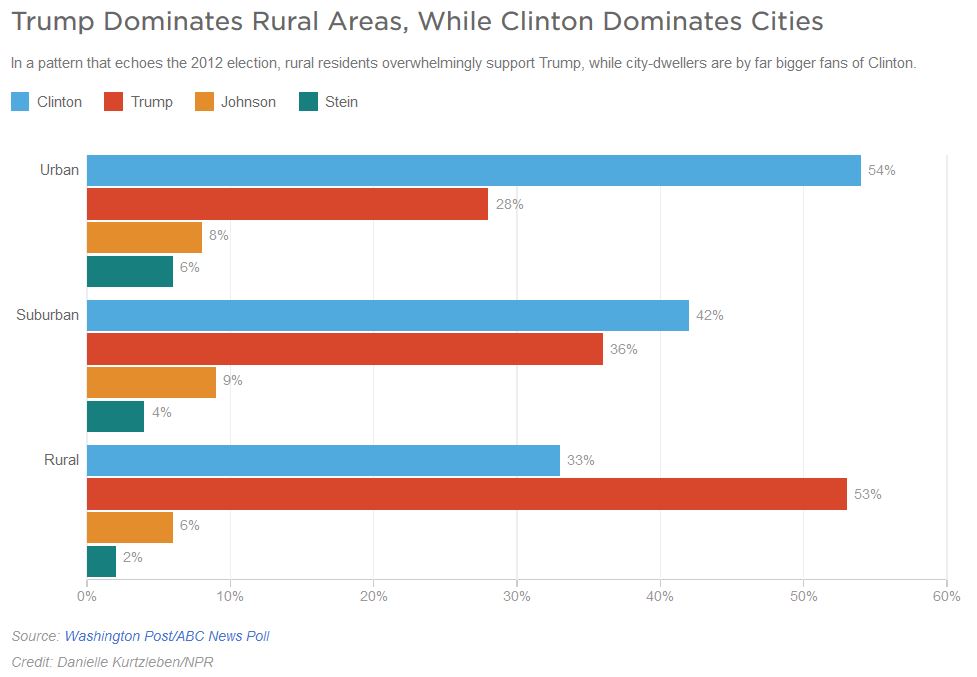
Based on these definitions, the rural/urban 2016 election divide can be simplified to resemble Figure 3 (http://www.npr.org/2016/08/18/490240652/is-rural-resentment-driving-voters-to-donald-trump):

rural-suburban-urban-votes-2016-presidential-electionFigure 3Blue: Clinton; Red: Trump; Yellow: Johnson; Green: Stein

In the election results shown in Figures 1 and 2, the rural/urban patterns look similar. In both elections, the Democrats won a small majority of the popular vote but – as we’ve discussed (November 1, 2016), the electoral vote is the deciding factor. Donald Trump clearly won that race this year as Barack Obama did in 2012.

One of the most pressing issues is the reason for the persistently sharp rural/urban split. This became a key talking point for an increasing number of commentators, but I have to admit that I still don’t have a satisfying answer that can account for it.

Nor is this specific to the United States. One of the most striking impacts of the Anthropocene period is rapid global urbanization, which I will discuss next week. Figure 4 shows some historic data about this trend in the US:

US Rural and Urban Population Growth Chart Figure 4 US Rural and Urban Population Chart from Climate Change Impacts on the United States: The Potential Consequences of Climate Variability and Change , published in 2001

The numbers clearly show that, as in the rest of the world, people are flocking to cities, which now comprise an overwhelming majority of the country’s population. Yet the rural populations in a few states can still shift presidential elections. This has caused many (on the losing side) to start grumbling about dissolving the Electoral College – something that I have argued against (November 1). Here is what the NYT’s Emily Badger recently wrote about it:

The Democratic candidate for president has now won the popular vote in six of the last seven elections. But in part because the system empowers rural states, for the second time in that span, the candidate who garnered the most votes will not be president.

Rural America, even as it laments its economic weakness, retains vastly disproportionate electoral strength. Rural voters were able to nudge Donald J. Trump to power despite Hillary Clinton’s large margins in cities like New York. In a House of Representatives that structurally disadvantages Democrats because of their tight urban clustering, rural voters helped Republicans hold their cushion. In the Senate, the least populous states are now more overrepresented than ever before. And the growing unity of rural Americans as a voting bloc has converted the rural bias in national politics into a potent Republican advantage.

“If you’re talking about a political system that skews rural, that’s not as important if there isn’t a major cleavage between rural and urban voting behavior,” said Frances Lee, a professor of government and politics at the University of Maryland. “But urban and rural voting behavior is so starkly different now so that this has major political consequences for who has power.

As Figure 4 demonstrates, the urban population is rapidly increasing, largely by means of migration. These newer urban dwellers are often exposed to minorities and immigrants more than their rural counterparts, as well as being forced to adapt faster to change. These interactions have become major markers in recent elections.

Significant fragments of the decreasing rural populations love their settings and have no desire to mingle with the city crowds. They cling to the past, wanting to recreate bygone conditions that would enable them to have what they believe (or were told by their parents) to be good life. This subset doesn’t like the changes taking place that apparently benefit the cities. Therefore, since the migration from rural to urban areas does take place, an important question is the nature of the clustering; i.e. who is moving. When I examined this, I noticed that these migrating constituencies include especially high percentages of (college educated) professionals and young people.

As we’ll see next week, on a global scale this urbanization process is not necessarily restricted to clustering at the top; rather, the main transplants are simply those looking for better jobs. Some of these newcomers are international immigrants who settle in poorer neighborhoods in search of better economic opportunities for themselves and their families. While sovereign countries can block some such immigration, in-country migration is subject to fewer restrictions. This means that the people who stay behind in the countryside include increasing numbers of older people who for various reasons did not attend college. In essence, this creates two new countries: one looking to the future and the other which strongly dislikes that future and has the power to slow down progress. Our Founding Fathers constructed the electoral system the way that they did specifically to force the government to pay attention to the rural population.

This analysis is far from complete; almost half of the electorate – about 100 million eligible voters – didn’t bother to vote, so they are not included in these data. In fact, at the moment I know more about rural/urban voter participation in India than I know about the distribution of these voters in the US. I will endeavor to fix that gap in my knowledge.

Posted in Election | Tagged , , , , , , , , , , , , , , , , , , , , , , , , , , , , , , , , , , , , , , , , , , , , , , , , , | 1 Comment

Prerequisites

Last week I posted a figure from the Economist that summarizes how various constituencies voted in the American presidential elections. I promised I’d focus on some of the non-racial factors that made a significant impact on the results. Let’s look at the aspect of college education.

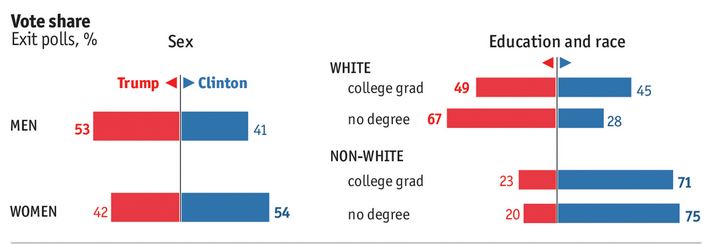
race-and-education-voting-statistics

Figure 1 (see original credits in last week’s blog)

Disregarding gender here, the message from these data is obvious: college education of white voters was a clear and decisive contributor to the outcome. Since I am a professor at the City University of New York, I feel a personal responsibility for this indicator. Rather than color code the country into blue or red sections, I’d prefer to work on filling some of the educational gaps we have when it comes to democratic prerequisites – including how to elect governments that will focus on a better future for our children and grandchildren in an ever more complicated world.

In academia, we require students to complete certain prerequisite courses before they are allowed to register for more advanced studies. This is meant to ensure that the students have acquired necessary skills, without which they would not be able to follow the course material. For instance, if you want to take an introductory course in physics you must first prove that you have the math skills that will enable you to actually work with the material covered in the class. When we vote for President of the United States or for any other office, the only prerequisite is that you be eligible to vote. This is determined by your citizenship and your age, provided that you are not a convicted felon. Education of any sort is not a requirement. I am not here to advocate that such restrictions should be put into place: this was tried before with disastrous consequences. However, technology is now opening doors to better inform the general public about issues that they are being asked to vote on.

I have been writing this blog for more than four years, with the express purpose of contributing to this effort: I reach more people through this blog than I do when you simply count my students at my paying job. Recently, I wrote a series of blogs (May 24 – June 14) dedicated to efforts to prepare the voting public for the governance issues that are specific to the new era in which humanity dominates the physical environment: the Anthropocene. The existence of the Anthropocene itself was not on the ballots so people could not vote against it. Instead, they elected people who essentially tried to convince them that its contributors – globalization, automation, and immigration that directly requires economic dislocation – are largely conspiracies that can be ignored. That attitude, combined with global changes in communication gave rise to an epidemic of false news. In many cases people didn’t have the criteria or resources to differentiate fact from fiction.

David Leonhardt, in his recent New York Times Op-Ed, describes education’s role in our ability to respond to economic changes. He also mentions one state governor that is trying to do something about it:

It’s the sort of devastation that now has the country’s attention. Donald Trump won the presidency with huge margins in places left behind. He lost the popular vote, but won 26 of the 30 lowest-income states, including the old powerhouses of Pennsylvania, Ohio and Michigan.

These places are stuck in what I call the Great American Stagnation. Tens of millions of people have experienced scant progress for decades. Median net worth is lower than in the 1980s, and middle-aged whites, shockingly, aren’t living as long as they used to. Ending this stagnation is the central political problem of our age: It fuels Trumpian anger and makes every other societal problem harder to solve.

In the wake of the financial crisis, Delaware’s new governor, Jack Markell, and other officials did obvious things, like using stimulus money to stem the damage and even managing to reopen the refinery. But Markell, who’d run as an insurgent Democrat, understood that nostalgia alone wouldn’t help families pay their bills. So he began looking for ways both to save old jobs and to create new ones. His answer wasn’t original — but that’s O.K., because it was right.

In his almost eight years in office, he has made his No. 1 priority lifting the skills of Delaware’s citizens. He worked on traditional education, expanding high-quality pre-K and helping low-income teenagers go to college. And he worked on what academic researchers like Robert Schwartz call “the forgotten half”: the many students who won’t graduate from college but who also need strong skills to find decent jobs. Their struggles are a major reason that America’s work force is no longer considered the world’s most highly skilled.

The tens of millions that Leonhardt is refering to fit within Hillary Clinton’s “deplorables” label – many through no fault of their own. They didn’t take that well and went to the polls to express their displeasure – even though in many cases that seemed to mean voting against their own interests.

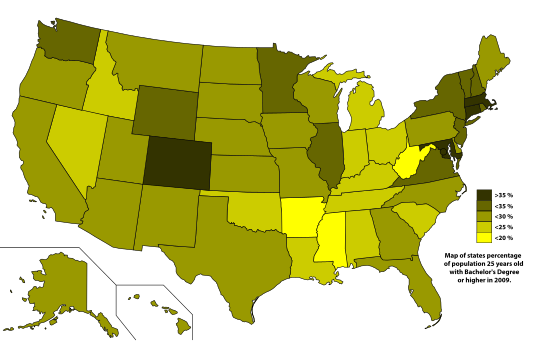
A map of college education in the United States is shown in Figure 2.

Ali Zifan - Own work; Map is based on https://commons.wikimedia.org/wiki/File:Blank_US_Map_(states_only).svg.

Ali Zifan – Own work; Map is based on https://commons.wikimedia.org/wiki/File:Blank_US_Map_(states_only).svg.

Figure 2 – A map of educational attainments in the US.

The states range between less than 20% tertiary education attainment (college graduation) and more than 35%. Here’s a more in-depth breakdown.

The next question to ask is how we are doing compared to other countries. Table 1 shows data selected from several large countries – both developed and less developed ones.

Table 1 – List of countries by tertiary education attainment

Country Age 25 – 64 (%)
United States 42
France 32
Germany 27
Italy 17
Japan 48
Russia 54
South Korea 45
Spain 35
United Kingdom 42
Brazil 14
China 10
Indonesia 8
Mexico 19
Turkey 17

We can see that the United States’ level of tertiary education is one of the highest among rich countries. This is also true if one delves more into details such as the variation between different age groups. Those levels are much lower in developing countries. Like most other socio-economic indicators, we have long way to go in accomplishing educational prerequisites globally.

The remedy – at least in terms of top priorities – is probably not to significantly enlarge college education levels. But it is urgent that we extend other educational opportunities to the more than half of the voting population not served by the college system structure.

The City University of New York, where I work, was originally set to address these issues:

The City University of New York (CUNY; pron.: /ˈkjuːni/) is the public university system of New York City, and the largest urban university in the United States. CUNY and the State University of New York (SUNY) are separate and independent university systems, although both are public institutions that receive funding from New York State. CUNY, however, is additionally funded by the City of New York. The university has one of the most diverse student bodies in the United States, with students hailing from 208 countries. The black, white and Hispanic undergraduate populations each comprise more than a quarter of the student body, and Asian undergraduates make up 18 percent. Fifty-eight percent are female, and 28 percent are 25 or older.[5]

CUNY has served a diverse student body, especially those excluded from or unable to afford private universities. Its four-year colleges offered a high quality, tuition-free education to the poor, the working class and the immigrants of New York City who met the grade requirements for matriculated status. During the post-World War I era, when some Ivy League universities, such as Yale University, discriminated against Jews, many Jewish academics and intellectuals studied and taught at CUNY.[7] The City College of New York developed a reputation of being “the Harvard of the proletariat.”[8]

The problem is that with time, the focus has shifted more toward the “Harvard” part of that title, while neglecting the “proletariat.” For the crucial sake of good governance we – and countless other institutions across the country have to find a way to make a U-turn back in the direction of the general public.

Posted in Climate Change, Election, Sustainability | Tagged , , , , , , , , , , , , , , , , , , , , , , , , , , , , , , , , , , , , , , , , , | 1 Comment

The Dangers of Apathy

Image from "Hitler's War Against the Jews" (1975) by Lucy Dawidowicz, p. 61.

Image from “Hitler’s War Against the Jews” (1975) by Lucy Dawidowicz, p. 61.

1938 Interior of Berlin synagogue after Kristallnacht

I am starting to write this blog on Thursday, November 10th. Today is a commemoration of Kristallnacht (November 9 – 10, 1938), the infamous night of violence that preceded the Nazi atrocities during the Holocaust.

I am also going today to the funeral of an old and dear family member who passed away a few days ago. He will be buried in Mount Hebron Cemetery in Queens, NY, a place that also holds the grave of Raphael Lemkin: the man credited with coining the term genocide.

Here is how I started my very first post, four and a half years ago:

The Webster Dictionary defines genocide as “the deliberate and systematic destruction of racial, political or cultural groups.” There is no question that the Holocaust was a genocide. Genocides do not repeat themselves exactly. They come in different guises. Despite the deniers, it is straightforward to teach students to condemn the Holocaust, but it is more difficult to teach them how to prevent future genocides. One of the most difficult parts is to see them coming. Despite the fact that Hitler published the first volume of his manifesto, Mein Kampf, in 1925, where he laid out his philosophy, he was, nevertheless, democratically elected as German Chancellor in 1933. Few people believed in 1933 that he would seriously try to accomplish what he preached or anticipated the consequences that resulted from his actions.

Predictions by the Intergovernmental Plan on Climate Change (IPCC) and most scientists, strongly suggest that we may be creating our next genocide ourselves; a “business as usual” scenario over the next 70 years (the expected lifespan of my grandchildren – my definition of “Now” in my book) will result in doubling of greenhouse gas emissions. Emissions at these levels would result in major extinctions around the globe, with more than 40% of ecosystems destroyed. The belief that we are not part of the ecosystems is a dangerous hubris. We have just passed the 7 billion population mark and even if we take the 40% prediction with a large grain of salt, we are talking about the potential genocide of billions of people.

Arnold Toynbee wrote that civilizations die from suicides, not murder. Even if the predicted consequences of “business and usual” environmental scenarios over the next 70 years turn out to be wrong in some details and even slightly wrong in timing, it’s clear that once we pass a critical point in the ability of the planet to adapt to the accumulation of greenhouse gasses in our atmosphere, the consequences amount to global suicide – a self-inflicted genocide. We know what we must do to mitigate this possible future genocide, but we need our collective will to do so. We can’t allow the deniers to win again.

As it stands now, climate change is not a genocide; nor is it a crime against humanity, much less inherently evil – but it has the prospect to be all three. That said, as decided at the Nuremburg trials, you don’t punish a possibility, no matter how dire. You try to change the outcome via education and other resources (Holocaust Remembrance Day). I am certainly not trying to compare Donald Trump to Adolf Hitler or to argue that a repeat of a short-term genocide of any sort is coming. As I’ve said repeatedly, though, in the lHowever, in my opinion, Trump’s election – along with the resurgence of nationalistic, xenophobic, anti-globalization, anti-immigrant, anti-trade movements in many parts of the world is an early sign of the Anthropocene (June 14, 2016).

I posted the ruined Berlin synagogue above because I fear that violence will start to raise its ugly head once it becomes obvious that the actual implementations of Trump’s promised changes to “Make America Great Again” are not necessarily welcome.

There are still absentee votes being tallied but as it stands, Hillary gathered 61.04 million individual votes and 228 electoral votes, while Trump won 60.37 million individual votes and 290 electoral votes. Hillary’s win of the popular vote amounted to a margin of more than ½ million votes – a margin that seems to be drifting ever-wider. Interestingly, while Hillary’s plurality was larger than that of Al Gore in 2000, Richard Nixon in 1968, and John F. Kennedy in 1960, she and Al Gore lost the presidency but both Nixon and Kennedy won their respective elections. According to the US Elections Project, only 133 million of the close to 232 million eligible voters actually voted. This amounts to 57.6% participation. That’s about 3% higher than the 2012 election (see my post on March 29, 2016) but it still means that almost 100 million eligible voters that didn’t give enough of a damn to exercise that right. The turnout in Pennsylvania was 61.1% (6 of the 9.7 million) and in Florida it was 65.1% (9.5 out of 14.6 million). Trump won Pennsylvania by 68,000 votes and Florida by 119,770 votes – numbers that would essentially equate to a tie within a margin of error.

Based on these numbers, my take on the voting pattern in the November election was that three major groups were in competition: the Republicans with Donald Trump as their candidate, the Democrats with Hillary Clinton as their candidate and the “don’t-give-a-damn” (DGAD) group: sort of a resurrection of the “Know-Nothing” party from the mid-19th century, with some obvious differences. The DGAD group clearly won a convincing plurality by doing nothing but by refusing to actively shape the government, they shifted that honor to the two other parties. Given that the Democrats and Republicans were basically tied, this meant electing a president, Congress and indirectly the Supreme Court by tossing a coin following constitutional rules. The Republicans won.

I am an old guy but I’m far from the only one to believe that these elections were probably the most consequential within my lifetime. As I have discussed repeatedly, we are in a global transition into a new era dominated by humans. Climate change is an early sign of this shift. Such a transition implies a conflict between the collective and the individual. We are electing governments that must take cooperative actions. In democratic societies, voters have an active say in this representation. People all over the word are trying to balance their own perceived needs with the collective actions necessary for human survival as a whole.

I wrote before that teaching for the Anthropocene (June 7, 2016) presents major challenges. What these elections, and the large “participation” of the DGAD group tell us is that we must change the emphasis from teaching to learning. Michelle Obama’s often quoted dictum of, “When they go low, we go high,” doesn’t work very well. Most people are not equipped to take the higher ground. They can connect much more easily with the lower rhetoric and tactics. Election campaigns like that we just witnessed provide teaching opportunities, while the election results act as tests of whether the electorate has learned those lessons. Well, we flunked! We will have to try harder next time.

Across the ocean, on a different continent, an Israeli journalist, Aluf Ben (editor in chief of the liberal Israeli national daily paper Haaretz) gave his “advice” to the Israeli politicians looking to be elected after Benjamin Netanyahu leaves office:

Donald Trump’s Lesson for Netanyahu: Make It Personal and Exaggerate:

Politics is first and foremost the art of story-telling and image, and those who would replace Netanyahu need to be more radical and more thuggish than Netanyahu himself.

Given the current political climate worldwide, his “advice” seems to apply to politicians across the globe, regardless of their political leanings. It is this so-called lesson that we must learn to fight against.

In the meantime we will live with what we got.

In their speeches immediately after the election, President Obama and Hillary Clinton advocated a peaceful transition of power; that is a message I hope we can take to heart. Mr. McConnell, meanwhile, led with a call to immediately dismantle any and all vestiges of the Obama presidency:

McConnell: Trump Can Unravel Nearly Everything Obama Did

The Senate majority leader wants the president-elect to start undoing President Barack Obama’s actions on health, safety and climate on “day one.”

My own advice to the Republicans: First, do no harm! Now that you are (or will soon be) in charge of all three branches of government, tread carefully. Don’t destroy something before you learn why it was constructed in the first place and have a well-researched alternative ready as a replacement.

Trump made some big promises:

  • Economic growth of 4% or more
  • Return industrial jobs that were lost through globalization (to be regained by reneging on trade agreements)
  • Provide better, more affordable, health care to all by destroying Obamacare,
  • Build a higher wall on the US-Mexico border (to be paid by Mexico)
  • Ban Muslims from entering into the country

I just fear that many of the above commitments cannot and will not be delivered upon and may result in major disappointment for the people who voted for him in the name of change. Disappointment easily descends into violence, which is usually directed at some of the most vulnerable segments of the population. As we have seen from historical precedence, the violence can be directed internally and externally. In both cases the results can be catastrophic to everybody. Please tread carefully!

Posted in Anthropogenic, Climate Change, Election | Tagged , , , , , , , , , , , , , , , , , , , , , , , , , , , , , , , , , , , , , , , , , , , , , , , , , , , , , , , , , , , , , , | 1 Comment

The Sun as an Example of Stability Through Balance of Forces

I am posting this on Election Day; I have no idea as to how the vote will pan out but I think all of us can agree that the results will be highly consequential. With this much at stake, any decision not to vote or vote for minority candidates might have disastrous effects. The only relevant thing left for me to do is to encourage everyone to vote.

Since I don’t want to take a “vacation” from posting on Election Day I will instead retreat to safer (less-political) ground: looking at our sun, an important natural system that works on the principle of dynamic equilibrium of two forces.

Our sun was formed about 4.6 billion years ago via a process illustrated in Figure 1.

It exists under what we call a hydrostatic equilibrium where at each point the outward push of pressure is balanced by the inward pull of gravity.

Solar system formation cloud gravity orbit

Figure 1

Our solar system, like billions of other star systems, formed out of stellar material that was subjected to three basic forces: gravity, pressure, and conservation of angular momentum. The only one of these scientific terms that is uncommon in everyday use is angular momentum. In physics, angular momentum is the combined product of linear momentum (mass and velocity) and the radius of the rotational motion. In the universe, almost everything rotates around something. Figure 1 shows that the process starts within a large cloud made up of the remnants of dead stars and primordial material left over from the original formation of the universe in the big bang, which happened roughly 13.8 billion years ago. The chemical composition of such a cloud is mostly hydrogen and helium, with very small quantities of heavier elements: residue from previous stars. The death process of every star starts with the exhaustion of hydrogen fuel from its core.

Gravity is an attractive force that becomes stronger as the objects approach each other. Within the denser parts of the cloud, therefore, as the dispersed masses compress, the power of gravity increases. As a result of this self-reinforcing process, most of this material condenses into a dense center called a protostar, as shown in part B.

At the same time that gravity works its wonders, the cloud spins and angular momentum exerts its own influences. The conservation of angular momentum requires that as the radius of the rotation decreases due to the gravitational attraction, the velocity of the rotation increases. In other words, the closer something is to the center, the faster it spins. As a result, the contraction of the cloud will be much greater perpendicular to the axis of rotation than parallel to it. A layout similar to that shown in Figure 1C emerges as the solar system takes the shape of a narrow disk.

The satellites that we see in Figure 1C represent the relatively small percentage of material that failed to fully consolidate within the protostar. Eventually these satellites coalesce to form the planetary system.

As the protostar compresses, its temperature rises; when the core contracts to its highest density, the temperature rises to around 10 million degrees Celsius (or 18 million Fahrenheit). The immensely high temperature and high density of the core are sufficient to ignite the powerful nuclear fusion of hydrogen to helium, generating a sizable amount of energy (a nuclear process similar to that of hydrogen bombs, developed after WWII). This fusion made our sun into a functioning star.

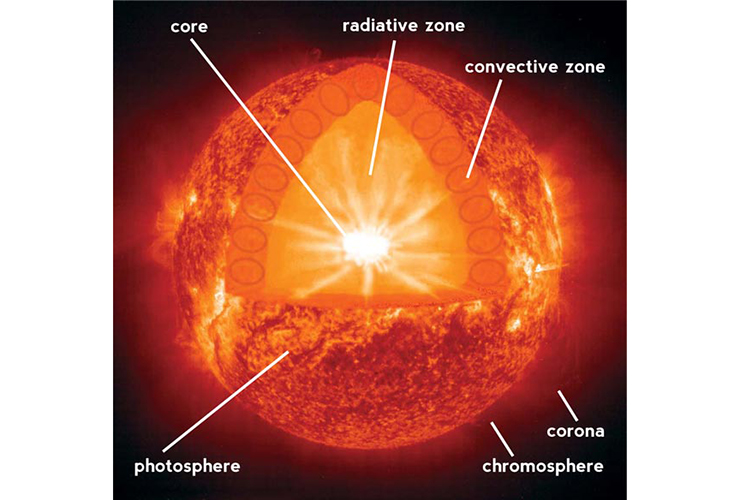
Sun structure layers

Figure 2 – Structure of the sun

The energy radiated from the surface of the sun balances that produced by its core. In about 5 billion years the sun is expected exhaust its supply of hydrogen and begin the red giant stage of its decay: the core will eventually separate from its shell. It will be converted into a white dwarf as its shell disperses into one of many clouds that will later form new stars.

As shown in part D of Figure 1, the planets were formed out of the leftover dreck from the sun’s conception. In a similar manner to the birth of the star, dust particles began to cluster, then gathered larger and larger fragments as the gravity of the combined mass gained strength.

Here is what would happen if one of the two opposing forces that maintain the sun’s equilibrium suddenly ceased to exist: first, ending the core’s hydrogen fusion, stops the outward pressure. In fact, this is a naturally occurring phenomenon that comes about when the hydrogen in the core of any star starts to run out. This marks the beginning of the star’s death. Lacking an opposing force, the core will continue to contract until a new stabilizing force emerges. In the case of the sun and similar stars, this takes the shape of electrons crammed so densely together from the core’s collapse that they convert into high density carbon. The resulting object, called a white dwarf, is very stable. For heavier stars, this countering force is not enough and the core will be converted either to a neutron star – which has a density of more than a billion times that of a white dwarf, or – in the case of even heavier stars – a black hole, which sucks in everything, including light. The shells of these heavier stars will not separate “smoothly” like the sun but with a violent and spectacular supernova.

If, on the other hand, outward pressure continued and somehow gravity ceased to exist (a hypothetical impossible in real life), the sun would disperse until the temperature of its components cooled to that of the surrounding space. In effect, the entire mass would have a similar fate to the sun’s shell, serving when conditions are right, as fodder for the birth of new stars.

In both cases, the disappearance of one of the opposing forces that keeps the sun together would result in the sun’s destruction.

As with the sun, the opposing forces and checks and balances within the branches of the government are key to the stability of state governance.

Posted in Climate Change | Tagged , , , , , , , , , , , , , , , , , , , , , , , , , , , , , , , , , , , , | 4 Comments

Election: Clustering

By the time this blog goes up, we will be exactly one week from the election. Most of us will be greatly relieved (almost independent of the results) when this presidential campaign is over. This was probably the most disturbing campaign that the majority of us have lived through – especially with regards to Donald Trump’s nomination as the Republican Party candidate and Russia’s active participation via hacking and WikiLeaks – mostly to Trump’s benefit. The selective hacking activities have made private communication public, considerably raising the temperature of the discourse.

Many have attempted to rationalize the high support that Donald Trump has enjoyed throughout this campaign. Significant segments of the population polled reported their strong support for the candidate. These segments include white males with no college education, and white citizens older than 50 (those within the Baby boomer generation). As I detailed last week, gender is also a significant factor.

A few days ago, the NYT printed Alec MacGillis’ Op-Ed, “Go Midwest, Young Hipster: If you really want Democrats to win in Iowa, move there.” MacGillis raised a central issue of the American governance system that acted as a “teaching opportunity” to me and invited a closer look. The issue can be summed up with the word “clustering.”

Liberals have a simple explanation for this state of affairs: Republican-led gerrymandering, which has put Democrats at a disadvantage in the House and in many state legislatures. But this overlooks an even bigger problem for their party. Democrats today are sorting themselves into geographic clusters where many of their votes have been rendered all but superfluous, especially in elections for the Senate, House and state government.

Americans’ tendency toward political self-segregation has been underway for a while now — it’s been eight years since Bill Bishop identified the dynamic in “The Big Sort.” This helps explain why red-blue maps of so many states consist of dark-blue islands in the cities surrounded by red exurbs and rural areas, a distribution that is also driven by urban concentrations of racial minorities and by the decades-long shift in allegiance from Democratic to Republican among working-class white voters.

The title of the article suggests a remedy. Definitions of the term hipster vary widely but one of the more basic entries explains the phrase as “a person who follows the latest trends and fashions, especially those regarded as being outside the cultural mainstream.” I am certainly not young; nor am I a hipster. However, I am white with the highest educational degree available. Additionally, I am a liberal living in New York City. New York is a state with an overwhelming majority of Democrats. In the 2012 elections, New Yorkers gave President Obama 63% of their vote while Mitt Romney only received 35%. In the same election, Obama got 52% of the vote in Iowa and a mere 50% in Florida, meaning that he barely carried the state. Clearly, my vote for a Democratic candidate carried considerably lower weight in New York than it would have in Iowa or Florida.

I mentioned MacGillis’ suggestion to my wife and posited that we might follow it in spite of not being young or hipsters. She gave me a funny look.

I decided to dig a bit deeper.

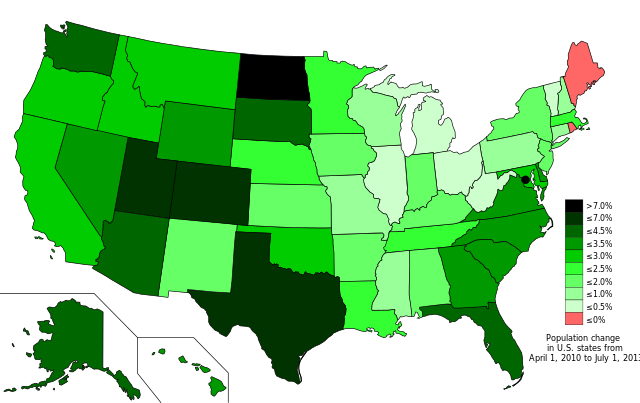
If the only clustering that takes place involves young hipsters or guys like me moving to hubs like New York, Massachussetts or California where Democrats significantly outnumber Republicans, the populations of these places should show growth while those of Iowa and other midwestern states should decrease, thus expanding the voting power of local Republicans.

By Ali Zifan - Own work; Map is based on data from United States Census Bureau.

By Ali Zifan – Own work; Map is based on data from United States Census Bureau.

Figure 1 State populations by recent growth rates

 Figure 1 shows the state population growth between the two recent census periods. New York is growing at a rate of around 2%, while California’s rate is a bit of higher. Both states are Democratic strongholds. Iowa is growing at approximately the same rate as New York. States that are growing at the fastest are Texas and North Dakota, two solid Republican states. Clearly there are other clusters forming than Liberal enclaves; these numbers show, however, that there are additional driving forces behind these migrations. Jobs, housing prices, climate, taxation, and education opportunities are obvious contenders.

I am not a political scientist (nor were the Founding Fathers who drafted the US Constitution) but in an election year like the one we are having, you don’t have to see Hamilton (I am lucky enough to have scored tickets for next spring) to appreciate their greatness. Through the US Constitution, they constructed a stable democracy that is not based on a one man, one vote system where all the votes weigh equally but rather on a dynamic equilibrium that is aims to balance opposing forces. Here are the relevant articles of the Constitution that mandate the American election systems:

 Article 1 Section 2:

The House of Representatives shall be composed of Members chosen every second Year by the People of the several States, and the Electors in each State shall have the Qualifications requisite for Electors of the most numerous Branch of the State Legislature.

Article 1 Section 3:

The Senate of the United States shall be composed of two Senators from each State, chosen by the Legislature thereof, for six Years; and each Senator shall have one Vote.

Article 2 Section 1

The executive Power shall be vested in a President of the United States of America.

He shall hold his Office during the Term of four Years, and, together with the Vice President, chosen for the same Term, be elected, as follows:

Each State shall appoint, in such Manner as the Legislature thereof may direct, a Number of Electors, equal to the whole Number of Senators and Representatives to which the State may be entitled in the Congress: but no Senator or Representative, or Person holding an Office of Trust or Profit under the United States, shall be appointed an Elector.

The Electors shall meet in their respective States, and vote by Ballot for two Persons, of whom one at least shall not be an Inhabitant of the same State with themselves. And they shall make a List of all the Persons voted for, and of the Number of Votes for each; which List they shall sign and certify, and transmit sealed to the Seat of the Government of the United States, directed to the President of the Senate. The President of the Senate shall, in the Presence of the Senate and House of Representatives, open all the Certificates, and the Votes shall then be counted. The Person having the greatest Number of Votes shall be the President, if such Number be a Majority of the whole Number of Electors appointed; and if there be more than one who have such Majority, and have an equal Number of Votes, then the House of Representatives shall immediately chuse by Ballot one of them for President; and if no Person have a Majority, then from the five highest on the List the said House shall in like Manner chuse the President. But in chusing the President, the Votes shall be taken by States, the Representation from each State having one Vote; A quorum for this Purpose shall consist of a Member or Members from two thirds of the States, and a Majority of all the States shall be necessary to a Choice. In every Case, after the Choice of the President, the Person having the greatest Number of Votes of the Electors shall be the Vice President. But if there should remain two or more who have equal Votes, the Senate shall chuse from them by Ballot the Vice President.

These articles were drafted on September 17, 1787 and ratified on June 21, 1788. The US was a completely different country at that time. I don’t have data for 1788 but I have some for 1820 – a difference of about one generation. The population in 1820 was about 10 million people, with a GDP/Capita equal to $2,358 in today’s dollars. The population now is about 310 million with GDP/Capita of about $51,000.

Unless the Constitution changes dramatically, Iowa will have its two senators to protect its interests from damaging legislation. This will remain the case no matter how many young hipsters move from Iowa to New York or LA and no matter how many people flock to North Dakota or Texas in search of a better job and lower taxes. The number of congress members per state changes periodically with every census to approximate population changes. The number of electors in the Electoral College for president reflects that balance of congressional changes. However, with the exceptions of Maine and Nebraska, all of the electors in a state go to the winner of the popular vote – whether that candidate wins by 1% or 30%.

Imagine the situation that would have developed under a one man, one vote system under the current global urbanization trends. In 1790 only about 5% of the population lived in urban areas, the rest living in rural areas. Today more than 80% of the population in the US lives in urban areas. This is clustering. Yet our election system that determines our governance was drafted in 1787. Imagine if the one man, one vote principle had prevailed. The urban 80% would have completely dominated the government. Out of pure self-interest, they’d likely determine that urban areas are tax free zones. Urban residents would instead live off of the “generosity” of the rural residents. Everybody would flock to the cities, unbalancing the economy and destroying the production of food, and the whole system will collapse.

I can elaborate on the consequences of clustering but I credit our Founding Fathers with being future-looking geniuses that created a governance system stable enough to survive even Donald Trump.

The next blog will be posted on Tuesday, November 8, Election Day. I will vote and go about my regular business – as ignorant as everyone else about what kind of government we will create. Meanwhile I will retreat to the safety of science and describe another system that was formed through an equilibrium of opposing forces; one that has been rather stable for the last 4.6 billion years, and which we expect will stay so for another 5 billion years – our sun.

Posted in Election | Tagged , , , , , , , , , , , , , , , , , , , , , , , , , , , , , , , , , , , , , , , , , , , , , , , , , , , , , , , , , , , , , , | 1 Comment

Election: Battle of the Sexes

men-vs-women Last week, I posited that: “Donald Trump attempted to downplay or disregard any fallout from his actions, concentrating instead on throwing red meat to keep at least his most dedicated supporters happy.”
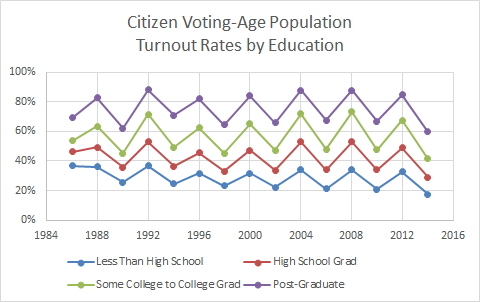
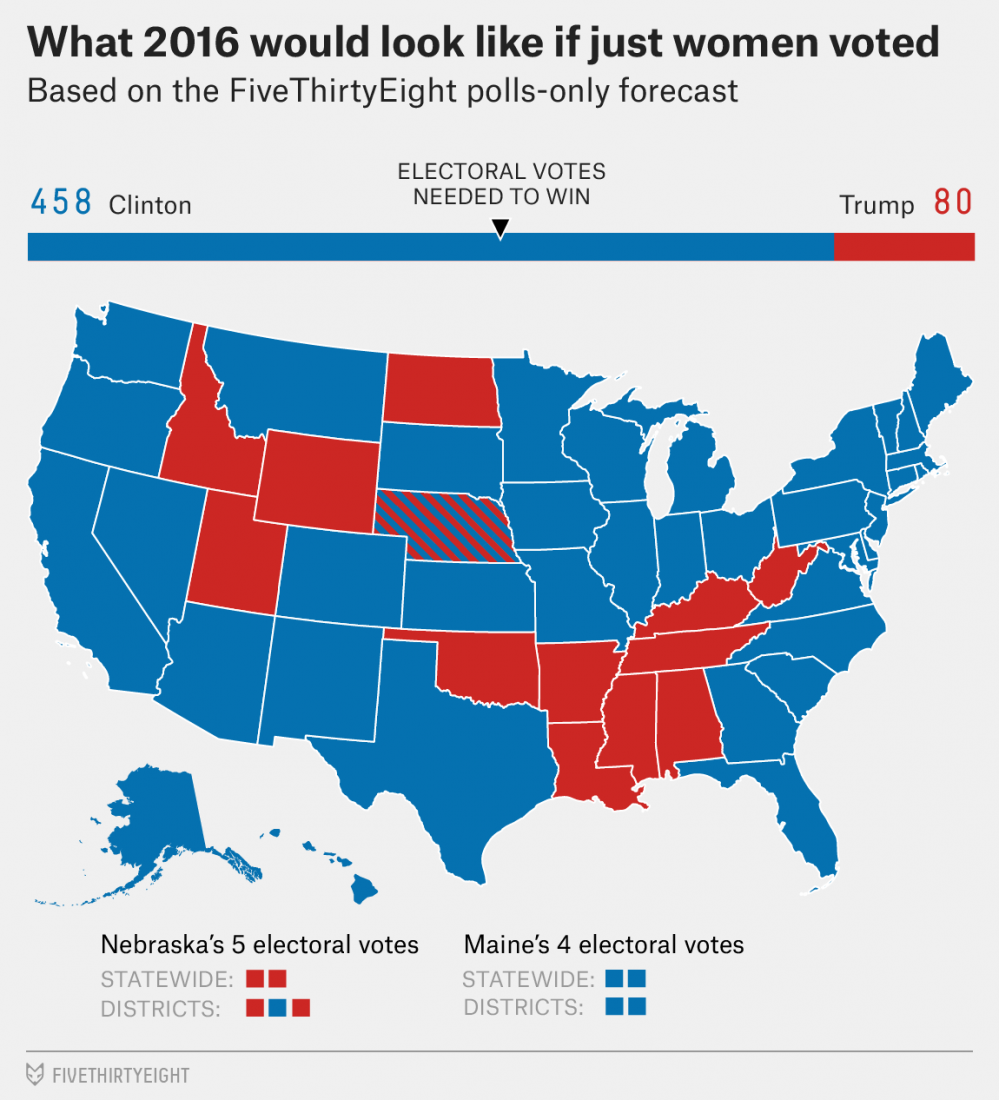
 In this blog I had initially planned to delve into the makeup of these dedicated supporters and to try to estimate their number. I shared the common perception that they were mainly white males with no college education. I was ready to analyze this hypothesis through data similar to those I have presented earlier (March 29, 2016); see Figure 1 for a breakdown of voting patterns by education levels. Clearly, the level with the least education usually doesn’t vote. I thought perhaps Trump would be enough of a draw to make many of them become more involved and flock to register and vote. Well, it’s already past the registration deadline in many states and some early voting already started. There is no sign of any such influx.

Voter Turnout Education College High School Participation Election

Figure 1 (see March 29 blog).

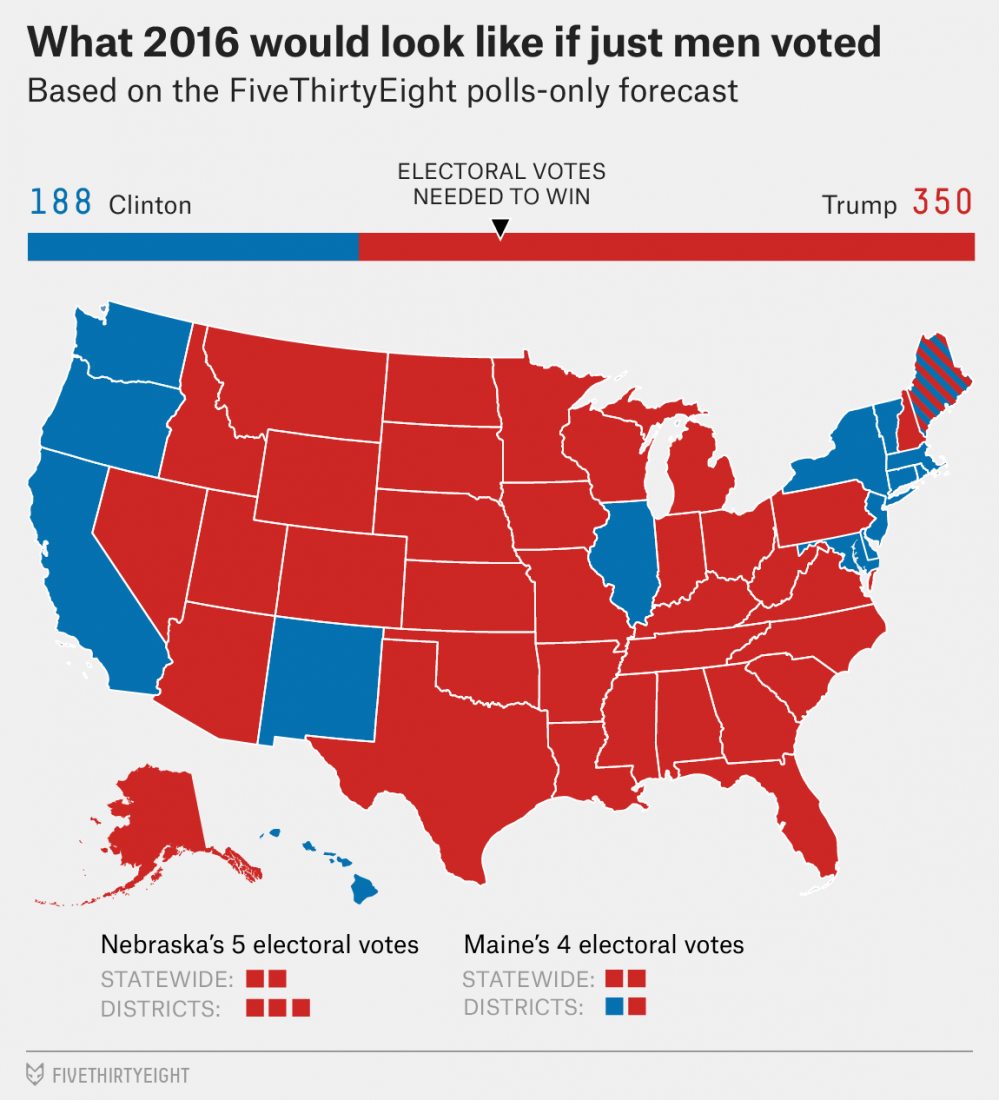
As I was contemplating where to go with this, FiveThirtyEight came up with some stunning findings, shown here in Figures 2 and 3. These two figures show projected election results if voting were restricted to a single gender. Overwhelmingly, men would have elected Donald Trump and women would have elected Hilary Clinton. The results were so striking that many Trump constituents half-seriously suggested repealing the 19th Amendment. That amendment, added to the US constitution in 1922, prohibits any citizen from being denied the right to vote on the basis of sex.

fivethirtyeight-men-voters-only Figure 2

fivethirtyeight-women-voters-onlyFigure 3

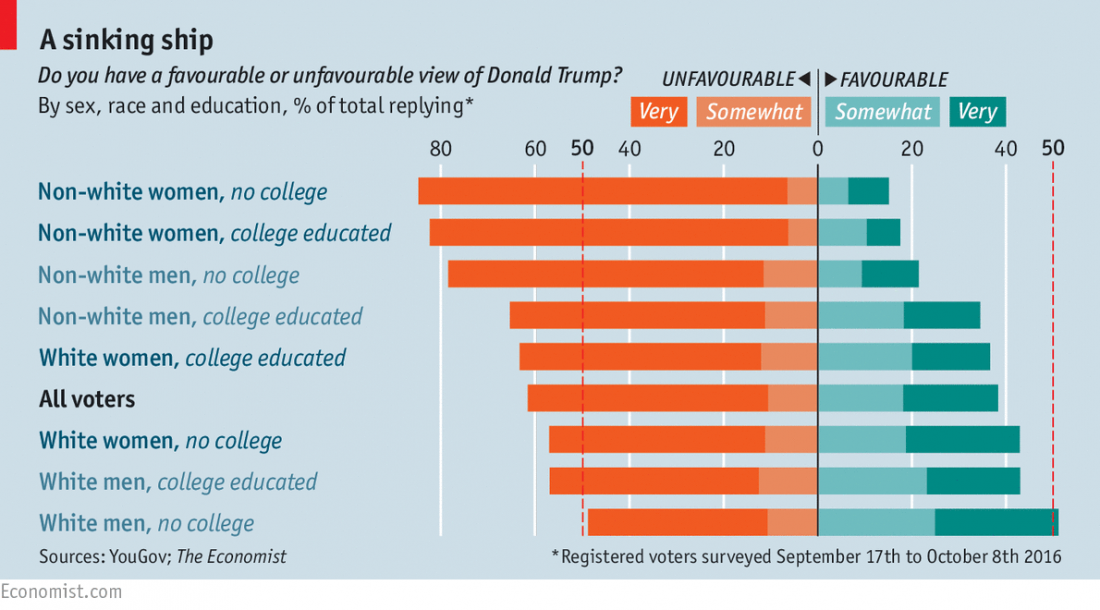
A few days after FiveThirtyEight published these findings, the Economist printed its own set of data, shown here in Figure 4.

economist-gender-education-race-support-of-trumpFigure 4

We see almost mirror symmetry depending on educational levels of men and women. True, the group that favors Donald Trump most is white males with no college education, but their counterpart – white women with no college education – favors Hilary Clinton by a rather wide margin. We must also remember that white men without a college education do not outnumber white woman with similar educational backgrounds.

The only conclusion that I could draw from these data is that education level is not the critical parameter; the real decider is gender.

Much of this comes from the perception of Clinton’s lack of traditionally ideal female qualities. Case in point: the continuous emphasis on her trust, likability, and honesty (August 9 blog). Furthermore, there’s Christopher Andersen’s biography of her, American Evita, in which he states that she curses in a way that, “would make Howard Stern blush” – what horror!

Aside from repealing the 19th Amendment, another possible solution to the gender asymmetrical polling could be to divide the United States between men and women to form two fully sovereign states. We’d have an Amazon land ruled by Hillary Clinton and a macho land ruled by Donald Trump. If Trump wanted to grope women he’d have to negotiate a trade agreement with Hillary. If both half-countries agreed to such a split it would probably be constitutional, so the courts wouldn’t have to intervene. Trump might even appoint Pat McCrory, the governor of North Carolina as the gate keeper.

I am an educated white male but I am not ashamed to say that I would not want to live within a Trump-governed male state. I suppose that statistically I align better with white females who have not attended college.

Posted in Election | Tagged , , , , , , , , , , , , , , , , , , , , , , , , , , , , , , , , , , , , , , , , , , , , , , , , , , , , , , , , , , , , , | 3 Comments

The Second Debate: Kenneth Bone Saves the Day

I am running behind. My intention this week was to cover two of the most contentious issues in this election period – not only within the US but globally: immigration and trade. I discussed immigration in a series of blogs in August and September but I didn’t discuss trade because I thought it was outside my scope of focus on this platform. I was wrong. Immigration and trade are both indicators of globalization, which in turn is the central indicator of the new era dominated by humans: the Anthropocene (February 3, 2015 and May 3June 14, 2016). I have talked about globalization mainly in terms of common threats – the most pressing of which I see being climate change. However, globalization can also help increase global wellbeing. Trade is not a zero sum game, it can benefit us all. As I mentioned in the last blog, globalization – as any socio-economical change, can result in winners and losers. The mechanism for sharing the benefits is a transfer of wealth from the winners to facilitate assistance for the losers. Good government should be judged by its determination and success in making that happen. These are appropriate topics in presidential debates but immigration was hardly mentioned in the first debate and any talk of trade was limited to negative implications.

The second presidential debate on Sunday, October 9, went well beyond all of this. It took place immediately after a tape was leaked in which Donald Trump was seen and heard going after women – married or single – in a way that made not only the country, but the world cringe in disgust. His polls declined sharply and the Republican Party found itself on the verge of implosion. Donald Trump attempted to downplay or disregard any fallout from his actions, concentrating instead on throwing red meat to keep at least his most dedicated supporters happy.

Unexpectedly, toward the end of the debate, most of which was an all-out brawl, two questions posed by audience members within the Town Hall setting, presented welcome exceptions.

The last question asked the candidates to name one characteristic they admired in their opponent. Trump actually came with a much better answer than Clinton did but both were exceedingly trite. It was obvious that the two cannot stand each other.

The question that interested me most was the penultimate one, posed by Mr. Kenneth Bone. It was in line with everything that I care about in this blog, so I am posting the discussion in full below:

QUESTION: What steps will your energy policy take to meet our energy needs, while at the same time remaining environmentally friendly and minimizing job loss for fossil power plant workers? (Mr. Kenneth Bone)

COOPER: Mr. Trump, two minutes?

TRUMP: Absolutely. I think it’s such a great question, because energy is under siege by the Obama administration. Under absolutely siege. The EPA, Environmental Protection Agency, is killing these energy companies. And foreign companies are now coming in buying our — buying so many of our different plants and then re-jiggering the plant so that they can take care of their oil.

We are killing — absolutely killing our energy business in this country. Now, I’m all for alternative forms of energy, including wind, including solar, et cetera. But we need much more than wind and solar.

And you look at our miners. Hillary Clinton wants to put all the miners out of business. There is a thing called clean coal. Coal will last for 1,000 years in this country. Now we have natural gas and so many other things because of technology. We have unbelievable — we have found over the last seven years, we have found tremendous wealth right under our feet. So good. Especially when you have $20 trillion in debt.

I will bring our energy companies back. They’ll be able to compete. They’ll make money. They’ll pay off our national debt. They’ll pay off our tremendous budget deficits, which are tremendous. But we are putting our energy companies out of business. We have to bring back our workers.

You take a look at what’s happening to steel and the cost of steel and China dumping vast amounts of steel all over the United States, which essentially is killing our steelworkers and our steel companies. We have to guard our energy companies. We have to make it possible.

The EPA is so restrictive that they are putting our energy companies out of business. And all you have to do is go to a great place like West Virginia or places like Ohio, which is phenomenal, or places like Pennsylvania and you see what they’re doing to the people, miners and others in the energy business. It’s a disgrace.

COOPER: Your time is up. Thank you.

TRUMP: It’s an absolute disgrace. COOPER: Secretary Clinton, two minutes.

CLINTON: And actually — well, that was very interesting. First of all, China is illegally dumping steel in the United States and Donald Trump is buying it to build his buildings, putting steelworkers and American steel plants out of business. That’s something that I fought against as a senator and that I would have a trade prosecutor to make sure that we don’t get taken advantage of by China on steel or anything else.

You know, because it sounds like you’re in the business or you’re aware of people in the business — you know that we are now for the first time ever energy-independent. We are not dependent upon the Middle East. But the Middle East still controls a lot of the prices. So the price of oil has been way down. And that has had a damaging effect on a lot of the oil companies, right? We are, however, producing a lot of natural gas, which serves as a bridge to more renewable fuels. And I think that’s an important transition.

We’ve got to remain energy-independent. It gives us much more power and freedom than to be worried about what goes on in the Middle East. We have enough worries over there without having to worry about that.

So I have a comprehensive energy policy, but it really does include fighting climate change, because I think that is a serious problem. And I support moving toward more clean, renewable energy as quickly as we can, because I think we can be the 21st century clean energy superpower and create millions of new jobs and businesses.

But I also want to be sure that we don’t leave people behind. That’s why I’m the only candidate from the very beginning of this campaign who had a plan to help us revitalize coal country, because those coal miners and their fathers and their grandfathers, they dug that coal out. A lot of them lost their lives. They were injured, but they turned the lights on and they powered their factories. I don’t want to walk away from them. So we’ve got to do something for them.

COOPER: Secretary Clinton…

CLINTON: But the price of coal is down worldwide. So we have to look at this comprehensively.

COOPER: Your time is up.

CLINTON: And that’s exactly what I have proposed. I hope you will go to HillaryClinton.com and look at my entire policy.

COOPER: Time is up. We have time for one more…

The question and answers emphasized the role of government in addressing the socio-economic issue at hand and the people that are directly impacted by the current and next steps regarding our energy transition. Both candidates answered the question in full and emphasized their fundamental differences on this important issue. I only wish that the full debate had been conducted in this spirit.

Many news organizations crowned Mr. Bone as the winner of this debate. I fully agree.

Posted in Anthropogenic, Climate Change, Election, immigration | Tagged , , , , , , , , , , , , , , , , , , , , , , , , , , , , , , , , , , , , , , , , , , , , , , , , , , , , , , , , , , , | Leave a comment