Educating for the Anthropocene: Learning Science in an Informal Environment

Political decisions in the Anthropocene require an understanding of the interactions between humans and the physical environment, as well as how to make them sustainable for future generations. These decisions cannot be limited to a small group of scientist advisors; there needs to be a common language between the scientists and the decision makers. We can only make that sort of common language prevalent amongst the general public if we extend our education beyond our short school careers to encompass the rest of our lives.

Such efforts must be global but I will focus on progress within the United States.

In a previous blog in this series (May 17) I outlined Pew Research survey data about the disconnect between the beliefs of the general public and scientists (chosen from AAAS membership). I looked at the different views on human evolution, climate change, and the Big Bang mechanism.

I am including another chart from the same Pew Research site regarding public perception of human evolution:

Pew Poll Public View of Evolution

The 55% (August 2014) of US adults who actively stated they don’t believe humans evolved due to natural processes (supreme being guided evolution + existed in present form) are probably eligible voters in any upcoming election – including the presidential race.

National Academies held a committee regarding how people learn science and published a book summarizing its conclusions:

Do people learn science in non-school settings? This is a critical question for policy makers, practitioners, and researchers alike—and the answer is yes. The committee found abundant evidence that across all venues—everyday experiences, designed settings, and programs—individuals of all ages learn science. The committee concludes that: Everyday experiences can support science learning for virtually all people. Informal learning practices of all cultures can be conducive to learning systematic and reliable knowledge about the natural world. Across the life span, from infancy to late adulthood, individuals learn about the natural world and develop important skills for science learning.

  • Designed spaces—including museums, science centers, zoos, aquariums, and environmental centers—can also support science learning. Rich with real-world phenomena, these are places where people can pursue and develop science interests, engage in science inquiry, and reflect on their experiences through sense-making conversations.
  • Programs for science learning take place in schools and community based and science-rich organizations and include sustained, self-organized activities of science enthusiasts. There is mounting evidence that structured, non-school science programs can feed or stimulate the science-specific interests of adults and children, may positively influence academic achievement for students, and may expand participants’ sense of future science career options.
  • Science media, in the form of radio, television, the Internet, and handheld devices, are pervasive and make science information increasingly available to people across venues for science learning. Science media are qualitatively shaping people’s relationship with science and are new means of supporting science learning. Although the evidence is strong for the impact of educational television on science learning, substantially less evidence exists on the impact of other media—digital media, gaming, radio—on science learning.

Learners in informal environments:

Strand 1: Experience excitement, interest, and motivation to learn about phenomena in the natural and physical world.

Strand 2: Come to generate, understand, remember, and use concepts, explanations, arguments, models, and facts related to science.

Strand 3: Manipulate, test, explore, predict, question, observe, and make sense of the natural and physical world.

Strand 4: Reflect on science as a way of knowing; on processes, concepts, and institutions of science; and on their own process of learning about phenomena.

Strand 5: Participate in scientific activities and learning practices with others, using scientific language and tools.

Strand 6: Think about themselves as science learners and develop an identity as someone who knows about, uses, and sometimes contributes to science.

There is a clear and strong commitment among researchers and practitioners to broadening participation in science learning. Efforts to improve inclusion of individuals from diverse groups are under way at all levels and include educators and designers, as well as learners themselves. However, it is also clear that laudable efforts for inclusion often fall short. Research has turned up several valuable insights into how to organize and compel broad, inclusive participation in science learning. The committee concludes:

  • Informal settings provide space for all learners to engage with ideas, bringing their prior knowledge and experience to bear.
  • Learners thrive in environments that acknowledge their needs and experiences, which vary across the life span. Increased memory capacity, reasoning, and metacognitive skills, which come with maturation, enable adult learners to explore science in new ways. Senior citizens retain many of these capabilities. Despite certain declines in sensory capabilities, such as hearing and vision, the cognitive capacity to reason, recall, and interpret events remains intact for most older adults.

Recommendation 1: Exhibit and program designers should create informal environments for science learning according to the following principles. Informal environments should

  • be designed with specific learning goals in mind (e.g., the strands of science learning)
  • be interactive
  • provide multiple ways for learners to engage with concepts, practices, and phenomena within a particular setting
  • facilitate science learning across multiple settings
  • prompt and support participants to interpret their learning experiences in light of relevant prior knowledge, experiences, and interests
  • support and encourage learners to extend their learning over time

Recommendation 2: From their inception, informal environments for science learning should be developed through community-educator partnerships and whenever possible should be rooted in scientific problems and ideas that are consequential for community members.

Recommendation 3: Educational tools and materials should be developed through iterative processes involving learners, educators, designers, and experts in science, including the sciences of human learning and development.

Front-Line Educators

Front-line educators include the professional and volunteer staff of institutions and programs that offer and support science learning experiences. In some ways, even parents and other care providers who interact with learners in these settings are front-line educators. Front-line educators may model desirable science learning behaviors, helping learners develop and expand scientific explanations and practice and in turn shaping how learners interact with science, with one another, and with educational materials.

They may also serve as the interface between informal institutions and programs and schools, communities, and groups of professional educators. Given the diversity of community members who do (or could) participate in informal environments, front-line educators should embrace diversity and work thoughtfully with diverse groups.

Recommendation 4: Front-line staff should actively integrate questions, everyday language, ideas, concerns, worldviews, and histories, both their own and those of diverse learners. To do so they will need support opportunities to develop cultural competence, and to learn with and about the groups they want to serve.

I have been aware of the urgent need to expand science education for some time. Many years ago I attended a contractors meeting about researching new solar cells. The Department of Energy (DOE) was funding this research. Its representatives organized the meeting and took part in the discussions. One of the representatives’ comments is now permanently lodged in my brain. He told us never to use logarithmic functions in our reports. The DOE representative was a scientist and personally had no problem with logarithmic functions. His argument was that it is congressmen and their staffs who must read the reports and then approve the DOE budgets that support our work. These are the people who struggle with logarithmic functions; these are the members of the public that we must equip with the knowledge necessary to govern the Anthropocene. I have often discussed logarithmic functions in this blog (August 6, 2012) and have emphasized how essential it is to convey quantitative information. It is imperative that instead of “dumbing down” material we focus on educating its readers.

The National Academies committee on learning science in informal settings was comprised of scientists from various disciplines. Their report extends teaching science to other settings besides traditional school environments and provides assessment tools for the effectiveness of learning in such alternative environments. The audience of learners that they address is not much different from the audience that schools target when trying to increase their science enrollment. It does not extend to the “general public” and does not address the most basic element of the scientific method that should be kindled within every one of us. (June 18, 2012):

We Are Not Prophets

The Popperian scientific method is based on refutability. We develop a hypothesis and/or theory based on everything that we know, and we should be able to test the theory based on predictions for observations that we haven’t yet made. If the tests fail, we change the theory. This amounts to prediction of future results. Since we are part of the system, failure might mean closing the window that allows us to survive. The science we’re talking about here is more like medicine – we have to make a rational diagnosis about the changes that take place in the physical world, but if our predictions might result in a harmful impact, we will need to act. On this scale, actions to restore equilibrium must become part of the science that we practice.

We cannot understand, vote or govern in the Anthropocene without believing in this fundamental basis of science.

Posted in Anthropogenic, Climate Change, Conference, Education, Sustainability | Tagged , , , , , , , , , , , , , , , , , , , , , , , , , , , , , , , , , , , , , , , , , , , , , , , , , , , , , , , , , , , , , , , , , , , , , | Leave a comment

Educating for the Anthropocene: The Global Picture

Just as the Anthropocene is global, so its governance must be as well. Of course, this is easier said than done; countries are the only sovereign entities we have, meaning that any such global governance can only be attained through consensus.

Worldwide environmental issues such as the anthropogenic destruction of stratospheric ozone and the anthropogenic chemical changes that we inflict on the atmosphere, are early manifestations of an ill-governed Anthropocene. We are dealing with the uneven geographical distribution of the security burden that has resulted from broken states and their fleeing refugees. On another facet, there are economic opportunities that serve as manifestations of the present global flux and likewise lead to massive migrations. Understanding of the global forces in action is vital – not only for those assigned the responsibility of governing but also for those that elect them.

The attempt to introduce a common core in the American educational system was strongly motivated by the fact despite our vast available resources, US students lag behind those educated elsewhere, even in places with fewer funds to devote to schooling.

It is time to take a better look at international education efforts.

By their nature, educational systems are local. We cannot look at the educational efforts of close to 200 countries on this platform. Instead, I will focus on the US in comparison to nine other countries that together constitute about 60% of the world population. The countries are listed in the table below:

10 most populous contries 2007 Table 1List of the world’s 10 most populous countries.

Wikipedia breaks down its international rankings into 10 different categories; it lists 13 sections within the category of education and innovation. International rankings are based on either equivalent tests within comparable groups of students or on surveys of people’s opinions from different countries. Table 2 shows a comparison of both sets of results. The educational ranking and the country ranking columns are based on US News surveys and the PISA (Programme for International Student Assessment) columns are based on equivalent tests.

Country Educational ranking Country ranking PISAMath PISAScience PISAReading
China (as represented by Shanghai) 22 17 613* 580* 570*
India 29 22
US 3 4 481 497 498
Indonesia 44 42 375 382 396
Brazil 27 20 391 405 410
Pakistan 59 56
Nigeria 58 57
Bangladesh
Russia 20 24 482 486 475
Japan 8 7 536 547 538

Table 2 – Educational ranking, country ranking and PISA scores (2012) of the most populated countries.

The data in the first two columns is based on surveys:

  • The Best Countries for Education are ranked based on scores on a compilation of three equally weighted country attributes: has top quality universities, well-developed public education system and would consider attending university there.
  • The Best Countries ranking evaluates 60 countries across 24 rankings drawn from a survey of more than 16,000 global citizens.

The methodology of the PISA tests is as follows:

Each student takes a two-hour handwritten test. Part of the test is multiple-choice and part involves fuller answers. There are six and a half hours of assessment material, but each student is not tested on all the parts. Following the cognitive test, participating students spend nearly one more hour answering a questionnaire on their background including learning habits, motivation, and family. School directors fill in a questionnaire describing school demographics, funding, etc. In 2012 the participants were, for the first time in the history of large-scale testing and assessments, offered a new type of problem, i.e. interactive (complex) problems requiring exploration of a novel virtual device.

The US News ranked 60 countries. England came first in country ranking and 3rd in educational ranking. Iran is last in terms of education. All 10 of the most populous countries except for Bangladesh show up on the list.

The PISA (Programme for International Student Assessment) is based on testing 15 year olds in 65 countries – including OECD and affiliated countries. India, Pakistan, Nigeria, and Bangladesh are not on the list. More than that, China is represented solely by Shanghai. Indeed, all the top rated “countries,” in addition to Shanghai, are the Chinese cities of Hong-Kong, Taipei, Macao and the City State of Singapore. Shanghai certainly doesn’t qualify to be in our table but the inclusion has been widely adopted with a clarifying comment. The OECD average PISA scores are 494 in math, 501 in science, and 496 in reading. That puts the US score slightly below the OECD average in math and slightly above it in science and reading.

Country Global ranking 100,000*Educational Index (2013)/GDP/Capita(2014)
China 7.67 
India 29.9
US 28 1.63
Indonesia 69 17.3
Brazil 60 5.64
Pakistan 22.9
Nigeria 13.3
Bangladesh 41.1
Russia 34 6.12
Japan 4 2.43

 Table 3

*Global country ranking and Educational Index normalized to the countries’ GDP.

Table 3 provides two kinds of additional scores: The Global ranking column, published by the OECD and reported by BBC, ranks performance in math and science. This ranking is based on an amalgamation of international assessments, including the OECD’s PISA tests, the TIMSS tests run by US-based academics, and TERCE tests in Latin America, putting developed and developing countries on a single scale. The top five places are all taken by Asian countries – Singapore, Hong Kong, South Korea, Taiwan and Japan. The BBC site included the following comment:

“These countries are also very good at attracting the most talented teachers in the most challenging classrooms, so that every student has access to excellent teachers.”

I personally compiled and normalized the Education Index of the 10 most populous countries according to their GDP/Capita.

Education index EI is calculated from “Expected years of schooling” EYS (Number of years a child of school entrance age can expect to spend in a given level of education) and “Mean years of schooling” MYS (Average number of completed years of education of a population [25 years and older]). “Expected years of schooling” is indexed by dividing by 18 and “Mean years of schooling” is indexed by dividing by 15. Education index is obtained by averaging these two indices. The maximum for “Mean years of schooling”, 15, is the projected maximum of this indicator for 2025. The maximum for “Expected years of schooling”, 18, is equivalent to achieving a master’s degree in most countries.

In other words, the Educational Index is based on effort – not on achievement by students or an inspiration where to study.

The GDP/Capita data were taken from the World Bank.

It should be clear from the last column in table 3 that the poorest developing countries actually spend a considerably larger percentage of their resources on education than the rich OECD countries. In fact, the US is the lowest on this scale.

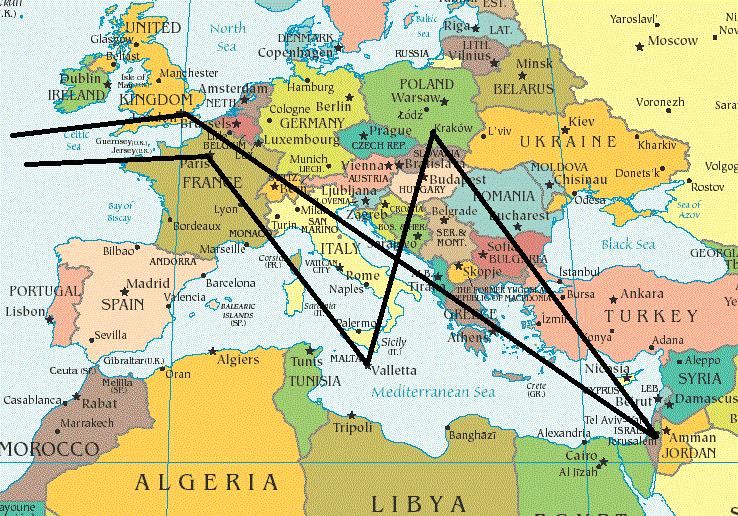
This month my wife and I will travel to Europe – including England, France, and Poland. I will also visit both Israel (where I have family and friends) and the island of Malta, where I will meet my Australian family; it is winter for them and they wanted a taste of warmer weather. During the trip, aside from the social aspects, I will try to delve into the massive migration from the Middle East and Africa that is overwhelming Europe. As I discussed in the context of last summer’s trip to China (July 21November 10, 2015), the promise of better educational opportunities is a strong driving force for people to leave their countries. Poor countries are well aware of this potential “brain drain,” a factor that likely serves as one of the strongest incentives to put as many resources in their educational system as they can.

Posted in Anthropogenic, Climate Change, Education | Tagged , , , , , , , , , , , , , , , , , , , , , , , , , , , , , , , , , , , , , , , , , , , , , , , , , , , , , , , , , , , , , , , , , , , , , , | Leave a comment

Educating for the Anthropocene: Trying to Climb Over the Obstacles

In previous blogs I have tried to summarize the transformation of the international educational system that is needed to accommodate the coming global shift to the Anthropocene (May 3, 2016):

The real point is that governing has reached a greater complexity than ever before. Governing bodies must consider global issues as well as local. They must set and implement policies that balance society’s safety and that of our physical environment. Such a feat necessitates considering multiple stories, setting priorities, and being aware of long-term consequences. It requires that scientists be involved in governance as well as that politicians be scientifically literate. For that, we need some major changes in our educational system to promote that sort of bilingualism.

Last week (May 24) I concentrated on the college where I teach: Brooklyn College of CUNY, and described some of the difficulties we’ve encountered while trying to actually implement such changes:

1.  An obscure pathway between graduation and job opportunities. The skillsets of being prepared to vote and operate within the coming Anthropocene are not yet marketable for job opportunities upon graduation. Nor do they provide clear pathways for advanced degrees. In many cases, attempts to correlate statistics of future job opportunities with the learned skills met with considerable amounts of skepticism.

2.  Credit requirements. The central premise of preparation for the demands of the emerging Anthropocene is becoming bilingual in the sciences and the social sciences. But sciences are much more vertical than social sciences. In other words, they require many more prerequisites. So a major that focuses on that bilingualism became a very large major. To graduate, students are required to take a certain number of credits (122 in Brooklyn College). A large major decreases students’ abilities to take elective courses outside their major and outside other requirements such as General Education.

My experience convinces me that the broader educational shift will at best be a halting transition with many more obstacles than the stuttering energy transition that I often talk about here.

The complications and difficulties arise because in the educational transition we not only face different opinions as to what the future will bring but also a sharp conflict between the roles of educational systems in preparing our children for the present and preparing them for the future. I gave my book (Climate Change: the Fork at the End of Now) a title that includes the word “now,” which I defined as the lifespan of my grandchildren; God willing, that will extend to the end of the century. The main job of the current educational system everywhere is to prepare the youngsters for the much shorter term version of “now” –the period immediately after graduation. When students and parents sense that there is a conflict between their long term and short term interests, they will always choose the short term.

Once I zoom out to global requirements, the obstacles become much more formidable than those I faced while trying to institute the educational transition within my school. The Anthropocene is a worldwide phenomenon; it has to be managed globally. This is especially true of changes to educational systems. Next week I will look at how educational systems everywhere directly correlate with resource distribution across the world. In communities that strive to feed their people, education is not a top priority.

Even if we neglect the huge disparity in resources available for education, the amount of knowledge necessary to understand the coming Anthropocene and help to guide its governance is very large and constantly growing. There is no way that students can master it all within the time period that we currently devote to education. Fortunately, this gloomy picture looks brighter when we consider technological developments: our educational experience need not be limited to the time that we spend in school. We can and should extend it throughout life.

Here is an example from my own activities:

At school I am in direct contact with about 120 students per week. On average, each of these undergraduate students spends about 3hrs/week with me. Adding in a few graduate students, we arrive at 500 student hours/week. This estimate is on the high side. I am being paid my salary for this activity. When we promote a faculty member (I serve on such a committee) the three elements that we consider are: teaching performance, research, and service. Most of the service is confined to college and departmental activities. We have a yearly prize for “community activity” but it doesn’t enter into the record for promotion – community in this case refers to anything outside of school and the college is not being paid to provide such activity.

I do realize that my responsibilities as an educator do not end with those tasks I am paid for. That is one reason behind my starting this blog; I want to share my expertise with the world. To that end, I pay a public relations office to publicize and edit the blog.

The statistics for the reach of this blog are given below:

Time Period Visitor Visits
Today: 244 1,525
Yesterday: 425 4,222
Last 7 Days (Week): 3,386 93,555
Last 30 Days (Month): 14,740 350,400
Last 365 Days (Year): 203,651 4,064,862
Total: 356,419 4,984,481

Since the blog is posted once a week, the number of visitors per posting is in the thousands. Of course, most of the visits to the blog are spambots that probably don’t read any of this, but compared to the 140 students that I teach regularly, there are plenty of exposure opportunities. I also make use of Facebook and Twitter to help spread my message.

Last week’s Facebook metrics:

Metric Last Week Previous Week Trend
Page Visits 18 8 ↑125.0%
Weekly Total Reach 269 83 ↑224.1%
People Engaged 13 5 ↑160.0%
Total Page Likes 107 98 ↑9.2%

My blog has had direct quotes featured on various platforms. I see this as an indication that not only are there actual people (not bots) reading, but my content is spreading successfully. Several of the links are posted on the sidebar. I have listed them below for your convenience:

I also integrate the blog into my teaching – both in terms of content and incorporating students’ comments.

CCF is obviously not alone. Statistics are hard to come by because the numbers change all the time, but recent figures counted almost 200 million blogs posted on the internet. They include any topic that one can dream of; likewise, their quality runs the gamut. Writing itself is one of the best available teaching tools. Almost all publications I know of have related blogs where readers can comment. Going through some of the comments (especially on unmoderated threads) can make one blush. Blogs are not edited textbooks so credentials and their verification are important when sourcing info but open platforms make such verification easier.

Blogs and their counterparts have global reach and are usually less limited (than traditional media) by local interests or censorship. They provide a context for bottom-up rather than top-down learning and teaching. Government agencies everywhere are becoming aware of the possibilities and resources that the internet offers. Hopefully they will use it to enhance future efforts to improve the world.

Posted in Climate Change, Education, Sustainability | Tagged , , , , , , , , , , , , , , , , , , , , , , , , , , , , , , , , , , , , , , , , , , , , , , , , , , , , , , , | Leave a comment

Educating for the Anthropocene: the Local View

The Anthropocene (April 26, 2016 blog) is a proposed epoch beginning when human activities started to have a significant global impact on Earth’s geology and ecosystems. Regardless of what we call our time period, if we want to successfully manage our planet, we have to select institutions capable of understanding how humans interact with the physical environment and act accordingly. This requires that we learn how to properly prepare for such endeavors, but there is almost universal agreement that our global educational systems are not up to the task (see last week’s blog about opinions of both the general public and scientists on the educational system in the US).

What are the requirements for such an educational system? (May 3, 2016):

The real point is that governing has reached a greater complexity than ever before. Governing bodies must consider global issues as well as local. They must set and implement policies that balance society’s safety and that of our physical environment. Such a feat necessitates considering multiple stories, setting priorities, and being aware of long-term consequences. It requires that scientists be involved in governance as well as that politicians be scientifically literate. For that, we need some major changes in our educational system to promote that sort of bilingualism.

In addition to the required bilingualism, educating for the Anthropocene necessitates globalization. We need to make the knowledge accessible worldwide; meanwhile, in relative terms (area per person), our planet is getting smaller and smaller. Humans need to each be able to make informed decisions regarding what we are doing and how we can do it better.

In a series of blogs that I wrote more than two years ago (Feb 25March 25, 2013) I tried to cover the needed educational transition. I discussed some of the issues within the US’s K-12 education that attracted my attention during the special session of the AAAS (American Association for the Advancement of Science) meeting in Boston that I attended. I later extended the discussion to colleges and universities. This is the same organization from which the Pew organization drew its statistics of scientists’ opinions on various issues (last week’s blog).

Our need for national standards arose from an increasing discrepancy between state standards, coupled with our lag in international competitiveness. Here is an excerpt from the first blog in that series:

When a youngster enters military service, he or she goes through basic training that can be very demanding. If he or she desires or is assigned to a leadership position or a specialized role, he or she must first undergo further training before being allowed to take part in any combat activity.

The age threshold for voting in most countries is 18. The preparation, in the optimum case is high school. I am absolutely not trying to advocate a reintroduction of literacy tests for voting. I do, however, think that we should use every opportunity available to educate our children on the nature of the choices on which they are being asked to vote.

Since I didn’t hear any mention in the talks about including voters’ education as part of the standards, I asked the speakers to comment on this with an emphasis on Climate Change.

The answer that I got was that the speakers are aware of the issue but in their opinion, to address it properly, we need to revisit our entire educational system and make broad changes – changes for which we are not yet prepared.

What is the Common Core?

State education chiefs and governors in 48 states came together to develop the Common Core, a set of clear college- and career-ready standards for kindergarten through 12th grade in English language arts/literacy and mathematics. Today, 42 states and the District of Columbia have voluntarily adopted and are working to implement the standards, which are designed to ensure that students graduating from high school are prepared to take credit bearing introductory courses in two- or four-year college programs or enter the workforce.

My earlier blogs were targeted at governance of climate change but now I am trying to expand that discussion to the governing of society’s future, with the belief that climate change is just an important early symptom of the Anthropocene.

This is a huge job and collectively we are not ready for it. The introduction of a national common core was meant to improve America’s educational standards in comparison to other countries, especially given our considerable resources. We can get into all of that another time. For starters, let’s look at a much smaller and better defined system – the school where I teach – Brooklyn College of the City University of New York (CUNY).

Brooklyn College’s preparation for the Anthropocene included the following initiatives:

  1. Establishment of a new Environmental Studies program, anchored on bilingual education in the sciences and social sciences, with the active participation of 14 departments.
  2. Establishment of a new General Education program consisting of about 25% of the credits required for all students’ graduation. In addition to major components in the sciences (including laboratory requirements) and social sciences, the program features major offerings in interdisciplinary courses, including health-related and environmental issues.
  3. Externally funded support to establish a program of quantitative reasoning across the curriculum.
  4. Establishment of a Global Studies program.

I was directly involved in most of these initiatives and tried to help put my school at the forefront of the changes to our broader educational system.

The paragraph below was taken from one of the Environmental Studies program’s early reports:

The Environmental Studies program is a liberal arts program aimed at educating students to be fluent in the languages of the social and physical sciences in the range of areas related to the environment, broadly construed. The program is actively involved in undergraduate education, research, and community service. It was officially approved on September 1998 to include a major in Environmental Studies. It was expanded recently to include an additional concentration in Environmental Management and a minor in Environmental Studies. An environmental concentration for the early childhood education and childhood education majors is planned.  At present, there are 3 declared majors. Students have not yet had an opportunity to declare a minor in the program.

Most of these programs that we hoped would “revolutionize” the educational system and be a guiding light for other schools didn’t pan out. They ended up failing or being diluted beyond recognition in one form or another. I was fired as director of the Environmental Studies program and disengaged myself from some of the other programs (fortunately, I have tenure and being fired from directing a program does not mean being fired from the school).

Opposition to such initiatives came from almost every corner. As is evident from the above quote, the initial success with students was limited. The maximum number of students that declared the Environmental Studies Program as their major was below 30, as compared to (2002 data) Psychology (515), Computer Science (759), and Economics (1061). Even small majors such as Physics (43), Geology (33), and Classics (31) did better. There were two main reasons for this limited success:

  1. An obscure pathway between graduation and job opportunities. The skillsets of being prepared to vote and operate within the coming Anthropocene are not yet marketable for job opportunities upon graduation. Nor do they provide clear pathways for advanced degrees. In many cases, attempts to correlate statistics of future job opportunities with the learned skills met with considerable amounts of skepticism.
  2. Credit requirements. The central premise of preparation for the demands of the emerging Anthropocene is becoming bilingual in the sciences and the social sciences. But sciences are much more vertical than social sciences. In other words, they require many more prerequisites. So a major that focuses on that bilingualism became a very large major. To graduate, students are required to take a certain number of credits (122 in Brooklyn College). A large major decreases students’ abilities to take elective courses outside their major and outside other requirements such as General Education.

The last, key, obstacle was the lack of understanding of quantitative reasoning across the curriculum.

Often, students come to the college with very few quantitative skills. In many cases these quantitative skills have diminished as the students progressed through their educational careers. The old adage about muscles, “use them or lose them,” is also true of academic skills such as quantitative reasoning. That includes some high-school-level math such as percentage calculation, exponential growth, elementary algebra, and working with large and small numbers. Many attempts to incorporate such skills throughout the curriculum and as graduation requirements translated into significant obstacles for students underprepared in these areas.

There are also more abstract hurdles involved in making even basic – not to mention interdisciplinary – changes in an academic environment. Henry Kissinger memorably said that, “academic politics are so vicious precisely because the stakes are so small.” He was in a position to know.

Indeed, academic departments hold a great amount of power within the university environment: the tenure system is associated with departmental service, not with institutional service. In almost all cases, a faculty member has to operate from within the departmental structure, which itself works to try to amplify its own strength, often allocating of resources on a departmental basis. This is a lifeline for any college activity.

Given such fierce competition, the discussion about interdisciplinary courses within the restructured General Education program has often run into objections such as, “we shouldn’t try to teach interdisciplinary topics before students master their disciplinary requirements” or, “if we need the car to be repaired we don’t have to learn to do it ourselves; we go to specialists in a garage.”

These are all serious impediments. In the next few blogs I will try to describe some local remedies before moving on to the international situation.

Posted in Anthropogenic, Climate Change, Education, Sustainability | Tagged , , , , , , , , , , , , , , , , , , , , , , , , , , , , , , , , , , , , , , , , , , , , , , , , , , , , , , , , , , , , , , , , , , , , , | Leave a comment

The Politics of the Anthropocene Part 2: The Data

Back to trying to politicize the Anthropocene. The key, as I see it (May 3, 2016), is that all of us must learn how to speak and listen in the same “language” (within English, Spanish, French, etc.). To do so we have to be able speak and understand both the language of science and that of governance. Certainly within democratic societies, some fluency in these languages is vital to making practical collective decisions that will benefit all of us, as well as our future generations.

The crucial element to achieving such bilingualism is adapting our educational system.

The Pew Research Center has extensive coverage of Science and Society. Hopefully these data will quantify the disparity between public opinion of scientific agreement and actual scientific consensus. All the data in this blog are taken from this source. Before I present the data, we have to clarify the methodologies that Pew Research uses to gather the data.

Survey Design – General Public

A combination of landline and cell random digit dial (RDD) samples was used to reach a representative sample of all adults in the United States who have access to either a landline or cellular telephone. Both samples were disproportionately stratified to increase the incidence of African-American and Hispanic respondents. Within each stratum, phone numbers were drawn with equal probabilities. The landline samples were list-assisted and drawn from active blocks containing one or more residential listings, while the cell samples were not list-assisted but were drawn through a systematic sampling from dedicated wireless 100-blocks and shared service 100-blocks with no directory-listed landline numbers. Both the landline and cell RDD samples were disproportionately stratified by county based on estimated incidences of African-American and Hispanic respondents.

Survey of scientists:

The survey of scientists was conducted online with a random sample of 3,748 U.S.-based members of the American Association for the Advancement of Science (AAAS) from September 11 to October 13, 2014. AAAS is the world’s largest general scientific society, and includes members from all scientific fields. Founded in 1848, AAAS publishes Science, one of the most widely circulated peer-reviewed scientific journals in the world. Membership in AAAS is open to all. The survey was conducted under the direction of Princeton Survey Research Associates International.

Here are some of the most relevant findings:

Obviously, given the focus of this blog, I emphasized climate change in my data selection. Climate change is also probably the most interdisciplinary topic being tested here; additionally, it requires numerous important governmental decisions be made now. These decisions will involve major changes in the energy supply that will directly affect both consumers and producers. The nature of these decisions means they are all political and understandably play central role in every election campaign.

Meanwhile, I included the survey that asked the general public if most scientists believe in evolution and the “big bang” theory. The results of this survey show that the public believes scientists are divided on the “big bang” but generally agree on evolution. Since these two questions are discipline-specific and don’t require any political decisions to be made (aside from the obvious inclusion or exclusion in the curriculum of innocent young students), the results reflect the quality of our educational system but do not have any impact on our daily life. Given that, those more familiar with the topics should have more say on related policy (such as curriculum). On the other hand, management of climate change and other issues that directly or indirectly affect us in the Anthropocene should be open to all. Everyone deserves a vote on those political issues that directly influence daily life.

Posted in Anthropogenic, Climate Change, Education | Tagged , , , , , , , , , , , , , , , , , , , , , , , , , , , , , , , , , , , , , , , , , , , , , , , , , , , , , , , , , , , , , , , , , , , , , , , , , , , , , , , , , , , , , , , , , , , , , | Leave a comment

Perceptions and Numbers: Obama’s Economic Legacy and Trump’s Pathway Forward

Last week I promised to delve more into the Pew Research Center’s trove of data on science and society, but a few things happened whose response took precedence.

One was the narrowing of the Republican field of candidates to Donald Trump. The other element that caught me off guard was the New York Times Magazine’s interview with President Obama, in which he reviewed his success in managing the American economy over the last seven years.

I’ve always had the impression (not properly researched) that one can come up with almost any ideology in the US and find at least a million adherents. The US is a good example of a country that can prosper and function reasonably well with such pluralism – so long as it is kept within the law.

Well, this presidential election provides an opportune test of that theory. Two presidential candidates that are still running, Donald Trump and Bernie Sanders, present a certain challenging novelty for the desired office. I was interested to find out the secret to their success.

The primary vote for Donald Trump in the Republican primaries, as of 4/27/16 is more than 10 million. That is more than Romney earned in the entire 2012 primary season. In fact, Trump is projected to set a record for number of primary voters once the contests end on June 14th. For Clinton, the corresponding number of voters so far is more than 12 million; for Sanders, it is over 9 million.

The number of eligible voters in the 2012 Presidential Election was more than 235 million. Even assuming a 55% turnout, that means close to 130 million voters.

Both Trump and Sanders significantly exceed my estimate of one million of followers but they are as yet well short of a presidential win. Bernie Sanders is close to mathematical elimination as a candidate but Donald Trump is almost certainly going to end up as one of the two candidates that more than 200 million eligible voters must choose between. I have found the press to be baffled as to the secret of both Trump and Sanders’ success. The key phrase that floats around as a possible explanation is protest vote. Protest against what? Protest votes are not new. In fact, Germany was a fertile ground for voters protesting the country’s loss in WWI, the reparations they had to pay, and the ineptitude of the Weimer government. This was part of what led to Hitler’s rise to power.

The degree of polarization surrounding both candidates is astounding. Here is an example taken from a New York Times letter to the editor:

An Outlier at Harvard: ‘I’m a Hillary Supporter’

APRIL 29, 2016

To the Editor:

Re “Daring to Back Clinton” (Metropolitan section, April 17), about the isolation felt by Columbia students who support Hillary Clinton:

At the age of 12, I canvassed for Senator Barack Obama’s 2008 presidential campaign. At the age of 18, I organized several Black Lives Matter protests. And at the age of 20, my peers consider me conservative.

Over this time, my political beliefs have remained unchanged. I still support entitlements, loathe mass incarceration, advocate for L.G.B.T.Q. rights, and believe in the government’s power to improve lives and create sweeping change. This ideology makes me a Democrat in the vein of Barack Obama, Jed Bartlet (“West Wing”) and even Mrs. Clinton. But on my college campus, I might as well be Pat Buchanan.

At Harvard, admitting that #ImWithHer is nearly tantamount to boasting “Make America Great Again.” If you haven’t shared a post from the writer and activist Shaun King, you are not a true liberal here.

When defending Mrs. Clinton becomes as unacceptable as bigotry, when her supporters are called privileged, oppressive and stupid, we lose the central feature of our democracy — pluralism.

Indeed, by surrounding themselves with only those who share their narrow set of political beliefs, the students who make up the liberal base on college campuses perpetuate the very oligarchical traditions they lament.

I’m a Hillary supporter. In their eyes, I might as well be a College Republican.

SAM KOPPELMAN

Cambridge, Mass.

The writer is op-ed editor of The Harvard Crimson.

This summer I will visit France where I have friends and family. I will be staying near Place de la Republic, which is currently the center of global attention for its ongoing protests. The age group represented in these protests is similar to the one that makes up so much of Bernie Sanders’ support here. But the source of protest there is a bit more transparent than that here. The French government wants to change the rules for hiring and firing workers and the protesters vehemently oppose such changes. In France these kind of protests have a history of success. Nor is the protest confined – to either France or the US – it has spread all over Europe (March 8, 2016 blog) bringing all kinds of players to the forefront.

Can we hope to have a similar success?

The closest thing to expressing the idea of a protest vote in numbers is a parameter called the Misery Index, which is shown in Figure 1 below. The index is calculated by simply adding the annual inflation rate and the seasonally adjusted unemployment rate. The chart below includes inflation, unemployment, the misery index, and who was president at the time.

misery index

Figure 1US Misery Index

The last 6 years look pretty good.

In Figure 2 we use info from the Pew Research Center to find the opinion of the American People on the topic: Partisan-views-of-current-economic-conditions-outlook-for-the-future

Figure 2Partisan views of current economic conditions, outlook for the future

Essentially, the Democrats consistently think that the economic conditions are pretty good while the Republicans disagree.

Donald Trump and Bernie Sanders both repeatedly bemoan that we are losing industrial jobs to other countries. This turns out to be very effective rhetoric in the industrial heartland of the country. Here is what Joseph Stiglitz has said about it:

“The observation is uncontroversial,” said Joseph Stiglitz, the Nobel winning economist at Columbia University. “Global employment in manufacturing is going down because productivity increases are exceeding increases in demand for manufactured products by a significant amount.”

Fortunately, this week, NY Times Magazine has published an extensive interview with President Obama giving him opportunity to defend his economic record. Here are some key paragraphs of what he had to say:

“I actually compare our economic performance to how, historically, countries that have wrenching financial crises perform,” he said. “By that measure, we probably managed this better than any large economy on Earth in modern history.”

“Many are still barely getting by,” Hillary Clinton said, while Donald Trump said that “we’re a third-world nation.”

“It has frustrated me only insofar as it has shaped the political debate,” he said. “We were moving so fast early on that we couldn’t take victory laps. We couldn’t explain everything we were doing. I mean, one day we’re saving the banks; the next day we’re saving the auto industry; the next day we’re trying to see whether we can have some impact on the housing market.”

“I mean, the truth of the matter is that if we had been able to more effectively communicate all the steps we had taken to the swing voter,” he said, “then we might have maintained a majority in the House or the Senate.”

“If you ask the average person on the streets, ‘Have deficits gone down or up under Obama?’ probably 70 percent would say they’ve gone up,” Obama said, with some justifiable exasperation — the deficit has in fact declined (by roughly three-quarters) since he took office, and polls do show that a large majority of Americans believe the opposite. There are, of course, many reasons so few Americans seem to be celebrating. “How people feel about the economy,” Obama told me, giving one part of his own theory, is influenced by “what they hear.” He went on: “And if you have a political party — in this case, the Republicans — that denies any progress and is constantly channeling to their base, which is sizable, say, 40 percent of the population, that things are terrible all the time, then people will start absorbing that.”

But as Obama also acknowledged, the public anger about the economy is not without empirical basis. A large swath of the nation has dropped out of the labor force completely, and the reality for the average American family is that its household income is $4,000 less than it was when Bill Clinton left office. Economic inequality, meanwhile, has only grown worse, with the top 1 percent of American households taking in more than half of the recent gains in income growth. “Millions and millions and millions and millions of people look at that pretty picture of America he painted and they cannot find themselves in it to save their lives,” Clinton himself said of Obama’s economy in March, while on the campaign trail for his wife.

I fully agree with the President’s conclusion. When 40% of the population is constantly shouting disaster, it sticks. The Pew Research data in Figure 2 backs the president. The protest on the macroeconomic scale is a perception that was politically ingrained. The individual protests that come out of job displacement are real, but to my knowledge, such votes do not form the backbone of either the Trump or the Sanders campaigns.

Posted in Climate Change, Sustainability | Tagged , , , , , , , , , , , , , , , , , , , , , , , , , , , , , , , , , , , , , , , , , , , , , , , , , , , , , , , , , , , , , , , , , , , , , , , , , , , | Leave a comment

The Politics of the Anthropocene Part 1: The Triggers.

Last week I listed three articles that prompted me to shift my focus from the ongoing 2016 presidential campaigns to the more abstract aspects of politicizing the Anthropocene, but I did not have time to speak about the articles in depth.

First, let’s define politics. I have a broad choice of dictionary definitions. I chose one that is not cyclical, meaning that it doesn’t include the term politics within the definition. I also avoided definitions that focused on getting a position in government because that would imply that those who already have positions in government are no longer engaging in politics. Here is what I came up with, from the Collins Dictionary:

Politics: “the complex or aggregate of relationships of people in society, esp those relationships involving authority or power.”

Now let’s get back to some key paragraphs of those three articles I mentioned.

  1. David Brooks’ “The Danger of a Single Story”:

In 2009 the Nigerian writer Chimamanda Ngozi Adichie gave a fabulous TED talk called “The Danger of a Single Story.” It was about what happens when complex human beings and situations are reduced to a single narrative: when Africans, for example, are treated solely as pitiable poor, starving victims with flies on their faces.

Her point was that each individual life contains a heterogeneous compilation of stories. If you reduce people to one, you’re taking away their humanity.

American politics has always been prone to single storyism — candidates reducing complex issues to simple fables. This year the problem is acute because Donald Trump and Bernie Sanders are the giants of Single Storyism. They reduce pretty much all issues to the same single story: the alien invader story.

  1. Eduardo Porter’s “Liberal Biases, Too, May Block Progress on Climate Change”:

That may sound like a strange question, particularly to readers of The New York Times. Today conservatives are the ones decidedly blocking any effort by the United States to curb its emissions of greenhouse gases.

And yet even as progressive environmentalists wring their hands at the G.O.P.’s climate change denial, there are biases on the left that stray just as far from the scientific consensus.

“The left is turning anti-science,” Marc Andreessen, the creator of Netscape who as a venture capitalist has become one of the most prominent thinkers of Silicon Valley, told me not long ago.

He was reflecting broadly about science and technology. His concerns ranged from liberals’ fear of genetically modified organisms to their mistrust of technology’s displacement of workers in some industries. “San Francisco is an interesting case,” he noted. “The left has become reactionary.”

Still, liberal biases may be most dangerous in the context of climate change, the most significant scientific and technological challenge of our time. For starters, they stand against the only technology with an established track record of generating electricity at scale while emitting virtually no greenhouse gases: nuclear power.

Only 35 percent of Democrats, compared with 60 percent of Republicans, favor building more nuclear power plants, according to a poll by the Pew Research Center.

It is the G.O.P. that is closer to the scientific consensus. According to a separate Pew poll of members of the American Association for the Advancement of Science, 65 percent of scientists want more nuclear power too.

  1. Frank Bruni’s “No way to Elect a President”:

With Donald Trump’s and Hillary Clinton’s victories in New York, we’re one furious contest closer to the end of this spectacle. But we’ve known for a while now where we’re headed, and it isn’t anyplace good.

American voters are displeased with the candidates they’ve been given. They’re disengaged from the process that winnows the field.

And that process disregards the political center, erodes common ground and leaves us with a government that can’t build the necessary consensus for, let alone implement, sensible action in regard to taxes, to infrastructure, to immigration, to guns, to just about anything.

Make America great again? We need to start by making it functional.

Regardless of how our time officially becomes known – be it Anthropocene or some other name, humanity is in control here. There are 7.3 billion people on Earth, with an ever-increasing GDP per person, and impressively efficient methods of global communication. If we want to implement sustainable development within the next 100 years, global coordination is imperative. Related governance in any part of this system requires careful consideration within the global context.

As I understand it, that’s the point that David Brooks is trying to make and I fully agree. I also agree with Brooks’ depiction of both Sanders and Trump as single-issue candidates, although the single issue is much better defined in Sanders’ campaign than within Trump’s.

The real point is that governing has reached a greater complexity than ever before. Governing bodies must consider global issues as well as local. They must set and implement policies that balance society’s safety and that of our physical environment. Such a feat necessitates considering multiple stories, setting priorities, and being aware of long-term consequences. It requires that scientists be involved in governance as well as that politicians be scientifically literate. For that, we need some major changes in our educational system to promote that sort of bilingualism.

As to Eduardo Porter’s piece, Porter does not restrict himself to climate change. He quotes Marc Andreessen, who generally complains that the left is turning anti-science – not only with regards to climate change, but also issues such as genetic engineering and efforts to increase productivity with robotic tools. Porter cites data from the Pew Research Center on scientific opinions of these issues.

Pew Research has extensive information about attitudes to these issues. In fact, I use it as a resource for the graduate course on Physics and Society that I am teaching. However, science is not settled through polls. Nor, aside from certain exceptions, is government policy. The same reasoning applies to both cases – not everybody starts from the same knowledge base on any of these issues, so not everybody is entitled to the same voice on these issues. This is not a call to reinstitute voting restrictions through literacy tests. For the most part, we vote, not on policies themselves but rather on the people that will introduce and implement these policies. We don’t necessarily have to be literate about the individual policies but we have to be well versed in examining the people that we vote for in terms of the values that they hold in setting and enforcing these policies.

Conservatives are well known for blocking effective efforts to mitigate the climate change brought about by the use of fossil fuels as our main source of energy, but Porter claims liberals have their own biases on this issue. He brings up the example of the left’s broad opposition to the use of nuclear energy as an alternative to fossil fuels in spite of the fact that it is a carbon-free energy source.

Anybody who remembers the Fukushima nuclear disaster or the Chernobyl disaster (now “celebrating” its 30 years anniversary), however,  should not be surprised at the fierce resistance that many have – be they liberals or conservatives, scientists or politicians – to relying on nuclear energy in its present form to be one of our main future energy sources. A broader concern – again, for scientists and nonscientists alike – is the technological proximity between peaceful nuclear energy application and its militarization in the form of bombs. Once again, we must keep in mind multiple stories and how we decide on priorities.

Meanwhile, Frank Bruni’s apparent disgust with the current cycle of the presidential election is based on his perception that everybody is running away from the political center to occupy the fringes on the left and right. We need the “center” to make it a functional government. Well, in a binary system the center is empty unless we have a significant overlap between the two choices. To me, the argument that Hillary Clinton does not represent a central position needs some explanation, unless we are using her gender here – claiming that asking us to vote for a woman as our next president is an extreme position. Here the gender attribute is binary as well – the center is empty (there are no transgender or genderqueer candidates).

I will delve more into the Pew Research trove of data on science and society soon, but will meanwhile keep my eyes out for and my blog open to unanticipated events.

Posted in Anthropogenic, Climate Change, Sustainability | Tagged , , , , , , , , , , , , , , , , , , , , , , , , , , , , , , , , , , , , , , , , , , , , , , , , , , , , , , , , , , , , | 1 Comment

Assessment: Spring 2016: Earth Day, Birthday(s), and Passover

As I said in Friday’s mini-post, this weekend I got to celebrate Earth Day, Passover, my wife’s birthday, and CCF’s 4 year anniversary – what a culmination of great events! Every year, I take this time to reflect on the last three months, follow up on my winter assessment (December 29, 2015), and contemplate the future.

Since the last assessment, I have focused on three issues:

  1. I looked at the continued coverage of the December 2015 COP21 meeting in Paris that resulted in a global agreement on mitigating climate change
  2. My January 2016 visit to Cuba sparked a series of 6 blogs about Cuba and the US embargo
  3. The beginning of the 2016 presidential campaigns led me to focus on the fact that close to half of the eligible voters in the US – a number that amounts to close to 100 million people – consistently don’t vote

My next assessment will be in September – after both parties hold their conventions and decide upon their platforms. I will also have just returned from a month-long trip to Europe, which is certain to flavor my outlook. Meanwhile, it seems to me that it’s about time to take a break from the election until August or September, when the list of candidates has narrowed.

I think it will be productive to focus on the interplay between science and politics. There were three recent articles in the New York Times that peaked my interest. One is by Eduardo Porter, who claims that opposition to climate change mitigation is not limited to conservatives. The second one by David Brooks, quotes Nigerian author Chimamanda Ngozi Adichie’s warnings about the danger of limiting explanations of complex issues to a single story or point of view. Finally, I was fascinated by Frank Bruni’s latest piece, where he shares his disgust at the way that we are trying to elect a president.

I am also taking advantage of my school’s week-long spring break, reading Sarah Bakewell’s book, At the Existentialist Café. I’m hoping to gain a more abstract perspective about life around me.

I’d like to share my thoughts as to how we should prepare for the future of our changing world that is so dominated by human beings. As I’ve said, we are currently in the midst of an era called the Anthropocene:

The Anthropocene is a proposed epoch that begins when human activities started to have a significant global impact on Earth’s geology and ecosystems. Neither the International Commission on Stratigraphy nor the International Union of Geological Sciences has yet officially approved the term as a recognized subdivision of geological time.

As I wrote before (February 3, 2015):

We are now living in the Anthropocene (May 14, 2013 blog) period. “Officially” we are not there yet, but with 7 billion people (as of October 2012) and growing, the change in designation becomes inevitable and humans will soon officially become the dominant part of the “natural environment.”

Bernie Sanders is calling us to join his “ultimate” revolution, but his version is limited to destroying our current governance system, and does not include a vision of building a new system to reflect our changing world. Naturally, as we are still in the primaries of the election cycle, the changes that he is advocating are mostly local to the US. He is the first one to admit that he doesn’t know too much about the world around us. His election would, however, be a better scenario than a presidency of Donald Trump, the leading candidate on the Republican side, who advocates building a tall wall on our southern border (demanding that Mexico foot the bill) that will isolate us from the rest of the world.

The Anthropocene is an epoch that describes the world; it is not limited to the United States. Nor is it just about human society; it is a term that integrates the physical environment with the human environment. Any governance system of our society necessarily includes our physical environment. To make significant changes to benefit our world, scientists will have to get involved in politics and politicians will have to get involved in science. As I have mentioned, “bilingualism” in talking about social studies and the sciences should be emphasized within the educational system. We can’t leave it to Ted Cruz or Sarah Palin to define what scientists should be. Similarly, we shouldn’t accept Marco Rubio’s excuse of not being a scientist to let him off the hook for dealing with climate change.

In the next few blogs I will try to launch a campaign of my own to politicize the Anthropocene. I want to increase proliferation of this kind of bilingualism between the sciences and social sciences and expand the opportunity pool for those that make the effort to learn the two languages. As a matter of fact, I already have one candidate for such jobs. She is graduating from our Honors College with a double major in Chemistry and Political Science. She wants to dedicate her life to making the world a better place, while also making enough money to support herself. Naturally, she is a bit confused about how to achieve all of this, but such things come with age.

I will be able to watch her efforts as I work to put the political Anthropocene into context within the mainstream consciousness.

Assessment: Since the end of December, on Twitter, I’m up to 348 followers. I also had 14 mentions, 62 retweets and over 43K organic tweet impressions. On Facebook, in the same time period, my page got an additional 96 “likes” and 12K impressions from almost 9K users. On my blog itself, I’m happy to report that I’ve had had 1,362 visits from 881 unique computers. To those of you reading, I thank you and (as always) welcome your comments. Please don’t forget to follow me on Twitter, “like” me on Facebook, and tell your friends to do the same. Not only do I post my newest blogs, I also share interesting articles and stories.

Posted in Anthropogenic, assessment, Climate Change, Education | Tagged , , , , , , , , , , , , , , , , , , , , , , , , , , , , , , , , , , , , , , , , , , , , , , , , , , , , , , , , , , , , , , , , , , , , , , , , , , , , , , , | Leave a comment

Happy Earth Day: Climate Change Fork Turns 4!

Cupcake 4 candles

Today is Earth Day, which means that it’s been 4 years since I started this blog! Not only that, but it’s my wife’s birthday and Passover too – a triple celebration.

You can check out my first post, where I looked at the links between the Holocaust, climate change denial, and what I think amounts to a global self-inflicted genocide. I’ve come a long way since then and I thank you so much for reading my blog.

Meanwhile, you can follow these links to find out more about Earth Day and things to do:

Earth Day.org
EPA: Earth Day
Time Out New York: The best Earth Day events in NYC
NYC Parks: Earth Day & Arbor Day

Posted in Climate Change | Tagged , , , , , , , , , , , , , , , , , , , , | Leave a comment

Climate Change and the Election: What is at Stake?

I started writing this blog on Wednesday, April 13. On that day, 71 years ago, I was liberated by American Army soldiers while on my way from Bergen-Belsen to Theresienstadt (Terezin). This blog will be posted on Tuesday, April 19 – primary election day in my state, New York, where for the first time that I can remember, the results will be crucial in determining the nature of our US government for the next four years.

In my mind the two dates are connected through one word – survivor.

My liberation on April 13, 1945 has unquestionably marked me as Holocaust survivor. In all the meetings in which I participate to thank the soldiers from the American unit that liberated me, I am tagged as a survivor. In the high schools I visit to talk about the Holocaust, I am tagged as a survivor. On April 13, I got an avalanche of emails “congratulating” me and in turn, I sent my own emails to thank the soldiers that had a hand in my becoming a survivor.

My youngest grandson sent me an email asking for the names of my family members that were murdered during the Holocaust for a class activity that they are having to commemorate “Yom Hashoa” (translation – disaster day). When I told him that I needed a day or so to put together the list, relations and circumstances – I was told not to bother. He needed only two names. I gave him my father’s and my uncle’s.

As a result of my background, I have family all over the world, and I try to keep in close contact with them. When we meet, like any other family, political discussions are on the table. Within my family and circle of close friends, people’s views span almost the entire political spectrum – from the far left to the not-so-extreme right. The main reason that the spectrum of opinions is not fully symmetrical is that the far right has moved further to the right and many of the voices that we hear sound – to those of us who have experienced the Holocaust – similar to the ones that were voiced during that awful period. However, even the not-so extreme right does not like immigrants, does not like to pay taxes, often likes a larger role for religion in government and likes small government that only gives them what they want.

The far left of my family also doesn’t like the status quo. They consider it to be unfair and would like to shred it without giving a second thought to what might replace it.

Such a wide spectrum of political thought can be found in the present choices that we have as we embark on selecting our government for the next four years. On the federal level, we will vote for a new President, Vice President and legislative members, to lead us toward the future. Yet, as pointed out in previous blogs, close to half of the eligible voters in the US do not participate in the decision making. More than 60% of the non-voters come from the half of the population below the median income. It shouldn’t be very surprising that their interests are underrepresented.

The future, per definition, is unknown. However, the ramifications of past and present activities can, should, and are being analyzed to determine their probable impact on our future. Climate change is just one of the important examples of such analysis. The issue is complicated and cannot be analyzed in a binary way. It does involve most of the activities that characterize global human civilization. The direct implications of past and present human activities on global climate is followed by analysis of the impact of the global climate change on all of us.

As I discussed in a blog that I wrote a year ago (April 7, 2015), there is a collection of 41 indicators that the World Bank associates with climate change in the following areas:

Energy (access to electricity, Investment in energy CO2 emission, CO2 emission per capita, methane emission, nitrous oxide emission, other greenhouse gases, electric power consumption, energy use, energy use per capita).

Water (agriculture irrigated land, agricultural land, agriculture value added, forest area, investment in water and sanitation, annual fresh water withdrawals, low land area elevations, cereal yield, improved sanitation, improved rural water sources)

Population (population, population growth, population in large urban area, population living in low elevations, urban population, mortality rate)

Governance (CPIA (Country Policy and Institutional Assessments), ease of doing business)

Economy (GDP, GNI per capita, GDP growth, investment in telecom, investment in transport, foreign direct investment)

Income Distribution and Poverty (malnutrition, poverty ratio)

Infrastructure (roads paved)

Education (primary completion rate, ratio of girls and boys in primary and secondary).

As part of that same blog, my students were asked to write comments that justify the inclusion of these indicators in the Climate Change category. Reviewing their very good comments/arguments can be useful before any election, including this one, and they can be found here; be sure to scroll to the end of the blog entry.

Climate Change is an early indicator of a planet that is reaching the Anthropocene age (February 3, 2015 blog), so it is worthwhile to list the publicly stated opinions of the five remaining presidential candidates on this important issue in order to get at least some idea about how each one intends to confront a challenging future. (I’m also including Marco Rubio, even though he has already dropped out of the Presidential race.)

Marco Rubio:

“We’re not going to make America a harder place to create jobs in order to pursue policies that will do absolutely nothing, nothing to change our climate,” Rubio said.

“America is a lot of things, the greatest country in the world, absolutely. But America is not a planet.” Well, at least he got that last part right.

Ted Cruz:

Sen. Ted Cruz, candidate for the highest office in the land, thinks that climate change — a phenomenon widely accepted by the scientists who study it — is a religious belief. “Climate change is not science. It’s religion,” Cruz told Glenn Beck on Thursday. To back up his claim, Cruz pointed to the way we talk about climate change. “Look at the language, where they call you a denier,” he said. “Denier is not the language of science … Any good scientist is a skeptic; if he’s not, he or she should not be a scientist. But yet the language of the global warming alarmists, ‘denier’ is the language of religion, it’s heretic, you are a blasphemer.”

Donald Trump:

The concept of global warming was created by and for the Chinese in order to make U.S. manufacturing non-competitive.

John Kasich:

Kasich distanced himself from the Pontiff on economic issues and environmental ones. “I think that man absolutely affects the environment, but as to whether, what the impact is… the overall impact — I think that’s a legitimate debate.” He then added: “We don’t want to destroy people’s jobs, based on some theory that is not proven.”

Bernie Sanders:

Right now, we have an energy policy that is rigged to boost the profits of big oil companies like Exxon, BP, and Shell at the expense of average Americans. CEO’s are raking in record profits while climate change ravages our planet and our people — all because the wealthiest industry in the history of our planet has bribed politicians into complacency in the face of climate change. Enough is enough. It’s time for a political revolution that takes on the fossil fuel billionaires, accelerates our transition to clean energy, and finally puts people before the profits of polluters.

— Senator Bernie Sanders

Hillary Clinton:

In continuation of the Obama Administration policy and approach, Hillary Clinton has called for an “all of the above” energy policy, utilizing the US’s large natural gas reserves to reduce its dependence on coal and imported oil. She has called for the US to become a “clean energy superpower” with the installation of 500 million solar panels by the end of her first term. She has not rejected the use of hydraulic fracturing (“fracking”) of natural gas from deposits underground using high-pressure injection of chemicals.

To the contrary, she has a long track record while Secretary of State of helping roll back a fracking ban in Bulgaria, and promoting American fracking technology around the world. Importantly, her focus is on shifting off coal, and her website proposes a $30 billion plan to help coal-dependent workers and communities transition to renewable energy. However Clinton’s “clean power” and “clean energy” phrases leave huge wiggle room, since these terms often do not exclude natural gas extraction and combustion, nuclear power, potentially problematic “big hydro” dams, and even high-temperature coal combustion with carbon capture and storage (CCS). In fact, Clinton’s coal plan includes research funding for CCS, widely seen in the coal industry as their last best hope in the face of climate activism. The campaigning organization 350.org created a scorecard that reviewed how Democratic candidates will “keep it in the ground?” (with the “it” being fossil fuels). They judged that the two campaigns shared positions on four issues. These include opposing the Keystone XL pipeline (which Clinton avoided taking a position on for years until a disputed reversal in September), opposing Arctic and offshore Atlantic drilling, and calling for the Department of Justice to investigate Exxon for its suppression of science on climate change.

Not surprisingly, Clinton’s entry is the longest here because she goes into fine details, something that tends to be missing in the other candidates’ entries.

As I read all these entries, it is apparent that all three Republican candidates who are still in the race do not want to deal with this issue because they claim that trying to do something about it will cost jobs. (By the way, there is no evidence that I am aware of which supports this claim and the unemployment level currently is at “full employment” level). Bernie Sanders has put it all on the shoulders of big corporations as he hopes to get rid of the status quo through revolution. Revolutions do not have great historical track record for improving anybody’s wellbeing, and the details are a bit obscure about how this revolution will take place. Looking at all of the various candidate’s positions, there do not seem to be many credible ones from which to choose.

A week after the New York primaries, there will be primaries in 5 Northeastern states (Connecticut, Delaware, Maryland, Pennsylvania and Rhode Island) with 462 Democratic and 172 Republican delegates at stake. New York State’s voting results will carry a considerable amount of weight and momentum in those elections.

Vote and stay tuned!

Posted in Climate Change | Tagged , , , , , , , , , , , , , , , , , , , , , , , , , , , , , , , , , , , , , , , , , , , , , , , , , , , , , , , , , , , , , , , , , , , , , , , , , , , , , , , , , , , , , , , , , , | Leave a comment