Climate Skepticism and Schools?

A few days ago, my wife emailed me a piece from PBS about the state of climate change education in K-12 classes:

Dueling Books Compete to Educate Kids on Climate Change:

The group that mailed books and DVDs arguing that global warming isn’t real to science teachers around the country last year is redoubling its efforts: It plans to publish and distribute a new book — this one aimed at both teachers and students — in the coming months.

But this time, teachers looking for alternative resources will find far more options available than they did just last year: At least three books about how to teach human-caused climate change to middle- and high-school science students will be published by early next year.

The dueling education campaigns are the latest sign of the extent to which children’s understanding of climate change is seen as up for grabs — a fight FRONTLINE and The GroundTruth Project have been reporting on over the past year.

“The public school science classroom is where the majority of U.S. citizens will get any formal instruction on climate science — if they get any at all,” said Glenn Branch, deputy director of the National Center for Science Education. “So it makes sense that classrooms would be a battleground for those who want climate change to be taught — and those who want it to be mis-taught.”

A 2016 nationwide survey of 1,500 public school science teachers found that 31 percent reported they teach that causes of climate change are up for debate, 10 percent teach that humans have no major role in climate change and 5 percent avoid the topic. Less than half of middle-school and high-school teachers reported they understood that scientists are in consensus that humans are causing climate change.

Last year, the Heartland Institute, a libertarian think tank that has dedicated itself for more than a decade to opposing action on climate change, said it mailed more than 200,000 copies of a book titled Why Scientists Disagree About Global Warming and an accompanying DVD to science teachers; the material was criticized by climate scientists for misrepresenting climate research and manipulating data. Democrats in the U.S. House of Representatives decried the campaign, and Democratic senators questioned Education Secretary Betsy DeVos.

Now, Heartland senior fellow James Taylor says he is editing a new “global warming guide” that presents “brief summaries of global warming topics.” Details about the Heartland book are still scarce — Taylor did not provide its title, and the distribution plan for the new book is not yet finalized, though Taylor said another mass mailing campaign is under consideration. The initial book they mailed out was for a general audience; this will be aimed specifically at educators and students, he said.

The article continues to list denier publications that will put our schools, our children, and our future voters in greater educational peril than they are in already. It will likely be left to politicians to mandate the books used by schools under their jurisdiction, specifically those that are dependent upon them for manpower and budgets. We don’t have a constitutional separation of State and schools.

I will follow these new denier books and the marketing campaigns of their politically divergent publishers as they come out.

I have been teaching climate change at a university for many years now, offering both general education classes and more specialized advanced courses. I have come to believe that education of the voting public (or more accurately, those eligible to vote) is probably the most promising tool for effective mitigation and prevention of the collective disaster of further climate change. The potential fallout from our continued ignorance is immense.

This blog, which I use as a supplement for my classes, started as a direct consequence of my wish to have some impact on the issue. I have discussed the importance of educating students on all levels several times here (see the March 4March 25, 2013 blogs on educational transition, the June 14, 2016 blog on education in the Anthropocene, or search for “education” in the box above).

I have yet to do any in-depth research on where we stand in training our future teachers (and retraining our working teachers) to cover climate change. My emphasis up until now has been on the necessity of multidisciplinary training but the PBS article has convinced me we need more than that. We need database-anchored training, independent of conclusions drawn by others, regardless of their notoriety or political affiliations.

Agencies and societies that deal directly with climate change are also realizing the need for teacher training on this issue. Good examples are NASA and the American Meteorological Society. Hopefully they are just the start of a much larger movement.

I will try to contact the School of Education within my university and see what can we do. Meanwhile, keep pushing and have a happy Thanksgiving.
Posted in Anthropocene, Anthropogenic, Climate Change, Education, Sustainability | Tagged , , , , , , , , , , , , , , , , , , , , , , , , , , , , , , , , , , , , , , , , , , , , , , , , , , | Leave a comment

Midterm Elections 2018: A Victory for the Constitution

NYC I voted stickersI posted early last week so I could emphasize the importance of voting to my students before Tuesday’s election. As of today, some states are still counting votes and some are proceeding to recounts because of the narrow margins. The available results indicate that Republicans have maintained control of the Senate, increasing their majority by one senator. Meanwhile, Democrats gained control of the House of Representatives, flipping 30+ House seats. They also netted about seven new governorships, even though the majority of the races featured Democrats trying to keep their seats in “red” states. The few climate change resolutions that made it onto ballots didn’t get voters’ approval. It was clearly not an overwhelming victory for either party, which just underscores how split this country still is.

A recent estimate put the number of eligible registered voters in the US north of 235 million. Current estimates of how many actually voted on Tuesday stand at roughly 114 million, which is below 50%. This means that yet again, more than 100 million eligible Americans decided that the issues were not important enough and it was OK to skip the voting booths. At Monday’s class before the election, I asked my students to bring their “I voted” stickers to the next class and promised to bring my own. I went to vote after work around 6pm. The media was already describing very heavy turnout with long lines at many polling locations so I was anticipating some waiting. There was none. However, after I voted, I went to claim my sticker. I didn’t get it. I was a bit upset and asked around, telling my local election staff about my promise to my students. They said that they’d run out, but after some pleading and intensive searching, a staff member was able to find me one to bring with me to class. Many of my students had similar experiences; instead, some of them took pictures of the stickers as a “receipt.” I viewed the shortage of stickers as evidence of a large turnout. Once the numbers started to come out, however, it was obvious that the turnout was only large relative to recent midterm elections – not nearly as high as presidential elections and not even close to the possible full participation. We still have work to do.

Well, what do these elections say about America, and what is the near-term prognosis? My view is that the Founding Fathers were near geniuses in that they were able to draft a document that can still serve as an example to the world of how governing states should work.

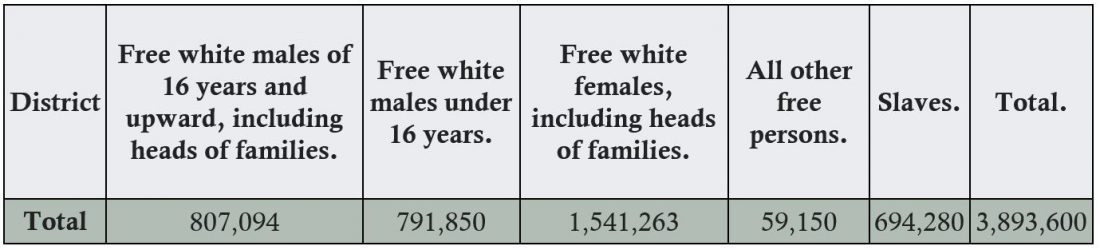
Our election process comes almost straight from the US Constitution, which was drafted in 1787 and ratified in 1790. As it happens, the first American census took place the same year. Table 1 summarizes the results:

Table 1 – Population data in the US compiled on the first census (1790)

The population now (2017) is 326 million with no slaves. We are the third most populous country in the world and the richest one. We are still bound by the same document from 1790 and it works just fine.
Not everybody is happy with its enforcement, though. This unhappiness is especially loud when the popular vote delivers one message and the election’s result reflects another, as happened this time with the Senate vote and in the 2016 presidential election. Paul Krugman just wrote a sobering op-ed in the NYT: “Real America Versus Senate America: Some of us are more equal than others, and they like Trump.” The Constitution was written for a federation of states and needed to be ratified by three quarters of them (Article 5). Yet it has kept America stable for all of these years as the country grew (not counting “minor” events like the American Civil War).

Let’s use Congress as an example. House seats are allocated by population and we vote on their control in rounds every two years. If we are not happy with our congressperson, or with the party that he/she represents, we vote them out in the next election. Two years of being unhappy is not too long to manage. Congresspeople are elected to represent the people. Senators are elected to represent the land (i.e. the states). The distribution of people and land changes with time but the governing system is designed to keep the balance. Presidential elections also try to keep the balance between people and land, with overwhelming weight thrown behind the people (Electoral College).

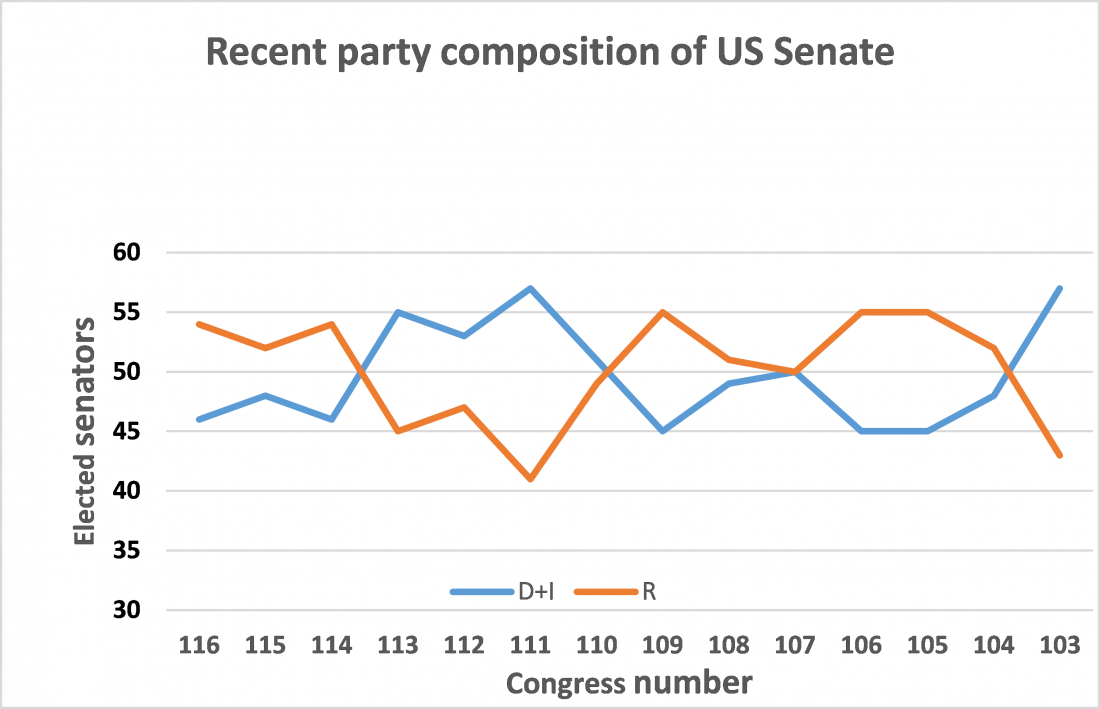
Recent party composition of US Senate, 1993-2021

(Data taken from https://history.house.gov/Institution/Election-Statistics/Election-Statistics/) Markers for some of the congresses: 103 – 1993-1995; 116 – 2019-2021. As mentioned before, the data for the 116th Congress Senate elections are not final. In the 111th Congress, two positions remained vacant.

Figure 1 – Party composition of the US Senate in the last 12 Congresses

Each congressional election covers one third of the senatorial seats. The senators that stood for reelection in 2018 were last elected in 2012 (the 113th Congress), when the Senate was overwhelmingly controlled by Democrats, so naturally most of the senators that were up for reelection were Democrats. The party affiliation of their last – 112th – congressional election is shown in Figure 1 (keep in mind that we’re reading the graph from right to left here). One can see that this system has “memory.”

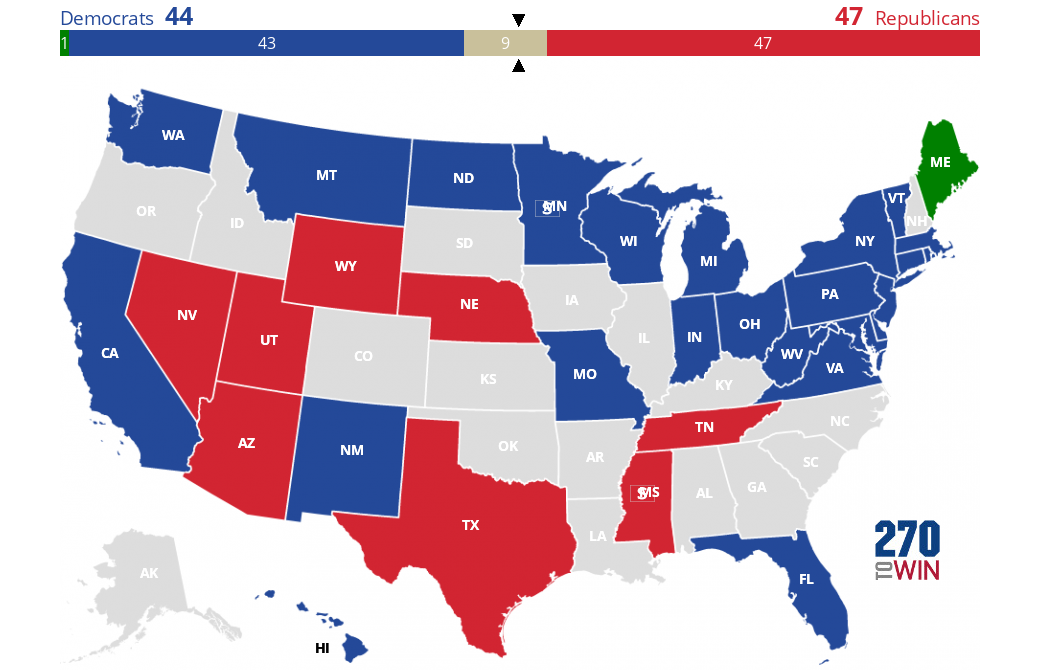
The electoral map of these senators is shown in Figure 2. Many of the Democratic senators who were up for reelection represent states that are now considered solidly “red” because they usually vote Republican. This time around, Democratic senators from Indiana, Missouri, and North Dakota lost their seats.

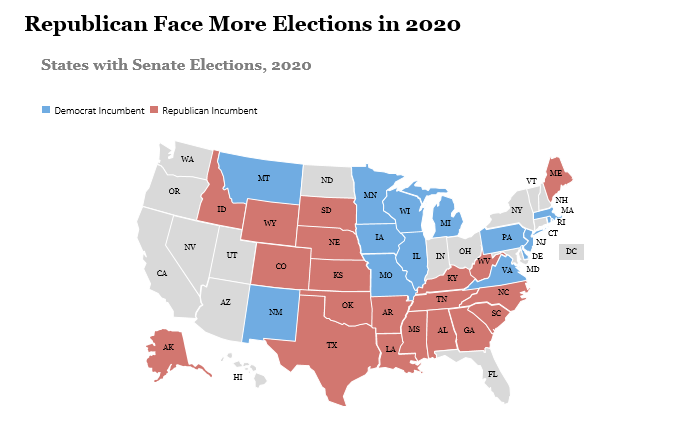
By the same token, the Republicans have held a majority since the 114th Congress. This means that most of the senators that are up for reelection in 2020 will be Republicans. Figure 3 shows the electoral map for the 2020 Senate election, which will feature more Republican senators defending their seats and a better chance for Democrats to regain control of the Senate.

2018 Senatorial mapFigure 2 – Senatorial map of the 2018 election

2020 senatorial map

Figure 3 – Senatorial map of the 2020 election

The net result of this memory effect? Increased stability.

Presidents are elected every four years with term limits of two terms. Again, if we don’t like the president that we elect, we only have to “suffer” him/her for a limited period of time and not elect him again. Provided that we vote.

The only governing arm without a term limit is the judiciary. The federal court system consists of District Courts, Circuit Courts, and the US Supreme Court, each of which are comprised of judges who have been recommended by presidents and approved by the Senate. These judges are markers of the political fluctuations in the other two branches of government. The assumption is that after gaining the security of lifetime appointments, they are free to practice independently of the political setting that was responsible for their election. Sometime this works, often it doesn’t. Brett Kavanaugh’s addition, for example, remains fraught with potential partisanship. Also, the recent hospitalization of Ruth Bader Ginsburg is an acute reminder of the fragility of this arm of the government.

Posted in administration, Climate Change, law, politics | Tagged , , , , , , , , , , , , , , , , , , , , , , , , , , , , , , , , , , , , , , , , , , , , , , , , , , , , , , , , , , , , , | 1 Comment

Election Day – Think Big!

I usually publish this blog on Tuesdays but this time I have asked my editor to put up the week’s post today so that I can address everyone – including my Monday class of 150 students – a day before the election.

Two events inspired me to write this post:

One was an exchange with a 25-year-old friend who is now a student in medical school. She is much more liberal than I am and we discussed the upcoming elections. She proclaimed that she was not going to vote. We discussed her reasons. Her main point was her strong belief that her vote would not change anything and that furthermore, nothing short of a “revolution” could bring about real change. As it happened, I had just seen a new play (The Niceties) that responds to the same premise.

The other cue was Glenn Thrush’s  New York Times piece that I shared on social media:

CAMILLA, Ga. — Renee Moss was standing in her ruined cotton field, boot-toeing a fallen boll that looked like a dirty snowball and debating her husband, Clayton, about how maybe, just maybe, Hurricane Michael was a result of climate change.

“Nope,” was the immediate response from Mr. Moss, a third-generation farmer in rural Mitchell County, where the storm’s 100-mile-per-hour winds last week destroyed a robust cotton crop at the precise moment when the bolls were fattest, fluffiest and set to be harvested.

A few minutes earlier, Mr. Moss’s insurance broker had told him that his losses were likely to be in the 80 to 100 percent range, the same faced by nearly every other farmer in this part of southwest Georgia. The area, which was directly in the path of the storm, is one of the largest bastions of multigenerational family farming in the country, and a major national producer of cotton, peanuts, sweet corn, pine timber and poultry.

“Look, I know the storms are making it unsustainable. If what’s happened this year happens next year, we’re done,” Mr. Moss, 38, told his wife. “But we’ve always had bad weather. Is it getting worse? Have we had three bad years in a row? Yeah. But I’m worried about the weather, not about climate change.”

I have emphasized the last two sentences because they speak to the heart of the matter. The rest I simply included for background. In a move that likely echoed my own sentiment, the NYT “honored” this bit as a “quote of the day.”

I am not sure if Mr. Moss has fully realized the connections and differences between weather and climate but (at least to me) his disconnect reflected a central quandary of this election: how to reconnect the “big picture” with individual constituents.

Climate change is not necessarily the central topic of this election but there are some local climate change issues that will be decided tomorrow.

Only half of the nation’s Millennials voted in the 2016 election. I wrote two blogs here that together sum up the essence of this year’s election. I’m citing the relevant sections to hopefully help frame our collective decision-making process for Tuesday:

From my October 2, 2018 blog featuring NPR’s interview with Greg Myre about his book, “‘America First’: From Charles Lindbergh to President Trump”:

Before the Pearl Harbor attack, Lindbergh and his followers were isolationists. According to Mr. Myre, that term does not apply to President Trump. He quotes Trump’s inauguration speech:

“From this day forward, a new vision will govern our land. From this day forward, it’s going to be only America first, America first,” Trump said at his inaugural on Jan. 20.

Mr. Myre instead defines the president’s philosophy in the following way:

Trump is more commonly described as a unilateralist — someone who thinks the U.S. can be engaged around the world, but on its own terms, unconstrained by alliances or multinational groups like the United Nations.

I also wrote a blog immediately after the 2016 elections that was posted on November 15, 2016:

As it stands now, climate change is not a genocide; nor is it a crime against humanity, much less inherently evil – but it has the prospect to be all three. That said, as decided at the Nuremburg trials, you don’t punish a possibility, no matter how dire. You try to change the outcome via education and other resources (Holocaust Remembrance Day). I am certainly not trying to compare Donald Trump to Adolf Hitler or to argue that a repeat of a short-term genocide of any sort is coming. As I’ve said repeatedly, though, in my opinion, Trump’s election – along with the resurgence of nationalistic, xenophobic, anti-globalization, anti-immigrant, anti-trade movements in many parts of the world is an early sign of the Anthropocene (June 14, 2016).

I posted the ruined Berlin synagogue above because I fear that violence will start to raise its ugly head once it becomes obvious that the actual implementations of Trump’s promised changes to “Make America Great Again” are not necessarily welcome.

There are still absentee votes being tallied but as it stands, Hillary gathered 61.04 million individual votes and 228 electoral votes, while Trump won 60.37 million individual votes and 290 electoral votes. Hillary’s win of the popular vote amounted to a margin of more than ½ million votes – a margin that seems to be drifting ever-wider. Interestingly, while Hillary’s plurality was larger than that of Al Gore in 2000, Richard Nixon in 1968, and John F. Kennedy in 1960, she and Al Gore lost the presidency but both Nixon and Kennedy won their respective elections. According to the US Elections Project, only 133 million of the close to 232 million eligible voters actually voted. This amounts to 57.6% participation. That’s about 3% higher than the 2012 election (see my post on March 29, 2016) but it still means that almost 100 million eligible voters that didn’t give enough of a damn to exercise that right. The turnout in Pennsylvania was 61.1% (6 of the 9.7 million) and in Florida it was 65.1% (9.5 out of 14.6 million). Trump won Pennsylvania by 68,000 votes and Florida by 119,770 votes – numbers that would essentially equate to a tie within a margin of error. 

As I said, only 50% of the eligible voters in the same generation as my med student friend (Millennials) voted in the 2016 election. We can look at both the climate and the electorate as collections of individuals – of weather and eligible voters, respectively. But we experience and understand climate changes by gathering multiyear data of weather patterns and elections are much quicker to calculate. We also have more immediate, individual power over election outcomes (and therefore policy matters) than overarching climate patterns.

Passivity should not be an option in either case. Go out and vote, if you can! If not, encourage your friends and family to do so!

Posted in administration, Anthropocene, Anthropogenic, Climate Change, Election, law, politics, Sustainability, Trump | Tagged , , , , , , , , , , , , , , , , , , , , , , , , , , , , , , , , , , , , , , , , , , , , , | 1 Comment

My Anthropocene

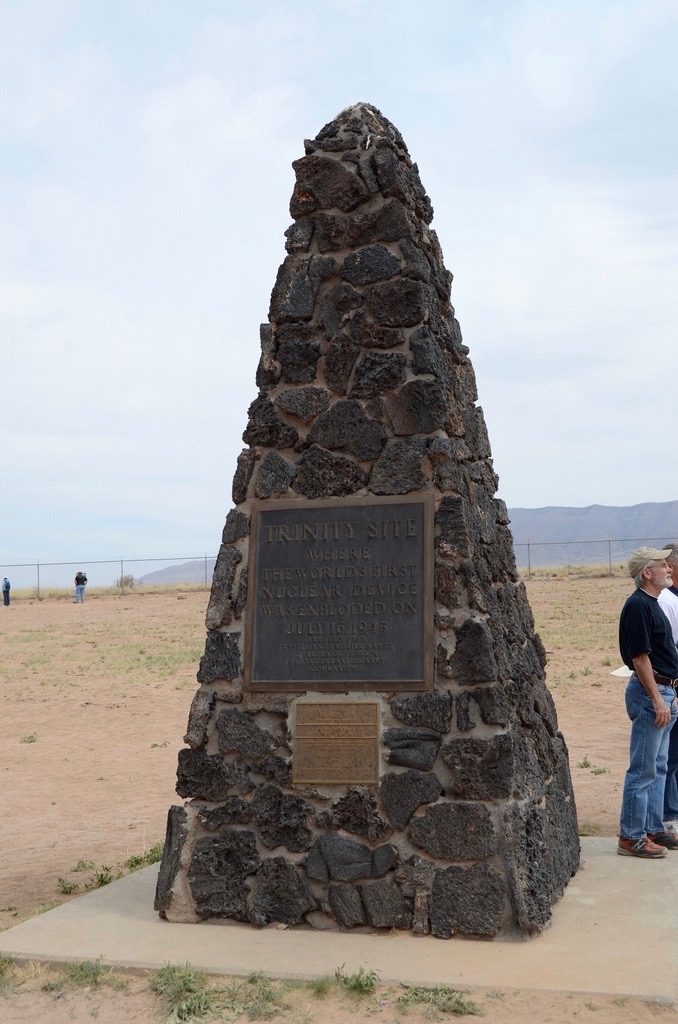
Monument to nuclear weapons testing grounds at Trinity, NM

I went on a short vacation to southern New Mexico For Columbus Day weekend. Aside from the region’s great weather in this season, that was one of only two weekends per year when the Trinity site (see last week’s blog) is open to visitors. The photograph above shows the monument to the site of the first ever test of a nuclear weapon, performed on July 16, 1945. The site has now become a popular tourist attraction. The background radiation is about 10% higher than that of the rest of New Mexico; it’s considered to be safe so long as visitors limit their trips to one or two hours. Meanwhile, the background radiation in Hiroshima and Nagasaki today is about the same as the global average.

I was interested in Trinity for two reasons:

  1. We teach a course at my school based on Richard Rhodes’ book, The Making of the Atomic Bomb and I wanted to be up to date on the topic.
  2. I am scheduled to give a talk at a Sigma Xi meeting in San Francisco on the “Global Parameterization of Climate Change Indicators,” as they relate to the Anthropocene. My visit to New Mexico took place before the publication of the latest IPCC report but – as I mentioned last week – the AWG is working to define the beginning of the new epoch to coincide with the nuclear arms testing that took place in the middle of the last century. I thought that it would be appropriate to reduce that boundary to a single point in time and space: the first nuclear test at Trinity.

Table 1 shows the major anthropogenic changes in some of the most important global indicators. Most of the values in the table were taken from the World Bank database. Given a lack of prior data, I used the earliest dates I could find for the “early” column. But the general trends are obvious: we live in a time of major change.

Table 1 – Yardsticks for the global transition

Indicators “Early” Current
Population 2.4*109 (1945) 7.5*109 (2017)
GDP/Capita (1990 USD) $2030 (1945) $5950 (2017)
Global life expectancy 44 (1945) 71 (2017)
Urbanization (% of population) 28% (1950) 55% (2017)
Access to electricity (% of population) 71% (1990) 87% (2016)
Atmospheric carbon dioxide concentration (ppmv) 310 (1945) 409 (2018)
Energy use (kg oil equivalent/capita) 1336 (1971) 1921 (2014)
Smoothed average land-ocean temperature relative to 1951-1980 average (oC) 0.009 (1945) 0.99 (2017)

It is difficult to identify, much less describe, the transitions between geological epochs. Experts are still attempting to figure out the details of the start of the Holocene and what distinguishes it from the preceding Pleistocene. The main tool for tracking the transition is carbon dating of various soil components:

Some of the best-preserved traces of the boundary are found in southern Scandinavia, where the transition from the latest glacial stage of the Pleistocene to the Holocene was accompanied by a marine transgression. These beds, south of Gothenburg, have been uplifted and are exposed at the surface. The boundary is dated around 10,300 ± 200 years BP (in radiocarbon years). This boundary marks the very beginning of warmer climates that occurred after the latest minor glacial advance in Scandinavia. This advance built the last Salpausselkä moraine, which corresponds in part to the Valders substage in North America. The subsequent warming trend was marked by the Finiglacial retreat in northern Scandinavia, the Ostendian (early Flandrian) marine transgression in northwestern Europe.

One of the fascinating aspects of this business is that the way we mark the boundaries of geological epochs is targeted at future generations. In geological time, we measure the future in thousands of years. These markers will remain for a long time in the form of changes in the composition of rocks and the nature of fossils. But who will be here thousands of years from now to witness these changes?

I have addressed this issue before (January 17, 2017 blog) in the context of how we warn future generations about the burial sites of nuclear waste:

A few days ago I revisited the nuclear waste issue when I watched a PBS program. Most of the material was familiar however I almost fainted when I heard about an aspect about which I was totally ignorant – WIPP (Waste Isolation Pilot Plant). There is a site in Carlsbad, New Mexico that already has a license to store radioactive waste provided that one “minor” condition is fulfilled: Markers should be placed there that will be functional 10,000 years from now to warn whatever civilization may come next not to trespass on the site due to the risk of exposure to the deadly radiation. A large, multidisciplinary group was assembled there to try to figure out what kind of civilization will be around then so as to tailor make said warnings. We are already spending big money on a distant future 10,000 years from now to warn our descendants or extraterrestrials of damage that we are inflicting now. It’s not out of line to broaden the scope for damage that most of us consider existential within the lifespan of our grandchildren.

Attempts to predict the nature of future generations over geological time are fascinating and few can actively refute such extrapolations. Attempts to make sure that the present version of humanity and our descendants remain part of such a future are much more difficult.

Posted in Anthropocene, Anthropogenic, Climate Change, IPCC | Tagged , , , , , , , , , , , , , , , , , , , , , , , , , , , , , , , , , , , , , , , , , , , , , , , , , , | Leave a comment

Two Anthropocenes

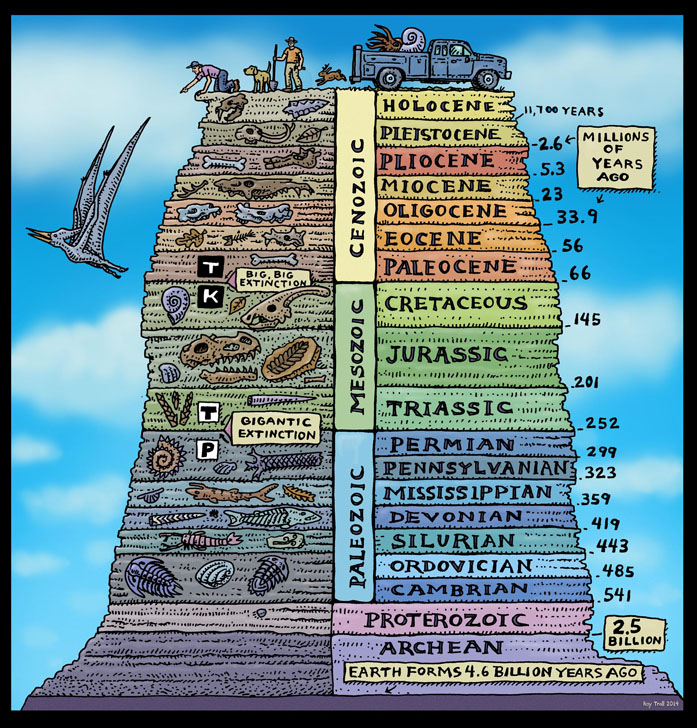
Image Credit: Ray Troll’s Ages of Rock

Image Credit: Ray Troll’s Ages of Rock

The alarming tone of the new IPCC report caught the immediate attention of the world’s media and triggered a quick dismissal from the president of the United States. The report, which spans about 1,300 pages, covers all the indicators that constitute early signs of the impending damage to the Earth. It emphasizes the amplification of damage expected between a global warming of 1.5oC and one of 2oC or higher. Since both temperatures are now becoming more and more questionable as achievable targets by the end of the century, the report also calls for a sharp acceleration in global efforts to completely decarbonize the world’s energy supply within one generation. This notion is an anathema to the current government of the US, the largest per-capita major global carbon emitter. But none of this came as a surprise to anyone who has been following the topic.

One big surprise (to me at least) was that the report finally included the concept of the Anthropocene. What’s more, it is featured at the very beginning of Chapter 1. This addition, in my opinion, is so significant and got such little media attention that I have decided to include it below despite repeated, “Do Not Cite, Quote or Distribute” warnings in the report:

Box 1.1: The Anthropocene: Strengthening the global response to 1.5°C global warming

Introduction

The concept of the Anthropocene can be linked to the aspiration of the Paris Agreement. The abundant empirical evidence of the unprecedented rate and global scale of impact of human influence on the Earth System (Steffen et al., 2016; Waters et al., 2016) has led many scientists to call for an acknowledgement that the Earth has entered a new geological epoch: the Anthropocene (Crutzen and Stoermer, 2000; Crutzen, 2002; Gradstein et al., 2012). Although rates of change in the Anthropocene are necessarily assessed over much shorter periods than those used to calculate long-term baseline rates of change, and therefore present challenges for direct comparison, they are nevertheless striking. The rise in global CO2 concentration since 2000 is about 20 ppm/decade, which is up to 10 times faster than any sustained rise in CO2 during the past 800,000 years (Lüthi et al., 2008; Bereiter et al., 2015). AR5 found that the last geological epoch with similar atmospheric CO2 concentration was the Pliocene, 3.3 to 3.0 Ma (Masson-Delmotte et al., 2013). Since 1970 the global average temperature has been rising at a rate of 1.7°C per century, compared to a long-term decline over the past 7,000 years at a baseline rate of 0.01°C per century (NOAA 2016, Marcott et al. 2013). These global-level rates of human-driven change far exceed the rates of change driven by geophysical or biosphere forces that have altered the Earth System trajectory in the past (e.g., Summerhayes 2015; Foster et al. 2017); even abrupt geophysical events do not approach current rates of human-driven change.

The geological dimension of the Anthropocene and 1.5°C global warming

The process of formalizing the Anthropocene is on-going (Zalasiewicz et al., 2017), but a strong majority of the Anthropocene Working Group (AWG) established by the Sub–Committee on Quaternary Stratigraphy of the International Commission on Stratigraphy have agreed that: (i) the Anthropocene has a geological merit; (ii) it should follow the Holocene as a formal epoch in the Geological Time Scale; and, that (iii) its onset should be defined as the mid–20th century. Potential markers in the stratigraphic record include an array of novel manufactured materials of human origin, and “these combined signals render the Anthropocene stratigraphically distinct from the Holocene and earlier epochs” (Waters et al., 2016). The Holocene period, which itself was formally adopted in 1885 by geological science community, began 11,700 years ago with a more stable warm climate providing for emergence of human civilization and growing human-nature interactions that have expanded to give rise to the Anthropocene (Waters et al., 2016).

The Anthropocene and the Challenge of a 1.5° C warmer world

The Anthropocene can be employed as a “boundary concept” (Brondizio et al., 2016) that frames critical insights into understanding the drivers, dynamics and specific challenges in responding to the ambition of keeping global temperature well below 2°C while pursuing efforts towards and adapting to a 1.5°C warmer world. The UNFCCC and its Paris Accord recognize the ability of humans to influence geophysical planetary processes (Chapter 2, Cross-Chapter Box 1 in this Chapter). The Anthropocene offers a structured understanding of the culmination of past and present human– environmental relations and provides an opportunity to better visualize the future to minimize pitfalls (Pattberg and Zelli, 2016; Delanty and Mota, 2017), while acknowledging the differentiated responsibility and opportunity to limit global warming and invest in prospects for climate-resilient sustainable development (Harrington, 2016) (Chapter 5). The Anthropocene also provides an opportunity to raise questions regarding the regional differences, social inequities and uneven capacities and drivers of global social–environmental changes, which in turn inform the search for solutions as explored in Chapter 4 of this report (Biermann et al., 2016). It links uneven influences of human actions on planetary functions to an uneven distribution of impacts (assessed in Chapter 3) as 29 well as the responsibility and response capacity to for example, limiting global warming to no more than a 1.5°C rise above pre–industrial levels. Efforts to curtail greenhouse gas emissions without incorporating the intrinsic interconnectivity and disparities associated with the Anthropocene world may themselves negatively affect the development ambitions of some regions more than others and negate sustainable development efforts (see Chapter 2 and Chapter 5).

I have frequently discussed the concept of the Anthropocene here (see February 3, 2015 blog, “Extinctions in the Anthropocene” and type Anthropocene into the search box for later entries). The IPCC report (Zalasiewicz et al., 2017) refers to a key publication in the journal Anthropocene ( 19, 55 (2017)) written by 25 participants in the AWG (Anthropocene Working Group) effort. However, the IPCC report does not include these crucial bits of the conclusion of the paper’s abstract:

Among the array of proxies that might be used as a primary marker, anthropogenic radionuclides associated with nuclear arms testing are the most promising; potential secondary markers include plastic, carbon isotope patterns and industrial fly ash. All these proxies have excellent global or near-global correlation potential in a wide variety of sedimentary bodies, both marine and non-marine.

The time scale shown above illustrates geological epochs – most of which last for millions of years. The latest epoch, the Holocene, has lasted approximately 10,000 years (11,700 years in the IPCC report) and spans the approximate history of human civilization (agriculture, urban settlements, etc.). There is no precedence for declaring the “beginning” of a new epoch. As the IPCC report mentioned, the Holocene designation wasn’t approved until 1885. Fuller accounts reveal that the period was only submitted to the International Geological Congress at that time. It was endorsed by the US Commission on Stratigraphic Nomenclature (the same organization that is now considering the Anthropocene) in 1969 but it is still not universally accepted.

The suggestion mentioned in the IPCC report for a “boundary concept” is interesting but a boundary requires the definition of both sides – which we lack here. A much more appropriate measure is to declare an end of the Holocene – an action for which we have plenty of precedence in our mapping of the geological time scale.

The requirements for visible markers for the transition (the current geological epoch map is based on fossil and rock evidence) are logical; it is therefore appropriate that we use the anthropogenic radionuclides associated with nuclear arms testing from the middle of the last century as our guide. In the next blog I will discuss some of the markers for the Holocene and show that the primary marker for the Anthropocene can be traced to July 16, 1945 at the Trinity site in New Mexico – the very first test of nuclear weapons.

The AWG’s long gestation for this change (as of 2009) is nothing compared to that regarding the start of the Holocene – which as I mentioned, is still ongoing. Such a lag is understandable. It is a monumental job. The IPCC’s decision to acknowledge the period is welcome. Unless someone successfully claims ownership of the word “Anthropocene,” (suggested originally by Paul Crutzen and ecologist Eugene Stoermer, 2000), it is a useful term to adopt to describe the era in which anthropogenic actions are responsible for deteriorations in the physical environment that are likely to lead to uninhabitability.

Data show that the difference in atmospheric concentrations of carbon dioxide between the current reference (Industrial Revolution) and the end of WWII (1945) is small. The current reference is 280 ppmv while the 1945 concentration is recorded to have 310 ppmv. Shifting the reference to 1945 might remove some direct blame from industry and shift it instead to society’s inability to include environmental impact in its choice of tools to accelerate economic growth. Shifting the reference might also emphasize the culpability of a significant segment of the population (including myself) and encourage them/us to work a bit harder to make amends.

To conclude, there are two Anthropocenes: One is a full, official geological epoch that might last for thousands of years and requires markers that will only be observable throughout such a period; the other only requires recognition that the current epoch of the Holocene has to end to reflect humanity’s vast effects on the physical environment. Next week’s blog will expand on the latter.

Posted in Anthropocene, Anthropogenic, Climate Change, IPCC | Tagged , , , , , , , , , , , , , , , , , , , , , , , , , , , , , , , , , , , , , , , , , , , , , , , , , , , , , | Leave a comment

Burying our Heads in the Sand

clip art of ostrich burying head in sandOstriches don’t actually bury their heads in the sand in the belief that it makes their predators unable to see them – but many of us do. Unfortunately many such human ostriches occupy high level positions of our government, putting us all – including our children and grandchildren – in great danger.

In last week’s beautiful blog on Tucson, Sonya Landau wrote:

In addition, while in theory there is a law that mandates all developers must prove that there is a 100-year water supply before starting any large development, the Arizona Supreme Court recently ruled in favor of developers, effectively gutting this protection.

The majority said the state agency need not consider other potential future claims for the same underground water — in this case, by the federal Bureau of Land Management — or even the possibility that those other claims could end up leaving the development and the people who buy homes there high and, literally, dry.

Arizona is not alone in ignoring the future. North Carolina, which was just starting to rebuild from the devastation that it suffered from Hurricane Florence, also had to endure the remnants of Michael, which had already demolished large swaths of Florida’s Panhandle as well as Georgia, and Alabama. Here’s a bit more about North Carolina’s efforts to rebuild – and whether doing so is feasible in light of future storms:

The privately owned Rodanthe pier has already undergone half a million dollars in renovation in seven years and the owners started a new round of repairs this week. Scientists have warned such rebuilding efforts are futile as sea levels rise and storms chew away the coast line but protests from developers and the tourism industry have led North Carolina to pass laws that disregard the predictions.

The idea of retreating is a tough sell for the people who live there and have invested in property. “You’re asking us to say, ‘Hey, 4,000 or 5,000 people on little Hatteras Island, it’s time for you to pack up and move,’ and that’s not a reasonable expectation,” said Bobby Outten, manager for Dare County on the Outer Banks.

Even though she acknowledges that sea levels are rising, Kelly is also among those who opposed making state policy decisions, including anything affecting home insurance or property values, based on the study’s dire 90-year forecast of sea-level rise. Kelly supported a 2012 state law that banned North Carolina from using the 90-year prediction on rising sea levels to influence coastal development policy.   The CRC released a second report in 2015 predicting sea level rise over a 30-year period, instead of 90 years. The new report was praised by developers as being more realistic and said sea levels would rise 1.9 to 10.6 inches. (bit.ly/2xyGDVr)

Florida is also in reconstruction mode after Michael. A piece in LiveScience describes some of the obstacles:

Florida, one of the States most susceptible to the effects of climate change and sea-level rise, verbally banned state environmental officials from using the term “climate change,” an investigation revealed. But the Sunshine State isn’t the only U.S. state that has attempted to “outlaw” climate science.

North Carolina, Louisiana and Tennessee have all passed laws that attempt to cast doubt on established climate science in boardrooms and classrooms.

This sort of denial comes from the very top and continues in spite of  repeated proof of the grave reality of climate change.

The Intergovernmental Panel on Climate Change (IPCC) posted its latest report on Saturday, October 6th. The report includes more than 1,300 pages. Here are some highlights from the IPCC’s press release on the 34-page “Summary for Policy Makers” (SPM). The SPM was approved by the governments of each IPCC member nation, including the US:

Summary for Policymakers of IPCC Special Report on Global Warming of 1.5ºC approved by governments

INCHEON, Republic of Korea, 8 Oct – Limiting global warming to 1.5ºC would require rapid, far reaching and unprecedented changes in all aspects of society, the IPCC said in a new assessment. With clear benefits to people and natural ecosystems, limiting global warming to 1.5ºC compared to 2ºC could go hand in hand with ensuring a more sustainable and equitable society, the Intergovernmental Panel on Climate Change (IPCC) said on Monday.

“One of the key messages that comes out very strongly from this report is that we are already seeing the consequences of 1°C of global warming through more extreme weather, rising sea levels and diminishing Arctic sea ice, among other changes,” said Panmao Zhai, Co-Chair of IPCC Working Group I.

The report highlights a number of climate change impacts that could be avoided by limiting global warming to 1.5ºC compared to 2ºC, or more. For instance, by 2100, global sea level rise would be 10 cm lower with global warming of 1.5°C compared with 2°C. The likelihood of an Arctic Ocean free of sea ice in summer would be once per century with global warming of 1.5°C, compared with at least once per decade with 2°C. Coral reefs would decline by 70-90 percent with global warming of 1.5°C, whereas virtually all (> 99 percent) would be lost with 2ºC.

The report finds that limiting global warming to 1.5°C would require “rapid and far-reaching” transitions in land, energy, industry, buildings, transport, and cities. Global net human-caused emissions of carbon dioxide (CO2) would need to fall by about 45 percent from 2010 levels by 2030, reaching ‘net zero’ around 2050. This means that any remaining emissions would need to be balanced by removing CO2 from the air.

President Trump’s reaction to the report was as follows:

It was given to me. And I want to look at who drew it … Because I can give you reports that are fabulous, and I can give you reports that aren’t so good. But I will be looking at it, absolutely.

While his quote is somewhat garbled, he seems to be saying that he doesn’t entirely trust the report. It is a bit odd for him to claim he doesn’t know who created it though, given that – as I just mentioned – the US is a party to the IPCC and someone in his administration had to sign off on it.

On a positive note, the new report – for the first time in the IPCC’s history – discusses the transition into the Anthropocene (type Anthropocene into the search box of the blog to see previous coverage). Next week’s blog will explore that addition.

Posted in administration, Anthropocene, Anthropogenic, Climate Change, Extreme Weather, IPCC, Sustainability, Trump | Tagged , , , , , , , , , , , , , , , , , , , , , , , , , , , , , , , , , , , , , , , , , , , , , , , | 2 Comments

Guest Blog by Sonya Landau: Unsustainable Desert: People Have Been Living in Tucson for Thousands of Years; How Much Longer Can That Continue?

I have been Micha’s editor and helped run this blog since the beginning. I’m excited to have the chance to contribute to Climate Change Fork.

Tucson is a magical place. Then again, I’m biased – it is my home town after all, and I am prone to bragging of its charms. One of the city’s most astonishing highlights its history: it’s been continuously occupied – and cultivated – for over 4,000 years (longer than anywhere else in the country)! Most people conjure up the Sahara when they think of a desert, i.e. a vast expanse of nothingness inimical to life. Others remember the armed saguaro cacti from the “Wile E Coyote and Roadrunner” cartoons – that’s where I’m from, I tell people. But even in that portrayal, which admittedly needs to be sparse for the whole premise to work, we don’t get an understanding of just how much life the Sonoran Desert holds. There are dozens of kinds of cacti, different trees, shrubs, and grasses, coyotes, bobcats, mountain lions, geckos, gila monsters, snakes, scorpions, pack rats, kangaroo mice, and yes – roadrunners (sadly, they’re neither 6’ tall nor purple). Overall, it’s been a home to many over the years. Still, it’s a desert, and while admiring the past, we also have to be aware of the future in light of climate change. Given that Tucson already reaches 100° F or more for most of the summer and gets less than a foot of rain every year, it’s hard not to be grim about what’s to come.

Micha has talked about climate refugees before. We are already seeing the effects of rising sea levels and bigger, more frequent hurricanes. Florence decimated North Carolina and Puerto Rico is still in shambles a year after Maria. Many low altitude nations are worried about their shores. Don’t forget, the president of the Maldives held a cabinet meeting underwater in 2009 to highlight the problem. Meanwhile, other climate issues threaten populations around the world. As you know from reading this blog, global warming does not necessarily mean that the weather in every place is warmer every day of the year. Instead, it amplifies naturally occurring patterns, making extreme weather events both more intense and more likely. In this case, however, we are talking about heat.

You won’t be shocked to hear that it gets hot in the desert – some days in the summer it reaches over 110o F in Tucson (and Phoenix is consistently at least 5o hotter) – but like many places all over the world, that temperature is rising, and so is the associated death. Last year, there were officially 155 heat-related deaths in Arizona, five more than the previous record set in 2016. The desert proves especially dangerous for undocumented immigrants. The US’s increasingly vigilant stance at the border with Mexico has not stopped people from crossing outright. Instead, it has pushed many into crossing at incredibly treacherous stretches of the border. Some of these people are hoping for a better life for themselves and their families; most are fleeing violence in their home countries. I imagine it won’t be that long before residents of Arizona become equally desperate to permanently escape the heat.

Water is literally life in the desert. Given the state’s finite resources and record temperatures, it’s both surprising and somewhat alarming how many people keep moving to Arizona. The Tucson metropolitan area has an estimated population of 994,000, while the Phoenix metropolitan area is believed to have surpassed 4.5 million in 2015.

It makes sense to be worried – according to the University of Arizona, “as recently as 1993 Tucson was the largest city in the U.S. — and perhaps globally — to be 100 percent dependent on groundwater.” Since then, the state has diversified its water portfolio, reducing that to 40%, supplemented by 40% from the Colorado River and 4% reclaimed water, with the rest from other surface sources. But with the ongoing drought, there are major doubts about how much longer the Colorado River can continue to support multiple states. In addition, while in theory there is a law that mandates all developers must prove that there is a 100-year water supply before starting any large development, the Arizona Supreme Court recently ruled in favor of developers, effectively gutting this protection.

The majority said the state agency need not consider other potential future claims for the same underground water — in this case, by the federal Bureau of Land Management — or even the possibility that those other claims could end up leaving the development and the people who buy homes there high and, literally, dry.

Don’t get me wrong – people are working to mitigate some of these issues. They’re making advances in reclaimed water treatment and “banking” unused Colorado River water in aquifers. It’s also gratifying to see that the bevvy of golf courses incongruent with the climate are now required to use reclaimed water instead of potable water. And Arizona’s making great strides with solar energy, providing rebates and tax incentives for both businesses and homeowners, though there is still the expected pushback from nonrenewable energy proponents and those worried about the economics of the energy transition. There are more solar panels every time I go back to visit Tucson – all of the public school playgrounds use them for shade cover, and they make up the roofs of many parking lots – including the one at the airport!

But can these small changes completely forestall the exodus that will become necessary once we run out of water and the heat is consistently higher than people can handle? It is always impossible to predict the future but I wonder how long my beloved Tucson, and the Sonoran Desert as a whole can remain a home and haven for people.

Posted in Climate Change, Extreme Weather, Guest Blog, immigration, refugee, Sustainability, Water | Tagged , , , , , , , , , , , , , , , , , , , , , , , , , , , , , , , , , , , , , , , , , , , , , , , , , , , , , , , , , , , , , , , , , , , , , , , , , , , | 5 Comments

Insanity at the Helm: Are We Steering the Wrong Way to the Future?

The last two weeks have seen a great deal of heavy breathing and crying. I summarized much of it in last week’s blog. The climax in this week’s news was probably Thursday’s testimonies of Judge Brett Kavanaugh and Dr. Christine Blasey Ford; the aftermath is still unfolding. As expected, without further investigation it was reduced to a “he said, she said” situation and devolved into an ugly mix of facts and politics. We shall see if the new FBI investigation changes anything. Whatever the final result, the US and the world will survive the presidency of Donald Trump and the effects of Judge Kavanaugh as a Supreme Court justice. The greater existential threat worldwide has to do with what happened two days earlier: President Trump gave his speech to the UN General Assembly, summarizing his administration’s philosophy as to the relationship between the US and the world.

Before getting into his speech, we need some background. Greg Myre gave an interesting perspective on this mindset last year on NPR: “‘America First’: From Charles Lindbergh to President Trump.” For those of you not familiar with Charles Lindbergh, he was an American hero whose 1927 flight from New York to Paris was the first ever solo nonstop flight across the Atlantic Ocean. He moved to England in the late 1930s. In 1941, he returned to the US to advocate against our country getting involved in the war in Europe. He was the leading voice of the America First Committee, which fought to isolate the US from the war. Contrary to some opinions, he was not a Nazi sympathizer; he just didn’t believe that the US, or anybody else, could save England from the Nazi juggernaut. Shortly after his return to the States, however, Pearl Harbor was attacked. Suddenly, not joining the war was no longer an option for the US. After that, Lindbergh actually joined the fight against Japan. Before the Pearl Harbor attack, Lindbergh and his followers were isolationists. According to Mr. Myre, that term does not apply to President Trump. He quotes Trump’s inauguration speech:

“From this day forward, a new vision will govern our land. From this day forward, it’s going to be only America first, America first,” Trump said at his inaugural on Jan. 20.

Mr. Myre instead defines the president’s philosophy in the following way:

Trump is more commonly described as a unilateralist — someone who thinks the U.S. can be engaged around the world, but on its own terms, unconstrained by alliances or multinational groups like the United Nations.

The world was a different place during Lindbergh’s time. Table 1 shows some of the indicators.

Table 1 – Yardsticks for the global transition

Indicators Then Now
Population 2.4*109 (1945) 7.5*109 (2017)
GDP/Capita (1990 US$) $2030 (1945) $5950 (2017)
Global life expectancy 44 (1945) 71 (2017)
Urbanization (% of population) 28% (1950) 55% (2017)
Atmospheric carbon dioxide concentration (ppmv) 310 (1945) 409 (2018)
Energy use (kg oil equivalent per capita) 1336 (1971) 1921 (2014)

In modern times, globalization isn’t a choice – it’s a necessity. We face global dangers that can be mitigated only through cooperative global efforts. These dangers include nuclear holocaust, climate change, pandemics, and massive refugee crises.

Many of our economic activities are global and critically depend on links in the chains that are located in different countries.

Unilateralism is not only a philosophy under this administration; it’s a policy. Below are the international partnerships and agreements from which the US is withdrawing or has expressed an intention to do so, as of January 2016:

  • Joint Comprehensive Plan of Action (also known as the Iran treaty)
    • Iran denuclearization for reversal of economic sanctions
    • Signatories: Russia, China, France, Germany, and England
  • Trans-Pacific Partnership
    • Trade agreement
    • Parties: Canada, Mexico, Chile, Peru, Australia, Brunei, Japan, Vietnam, Malaysia, Singapore, and New Zealand
  • Paris Climate Accord
    • Parties & Signatories: all the countries in the world
  • UN Commission on Human Rights
    • UN organization
  • Threats to leave or break:
    • NAFTA (Canada and Mexico) *a new agreement was finalized on Sunday, September 30th; crisis averted!
    • WTO (World Trade Organization)
    • G-7
    • International Criminal Court

This list comprises a significant fraction of our global infrastructure.

Below are the relevant paragraphs from President Trump’s most recent UN speech:

America chooses independence and cooperation over global government, each must pursue its own customs. The U.S. won’t tell you how to live, work, or worship. We ask you to honor our sovereignty in return. My highest honor is to represent the U.S. abroad. I forged strong alliances with the leaders of many nations.

… So the U.S. took the only possible course, withdrew from the human rights council, and we will not return till reform is enacted. And will not give recognition to the International Criminal Court. The ICC has no legitimacy and no authority. It claims universal jurisdiction while violating due process, violating justice, we will never surrender to this unaccountable global bureaucracy. We reject globalism and embrace patriotism, around the world responsible nations must resist the threats to sovereignty. In America we believe strongly in energy security for ourselves and our allies.

… Illegal immigration finances criminal networks, and the flow of deadly drugs. It produces a vicious circle of crime and poverty. Only by upholding national borders, can we break the cycle, we recognize the right of every nation to have own immigration policy according to its national interest. This must be respected. US will not participate in the new Global compact of migration, it is a global body unaccountable to our own people. People should build more hopeful future in the own country. Make their countries great again.

… The U.N. is the world’s largest giver of foreign aid. But few aid is given to us, that’s why we are looking into our assistance. We will examine what is working and not working and whether countries that receive our dollars and protection have our interest at heart. Only to those who are our friends we will continue.  We expect countries to pay a fair share for their own defense. The UN must become more effective and accountable. The UN has unlimited potential. As part of reform efforts we said we won’t pay more than 25 percent of peacekeeping budget, sharing in this large burden.

… We believe in the majesty of freedom and dignity of individual, self-government and rule of law, culture built on strong families, fierce independence. We celebrate our heroes, love our country. Inside this great chamber each patriot feels the same powerful love for his own nation, the same loyalty to your homeland. Passion has inspired reform and revolution, sacrifice, scientific breakthrough and magnificent works of art. We must not erase it, but embrace it, draw on its wisdom, find a way to make our nations greater, the regions safer, and the world better. To unleash potential of our people, sovereignty and independent nations are the only vehicle where freedom succeeds. We must protect sovereignty and independence above all. When we do we will find new avenues for cooperation unfolding before us, new ways of peace making, new purpose, and new spirit flourishing more around us. Making this a more beautiful world. Let us choose the future of patriotism, let us come here to stand for our people and for their nations, forever strong, sovereign, just, thankful for the grace and the glory of God, God bless the nations of the globe.

US National Security Adviser John Bolton summarized the philosophy in his own speech to the Federalist Society:

This Administration will fight back to protect American constitutionalism, our sovereignty, and our citizens. No committee of foreign nations will tell us how to govern ourselves and defend our freedom. We will stand up for the U.S. Constitution abroad, just as we do at home. And, as always, in every decision we make, we will put the interests of the American People FIRST.

In Polish we call such a philosophy, “Zosia samosia.” The phrase refers to someone independent who doesn’t need (or want) help or assistance from anybody. It’s usually used to describe a spoiled kid. This is a dangerous attitude for the most powerful nation in the world to espouse.

Posted in administration, politics, Trump, UN | Tagged , , , , , , , , , , , , , , , , , , , , , , , , , , , , , , , , , , , , , , , , , , , , , , , , , , , , , , , , , , , , , , , , , , , , , , , , , , , , , , , , , , | 1 Comment

Blurred Lines: Balance, Bias, Kavanaugh, and Fox News on Climate Change

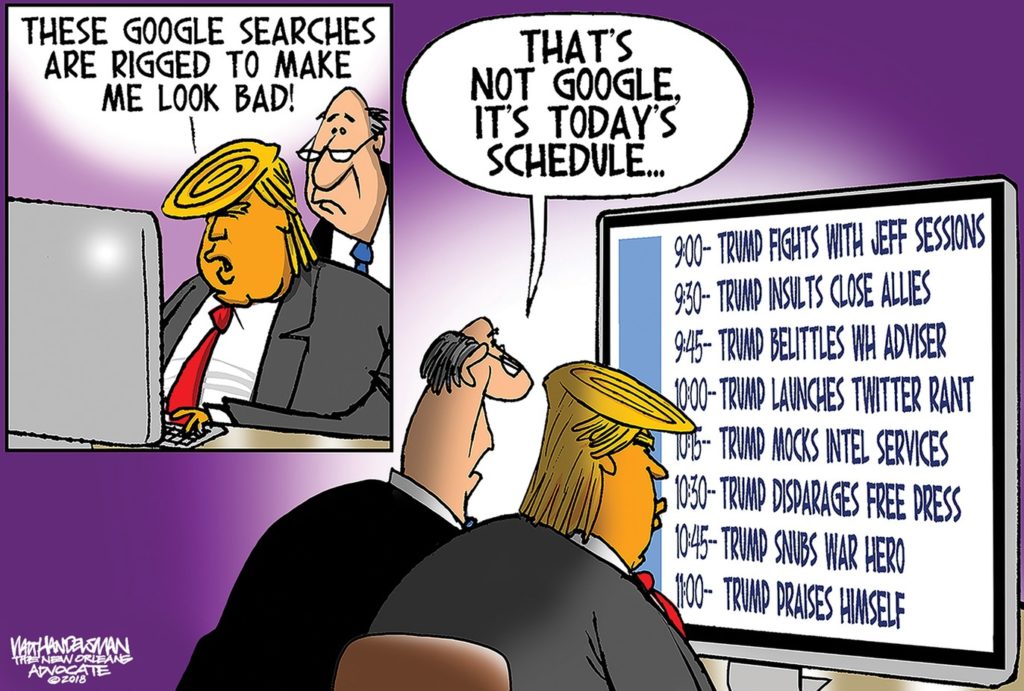
cartoon of Trump - "These Google searches are rigged to make me look bad!" ... "That's not Google, it's today's schedule."My original plan for this week was to focus on President Trump’s complaints that Google’s search engines are biased against him, and his demand that the Justice Department investigate. I found a fitting cartoon by Walt Handelsman. The Justice Department is already following his wishes, conducting anti-trust investigations of Google and Facebook. I don’t know of anyone raising the issue of the First Amendment here, or to what extent it would apply to the issue at hand. But the next step being threatened is to investigate schools for biased teaching. This could easily result in the elimination of any traces of current events from the curriculum, leaving students completely unprepared for the reality that they will face once asked to think for themselves.

Speaking of bias and balance, I came across a new paper published in PNAS (Proceedings of the National Academy of Sciences) written by three sociologists (Douglas Guilbeault, Joshua Becker, and Damon Centola): “Social learning and partisan bias in the interpretation of climate trends.” The paper provides data to show that exposure to social media is effective in eliminating bias in the interpretation of climate change, although it warns that, “social learning can be reduced, and belief polarization maintained, as a result of partisan priming.” I wanted to look into why social media doesn’t seem to be protected by the First Amendment even if it is not “balanced.”

As I was working on writing about that, two new issues surfaced: one had to do with the confirmation of Judge Brett Kavanaugh to the Supreme Court; the other, which got far less attention, was a story about climate change from Fox News. My interest in the Fox News piece is consistent with the focus of this blog and I will expand upon it in a minute. My focus on the Kavanaugh confirmation is less obvious. So let me start with this:

For those of you who live on a different planet (or just under a rock) and don’t know what I am talking about, I am including two short blurbs from the Economist’s Espresso from Friday, September 21st to give you some background:

Family matters: Value Voters Summit
Today the annual gathering of social conservatives kicks off in Washington, DC. The movement has a curious and fervid attachment to President Donald Trump—who, as a thrice-married man who just had his anatomical peculiarities revealed by a porn actress, is not a poster child for family values. But Value Voter Christians, who once believed in a vindictive Old Testament God, discovered the redemption of sinners when Donald Trump came along. In 2011 only 30% of white evangelicals thought an immoral man could be a virtuous elected official; on the eve of Mr Trump’s election, 72% did. Their professed rationale is simple: to fill the Supreme Court with conservatives who would overturn Roe v Wade , the 1973 decision granting abortion rights. Like Mr Trump, the Republicans’ Supreme Court nominee, Brett Kavanaugh, stands accused of sexual assault (which he denies). His accuser could soon testify, but expect social conservatives to overlook whatever trespass may emerge.

Christine Blasey Ford’s lawyer said she cannot testify about Brett Kavanaugh by Monday, the date set by Republican senators, but she would next week under terms “which ensure her safety”. Ms Blasey says Donald Trump’s nominee to America’s Supreme Court sexually assaulted her in 1982. She has asked for an FBI investigation, which Republicans oppose. Mr Kavanaugh denies the allegations.

Two things from above pain me given my desire for rationality in my political system and – perhaps naively, my fellow Americans:

The first one is the Evangelical voter bloc’s desire to confirm Judge Kavanaugh regardless of what he did to Dr. Ford when he was 17 and she was 15. They desperately want him to overturn Roe v. Wade, which makes abortion legal throughout the US, and they are willing to compromise on other moral issues along the way. What is not obvious from the Espresso piece but was published by other papers was that these same Evangelicals are threatening to abstain en mass from the November election if the confirmation does not go through. This sounds to me like shooting yourself in the foot. If they do so, there is a much better chance that control of the Senate will shift to Democrats, who are unlikely to approve any Supreme Court candidate that would put Roe v. Wade in danger.

The second aspect of this that insults both my senses of rationality and justice has to do with Dr. Ford’s insistence upon an objective investigation of her claim of attempted rape. This has less to do with her quite understandable demand and much more to do with due process. Without such an investigation, the two testimonies (hers and that of Judge Kavanaugh) become a “he said, she said” issue (he completely denies the charge) and the confirmation vote becomes an apparent verdict of the matter that holds the potential to ruin the life of the “loser.” The lack of such an investigation leaves us with no mechanism to separate the facts from the politics. Both are legitimate considerations here but there’s no doubt that they need to be separated.

Meanwhile, I was busy this week following climate change-related developments. The climate change issues that dominated the headlines were the aftermath of Florence and new estimates for sea level rise. The latter specifically focused on attempts to understand the mechanisms of the ice melting in Greenland and Antarctica and their direct global impacts on sea level. On Saturday, September 22nd, this emphasis peaked with proposals to build big walls to isolate the Polar Regions from the rest of the ocean. I also read a great Reuters piece that thoroughly explained NASA’s efforts to understand the various mechanisms that contribute to the accelerated melting of the Greenland ice cover – the second largest ground-based global ice cover (after Antarctica). This report had access to the as yet unpublished new IPCC report that is scheduled to come out in September 2019. The piece is so detailed and consequential that I immediately added it to the list of required reading for my climate change class. I will come back to it in future blogs. Here I want to focus on a different but related piece – one that shocked me and perhaps did the same for others:

Ice sheet 60 times the size of England could melt, causing 4m sea-level rise – and plunging UK coasts into ocean

An enormous ice sheet is at risk of melting even if temperatures rise by just 2°C, potentially sparking major climate chaos. Scientists say that if the East Antarctic Ice Sheet –which is 60 times the size of England – melts, sea levels could rise by four meters, putting areas of the UK at risk of disappearing entirely. Melting ice can have a devastating effect on the world, causing the planet to heat up more quickly, changing ocean circulation systems that regulate global weather, and increasing the risk of flooding and tsunamis damage.

A study into historical ice loss suggests even “moderate warming” of Earth could melt the East Antarctic Ice Sheet. Now a study in Nature suggests that 2°C of warming over “a couple of millennia” could cause significant melting of the EAIS. “Antarctica is around twice the size of Australia, with ice sheets several kilometers thick and containing around half of the world’s fresh water,” said Dr Kevin Welsh, at the University of Queensland, a co-author on the study. “The East Antarctic Ice Sheet covers about two thirds of the area, and because its base is largely above sea level it was generally thought to be less sensitive to warming climates than the adjacent West Antarctic Ice Sheet. “However, some areas – like the Wilkes Land Subglacial Basin, directly south of Australia – are below sea level and contain enough ice to raise global sea levels by several meters.       “The evidence we have suggests that with the predicted 2°C warming in Antarctica – if sustained over a couple of millennia – the sheet would start melting in these locations.”

I am not a dedicated viewer or reader of Fox News. It is, in my view and that of many others, the mouthpiece of climate deniers. But President Trump and his administration are avid fans so there is a chance that they might have read this piece and started thinking, “My God – this is happening on our watch – shouldn’t we do something about it?” Maybe it’s wishful thinking but the possibility is there. I already know that the lines between publications – and therefore their values – are blurring because I am a subscriber to National Geographic, which is now owned partially by 21st Century Fox – a huge company controlled by Fox News’ Rupert Murdoch. But the nature of National Geographic has not shifted with its change in ownership. As these lines blur, it is becoming more and more difficult to identify trustworthy sources. In order to believe, we need to investigate – and top-down investigations (such as Senate committees) are not always much help. If we can’t trust anyone else, we need to be comfortable with conducting our own investigations. To be able to do that we have to follow the issues closely.

Posted in administration, Anthropogenic, Climate Change, Extreme Weather, politics, Sustainability, Trump | Tagged , , , , , , , , , , , , , , , , , , , , , , , , , , , , , , , , , , , , , , , , , , , , , , , , , , , , , , , , , , , , , , , , , , , | Leave a comment

Naming Seasons and Weather Events

Thursday, September 6th in New York City was really hot and humid with temperatures well above 90oF. The next day the temperatures plunged to mid-70s and stayed there for several days, with almost constant rain. Today (Saturday, September 15th), while I am writing this, the weather here is fine but Hurricane Florence is flooding the Carolinas and Typhoon Mangkhut is doing the same to the Philippines as it makes its way to China. We still haven’t estimated the number of deaths and the full economic damages these storms will inflict.

Was the NYC heat wave on September 6th the last one of this year? Who knows? Why don’t we give names to heat waves the way we do with hurricanes and typhoons? I grew up in Israel, which is in the Eastern Mediterranean and experiences wet winters and dry summers. Israelis give names to the first rain (Hayorre) and the last one (Malkosh). There are first rain celebrations that sometimes include songs. I am not familiar with any celebrations of the last rain, but then it would be harder to pin down – how do you know that this rain is the last one? You could speculate with the help of recent history and an almanac but you might be wrong.

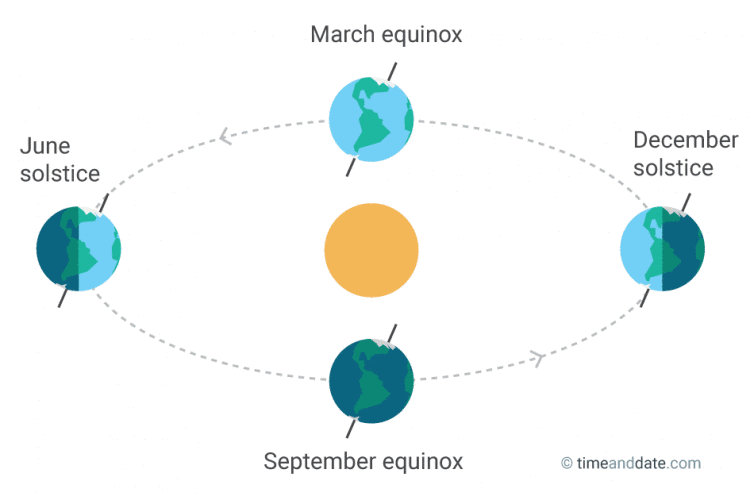
My fall semester started at the end of August. We distinguish it from the spring semester that starts around the end of January – but how do we come up with dates for the seasons? Does the weather repeat itself so exactly in corresponding years? Are the designations of seasons the same all around the world? I ask these sorts of classical questions at the beginning of my Cosmology class and usually get mixed answers. Students hearing these questions for the first time almost always say that summer comes when we are closest to the sun while winter happens when we are farthest away. I pose these questions in the middle of a brief survey of the history of astronomy. We discuss Kepler’s laws – especially Kepler’s First Law, which states that the planets orbit the sun in an elliptical orbit rather than a circular orbit as was taught previously. With the sun being at one of the two foci ellipse (there’s nothing at the other), their answers make perfect sense – until we then ask why in that case do we have summer in NYC while the Australians have winter in Melbourne, and vise versa?

The correct answer rests in Figure 1, with an explanation given below:

The Earth’s axis is slightly tilted in relation to its orbit around the sun. This is why we have seasons

Since the year has 12 months, each season lasts about three months. However, the dates when the seasons begin and end vary depending on whom you ask. Two methods are most commonly used to define the dates of the seasons: the astronomical definition and the meteorological definition

The astronomical definition uses the dates of equinoxes and solstices to mark the beginning and end of the seasons.
Spring begins on the spring equinox;
Summer begins on the summer solstice;
Fall (autumn) begins on the fall equinox; and
Winter begins on the winter solstice.

Figure of Earth's rotation around the sun, equinoxes and solsticesFigure 1 Earth’s orbit around the sun.

According to the meteorological definition, the seasons begin on the first day of the months that include the equinoxes and solstices:

Spring runs from March 1 to May 31;
Summer runs from June 1 to August 31;
Fall (autumn) runs from September 1 to November 30; and
Winter runs from December 1 to February 28 (February 29 in a leap year).

The question which definition to use divides countries and regions around the world. For example, Australia and New Zealand use the meteorological definition, so spring begins on September 1 each year. In many other countries, both definitions are used, depending on the context.

Ireland uses an ancient Celtic calendar system to determine the seasons, so spring begins on St Brigid’s Day on February 1. Some cultures, especially those in South Asia have calendars that divide the year into six seasons, instead of the four that most of us are familiar with.

In Finland and Sweden, the dates of the seasons are not based on the calendar at all, but on temperatures. Here, spring officially begins when the average temperature rises above 0 °C

(32 °F). This means that the seasons within each county start and end on different dates, depending on the regions and their climate.

Solstice in Figure 1 is defined as the point in the Earth’s orbit at which the sun is at the greatest distance from the celestial equator while the equinox is defined as the shortest distance (when the Earth actually sits on the equator). The ellipse in Figure 1 is exaggerated for clarity. The difference between the elliptical orbit and a circle is defined by the ratio of the long axis to the short axis. In a circle both axes are the same. In the Earth’s orbit the ratio deviates from a circle by about 3%.

As you can see, the dates of the seasons are approximately defined by the position of the Earth relative to the sun but the corresponding weather is not. The weather in the seasons is instead determined by the tilt of the Earth’s axis in relation to the path defined by the solar orbit. This tilt means that the northern and southern hemispheres are alternately exposed to the direct power of the sun, so summer in the northern hemisphere corresponds to winter in the southern hemisphere.

Focusing on a particular spot in the northern hemisphere, the definitions of the seasons in Sweden and Finland are interesting. The Finnish seasons are as follows:

Winter – Less than 0oC (32oF)

Spring – between 0o and 10oC (50oF)

Summer – more than 10oC

Fall – between 0o and 10oC

The listed temperatures are for averages from the middle of the country.

There is a similar quandary here to the Israeli naming of the last rain: how do you calculate averages ahead of the events?

This unique specificity in Finland and Sweden piqued my interest especially because I will be visiting Lapland in January to observe the Northern Lights among other things. More importantly though, can we use the start and end dates of these seasons as another measure of the impact of climate change? Given what we’ve seen so far and our projections for the future, their timing should shift as the temperature changes. I tried to find the recent history of the timing of the seasons there but didn’t have any success. Once I get there I will try to consult my local guides for data.

Back to naming individual weather events:
Officially, the science community only names tropical cyclones. However, in the US, the National Weather Service assigns names to hurricanes due to their immense impacts on life and property; there is a general belief that naming them garners more attention and gives governments and residents more time to prepare.

Heat waves don’t get names. In most cases, their geographical distribution is similar to that of hurricanes but as of yet they have not inflicted as much damage. Also, there is less that people can do in terms of last-minute preparations. However, naming them in the summer might be fun. We are open to suggestions. Heat wave Hades, anyone?

Posted in Climate Change, Extreme Weather | Tagged , , , , , , , , , , , , , , , , , , , , , , , , , , , , , , , , , , , , , , , , , , , , , , , , , , , | 1 Comment